

How to Grow and Care for Calendula
Calendula officinalis
Written by Emilio Marruso · last checked
Not toxic to cats and dogs, according to the sources · Sources
At a glance
Calendula goes from seed to flower in just 30–50 days, in full sun or partial shade. Its blooms can be picked again and again through the season, and both flowers and leaves are edible: the petals have a tangy, peppery flavor and add color to salads. It even flowers best without heavy feeding, so it asks for very little.
- Sun
Full sun to partial shade
What the sources say (2)
Light: Full sun to partial shade
Calendula can be planted in full sun or partial shade, spaced 12 to 18 inches apart, in well-drained soil.
— Calendula – Gardening Solutions [5] Light: Full sun (6 or more hours of direct sunlight a day) Partial Shade (Direct sunlight only part of the day, 2-6 hours)
— Calendula officinalis (Calendula, Calendula (Pot Marigold), Common Marigold, Garden Marigold, Gold bloom, Holligold, Marigold, Mary Bud, Pot Marigold, Ruddles) | North Carolina Extension Gardener Plant Toolbox [1] - Water
Water weekly in summer to keep the soil evenly moist, then less; too much water rots the roots
What the sources say (2)
Watering notes: Grows best in evenly moist soil; water weekly in summer, then reduce once established; overwatering can cause root rot
Plants can self-sow, so allow a few plants to set seed for blooms next season. Calendula grows best in evenly moist soil.
— How to grow calendula (Calendula officinalis) | Extension [2] Water weekly with 1–1½″ during summer, then reduce once established—avoid overwatering to prevent root rot.
— How to Grow Calendula in Your Garden | USU [6] - Cold
Survives winters down to −50 °F (−45.6 °C)
Very hardy · USDA 2a · RHS H7 · Z2
What the sources say (2)
Hardiness, coldest zone: 2a [winter low −45.6 to −42.8 °C (−50 to −45 °F)]
2a, 2b, 3a, 3b, 4a, 4b, 5a, 5b, 6a, 6b, 7a, 7b, 8a, 8b, 9a, 9b, 10a, 10b, 11a, 11b
— Calendula officinalis (Calendula, Calendula (Pot Marigold), Common Marigold, Garden Marigold, Gold bloom, Holligold, Marigold, Mary Bud, Pot Marigold, Ruddles) | North Carolina Extension Gardener Plant Toolbox [1] Hardiness, warmest zone: 11b [winter low 7.2 to 10 °C (45 to 50 °F)]
2a, 2b, 3a, 3b, 4a, 4b, 5a, 5b, 6a, 6b, 7a, 7b, 8a, 8b, 9a, 9b, 10a, 10b, 11a, 11b
— Calendula officinalis (Calendula, Calendula (Pot Marigold), Common Marigold, Garden Marigold, Gold bloom, Holligold, Marigold, Mary Bud, Pot Marigold, Ruddles) | North Carolina Extension Gardener Plant Toolbox [1] - Spacing
16 in between rows
What the sources say (1)
Row spacing: 40.6 cm (16 in)
Planting Depth: ¼ inch Soil Temperature: 60℉ Germination: 10-15 days Plant Spacing: 16 inches Row Spacing: 16 inches Maturity: 30-50 days
— How to grow calendula (Calendula officinalis) | Extension [2] - Planting
Plant out young plants after the last frost
What the sources say (2)
Planting: Transplants: after the last frost date, once danger of frost has passed
plant the seedlings or purchased starter plants directly in the garden just after the last frost date.
— Calendula officinalis (Calendula, Calendula (Pot Marigold), Common Marigold, Garden Marigold, Gold bloom, Holligold, Marigold, Mary Bud, Pot Marigold, Ruddles) | North Carolina Extension Gardener Plant Toolbox [1] Plant transplants after danger of frost has past.
— How to Grow Calendula in Your Garden | USU [6] - Feeding
Compost before planting, then a light monthly feeding; too much fertilizer means fewer flowers
What the sources say (5)
When: Before planting, worked into the top 15.2 cm [6 in] of soil as the soil test indicates; then through the growing season
Before planting, determine fertilizer needs with a soil test and then follow the test report recommendations. If fertilizer applications are warranted, work the fertilizer into the top 6 inches of soil.
— How to Grow Calendula in Your Garden | USU [6] Side dress plants every month with a complete soluble fertilizer to insure optimal growth and constant bloom development.
— How to Grow Calendula in Your Garden | USU [6] How often: Monthly side-dressing
Calendula needs little additional fertilization. Side dress plants every month with a complete soluble fertilizer to insure optimal growth and constant bloom development.
— How to Grow Calendula in Your Garden | USU [6] Natural fertilizers: Well-composted organic matter, no more than 2.54 cm [1 in] per 9.29 m² of garden area
If you fertilize with compost, apply no more than 1 inch of well-composted organic matter per 100 square feet of garden area.
— How to Grow Calendula in Your Garden | USU [6] Avoid: Heavy fertilization: plants flower best when not heavily fertilized
Plants flower best when they are not heavily fertilized and they prefer moderate watering.
— Calendula, Calendula officinalis – Wisconsin Horticulture [3] - Pruning
Cut it back in fall to refresh the plant
What the sources say (1)
Pruning: Fall (cut back to rejuvenate)
Marigolds do not do well in hot summer weather or times of drought, but can be cut back to rejuvenate in the fall.
— Calendula officinalis (Calendula, Calendula (Pot Marigold), Common Marigold, Garden Marigold, Gold bloom, Holligold, Marigold, Mary Bud, Pot Marigold, Ruddles) | North Carolina Extension Gardener Plant Toolbox [1] - Harvest
Pick flowers at full bloom, again and again; petals and leaves are edible in salads
What the sources say (4)
Harvest: Cut flowers: any time, longer-lasting when picked half open; culinary use: when flowers are fully expanded or at full bloom; blooms can be harvested multiple times in a season
Cut flowers can be picked at any time, but will last longer if harvested when half open.
— How to grow calendula (Calendula officinalis) | Extension [2] Harvest the whole flower tops or just the petals when the flowers are fully expanded.
— Calendula, Calendula officinalis – Wisconsin Horticulture [3] Petals can be removed for culinary use. Blooms can be harvested multiple times in a season.
— How to Grow Calendula in Your Garden | USU [6] How to harvest: Pick the complete flower at full bloom; petals can be removed for culinary use; blooms can be harvested multiple times in a season.
To harvest flowers, pick the complete flower at full bloom. Petals can be removed for culinary use. Blooms can be harvested multiple times in a season.
— How to Grow Calendula in Your Garden | USU [6] - Pests
Aphids, whiteflies, slugs, snails and powdery mildew; blast aphids off with a hard stream of water
What the sources say (4)
Pests: aphids, whiteflies, slugs, snails
Watch for slugs and snails, particularly on young plants, aphids and whiteflies.
— Calendula officinalis (Calendula, Calendula (Pot Marigold), Common Marigold, Garden Marigold, Gold bloom, Holligold, Marigold, Mary Bud, Pot Marigold, Ruddles) | North Carolina Extension Gardener Plant Toolbox [1] Calendula generally has few pest problems, but may have problems with aphids, powdery mildew and occasionally cucumber mosaic virus.
— Calendula, Calendula officinalis – Wisconsin Horticulture [3] Diseases: powdery mildew, cucumber mosaic virus
Cucumber mosaic disease and powdery mildew can cause problems with this plant.
— Calendula officinalis (Calendula, Calendula (Pot Marigold), Common Marigold, Garden Marigold, Gold bloom, Holligold, Marigold, Mary Bud, Pot Marigold, Ruddles) | North Carolina Extension Gardener Plant Toolbox [1] Calendula generally has few pest problems, but may have problems with aphids, powdery mildew and occasionally cucumber mosaic virus.
— Calendula, Calendula officinalis – Wisconsin Horticulture [3] - Propagation
Grows from seed or from young plants
What the sources say (2)
Propagation: Seed; transplants
Recommended Propagation Strategy: Seed Country Or Region Of Origin: Mediterranean
— Calendula officinalis (Calendula, Calendula (Pot Marigold), Common Marigold, Garden Marigold, Gold bloom, Holligold, Marigold, Mary Bud, Pot Marigold, Ruddles) | North Carolina Extension Gardener Plant Toolbox [1] Calendula can be grown by transplants or seed. Seeds germinate readily.
— How to Grow Calendula in Your Garden | USU [6] - Sowing
Sow 1/4 in deep once the soil hits 60 °F (16 °C), or indoors 6–8 weeks before the last frost
What the sources say (4)
Sowing: Spring: direct sow once soil reaches 60 F and danger of heavy frost has passed, or just before the last frost date; start indoors 6 to 8 weeks before last frost
Direct sow in early spring once the soil temperature has reached
— How to grow calendula (Calendula officinalis) | Extension [2] Seeds can be sown directly in the garden just before last frost date, but for earlier bloom start seeds indoors about 6 to 8 weeks before last frost.
— Calendula, Calendula officinalis – Wisconsin Horticulture [3] Sowing depth: 0.6 cm (1/4 in)
Planting Depth: ¼ inch Soil Temperature: 60℉ Germination: 10-15 days Plant Spacing: 16 inches Row Spacing: 16 inches Maturity: 30-50 days
— How to grow calendula (Calendula officinalis) | Extension [2] Plant seeds ¼ inch deep when soil temperatures reach 60°F. Seeds germinate in 1-2 weeks.
— How to Grow Calendula in Your Garden | USU [6] - Containers
Grows in containers too
What the sources say (1)
In containers: Yes
As its other common name would imply, it also does well in containers.
— Calendula – Gardening Solutions [5] - Safety
Non-toxic to people, cats and dogs
Overview
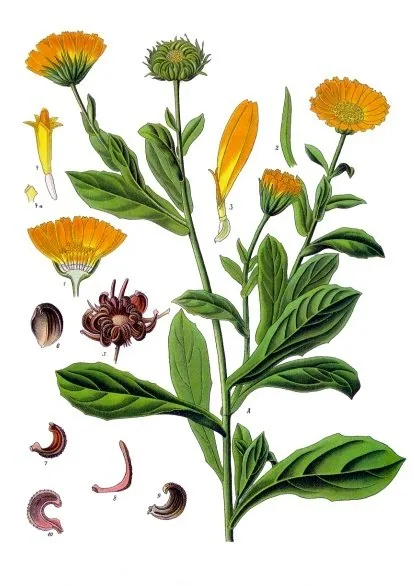
Calendula officinalis is an annual grown for edible, yellow to orange daisy-like flowers. [6][5] It is grown in full sun to partial shade in well-drained soil and is usually started from seed in spring. [5][6]
Calendula care
How to water Calendula
Watering
The sources disagree:
Marigolds do not do well in hot summer weather or times of drought, but can be cut back to rejuvenate in the fall.
[1]
What the sources say (2)
Plants flower best when they are not heavily fertilized and they prefer moderate watering.Routine watering is advisable, but calendula can survive in low water conditions. Avoid overwatering. Supply 1 to 1½ inches of water per week in mid-summer for optimal growth.Watering notes
Grows best in evenly moist soil; water weekly in summer, then reduce once established; overwatering can cause root rot
What the sources say (2)
Plants can self-sow, so allow a few plants to set seed for blooms next season. Calendula grows best in evenly moist soil.Water weekly with 1–1½″ during summer, then reduce once established—avoid overwatering to prevent root rot.How much light Calendula needs
Full sun to partial shade
What the sources say (2)
Calendula can be planted in full sun or partial shade, spaced 12 to 18 inches apart, in well-drained soil.Light:
Full sun (6 or more hours of direct sunlight a day)
Partial Shade (Direct sunlight only part of the day, 2-6 hours)How much cold Calendula can take
Hardiness, coldest zone
2a [winter low −45.6 to −42.8 °C (−50 to −45 °F)]
What the sources say (1)
2a, 2b, 3a, 3b, 4a, 4b, 5a, 5b, 6a, 6b, 7a, 7b, 8a, 8b, 9a, 9b, 10a, 10b, 11a, 11bHardiness, warmest zone
11b [winter low 7.2 to 10 °C (45 to 50 °F)]
What the sources say (1)
2a, 2b, 3a, 3b, 4a, 4b, 5a, 5b, 6a, 6b, 7a, 7b, 8a, 8b, 9a, 9b, 10a, 10b, 11a, 11bWhere to grow Calendula
In containers
Yes
What the sources say (1)
As its other common name would imply, it also does well in containers.Spacing
The sources give different values depending on region, zone or growing conditions.
What each source says
According to UF/IFAS Gardening Solutions: 30.5-45.7 cm (12-18 in)
According to UNH Extension: 40.6 cm (16 in)
According to Utah State University Extension: 20.3-30.5 cm (8-12 in)
What the sources say (3)
According to UF/IFAS Gardening Solutions: Calendula can be planted in full sun or partial shade, spaced 12 to 18 inches apart, in well-drained soil.According to UNH Extension: Thin seedlings to 16” apart when they have reached 1-2” tall.According to Utah State University Extension: After emergence, thin seedlings to 8 to 12 inches apart in the row.How to propagate Calendula
Seed; transplants
What the sources say (2)
Recommended Propagation Strategy:
Seed
Country Or Region Of Origin:
MediterraneanCalendula can be grown by transplants or seed. Seeds germinate readily.How to grow Calendula
The plant
Life cycle
annual
What the sources say (2)
Calendula officinalis is an annual herb in the daisy family (Asteraceae) originating from southern Europe and the Eastern Mediterranean area.Calendula, also called pot marigold, is an annual herb grown for its medicinal blooms, edible leaves and stems.Family
Asteraceae
What the sources say (2)
Calendula officinalis is an annual herb in the daisy family (Asteraceae) originating from southern Europe and the Eastern Mediterranean area.Genus:
Calendula
Species:
officinalis
Family:
Asteraceae
Uses (Ethnobotany):
Use medicinally for stomach problemsMature height
The sources disagree:
Calendula is an annual that grows 10-12” tall. The flowers are daisy-like and bright orange or yellow.
[2]Plants grow 8 to 24 inches tall and require regular irrigation for best performance.
[6]has a dense, rounded shape and grows to a height and spread of about 1 to 1.5 feet.
[5]Dimensions: Height: 1 ft. 0 in. - 2 ft. 0 in. Width: 1 ft. 0 in. - 2 ft. 0 in.
[1]
Sowing and growth
Days to germination
The sources disagree:
Planting Depth: ¼ inch Soil Temperature: 60℉ Germination: 10-15 days Plant Spacing: 16 inches Row Spacing: 16 inches Maturity: 30-50 days
[2]Sow the seeds ¼ to ½ inches deep; light will inhibit germination. Seeds should germinate in 5 to 15 days.
[3]Plant seeds ¼ inch deep when soil temperatures reach 60°F. Seeds germinate in 1-2 weeks.
[6]
Sowing depth
0.6 cm (1/4 in)
What the sources say (2)
Planting Depth: ¼ inch
Soil Temperature: 60℉
Germination: 10-15 days
Plant Spacing: 16 inches
Row Spacing: 16 inches
Maturity: 30-50 daysPlant seeds ¼ inch deep when soil temperatures reach 60°F. Seeds germinate in 1-2 weeks.Row spacing
40.6 cm (16 in)
What the sources say (1)
Planting Depth: ¼ inch
Soil Temperature: 60℉
Germination: 10-15 days
Plant Spacing: 16 inches
Row Spacing: 16 inches
Maturity: 30-50 daysDays to maturity
30-50 days
What the sources say (1)
Planting Depth: ¼ inch
Soil Temperature: 60℉
Germination: 10-15 days
Plant Spacing: 16 inches
Row Spacing: 16 inches
Maturity: 30-50 daysHarvest and storage
How to harvest
Pick the complete flower at full bloom; petals can be removed for culinary use; blooms can be harvested multiple times in a season.
What the sources say (1)
To harvest flowers, pick the complete flower at full bloom. Petals can be removed for culinary use. Blooms can be harvested multiple times in a season.Storage
Store blooms in a moisture-tight container in a cool, dark place.
What the sources say (1)
Store blooms in a moisture tight container in a cool, dark place.Saving seeds
Collect seeds when fully mature and dry.
What the sources say (1)
Plants will re-bloom in about 2 weeks. Collect seeds when fully mature and dry.Pests and diseases
Pests
aphids, whiteflies, slugs, snails
What the sources say (2)
Watch for slugs and snails, particularly on young plants, aphids and whiteflies.Calendula generally has few pest problems, but may have problems with aphids, powdery mildew and occasionally cucumber mosaic virus.Diseases
powdery mildew, cucumber mosaic virus
What the sources say (2)
Cucumber mosaic disease and powdery mildew can cause problems with this plant.Calendula generally has few pest problems, but may have problems with aphids, powdery mildew and occasionally cucumber mosaic virus.Fertilizing
When
Before planting, worked into the top 15.2 cm [6 in] of soil as the soil test indicates; then through the growing season
What the sources say (2)
Before planting, determine fertilizer needs with a soil test and then follow the test report recommendations. If fertilizer applications are warranted, work the fertilizer into the top 6 inches of soil.Side dress plants every month with a complete soluble fertilizer to insure optimal growth and constant bloom development.How often
Monthly side-dressing
What the sources say (1)
Calendula needs little additional fertilization. Side dress plants every month with a complete soluble fertilizer to insure optimal growth and constant bloom development.Natural fertilizers
Well-composted organic matter, no more than 2.54 cm [1 in] per 9.29 m² of garden area
What the sources say (1)
If you fertilize with compost, apply no more than 1 inch of well-composted organic matter per 100 square feet of garden area.Mineral fertilizers
Complete soluble fertilizer, side-dressed; little additional fertilization needed
What the sources say (1)
Calendula needs little additional fertilization. Side dress plants every month with a complete soluble fertilizer to insure optimal growth and constant bloom development.Avoid
Heavy fertilization: plants flower best when not heavily fertilized
What the sources say (1)
Plants flower best when they are not heavily fertilized and they prefer moderate watering.Calendula pests and problems
Powdery mildew
Symptom: White fungal patches on leaves that can spread to all the plants; associated with cool, wet weather.
What to do: Ensure good air circulation, control irrigation and remove infested plant parts.
What the sources say (2)
White fungal patches on leaves that can spread to all the plants. Associated with cool, wet weather conditions.
— How to Grow Calendula in Your Garden | USU [6] Insure good air circulation, control irrigation and remove infested plant parts.
— How to Grow Calendula in Your Garden | USU [6] Aphids
Symptom: Green or black soft-bodied insects feeding on the underside of leaves, causing honeydew and crinkled or curled leaves.
What to do: Hard stream of water or regular applications of insecticidal soap.
What the sources say (2)
Green or black soft bodies insects that feed on the underside of the leaves. Aphids produce honeydew and cause crinkled or curled leaves.
— How to Grow Calendula in Your Garden | USU [6] These insects are easily controlled by a hard stream of water or by regular applications of insecticidal soap.
— How to Grow Calendula in Your Garden | USU [6] Whiteflies
Symptom: Small white flies that hide and feed on the underside of leaves.
What to do: Hard stream of water or regular applications of insecticidal soap.
Slugs and snails
Symptom: Watch for slugs and snails, particularly on young plants.
What to do: Not specified in source.
What the sources say (1)
Watch for slugs and snails, particularly on young plants, aphids and whiteflies.
— Calendula officinalis (Calendula, Calendula (Pot Marigold), Common Marigold, Garden Marigold, Gold bloom, Holligold, Marigold, Mary Bud, Pot Marigold, Ruddles) | North Carolina Extension Gardener Plant Toolbox [1]
Remedies
Each remedy shows what official sources say about it; traditional remedies without an official source are marked as such. Harmful ones are listed so you know to avoid them.
Treating the plant
aphids
hard stream of water Works
How: Aphids are easily controlled by a hard stream of water or by regular applications of insecticidal soap.
These insects are easily controlled by a hard stream of water or by regular applications of insecticidal soap.
— How to Grow Calendula in Your Garden | USU [6] What the evidence says These insects are easily controlled by a hard stream of water or by regular applications of insecticidal soap.
— How to Grow Calendula in Your Garden | USU [6]
whiteflies
hard stream of water Works
How: Whiteflies are easily controlled by a hard stream of water or by regular applications of insecticidal soap.
These insects are easily controlled by a hard stream of water or by regular applications of insecticidal soap.
— How to Grow Calendula in Your Garden | USU [6] What the evidence says These insects are easily controlled by a hard stream of water or by regular applications of insecticidal soap.
— How to Grow Calendula in Your Garden | USU [6]
powdery mildew
baking soda spray Not verified
Traditional remedy, not verified by an official source.
Homemade pesticides do not have reliable guidance on use rates, safety procedures, or potential impacts on beneficial organisms and the environment.
— pubs.ext.vt.edu [7] How: Spraying a mixture of baking soda, water, and a touch of dish soap.
slugs
hand-picking at night Not verified
Traditional remedy, not verified by an official source.
How: Head out each night with a flashlight and pluck snails and slugs off your plants.
Is Calendula poisonous?
Reported by the source, quoted verbatim. This is not medical or veterinary advice: if a person or an animal may have eaten this plant, contact a poison control centre or a veterinarian.
Animals
#butterfly friendly #summer flowers #non-toxic for cats #non-toxic for dogs #stormwater demo garden orange co
[1]The source flags the risk for this animal but does not explain why.
People
This plant is non-toxic and is safe for any use.
[6]
Calendar
Sowing
Spring: direct sow once soil reaches 60 F and danger of heavy frost has passed, or just before the last frost date; start indoors 6 to 8 weeks before last frost
What the sources say (2)
Direct sow in early spring once the soil temperature has reachedSeeds can be sown directly in the garden just before last frost date, but for earlier bloom start seeds indoors about 6 to 8 weeks before last frost.Planting
Transplants: after the last frost date, once danger of frost has passed
What the sources say (2)
plant the seedlings or purchased starter plants directly in the garden just after the last frost date.Plant transplants after danger of frost has past.Harvest
Cut flowers: any time, longer-lasting when picked half open; culinary use: when flowers are fully expanded or at full bloom; blooms can be harvested multiple times in a season
What the sources say (3)
Cut flowers can be picked at any time, but will last longer if harvested when half open.Harvest the whole flower tops or just the petals when the flowers are fully expanded.Petals can be removed for culinary use. Blooms can be harvested multiple times in a season.Pruning
Fall (cut back to rejuvenate)
What the sources say (1)
Marigolds do not do well in hot summer weather or times of drought, but can be cut back to rejuvenate in the fall.Months as given by the sources, which are mostly from the United States (northern hemisphere). In the southern hemisphere they shift by about six months.
Relative to frost
Less precise estimate: there is no weather station within 300 km.
Find frost dates by ZIP code or city
Sow indoors: 6 to 8 weeks before the last frost
To cultivate Marigolds, you can start seeds indoors about 6 to 8 weeks before the last frost and plant the seedlings or purchased starter plants directly in the garden just after the last frost date.
— Calendula officinalis (Calendula, Calendula (Pot Marigold), Common Marigold, Garden Marigold, Gold bloom, Holligold, Marigold, Mary Bud, Pot Marigold, Ruddles) | North Carolina Extension Gardener Plant Toolbox [1] Transplant: around the last frost
To cultivate Marigolds, you can start seeds indoors about 6 to 8 weeks before the last frost and plant the seedlings or purchased starter plants directly in the garden just after the last frost date.
— Calendula officinalis (Calendula, Calendula (Pot Marigold), Common Marigold, Garden Marigold, Gold bloom, Holligold, Marigold, Mary Bud, Pot Marigold, Ruddles) | North Carolina Extension Gardener Plant Toolbox [1]
Count from the average frost dates where you live.
Edibility
Reported by the source, quoted verbatim. Do not eat a plant on the basis of this page alone: identification mistakes can be dangerous.
Indicative values
Values from a secondary source, not checked word for word like the rest of this page. Use them as a starting point.
- Hours of sun
- 8-10 hoursIndicative value, adapt it to your climate · Secondary source
- Soil pH
- 6-7Indicative value, adapt it to your climate · Secondary source
- Care level
- MediumIndicative value, adapt it to your climate · Secondary source
- Growth rate
- LowIndicative value, adapt it to your climate · Secondary source
Similar plants
- Field marigold Calendula arvensis
- African Daisy Dimorphotheca pluvialis
- African Marigold Tagetes erecta
- Ageratum Ageratum houstonianum
- Alpine aster Aster alpinus
- Appalachian Blazing Star Liatris squarrulosa
- Appalachian Ironweed Vernonia glauca
- Appalachian Sunflower Helianthus atrorubens
Sources
Every value above is quoted from these documents. Links lead to the original publisher.
- Calendula officinalis (Calendula, Calendula (Pot Marigold), Common Marigold, Garden Marigold, Gold bloom, Holligold, Marigold, Mary Bud, Pot Marigold, Ruddles) | North Carolina Extension Gardener Plant Toolbox · plants.ces.ncsu.edu, consulted
- How to grow calendula (Calendula officinalis) | Extension · extension.unh.edu, consulted
- Calendula, Calendula officinalis – Wisconsin Horticulture · hort.extension.wisc.edu, consulted
- Calendula - Calendula officinalis | North Carolina Extension Gardener Plant Toolbox · plants.ces.ncsu.edu, consulted
- Calendula – Gardening Solutions · gardeningsolutions.ifas.ufl.edu, consulted
- How to Grow Calendula in Your Garden | USU · extension.usu.edu, consulted
- pubs.ext.vt.edu · pubs.ext.vt.edu
Written by Emilio Marruso · last checked