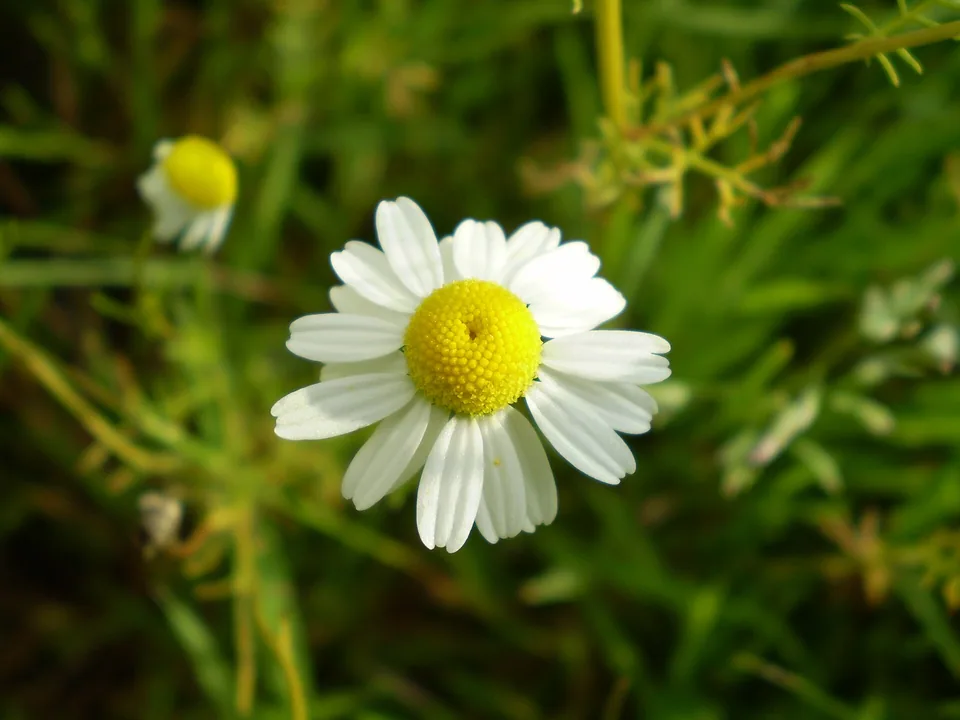


How to Grow and Care for Chamomile
Matricaria chamomilla
Written by Emilio Marruso · last checked
Toxic to: Cats, Dogs, Horses, People · Why
At a glance
Chamomile is an easy annual that grows well even in poor soil and asks for little fertilizer. Give it full sun, press the seeds onto the soil surface, and they sprout within a week in warm weather. When the flowers are near full bloom, snip them off and use them fresh or dried for tea.
- Sun
Full sun
What the sources say (2)
Light: Full sun
This plant thrives in full sun and moist to dry, well-drained, sandy, loamy soil
— Matricaria chamomilla (Annual Chamomile, Chamomile, German Chamomile, Scented Mayweed, Sweet False Chamomile, Wild Chamomile) | North Carolina Extension Gardener Plant Toolbox [1] Grow chamomile in full sun and in well-drained soil
— German Chamomile, Matricaria chamomilla – Wisconsin Horticulture [2] - Water
Keep the top of the soil moist but not wet; the roots are shallow
What the sources say (2)
Watering: Irrigate as needed to keep the upper levels of the soil moist but not wet
irrigate as needed to keep upper levels of the soil moist but not wet.
— German Chamomile, Matricaria chamomilla – Wisconsin Horticulture [2] Watering notes: Shallow-rooted
Since the plants are shallow-rooted, irrigate as needed to keep upper levels of the soil moist but not wet.
— German Chamomile, Matricaria chamomilla – Wisconsin Horticulture [2] - Planting
Move plants outdoors after the last frost date
What the sources say (1)
Planting: Transplant outdoors after the last frost date
started indoors 6 to 8 weeks before the average last date of frost to be transplanted outdoors after the last frost date.
— German Chamomile, Matricaria chamomilla – Wisconsin Horticulture [2] - Feeding
Needs little fertilizer; it does well in poor soil
What the sources say (1)
How often: Little: it grows well in poor soils and does not need much fertilizer
It will grow well in poor soils, so does not need much fertilizer and has few pest problems other than aphids.
— German Chamomile, Matricaria chamomilla – Wisconsin Horticulture [2] - Harvest
Snip the flowers near full bloom; use them fresh or dried for tea
What the sources say (3)
Harvest: When the flowers are near full bloom
Harvest the flowers when they are near full bloom for best quality
— German Chamomile, Matricaria chamomilla – Wisconsin Horticulture [2] How to harvest: Harvest the flowers when they are near full bloom for best quality, snipping just the inflorescence from the stem; flowers may be used fresh or dried
Harvest the flowers when they are near full bloom for best quality
— German Chamomile, Matricaria chamomilla – Wisconsin Horticulture [2] snipping just the inflorescence from the stem. Flowers may be used fresh or dried.
— German Chamomile, Matricaria chamomilla – Wisconsin Horticulture [2] - Pests
Watch for aphids and powdery mildew
What the sources say (2)
Pests: aphids
No serious insect or disease problems. Monitor for aphids. May be susceptible to fungal diseases such as powdery mildew.
— Matricaria chamomilla (Annual Chamomile, Chamomile, German Chamomile, Scented Mayweed, Sweet False Chamomile, Wild Chamomile) | North Carolina Extension Gardener Plant Toolbox [1] Diseases: powdery mildew
No serious insect or disease problems. Monitor for aphids. May be susceptible to fungal diseases such as powdery mildew.
— Matricaria chamomilla (Annual Chamomile, Chamomile, German Chamomile, Scented Mayweed, Sweet False Chamomile, Wild Chamomile) | North Carolina Extension Gardener Plant Toolbox [1] - Watch out
Big plants transplant poorly: move them while small or grow each in its own pot
- Size
6 in to 2 ft tall and wide
What the sources say (2)
Mature height: 15-61 cm (0 ft 6 in - 2 ft 0 in)
Dimensions: Height: 0 ft. 6 in. - 2 ft. 0 in. Width: 0 ft. 6 in. - 2 ft. 0 in.
— Matricaria chamomilla (Annual Chamomile, Chamomile, German Chamomile, Scented Mayweed, Sweet False Chamomile, Wild Chamomile) | North Carolina Extension Gardener Plant Toolbox [1] Mature width: 15-61 cm (0 ft 6 in - 2 ft 0 in)
Dimensions: Height: 0 ft. 6 in. - 2 ft. 0 in. Width: 0 ft. 6 in. - 2 ft. 0 in.
— Matricaria chamomilla (Annual Chamomile, Chamomile, German Chamomile, Scented Mayweed, Sweet False Chamomile, Wild Chamomile) | North Carolina Extension Gardener Plant Toolbox [1] - Sowing
Press seeds onto the surface, uncovered: outdoors in fall, or indoors 6–8 weeks before the last frost
What the sources say (4)
Sowing: Outdoors in fall or shortly before the average last frost date; or indoors 6 to 8 weeks before the average last frost date
Chamomile is propagated from seed , either planted directly in the garden in fall or shortly before the average last date of frost or started indoors 6 to 8 weeks before the average last date of frost
— German Chamomile, Matricaria chamomilla – Wisconsin Horticulture [2] Best grown in individual containers indoors for 6 to 8 weeks before the last frost in spring.
— Matricaria chamomilla (Annual Chamomile, Chamomile, German Chamomile, Scented Mayweed, Sweet False Chamomile, Wild Chamomile) | North Carolina Extension Gardener Plant Toolbox [1] Sowing depth: 0 cm [0 in] (surface sow and press into the soil; seeds need light)
The seeds need light to germinate, so surface sow and press into the soil.
— German Chamomile, Matricaria chamomilla – Wisconsin Horticulture [2] Days to germination: within 7 days (1 week) under warm conditions; seeds need light to germinate
The seeds need light to germinate, so surface sow and press into the soil. Under warm conditions, germination generally occurs within a week.
— German Chamomile, Matricaria chamomilla – Wisconsin Horticulture [2] - Containers
Grows in containers too
What the sources say (1)
In containers: Yes
Landscape Location: Container Meadow Patio Rock Wall Small Space Walkways
— Matricaria chamomilla (Annual Chamomile, Chamomile, German Chamomile, Scented Mayweed, Sweet False Chamomile, Wild Chamomile) | North Carolina Extension Gardener Plant Toolbox [1] - Safety
Toxic to dogs, cats and horses; may cause allergic reactions in people allergic to ragweed
Overview
German chamomile is an annual herb in the daisy family used for herbal tea and as an ornamental. [1] It is grown from seed in full sun and well-drained soil, and larger plants do not transplant well. [2] Flowers are harvested near full bloom. [2]
Chamomile care
How to water Chamomile
Watering
Irrigate as needed to keep the upper levels of the soil moist but not wet
What the sources say (1)
irrigate as needed to keep upper levels of the soil moist but not wet.Watering notes
Shallow-rooted
What the sources say (1)
Since the plants are shallow-rooted, irrigate as needed to keep upper levels of the soil moist but not wet.How much light Chamomile needs
Full sun
What the sources say (2)
This plant thrives in full sun and moist to dry, well-drained, sandy, loamy soilGrow chamomile in full sun and in well-drained soilWhere to grow Chamomile
Yes
What the sources say (1)
Landscape Location:
Container
Meadow
Patio
Rock Wall
Small Space
WalkwaysHow to propagate Chamomile
Seed
What the sources say (2)
German chamomile can be propagated from seeds, but tends not to transplant well.Chamomile is propagated from seed , either planted directly in the garden in fallHow to grow Chamomile
The plant
Life cycle
annual
What the sources say (1)
German chamomile is an annual herb in the daisy family (Asteraceae) native to Macaronesia, North Africa, and temperate Eurasia to Indo-China.Family
Asteraceae
What the sources say (1)
German chamomile is an annual herb in the daisy family (Asteraceae) native to Macaronesia, North Africa, and temperate Eurasia to Indo-China.Mature height
15-61 cm (0 ft 6 in - 2 ft 0 in)
What the sources say (1)
Dimensions: Height: 0 ft. 6 in. - 2 ft. 0 in. Width: 0 ft. 6 in. - 2 ft. 0 in.Mature width
15-61 cm (0 ft 6 in - 2 ft 0 in)
What the sources say (1)
Dimensions: Height: 0 ft. 6 in. - 2 ft. 0 in. Width: 0 ft. 6 in. - 2 ft. 0 in.Sowing and growth
Days to germination
within 7 days (1 week) under warm conditions; seeds need light to germinate
What the sources say (1)
The seeds need light to germinate, so surface sow and press into the soil. Under warm conditions, germination generally occurs within a week.Sowing depth
0 cm [0 in] (surface sow and press into the soil; seeds need light)
What the sources say (1)
The seeds need light to germinate, so surface sow and press into the soil.Harvest and storage
How to harvest
Harvest the flowers when they are near full bloom for best quality, snipping just the inflorescence from the stem; flowers may be used fresh or dried
What the sources say (2)
Harvest the flowers when they are near full bloom for best qualitysnipping just the inflorescence from the stem. Flowers may be used fresh or dried.Pests and diseases
Pests
aphids
What the sources say (1)
No serious insect or disease problems. Monitor for aphids. May be susceptible to fungal diseases such as powdery mildew.Diseases
powdery mildew
What the sources say (1)
No serious insect or disease problems. Monitor for aphids. May be susceptible to fungal diseases such as powdery mildew.Fertilizing
How often
Little: it grows well in poor soils and does not need much fertilizer
What the sources say (1)
It will grow well in poor soils, so does not need much fertilizer and has few pest problems other than aphids.Chamomile pests and problems
Aphids and powdery mildew
Symptom: Aphids; possible fungal diseases such as powdery mildew
What to do: Monitor for aphids
What the sources say (1)
No serious insect or disease problems. Monitor for aphids. May be susceptible to fungal diseases such as powdery mildew.
— Matricaria chamomilla (Annual Chamomile, Chamomile, German Chamomile, Scented Mayweed, Sweet False Chamomile, Wild Chamomile) | North Carolina Extension Gardener Plant Toolbox [1] Poor transplanting
Symptom: Larger plants do not transplant well
What to do: Grow individually in containers or transplant when small
What the sources say (1)
Larger plants do not transplant well, so grow individually in containers or transplant when small.
— German Chamomile, Matricaria chamomilla – Wisconsin Horticulture [2]
Remedies
Each remedy shows what official sources say about it; traditional remedies without an official source are marked as such. Harmful ones are listed so you know to avoid them.
Treating the plant
aphids
water spray from a hose Works
How: Clusters of tiny aphids are easy to spray off with the regular garden hose.
They are easy to spray off with the regular garden hose, or a little bit of insecticide spray can help control the bugs.
— heritagegarden.uic.edu [5] What the evidence says German chamomile has few problems other than aphids. Wash them off with a spray of water.
— ucanr.edu [6]
Is Chamomile toxic to pets?
Reported by the source, quoted verbatim. This is not medical or veterinary advice: if a person or an animal may have eaten this plant, contact a poison control centre or a veterinarian.
Animals
Toxic to dogs, cats, and horses. VIDEO Created by Laura Barth
[1]The source flags the risk for this animal but does not explain why.
People
Calendar
Sowing
Outdoors in fall or shortly before the average last frost date; or indoors 6 to 8 weeks before the average last frost date
What the sources say (2)
Chamomile is propagated from seed , either planted directly in the garden in fall or shortly before the average last date of frost or started indoors 6 to 8 weeks before the average last date of frostBest grown in individual containers indoors for 6 to 8 weeks before the last frost in spring.Planting
Transplant outdoors after the last frost date
What the sources say (1)
started indoors 6 to 8 weeks before the average last date of frost to be transplanted outdoors after the last frost date.Harvest
When the flowers are near full bloom
What the sources say (1)
Harvest the flowers when they are near full bloom for best qualityMonths as given by the sources, which are mostly from the United States (northern hemisphere). In the southern hemisphere they shift by about six months.
Relative to frost
Less precise estimate: there is no weather station within 300 km.
Find frost dates by ZIP code or city
Sow indoors: 6 to 8 weeks before the last frost
Best grown in individual containers indoors for 6 to 8 weeks before the last frost in spring.
— Matricaria chamomilla (Annual Chamomile, Chamomile, German Chamomile, Scented Mayweed, Sweet False Chamomile, Wild Chamomile) | North Carolina Extension Gardener Plant Toolbox [1] Transplant: around the last frost
started indoors 6 to 8 weeks before the average last date of frost to be transplanted outdoors after the last frost date.
— German Chamomile, Matricaria chamomilla – Wisconsin Horticulture [2]
Count from the average frost dates where you live.
Edibility
Reported by the source, quoted verbatim. Do not eat a plant on the basis of this page alone: identification mistakes can be dangerous.
Edibility: Flowers for tea and other culinary uses.
[1]
Indicative values
Values from a secondary source, not checked word for word like the rest of this page. Use them as a starting point.
- Drought tolerant
- yesIndicative value, adapt it to your climate · Secondary source
- Soil pH
- 6-7.5Indicative value, adapt it to your climate · Secondary source
- USDA hardiness zones
- 2-8 [winter low −45.6 to −6.7 °C (−50 to 20 °F)]Indicative value, adapt it to your climate · Secondary source
- Care level
- MediumIndicative value, adapt it to your climate · Secondary source
- Growth rate
- HighIndicative value, adapt it to your climate · Secondary source
- Pruning
- March, April, May, MayIndicative value, adapt it to your climate · Secondary source
Similar plants
- African Daisy Dimorphotheca pluvialis
- African Marigold Tagetes erecta
- Ageratum Ageratum houstonianum
- Alpine aster Aster alpinus
- Appalachian Blazing Star Liatris squarrulosa
- Appalachian Ironweed Vernonia glauca
- Appalachian Sunflower Helianthus atrorubens
- Aromatic Aster Symphyotrichum oblongifolium
Sources
Every value above is quoted from these documents. Links lead to the original publisher.
- Matricaria chamomilla (Annual Chamomile, Chamomile, German Chamomile, Scented Mayweed, Sweet False Chamomile, Wild Chamomile) | North Carolina Extension Gardener Plant Toolbox · plants.ces.ncsu.edu, consulted
- German Chamomile, Matricaria chamomilla – Wisconsin Horticulture · hort.extension.wisc.edu, consulted
- Chamomile - Matricaria chamomilla | North Carolina Extension Gardener Plant Toolbox · plants.ces.ncsu.edu, consulted
- Wild Chamomile - Matricaria chamomilla | North Carolina Extension Gardener Plant Toolbox · plants.ces.ncsu.edu, consulted
- heritagegarden.uic.edu · heritagegarden.uic.edu
- ucanr.edu · ucanr.edu
Written by Emilio Marruso · last checked