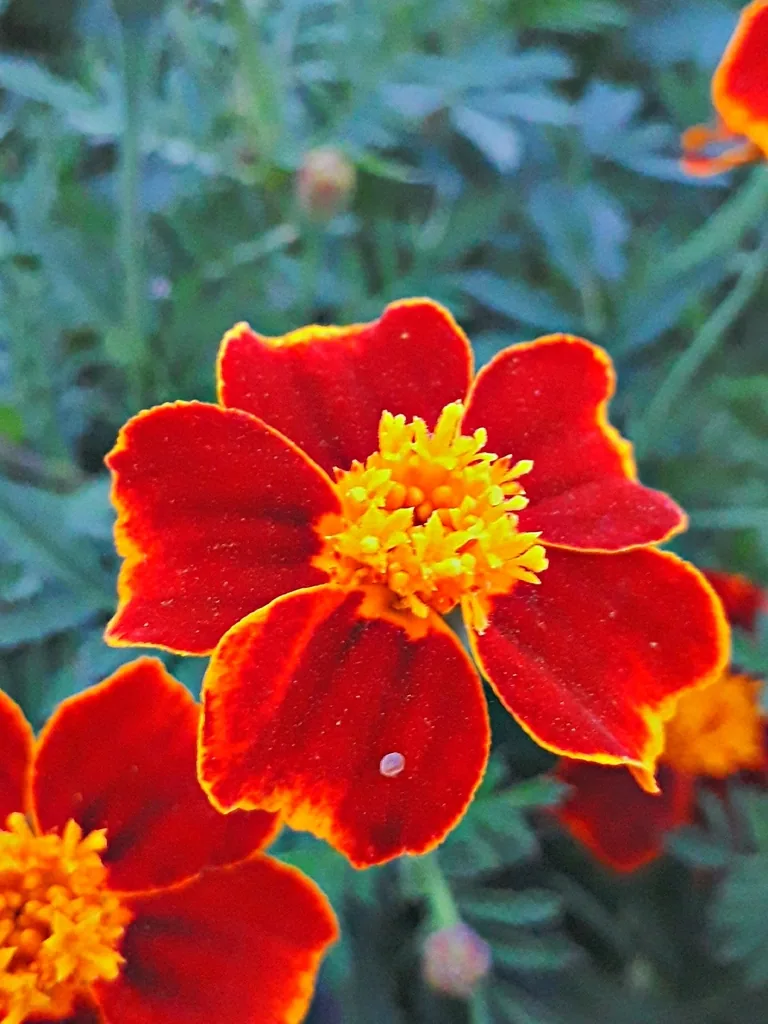
How to Grow and Care for French Marigold
Tagetes patula
Written by Emilio Marruso · last checked
Toxic to: People · Why
At a glance
French marigold is a cheerful annual that is easy to start: sown right in the garden, its seeds sprout in 5–7 days. It stays small, 6–12 inches tall, and is happy in full sun or partial shade, in the ground or in pots, even indoors. Its roots also give off a substance that keeps tiny soil pests called nematodes away.
- Sun
Full sun to partial shade
What the sources say (2)
Light: Full sun to partial shade
French marigold prefers full sun to partial shade in average, well-drained, evenly moist soil. It is deer-resistant and drought-tolerant once established.
— Tagetes patula (French Marigold) | North Carolina Extension Gardener Plant Toolbox [1] Full sun in moist well-drained soil Cultivars Large number of cultivars to choose from.
— Dwarf French Marigold (Tagetes patula)-Hort Answers - University of Illinois Extension [3] - Spacing
8–10 in between plants
What the sources say (1)
Spacing: 20.3-25.4 cm (8 to 10 in)
Plant French and signet types 8 to 10 inches apart
— Marigolds: From Folklore to the Home Garden [4] - Feeding
Slow-release food at planting, then now and then; too much nitrogen means leaves, not flowers
What the sources say (9)
When: At planting, then occasionally during the growing season
In the absence of soil test results, a slow-release fertilizer formulated for annuals can be incorporated at the time of planting.
— How to Grow and Care for Marigolds in South Carolina | Home & Garden Information Center [5] Phosphorus deficiency is noted by the purpling of lower leaves. Fertilizing occasionally with a complete fertilizer during the growing season often prevents or reduces these issues.
— Growing Marigolds in the Home Garden | Yard and Garden [7] Mineral fertilizers: Balanced fertilizer or one with a higher middle number; complete fertilizer during the season; slow-release fertilizer for annuals at planting
in containers: When planting marigolds in containers, use a soil-less potting mix supplemented with slow-release fertilizer or occasionally water with diluted liquid fertilizer.
— Marigolds: From Folklore to the Home Garden [4] A nitrogen-rich fertilizer stimulates more foliage growth at the expense of flowers. Use a balanced fertilizer or one with a higher middle number in the nutrient analysis to encourage flowering.
— Marigolds: From Folklore to the Home Garden [4] Phosphorus deficiency is noted by the purpling of lower leaves. Fertilizing occasionally with a complete fertilizer during the growing season often prevents or reduces these issues.
— Growing Marigolds in the Home Garden | Yard and Garden [7] In the absence of soil test results, a slow-release fertilizer formulated for annuals can be incorporated at the time of planting.
— How to Grow and Care for Marigolds in South Carolina | Home & Garden Information Center [5] Avoid: High-nitrogen fertilizers and heavy feeding
Avoid fertilizers that are high in nitrogen, the first number in the nutrient analysis. A nitrogen-rich fertilizer stimulates more foliage growth at the expense of flowers.
— Marigolds: From Folklore to the Home Garden [4] Water : Moderate; ensure even moisture in soil but avoid waterlogging Fertilization : Low feeders; does not require heavy fertilization
— Marigolds – Wisconsin Horticulture [6] Signs of excess: More foliage at the expense of flowers with nitrogen-rich fertilizer
Avoid fertilizers that are high in nitrogen, the first number in the nutrient analysis. A nitrogen-rich fertilizer stimulates more foliage growth at the expense of flowers.
— Marigolds: From Folklore to the Home Garden [4] - Harvest
Flowers make refreshing drinks; leaves add flavor
- Pests
Watch for spider mites, thrips and leafhoppers, plus powdery mildew and gray mold
What the sources say (4)
Pests: spider mites, thrips, leafhoppers
Spider mites and thrips may also be a problem.
— Tagetes patula (French Marigold) | North Carolina Extension Gardener Plant Toolbox [1] Additional pests and problems that may affect this plant: Mites, leaf hoppers, botrytis, pythium root rot, aster yellows
— Dwarf French Marigold (Tagetes patula)-Hort Answers - University of Illinois Extension [3] Diseases: powdery mildew, botrytis, leaf spot, rots, aster yellows, pythium root rot
It can be susceptible to powdery mildew, botrytis, leaf spot and rots.
— Tagetes patula (French Marigold) | North Carolina Extension Gardener Plant Toolbox [1] Additional pests and problems that may affect this plant: Mites, leaf hoppers, botrytis, pythium root rot, aster yellows
— Dwarf French Marigold (Tagetes patula)-Hort Answers - University of Illinois Extension [3] - Size
6–12 in tall and 6–18 in wide
What the sources say (3)
Mature height: 15-30 cm (6 to 12 inches)
It is 6 to 12 inches high and 6 to 18 inches wide.
— Tagetes patula (French Marigold) | North Carolina Extension Gardener Plant Toolbox [1] Mature Height 6-12 Inches
— Dwarf French Marigold (Tagetes patula)-Hort Answers - University of Illinois Extension [3] Mature width: 15-46 cm (6 to 18 inches)
Dimensions: Height: 0 ft. 6 in. - 1 ft. 0 in. Width: 0 ft. 6 in. - 1 ft. 6 in.
— Tagetes patula (French Marigold) | North Carolina Extension Gardener Plant Toolbox [1] - Propagation
Save seed at season's end, only from open-pollinated kinds; hybrid seed may not grow true
What the sources say (1)
Saving seeds: Save seed at the end of the season from open-pollinated cultivars only; seed from hybrid cultivars may be sterile or produce offspring that do not resemble the parent plant
At the end of the season, seed can be saved from open-pollinated cultivars, but avoid saving seed from hybrid cultivars, as they may be sterile or produce offspring that do not resemble the parent plant.
— How to Grow and Care for Marigolds in South Carolina | Home & Garden Information Center [5] - Sowing
Sow 1/4 inch deep right in the garden; seeds sprout in 5–7 days
What the sources say (3)
Sowing depth: 0.6 cm (1/4 inch)
Plant the seed approximately ¼ inch deep and expect germination in 5 to 7 days.
— How to Grow and Care for Marigolds in South Carolina | Home & Garden Information Center [5] When starting marigolds, moisten the soil and sow seeds about 1 inch apart and ¼ inch deep.
— Marigolds: From Folklore to the Home Garden [4] Days to germination: 5-7 (direct sowing)
Plant the seed approximately ¼ inch deep and expect germination in 5 to 7 days.
— How to Grow and Care for Marigolds in South Carolina | Home & Garden Information Center [5] - Containers
Grows well in pots, even indoors
What the sources say (3)
In containers: Yes
French marigolds are great for beds, containers or as an edging plant in borders.
— Tagetes patula (French Marigold) | North Carolina Extension Gardener Plant Toolbox [1] Good border and edging annual. Good in containers.
— Dwarf French Marigold (Tagetes patula)-Hort Answers - University of Illinois Extension [3] Indoors: Yes
Landscape Location: Container Houseplants Patio Pool/Hardscape Recreational Play Area
— Tagetes patula (French Marigold) | North Carolina Extension Gardener Plant Toolbox [1] - Safety
Sap on broken skin plus sunlight can burn and blister; the flower scent may irritate nose and eyes
Overview
French marigold is a compact bushy annual in the aster family, native to Mexico and Guatemala. [1] It prefers full sun to partial shade in well-drained, evenly moist soil and is drought-tolerant once established. [1] It is used in beds, containers and borders and attracts pollinators. [1]
This record is incomplete: the sources we read do not cover every field yet.
Not yet covered by our sources: Hardiness, coldest zone, Hardiness, warmest zone, Pruning, Propagation
French Marigold care
Measurements in square brackets are our conversion into the other unit system; the quoted text is unchanged.
How to water French Marigold
The sources give different values depending on region, zone or growing conditions.
What each source says
According to NC State Extension: Evenly moist soil; drought-tolerant once established
According to Penn State Extension: Allow the soil to dry slightly between each watering, then water thoroughly and deeply; water more frequently during hot weather
According to Clemson HGIC: About 1 inch [2.5 cm] of water per week after establishment; allow the soil to dry somewhat between waterings
According to UW-Madison Extension: Moderate; ensure even moisture in soil but avoid waterlogging
According to Iowa State Extension: Well-drained to dry soils; drought tolerant once established
What the sources say (6)
According to NC State Extension: French marigold prefers full sun to partial shade in average, well-drained, evenly moist soil. It is deer-resistant and drought-tolerant once established.According to Penn State Extension: allow the soil to dry slightly between each watering, then water thoroughly and deeplyAccording to Clemson HGIC: In the absence of adequate rainfall, water the soil deeply once a week, allowing it to dry somewhat between waterings.According to UW-Madison Extension: Water : Moderate; ensure even moisture in soil but avoid waterloggingAccording to Iowa State Extension: Most marigolds prefer full sun with well-drained to dry soils. Once established, they are drought tolerantFrench marigold prefers full sun to partial shade in average, well-drained, evenly moist soil. It is deer-resistant and drought-tolerant once established.How much light French Marigold needs
Full sun to partial shade
What the sources say (2)
French marigold prefers full sun to partial shade in average, well-drained, evenly moist soil. It is deer-resistant and drought-tolerant once established.Full sun in moist well-drained soil
Cultivars
Large number of cultivars to choose from.How much cold French Marigold can take
Hardiness, coldest zone
Not stated in the sources we read.
Hardiness, warmest zone
Not stated in the sources we read.
Where to grow French Marigold
Indoors
Yes
What the sources say (1)
Landscape Location:
Container
Houseplants
Patio
Pool/Hardscape
Recreational Play AreaIn containers
Yes
What the sources say (2)
French marigolds are great for beds, containers or as an edging plant in borders.Good border and edging annual. Good in containers.Spacing
20.3-25.4 cm (8 to 10 in)
What the sources say (1)
Plant French and signet types 8 to 10 inches apartHow to propagate French Marigold
Not stated in the sources we read.
How to grow French Marigold
The plant
Life cycle
annual
What the sources say (1)
French marigold is a compact bushy annual in the aster family (Asteraceae) and native to Mexico and Guatemala.Family
Asteraceae
What the sources say (1)
French marigold is a compact bushy annual in the aster family (Asteraceae) and native to Mexico and Guatemala.Mature height
15-30 cm (6 to 12 inches)
Mature width
15-46 cm (6 to 18 inches)
What the sources say (1)
Dimensions: Height: 0 ft. 6 in. - 1 ft. 0 in. Width: 0 ft. 6 in. - 1 ft. 6 in.Sowing and growth
Days to germination
5-7 (direct sowing)
What the sources say (1)
Plant the seed approximately ¼ inch deep and expect germination in 5 to 7 days.Sowing depth
0.6 cm (1/4 inch)
What the sources say (2)
Plant the seed approximately ¼ inch deep and expect germination in 5 to 7 days.When starting marigolds, moisten the soil and sow seeds about 1 inch apart and ¼ inch deep.Harvest and storage
Saving seeds
Save seed at the end of the season from open-pollinated cultivars only; seed from hybrid cultivars may be sterile or produce offspring that do not resemble the parent plant
What the sources say (1)
At the end of the season, seed can be saved from open-pollinated cultivars, but avoid saving seed from hybrid cultivars, as they may be sterile or produce offspring that do not resemble the parent plant.Pests and diseases
Pests
spider mites, thrips, leafhoppers
What the sources say (2)
Spider mites and thrips may also be a problem.Additional pests and problems that may affect this plant: Mites, leaf hoppers, botrytis, pythium root rot, aster yellowsDiseases
powdery mildew, botrytis, leaf spot, rots, aster yellows, pythium root rot
What the sources say (2)
It can be susceptible to powdery mildew, botrytis, leaf spot and rots.Additional pests and problems that may affect this plant: Mites, leaf hoppers, botrytis, pythium root rot, aster yellowsFertilizing
When
At planting, then occasionally during the growing season
What the sources say (2)
In the absence of soil test results, a slow-release fertilizer formulated for annuals can be incorporated at the time of planting.Phosphorus deficiency is noted by the purpling of lower leaves. Fertilizing occasionally with a complete fertilizer during the growing season often prevents or reduces these issues.How often
Occasionally during the growing season
What each source says
in containers: Occasional diluted liquid feeding, or slow-release fertilizer in the potting mix
What the sources say (2)
in containers: When planting marigolds in containers, use a soil-less potting mix supplemented with slow-release fertilizer or occasionally water with diluted liquid fertilizer.Phosphorus deficiency is noted by the purpling of lower leaves. Fertilizing occasionally with a complete fertilizer during the growing season often prevents or reduces these issues.Mineral fertilizers
Balanced fertilizer or one with a higher middle number; complete fertilizer during the season; slow-release fertilizer for annuals at planting
What each source says
in containers: Slow-release fertilizer in a soilless potting mix, or diluted liquid fertilizer
What the sources say (4)
in containers: When planting marigolds in containers, use a soil-less potting mix supplemented with slow-release fertilizer or occasionally water with diluted liquid fertilizer.A nitrogen-rich fertilizer stimulates more foliage growth at the expense of flowers. Use a balanced fertilizer or one with a higher middle number in the nutrient analysis to encourage flowering.Phosphorus deficiency is noted by the purpling of lower leaves. Fertilizing occasionally with a complete fertilizer during the growing season often prevents or reduces these issues.In the absence of soil test results, a slow-release fertilizer formulated for annuals can be incorporated at the time of planting.Avoid
High-nitrogen fertilizers and heavy feeding
What the sources say (2)
Avoid fertilizers that are high in nitrogen, the first number in the nutrient analysis. A nitrogen-rich fertilizer stimulates more foliage growth at the expense of flowers.Water : Moderate; ensure even moisture in soil but avoid waterlogging
Fertilization : Low feeders; does not require heavy fertilizationSigns of deficiency
Overall yellowing of the leaves (nitrogen); purpling of the lower leaves (phosphorus)
What the sources say (1)
Nitrogen-deficient soils will lead to overall yellowing of the leaves. Phosphorus deficiency is noted by the purpling of lower leaves.Signs of excess
More foliage at the expense of flowers with nitrogen-rich fertilizer
What the sources say (1)
Avoid fertilizers that are high in nitrogen, the first number in the nutrient analysis. A nitrogen-rich fertilizer stimulates more foliage growth at the expense of flowers.French Marigold pests and problems
Fungal diseases
Symptom: Susceptible to powdery mildew, botrytis, leaf spot and rots
What to do: Not stated in sources
What the sources say (1)
It can be susceptible to powdery mildew, botrytis, leaf spot and rots.
— Tagetes patula (French Marigold) | North Carolina Extension Gardener Plant Toolbox [1] Spider mites and thrips
Symptom: Spider mites and thrips may also be a problem
What to do: Not stated in sources
What the sources say (1)
Spider mites and thrips may also be a problem. Some cultivars have shown good resistance to abiotic disorders.
— Tagetes patula (French Marigold) | North Carolina Extension Gardener Plant Toolbox [1] Aster yellows
Symptom: Phytoplasma disease listed among the pests and problems
What to do: Not stated in sources
What the sources say (1)
Additional pests and problems that may affect this plant: Mites, leaf hoppers, botrytis, pythium root rot, aster yellows
— Dwarf French Marigold (Tagetes patula)-Hort Answers - University of Illinois Extension [3]
Remedies
Each remedy shows what official sources say about it; traditional remedies without an official source are marked as such. Harmful ones are listed so you know to avoid them.
First aid
First aid: not a substitute for a doctor
skin irritation from contact with the plant
washing the skin with soap and water Official source, not independently tested
However, if the symptoms persist or worsen, contact your physician for further treatment.
— chop.edu [8] Instead, contact the Poison Control Center at 1-800-222-1222 immediately for information on what to do.
— chop.edu [9] Skin redness, burning pain, and blisters when broken skin is in contact with cell sap plus sunlight; nose and eye irritation from aroma of flowers.
— Tagetes patula (French Marigold) | North Carolina Extension Gardener Plant Toolbox [1] How: After contact with a skin irritant plant, wash the exposed areas thoroughly with soap and water
After contact with a skin irritant plant, wash the exposed areas thoroughly with soap and water.
— chop.edu [8]
Treating the plant
spider mites
strong spray of water from the hose Not verified
Traditional remedy, not verified by an official source.
How: If caught early, mites and thrips can sometimes be knocked down with a strong spray from the garden hose
neem oil Works
How: Use neem or horticultural oil if you encounter an infestation
Use neem or horticultural oil if you encounter an infestation.
— thespruce.com [10] What the evidence says Neem oil is found in the seeds of the neem tree. The active component found in this biological pesticide reduces insect feeding
— extension.illinois.edu [11] insecticidal soap Works
How: Insecticidal soap applied according to label directions
Marigolds have few pests or problems, but spider mites and aphids may infest the plants. Usually, insecticidal soap applied according to label directions will solve the problem.
— Marigolds: From Folklore to the Home Garden [4] What the evidence says For example, insecticidal soap is a safe, effective organic insecticide with minimal environmental impact.
— extension.psu.edu [12]
thrips
strong spray of water from the hose Not verified
Traditional remedy, not verified by an official source.
How: If caught early, mites and thrips can sometimes be knocked down with a strong spray from the garden hose
aphids
insecticidal soap Works
How: A weekly application of organic insecticidal soap, or a spray of water
Marigolds have few pests overall, but spider mites and aphids sometimes infest them. Usually, a spray of water or a weekly application of organic insecticidal soap is all it takes to get rid of these pests.
— almanac.com [13] What the evidence says For example, insecticidal soap is a safe, effective organic insecticide with minimal environmental impact.
— extension.psu.edu [12]
slugs
hand-picking at night Not verified
Traditional remedy, not verified by an official source.
How: Head out each night with a flashlight and pluck as many snails and slugs off your plants as you can manage
aster yellows
removing infected plants Official source, not independently tested
How: Remove infected plants to prevent the spread of the phytoplasma to marigolds or other Aster family members
It is recommended that infected plants be removed to prevent the spread of the phytoplasma to marigolds or other Aster family members.
— Growing Marigolds in the Home Garden | Yard and Garden [7]
Is French Marigold poisonous?
Reported by the source, quoted verbatim. This is not medical or veterinary advice: if a person or an animal may have eaten this plant, contact a poison control centre or a veterinarian.
Poison Symptoms: Skin redness, burning pain, and blisters when broken skin is in contact with cell sap plus sunlight; nose and eye irritation from aroma of flowers. Poison Toxic Principle: Phototoxic thiophene derivatives
[1]- Poisonous parts
Poison Part: Flowers Leaves Roots
[1]- Toxic principle
Poison Toxic Principle: Phototoxic thiophene derivatives
[1]- Symptoms
Skin redness, burning pain, and blisters when broken skin is in contact with cell sap plus sunlight; nose and eye irritation from aroma of flowers.
[1]- Severity
This plant has low severity poison characteristics.
[1]
Calendar
Planting
The sources give different values depending on region, zone or growing conditions.
What each source says
According to Penn State Extension: Anytime from spring through midsummer
According to Clemson HGIC: After the last frost in spring
What the sources say (3)
According to Penn State Extension: Plant French and signet marigolds anytime from spring through midsummer.According to Clemson HGIC: The ideal time to plant marigolds is after the last frost in spring.Plant French and signet marigolds anytime from spring through midsummer.Pruning
Not stated in the sources we read.
Months as given by the sources, which are mostly from the United States (northern hemisphere). In the southern hemisphere they shift by about six months.
Relative to frost
Less precise estimate: there is no weather station within 300 km.
Find frost dates by ZIP code or city
Plant: around the last frost
The ideal time to plant marigolds is after the last frost in spring.
— How to Grow and Care for Marigolds in South Carolina | Home & Garden Information Center [5] Sow outdoors: around the last frost
Once the soil has warmed and the danger of frost has passed, sow seeds directly into the garden.
— How to Grow and Care for Marigolds in South Carolina | Home & Garden Information Center [5]
Count from the average frost dates where you live.
Edibility
Reported by the source, quoted verbatim. Do not eat a plant on the basis of this page alone: identification mistakes can be dangerous.
Indicative values
Values from a secondary source, not checked word for word like the rest of this page. Use them as a starting point.
- Drought tolerant
- yesIndicative value, adapt it to your climate · Secondary source
- Soil pH
- 6-7Indicative value, adapt it to your climate · Secondary source
- USDA hardiness zones
- 2-11 [winter low −45.6 to 10 °C (−50 to 50 °F)]Indicative value, adapt it to your climate · Secondary source
- Care level
- MediumIndicative value, adapt it to your climate · Secondary source
- Growth rate
- LowIndicative value, adapt it to your climate · Secondary source
- Pruning
- AugustIndicative value, adapt it to your climate · Secondary source
- Propagation
- Seed Propagation, Cutting, Division, Layering PropagationIndicative value, adapt it to your climate · Secondary source
Similar plants
- African Marigold Tagetes erecta
- Lemon Marigold Tagetes tenuifolia
- Sweetscented marigold Tagetes lucida
- African Daisy Dimorphotheca pluvialis
- Ageratum Ageratum houstonianum
- Alpine aster Aster alpinus
- Appalachian Blazing Star Liatris squarrulosa
- Appalachian Ironweed Vernonia glauca
Sources
Every value above is quoted from these documents. Links lead to the original publisher.
- Tagetes patula (French Marigold) | North Carolina Extension Gardener Plant Toolbox · plants.ces.ncsu.edu, consulted
- Tagetes (Marigold) | North Carolina Extension Gardener Plant Toolbox · plants.ces.ncsu.edu, consulted
- Dwarf French Marigold (Tagetes patula)-Hort Answers - University of Illinois Extension · web.extension.illinois.edu, consulted
- Marigolds: From Folklore to the Home Garden · extension.psu.edu, consulted
- How to Grow and Care for Marigolds in South Carolina | Home & Garden Information Center · hgic.clemson.edu, consulted
- Marigolds – Wisconsin Horticulture · hort.extension.wisc.edu, consulted
- Growing Marigolds in the Home Garden | Yard and Garden · yardandgarden.extension.iastate.edu, consulted
- chop.edu · chop.edu
- chop.edu · chop.edu
- thespruce.com · thespruce.com
- extension.illinois.edu · extension.illinois.edu
- extension.psu.edu · extension.psu.edu
- almanac.com · almanac.com
Written by Emilio Marruso · last checked