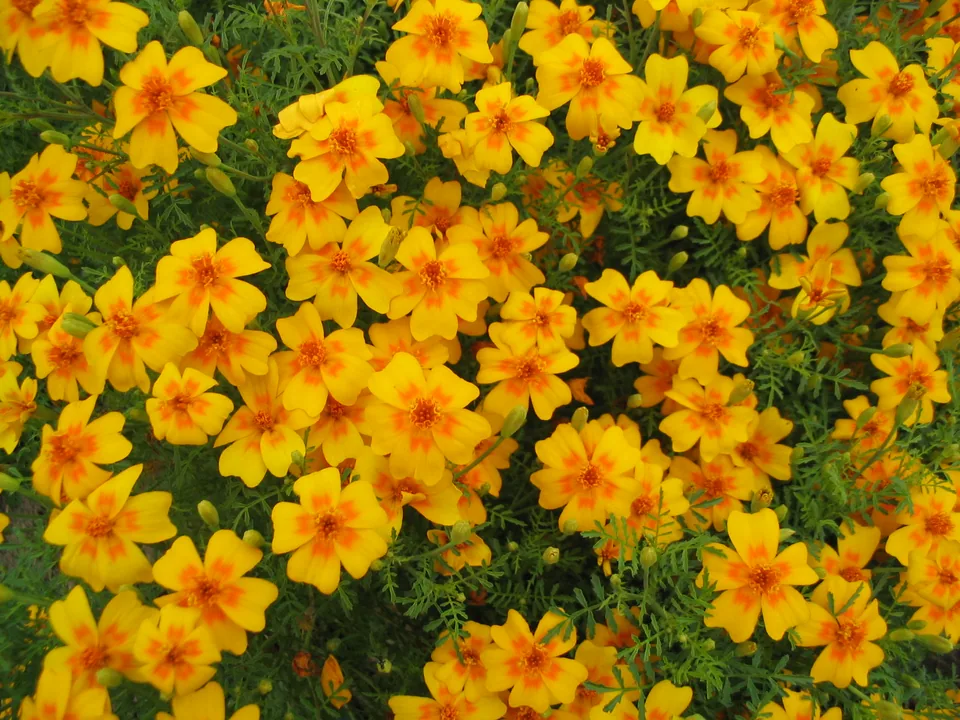


How to Grow and Care for Lemon Marigold
Tagetes tenuifolia
Written by Emilio Marruso · last checked
Toxic to: People · Why
At a glance
Signet marigold fills the garden with cheerful flowers from just a few seeds: start them indoors 6 to 8 weeks before the last frost, then plant out once frost has passed. Give it full sun and regular watering, and snip off faded flowers to keep the blooms coming. The flowers of some varieties even have a pleasant citrus flavor for garnishing.
- Sun
Full sun
What the sources say (1)
Light: Full sun
Lemon marigold does well in full sun and in a wide variety of soils, including clay, but it will not tolerate shade.
— Tagetes tenuifolia (Lemon Marigold, Signet Marigold, Stiped Mexican Marigold) | North Carolina Extension Gardener Plant Toolbox [1] - Water
Water regularly but not too much; it handles some dryness and likes moist, well-drained soil
What the sources say (2)
Watering: Water regularly but do not overwater
It can tolerate some dry conditions, but prefers a moist, well-drained environment. Water regularly but do not overwater.
— Tagetes tenuifolia (Lemon Marigold, Signet Marigold, Stiped Mexican Marigold) | North Carolina Extension Gardener Plant Toolbox [1] Watering notes: Tolerates some dry conditions but prefers a moist, well-drained environment
It can tolerate some dry conditions, but prefers a moist, well-drained environment.
— Tagetes tenuifolia (Lemon Marigold, Signet Marigold, Stiped Mexican Marigold) | North Carolina Extension Gardener Plant Toolbox [1] - Cold
Survives winters down to −50 °F (−45.6 °C)
Very hardy · USDA 2a · RHS H7 · Z2
What the sources say (2)
Hardiness, coldest zone: 2a [winter low −45.6 to −42.8 °C (−50 to −45 °F)]
USDA Plant Hardiness Zone: 2a, 2b, 3a, 3b, 4a, 4b, 5a, 5b, 6a, 6b, 7a, 7b, 8a, 8b, 9a, 9b, 10a, 10b, 11a, 11b
— Tagetes tenuifolia (Lemon Marigold, Signet Marigold, Stiped Mexican Marigold) | North Carolina Extension Gardener Plant Toolbox [1] Hardiness, warmest zone: 11b [winter low 7.2 to 10 °C (45 to 50 °F)]
USDA Plant Hardiness Zone: 2a, 2b, 3a, 3b, 4a, 4b, 5a, 5b, 6a, 6b, 7a, 7b, 8a, 8b, 9a, 9b, 10a, 10b, 11a, 11b
— Tagetes tenuifolia (Lemon Marigold, Signet Marigold, Stiped Mexican Marigold) | North Carolina Extension Gardener Plant Toolbox [1] - Planting
Plant out after the last frost date
What the sources say (1)
Planting: After the last frost date
Set plants out after the last frost date. Plant taller varieties deep in sites protected from strong wind or heavy rain
— Tagetes tenuifolia (Lemon Marigold, Signet Marigold, Stiped Mexican Marigold) | North Carolina Extension Gardener Plant Toolbox [1] - Feeding
A complete fertilizer now and then while it grows; all-yellow leaves mean it needs nitrogen
What the sources say (4)
When: During the growing season
Fertilizing occasionally with a complete fertilizer during the growing season often prevents or reduces these issues.
— [2] How often: Occasionally
Fertilizing occasionally with a complete fertilizer during the growing season often prevents or reduces these issues.
— [2] Mineral fertilizers: Complete fertilizer
Fertilizing occasionally with a complete fertilizer during the growing season often prevents or reduces these issues.
— [2] Signs of deficiency: Overall yellowing of the leaves (nitrogen); purpling of the lower leaves (phosphorus)
Nitrogen-deficient soils will lead to overall yellowing of the leaves. Phosphorus deficiency is noted by the purpling of lower leaves.
— [2] - Pruning
Remove dead flowers before seeds form to keep it blooming longer
What the sources say (1)
Pruning: Remove dead flowers before the seeds form to extend the flowering season
Remove dead flowers before the seeds form to extend the flowering season. It is often grown
— Tagetes tenuifolia (Lemon Marigold, Signet Marigold, Stiped Mexican Marigold) | North Carolina Extension Gardener Plant Toolbox [1] - Harvest
Some varieties have citrus-flavored flowers: use a few as flavoring or garnish
- Pests
Watch out for snails, slugs and gray mold
What the sources say (2)
Pests: snails, slugs
Insects, Diseases and Other Plant Problems: Susceptible to snails, slugs and botrytis.
— Tagetes tenuifolia (Lemon Marigold, Signet Marigold, Stiped Mexican Marigold) | North Carolina Extension Gardener Plant Toolbox [1] Diseases: botrytis
Insects, Diseases and Other Plant Problems: Susceptible to snails, slugs and botrytis.
— Tagetes tenuifolia (Lemon Marigold, Signet Marigold, Stiped Mexican Marigold) | North Carolina Extension Gardener Plant Toolbox [1] - Size
8 to 30 in tall and 9 to 30 in wide
What the sources say (2)
Mature height: 20-76 cm (8 to 30 in)
grows between 8 to 30 inches in height and 9 to 30 inches in width.
— Tagetes tenuifolia (Lemon Marigold, Signet Marigold, Stiped Mexican Marigold) | North Carolina Extension Gardener Plant Toolbox [1] Mature width: 23-76 cm (9 to 30 in)
grows between 8 to 30 inches in height and 9 to 30 inches in width.
— Tagetes tenuifolia (Lemon Marigold, Signet Marigold, Stiped Mexican Marigold) | North Carolina Extension Gardener Plant Toolbox [1] - Propagation
Grows from seed
What the sources say (1)
Propagation: Seed
It will grow best from seed that you can start indoors 6 to 8 weeks before the last frost date
— Tagetes tenuifolia (Lemon Marigold, Signet Marigold, Stiped Mexican Marigold) | North Carolina Extension Gardener Plant Toolbox [1] - Sowing
Sow indoors 6–8 weeks before the last frost date
What the sources say (1)
Sowing: Start seed indoors 6 to 8 weeks before the last frost date
It will grow best from seed that you can start indoors 6 to 8 weeks before the last frost date
— Tagetes tenuifolia (Lemon Marigold, Signet Marigold, Stiped Mexican Marigold) | North Carolina Extension Gardener Plant Toolbox [1] - Containers
Grows in containers too
What the sources say (1)
In containers: Yes
It can be planted in containers and hanging baskets, in borders, along foundations and hardscapes
— Tagetes tenuifolia (Lemon Marigold, Signet Marigold, Stiped Mexican Marigold) | North Carolina Extension Gardener Plant Toolbox [1] - Safety
May cause mild skin irritation that usually lasts only a few minutes
Overview
Lemon marigold is a flowering annual or perennial grown for its ornamental value and lemon-scented foliage. [1] It grows best in full sun and moist, well-drained soil, and can be planted in containers and hanging baskets. [1] Contact with the flowers, roots or sap can cause minor skin irritation. [1]
Lemon Marigold care
How to water Lemon Marigold
Watering
Water regularly but do not overwater
What the sources say (1)
It can tolerate some dry conditions, but prefers a moist, well-drained environment. Water regularly but do not overwater.Watering notes
Tolerates some dry conditions but prefers a moist, well-drained environment
What the sources say (1)
It can tolerate some dry conditions, but prefers a moist, well-drained environment.How much light Lemon Marigold needs
Full sun
What the sources say (1)
Lemon marigold does well in full sun and in a wide variety of soils, including clay, but it will not tolerate shade.How much cold Lemon Marigold can take
Hardiness, coldest zone
2a [winter low −45.6 to −42.8 °C (−50 to −45 °F)]
What the sources say (1)
USDA Plant Hardiness Zone:
2a, 2b, 3a, 3b, 4a, 4b, 5a, 5b, 6a, 6b, 7a, 7b, 8a, 8b, 9a, 9b, 10a, 10b, 11a, 11bHardiness, warmest zone
11b [winter low 7.2 to 10 °C (45 to 50 °F)]
What the sources say (1)
USDA Plant Hardiness Zone:
2a, 2b, 3a, 3b, 4a, 4b, 5a, 5b, 6a, 6b, 7a, 7b, 8a, 8b, 9a, 9b, 10a, 10b, 11a, 11bWhere to grow Lemon Marigold
Yes
What the sources say (1)
It can be planted in containers and hanging baskets, in borders, along foundations and hardscapesHow to propagate Lemon Marigold
Seed
What the sources say (1)
It will grow best from seed that you can start indoors 6 to 8 weeks before the last frost dateHow to grow Lemon Marigold
The plant
Life cycle
perennial or annual
What the sources say (1)
Lemon marigold is an attractive, flowering perennial or annual in the daisy family (Asteraceae).Family
Asteraceae
What the sources say (1)
Lemon marigold is an attractive, flowering perennial or annual in the daisy family (Asteraceae).Mature height
20-76 cm (8 to 30 in)
What the sources say (1)
grows between 8 to 30 inches in height and 9 to 30 inches in width.Mature width
23-76 cm (9 to 30 in)
What the sources say (1)
grows between 8 to 30 inches in height and 9 to 30 inches in width.Pests and diseases
Pests
snails, slugs
What the sources say (1)
Insects, Diseases and Other Plant Problems: Susceptible to snails, slugs and botrytis.Diseases
botrytis
What the sources say (1)
Insects, Diseases and Other Plant Problems: Susceptible to snails, slugs and botrytis.Fertilizing
When
During the growing season
What the sources say (1)
Fertilizing occasionally with a complete fertilizer during the growing season often prevents or reduces these issues.How often
Occasionally
What the sources say (1)
Fertilizing occasionally with a complete fertilizer during the growing season often prevents or reduces these issues.Mineral fertilizers
Complete fertilizer
What the sources say (1)
Fertilizing occasionally with a complete fertilizer during the growing season often prevents or reduces these issues.Signs of deficiency
Overall yellowing of the leaves (nitrogen); purpling of the lower leaves (phosphorus)
What the sources say (1)
Nitrogen-deficient soils will lead to overall yellowing of the leaves. Phosphorus deficiency is noted by the purpling of lower leaves.Lemon Marigold pests and problems
Snails, slugs and botrytis
Symptom: Susceptible to snails, slugs and botrytis.
What the sources say (1)
Insects, Diseases and Other Plant Problems: Susceptible to snails, slugs and botrytis.
— Tagetes tenuifolia (Lemon Marigold, Signet Marigold, Stiped Mexican Marigold) | North Carolina Extension Gardener Plant Toolbox [1]
Remedies
Each remedy shows what official sources say about it; traditional remedies without an official source are marked as such. Harmful ones are listed so you know to avoid them.
Treating the plant
slugs and snails
hand-picking into soapy water Not verified
Traditional remedy, not verified by an official source.
How: Pick slugs and snails by hand and drop them in a bucket of soapy water.
beer trap Not verified
Traditional remedy, not verified by an official source.
How: Dig a small hole near the plant and place a small tray filled with beer in it; the slugs are attracted to the beer and drown.
salt sprinkled on slugs Harmful
But you need to be careful not to put too much salt on the plant as it can damage them as well.
— gardeningmentor.com [3] How: Sprinkle salt on the slugs and snails.
You can also sprinkle salt on the slugs and snails to kill them.
— gardeningmentor.com [3] What the evidence says Salts work by desiccating plants—again, all parts of the plant it touches.
— extension.uconn.edu [4]
aphids
strong water spray Not verified
Traditional remedy, not verified by an official source.
How: Spray water on the aphids to dislodge them to the ground; repeat several times during the week.
thrips
neem oil and dish soap spray Partly works
Spray one leaf of the plant and leave it for 24 hours. Make sure there is no adverse reaction to this mixture on the leaf.
— gardeningmentor.com [3] You don’t want to use too much because it’s toxic to the plant.
— gardeningmentor.com [3] How: Mix 1 teaspoon of neem oil, 1/2 teaspoon of dish soap and a quart of clean water in a spray can; spray every week on all parts of the plant until the thrips are gone.
Take 1 teaspoon of neem oil , 1/2 teaspoon of dish soap, and a quart of clean water.
— gardeningmentor.com [3] What the evidence says However, neem oil is not effective against every insect and disease, and often must be frequently reapplied to reach the desired outcome.
— extension.unh.edu [5]
spider mites
neem oil and dish soap spray Partly works
Spray one leaf of the plant and leave it for 24 hours. Make sure there is no adverse reaction to this mixture on the leaf.
— gardeningmentor.com [3] How: Spray the mixture of 1 teaspoon of neem oil and 1/2 teaspoon of dish soap in a quart of water on the affected parts every week until the spider mites are gone.
It’s easy to get rid of spider mites using the same solution as for thrips.
— gardeningmentor.com [3] What the evidence says However, neem oil is not effective against every insect and disease, and often must be frequently reapplied to reach the desired outcome.
— extension.unh.edu [5]
Is Lemon Marigold poisonous?
Reported by the source, quoted verbatim. This is not medical or veterinary advice: if a person or an animal may have eaten this plant, contact a poison control centre or a veterinarian.
Poison Severity: Low Poison Symptoms: Skin irritation is minor, or typically only lasting a few minutes
[1]- Poisonous parts
Causes Contact Dermatitis: Yes Poison Part: Flowers Roots Sap/Juice
[1]- Toxic principle
Poison Toxic Principle: Phototoxic thiophene derivatives Causes Contact Dermatitis: Yes
[1]- Symptoms
Poison Symptoms: Skin irritation is minor, or typically only lasting a few minutes
[1]- Severity
This plant has low severity poison characteristics. See below
[1]
Calendar
Sowing
Start seed indoors 6 to 8 weeks before the last frost date
What the sources say (1)
It will grow best from seed that you can start indoors 6 to 8 weeks before the last frost datePlanting
After the last frost date
What the sources say (1)
Set plants out after the last frost date. Plant taller varieties deep in sites protected from strong wind or heavy rainPruning
Remove dead flowers before the seeds form to extend the flowering season
What the sources say (1)
Remove dead flowers before the seeds form to extend the flowering season. It is often grownMonths as given by the sources, which are mostly from the United States (northern hemisphere). In the southern hemisphere they shift by about six months.
Relative to frost
Less precise estimate: there is no weather station within 300 km.
Find frost dates by ZIP code or city
Sow indoors: 6 to 8 weeks before the last frost
It will grow best from seed that you can start indoors 6 to 8 weeks before the last frost date
— Tagetes tenuifolia (Lemon Marigold, Signet Marigold, Stiped Mexican Marigold) | North Carolina Extension Gardener Plant Toolbox [1] Transplant: around the last frost
Set plants out after the last frost date.
— Tagetes tenuifolia (Lemon Marigold, Signet Marigold, Stiped Mexican Marigold) | North Carolina Extension Gardener Plant Toolbox [1]
Count from the average frost dates where you live.
Edibility
Reported by the source, quoted verbatim. Do not eat a plant on the basis of this page alone: identification mistakes can be dangerous.
The flowers of some cultivars have a pleasant citrus-like flavour and can be used sparingly as a flavouring or as a garnish.
[1]
Similar plants
- African Marigold Tagetes erecta
- French Marigold Tagetes patula
- Sweetscented marigold Tagetes lucida
- African Daisy Dimorphotheca pluvialis
- Ageratum Ageratum houstonianum
- Alpine aster Aster alpinus
- Appalachian Blazing Star Liatris squarrulosa
- Appalachian Ironweed Vernonia glauca
Sources
Every value above is quoted from these documents. Links lead to the original publisher.
- Tagetes tenuifolia (Lemon Marigold, Signet Marigold, Stiped Mexican Marigold) | North Carolina Extension Gardener Plant Toolbox · plants.ces.ncsu.edu, consulted
- yardandgarden.extension.iastate.edu · yardandgarden.extension.iastate.edu
- gardeningmentor.com · gardeningmentor.com
- extension.uconn.edu · extension.uconn.edu
- extension.unh.edu · extension.unh.edu
Written by Emilio Marruso · last checked