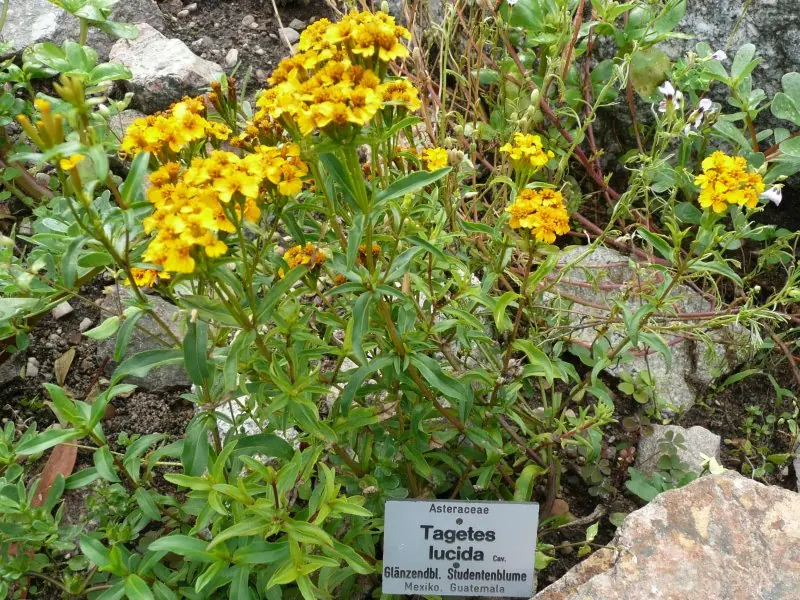


How to Grow and Care for Sweetscented marigold
Tagetes lucida
Written by Emilio Marruso · last checked
Toxic to: People · Why
At a glance
Mexican tarragon gives you leaves with a flavor like anise, great fresh or dried in soups and sauces, and flowers you can brew into tea. It loves full to part sun, and once settled it handles dry spells with only occasional watering. It even grows happily in a pot or indoors, so you can pick fresh leaves whenever you need them.
- Sun
Full sun to part sun
What the sources say (2)
Light: Full sun to part sun
Plant it in the full sun in light well-drained soils.
— Tagetes lucida (Mexican Marigold, Mexican Mint Marigold, Mexican Tarragon, Sweet Mace, Sweetscented marigold, Texas Tarragon) | North Carolina Extension Gardener Plant Toolbox [1] Plant in full or part sun. Seeds can be difficult to find and are slow to germinate.
— Mexican Tarragon | UC Marin Master Gardeners [3] - Water
Handles drought once settled; water now and then, on the soil, not the leaves
What the sources say (3)
Watering: Drought tolerant once established; grows best with occasional irrigation
While it is drought tolerant once established, it will grow best with occasional irrigation.
— Mexican Tarragon – Gardening Solutions [2] Mexican tarragon is drought tolerant but prefers consistent water. Allow soil to dry out before watering again.
— Mexican Tarragon | UC Marin Master Gardeners [3] Watering notes: Avoid watering the leaves
Water Requirements Mexican tarragon is drought tolerant but prefers consistent water. Allow soil to dry out before watering again. Avoid watering the leaves
— Mexican Tarragon | UC Marin Master Gardeners [3] - Cold
Survives winters down to 10 °F (−12.2 °C)
Hardy in cold winters · USDA 8a · RHS H5 · Z8
What the sources say (2)
Hardiness, coldest zone: 8a [winter low −12.2 to −9.4 °C (10 to 15 °F)]
USDA Plant Hardiness Zone: 8a, 8b, 9a, 9b, 10a, 10b, 11a, 11b
— Tagetes lucida (Mexican Marigold, Mexican Mint Marigold, Mexican Tarragon, Sweet Mace, Sweetscented marigold, Texas Tarragon) | North Carolina Extension Gardener Plant Toolbox [1] Hardiness, warmest zone: 11b [winter low 7.2 to 10 °C (45 to 50 °F)]
USDA Plant Hardiness Zone: 8a, 8b, 9a, 9b, 10a, 10b, 11a, 11b
— Tagetes lucida (Mexican Marigold, Mexican Mint Marigold, Mexican Tarragon, Sweet Mace, Sweetscented marigold, Texas Tarragon) | North Carolina Extension Gardener Plant Toolbox [1] - Planting
Plant in spring, after the last frost
What the sources say (1)
Planting: Spring, after last frost
When to Plant Plant in spring after last frost. Planting Plant in full or part sun.
— Mexican Tarragon | UC Marin Master Gardeners [3] - Feeding
No feeding needed; if it flowers little, give fish emulsion once a month
What the sources say (2)
How often: Not necessary; once a month if blooms are sparse
Fertilizing Not necessary. Apply fish emulsion once a month if blooms are sparse.
— Mexican Tarragon | UC Marin Master Gardeners [3] Natural fertilizers: Fish emulsion, only if blooms are sparse
Fertilizing Not necessary. Apply fish emulsion once a month if blooms are sparse.
— Mexican Tarragon | UC Marin Master Gardeners [3] - Harvest
Pick leaves as needed, best fresh; freeze, dry or keep them in vinegar for later
What the sources say (4)
Harvest: Leaves as needed
Harvesting Harvest leaves as needed as they are best fresh.
— Mexican Tarragon | UC Marin Master Gardeners [3] How to harvest: Harvest leaves as needed; they are best fresh.
Harvest leaves as needed as they are best fresh.
— Mexican Tarragon | UC Marin Master Gardeners [3] Storage: Long term: freeze or store in vinegar. Alternatively dry: bundle stems and hang upside down for about a week, strip the leaves and store in a glass jar until next season.
For long term storage Mexican tarragon does best when frozen or stored in vinegar.
— Mexican Tarragon – Gardening Solutions [2] To dry leaves, bundle stems and hang upside down. In about a week, strip leaves from stems and store in glass jar until next season.
— Mexican Tarragon | UC Marin Master Gardeners [3] - Pests
Slugs and snails, especially on seedlings; now and then gray mold
What the sources say (2)
Pests: slugs, snails
Slugs and snails can be a problem especially for seedlings.
— Tagetes lucida (Mexican Marigold, Mexican Mint Marigold, Mexican Tarragon, Sweet Mace, Sweetscented marigold, Texas Tarragon) | North Carolina Extension Gardener Plant Toolbox [1] Diseases: botrytis
Botrytis is an occasional disease problem.
— Tagetes lucida (Mexican Marigold, Mexican Mint Marigold, Mexican Tarragon, Sweet Mace, Sweetscented marigold, Texas Tarragon) | North Carolina Extension Gardener Plant Toolbox [1] - Size
6 to 18 inches wide
What the sources say (1)
Mature width: 15-46 cm (0.5-1.5 ft)
Width: 0 ft. 6 in. - 1 ft. 6 in.
— Tagetes lucida (Mexican Marigold, Mexican Mint Marigold, Mexican Tarragon, Sweet Mace, Sweetscented marigold, Texas Tarragon) | North Carolina Extension Gardener Plant Toolbox [1] - Propagation
From seed or from pieces taken at the base of the plant, with roots attached
What the sources say (2)
Propagation: Seed; cuttings from the base of the plant (stem including roots)
or along a pathway or patio. Propagate this plant by seed.
— Tagetes lucida (Mexican Marigold, Mexican Mint Marigold, Mexican Tarragon, Sweet Mace, Sweetscented marigold, Texas Tarragon) | North Carolina Extension Gardener Plant Toolbox [1] Also easily propagated from cuttings from base of plant. Break off stem including the roots.
— Mexican Tarragon | UC Marin Master Gardeners [3] - Sowing
Seeds sprout in 14 days
What the sources say (1)
Days to germination: 14 (about two weeks)
The seeds take about two weeks to germinate, so don’t fear if you don’t see plants popping up right away.
— Mexican Tarragon – Gardening Solutions [2] - Containers
Grows in containers and indoors too
What the sources say (2)
In containers: Yes
Landscape Location: Container Houseplants Patio Walkways Landscape Theme:
— Tagetes lucida (Mexican Marigold, Mexican Mint Marigold, Mexican Tarragon, Sweet Mace, Sweetscented marigold, Texas Tarragon) | North Carolina Extension Gardener Plant Toolbox [1] Indoors: Yes
Landscape Location: Container Houseplants Patio Walkways Landscape Theme:
— Tagetes lucida (Mexican Marigold, Mexican Mint Marigold, Mexican Tarragon, Sweet Mace, Sweetscented marigold, Texas Tarragon) | North Carolina Extension Gardener Plant Toolbox [1] - Safety
Sap on broken skin in sunlight can burn and blister; harmful if eaten in large amounts
Overview
Mexican tarragon is a perennial herb with an anise-like flavor that is used as a tarragon substitute. [2] It is grown in full sun to part sun and is drought tolerant once established. [2][3] Contact with the plant can cause skin irritation in some people. [1]
Sweetscented marigold care
How to water Sweetscented marigold
Watering
Drought tolerant once established; grows best with occasional irrigation
What the sources say (2)
While it is drought tolerant once established, it will grow best with occasional irrigation.Mexican tarragon is drought tolerant but prefers consistent water. Allow soil to dry out before watering again.Watering notes
Avoid watering the leaves
What the sources say (1)
Water Requirements
Mexican tarragon is drought tolerant but prefers consistent water. Allow soil to dry out before watering again. Avoid watering the leavesHow much light Sweetscented marigold needs
Full sun to part sun
What the sources say (2)
Plant it in the full sun in light well-drained soils.Plant in full or part sun. Seeds can be difficult to find and are slow to germinate.How much cold Sweetscented marigold can take
Hardiness, coldest zone
8a [winter low −12.2 to −9.4 °C (10 to 15 °F)]
What the sources say (1)
USDA Plant Hardiness Zone:
8a, 8b, 9a, 9b, 10a, 10b, 11a, 11bHardiness, warmest zone
11b [winter low 7.2 to 10 °C (45 to 50 °F)]
What the sources say (1)
USDA Plant Hardiness Zone:
8a, 8b, 9a, 9b, 10a, 10b, 11a, 11bWhere to grow Sweetscented marigold
Indoors
Yes
What the sources say (1)
Landscape Location:
Container
Houseplants
Patio
Walkways
Landscape Theme:In containers
Yes
What the sources say (1)
Landscape Location:
Container
Houseplants
Patio
Walkways
Landscape Theme:How to propagate Sweetscented marigold
Seed; cuttings from the base of the plant (stem including roots)
What the sources say (2)
or along a pathway or patio. Propagate this plant by seed.Also easily propagated from cuttings from base of plant. Break off stem including the roots.How to grow Sweetscented marigold
The plant
Life cycle
perennial (grown as an annual in zones colder than 8)
What the sources say (1)
Mexican tarragon is native to the hillside and woodlands of Mexico and South America, where it is a perennial. In zones colder than 8 it is grown as an annual.Family
Asteraceae
What the sources say (1)
Both Mexican tarragon and French tarragon belong to the plant family Asteraceae.Mature height
Mature width
15-46 cm (0.5-1.5 ft)
What the sources say (1)
Width: 0 ft. 6 in. - 1 ft. 6 in.Sowing and growth
Days to germination
14 (about two weeks)
What the sources say (1)
The seeds take about two weeks to germinate, so don’t fear if you don’t see plants popping up right away.Harvest and storage
How to harvest
Harvest leaves as needed; they are best fresh.
What the sources say (1)
Harvest leaves as needed as they are best fresh.Storage
Long term: freeze or store in vinegar. Alternatively dry: bundle stems and hang upside down for about a week, strip the leaves and store in a glass jar until next season.
What the sources say (2)
For long term storage Mexican tarragon does best when frozen or stored in vinegar.To dry leaves, bundle stems and hang upside down. In about a week, strip leaves from stems and store in glass jar until next season.Pests and diseases
Pests
slugs, snails
What the sources say (1)
Slugs and snails can be a problem especially for seedlings.Diseases
botrytis
What the sources say (1)
Botrytis is an occasional disease problem.Fertilizing
How often
Not necessary; once a month if blooms are sparse
What the sources say (1)
Fertilizing
Not necessary. Apply fish emulsion once a month if blooms are sparse.Natural fertilizers
Fish emulsion, only if blooms are sparse
What the sources say (1)
Fertilizing
Not necessary. Apply fish emulsion once a month if blooms are sparse.Sweetscented marigold pests and problems
Slugs and snails
Symptom: Problem especially for seedlings
What the sources say (1)
Slugs and snails can be a problem especially for seedlings. Botrytis is an occasional disease problem.
— Tagetes lucida (Mexican Marigold, Mexican Mint Marigold, Mexican Tarragon, Sweet Mace, Sweetscented marigold, Texas Tarragon) | North Carolina Extension Gardener Plant Toolbox [1] Botrytis
Symptom: Occasional disease problem
What the sources say (1)
Slugs and snails can be a problem especially for seedlings. Botrytis is an occasional disease problem.
— Tagetes lucida (Mexican Marigold, Mexican Mint Marigold, Mexican Tarragon, Sweet Mace, Sweetscented marigold, Texas Tarragon) | North Carolina Extension Gardener Plant Toolbox [1]
Remedies
Each remedy shows what official sources say about it; traditional remedies without an official source are marked as such. Harmful ones are listed so you know to avoid them.
First aid
First aid: not a substitute for a doctor
sap and sunlight skin reaction
cool wet cloth on the rash Official source, not independently tested
If it isn’t getting better, is very painful or looks infected (more discoloration, warmth, pus, fever), contact a healthcare provider.
— my.clevelandclinic.org [4] How: Put a cool, wet cloth on the rash for 10 to 15 minutes.
Put a cool, wet cloth on the rash for 10 to 15 minutes. This eases pain and swelling.
— my.clevelandclinic.org [4] wash skin with mild soap and warm water Official source, not independently tested
How: Wash your skin with mild soap and warm water. Pat it dry with a clean towel.
Wash your skin with mild soap and warm water. Pat it dry with a clean towel.
— my.clevelandclinic.org [4] keep the area out of sunlight Official source, not independently tested
How: Keep the area out of sunlight. When outside, cover it with clothing or use sunscreen.
Keep the area out of sunlight. When outside, cover it with clothing or use sunscreen.
— my.clevelandclinic.org [4]
Treating the plant
slugs and snails
beer trap Not verified
Traditional remedy, not verified by an official source.
How: Use a bespoke slug trap or a pint glass, filling it one-third with beer (ideally ale not lager). Partially bury the trap, leaving at least 1cm above the soil surface. The slugs will drown.
copper ring barrier Not verified
Traditional remedy, not verified by an official source.
as the leaves grow, they may flop over the copper ring, and be eaten.
— gardenersworld.com [5] How: Place a copper ring around emerging shoots so they can grow without being eaten.
hand-picking Works
How: Patrol your garden on wet evenings and hand-pick slugs and snails from your plants.
Patrol your garden on wet evenings and hand-pick slugs and snails from your plants
— gardenersworld.com [5] What the evidence says Many insect and disease issues can be solved in the home garden by hand-picking insects or clipping and disposing of diseased plant parts.
— extension.unh.edu [6]
Is Sweetscented marigold poisonous?
Reported by the source, quoted verbatim. This is not medical or veterinary advice: if a person or an animal may have eaten this plant, contact a poison control centre or a veterinarian.
Poison Symptoms: Skin redness, burning pain, and blisters when broken skin is in contact with cell sap plus sunlight; nose and eye irritation from aroma of flowers.
[1]- Poisonous parts
Poison Part: Flowers Leaves Roots
[1]- Toxic principle
Poison Toxic Principle: Phototoxic thiophene derivatives
[1]- Symptoms
Poison Symptoms: Skin redness, burning pain, and blisters when broken skin is in contact with cell sap plus sunlight; nose and eye irritation from aroma of flowers.
[1]- Severity
Poison Severity: Low
[1]
it can be harmful if eaten in large amounts. The juice, sap, or thorns of these plants may cause a painful skin rash or irritation.
[1]
Calendar
Planting
Spring, after last frost
What the sources say (1)
When to Plant
Plant in spring after last frost.
Planting
Plant in full or part sun.Harvest
Leaves as needed
What the sources say (1)
Harvesting
Harvest leaves as needed as they are best fresh.Months as given by the sources, which are mostly from the United States (northern hemisphere). In the southern hemisphere they shift by about six months.
Relative to frost
Less precise estimate: there is no weather station within 300 km.
Find frost dates by ZIP code or city
Plant: around the last frost
Plant in spring after last frost.
— Mexican Tarragon | UC Marin Master Gardeners [3]
Count from the average frost dates where you live.
Edibility
Reported by the source, quoted verbatim. Do not eat a plant on the basis of this page alone: identification mistakes can be dangerous.
Similar plants
- African Marigold Tagetes erecta
- French Marigold Tagetes patula
- Lemon Marigold Tagetes tenuifolia
- African Daisy Dimorphotheca pluvialis
- Ageratum Ageratum houstonianum
- Alpine aster Aster alpinus
- Appalachian Blazing Star Liatris squarrulosa
- Appalachian Ironweed Vernonia glauca
Sources
Every value above is quoted from these documents. Links lead to the original publisher.
- Tagetes lucida (Mexican Marigold, Mexican Mint Marigold, Mexican Tarragon, Sweet Mace, Sweetscented marigold, Texas Tarragon) | North Carolina Extension Gardener Plant Toolbox · plants.ces.ncsu.edu, consulted
- Mexican Tarragon – Gardening Solutions · gardeningsolutions.ifas.ufl.edu, consulted
- Mexican Tarragon | UC Marin Master Gardeners · ucanr.edu, consulted
- my.clevelandclinic.org · my.clevelandclinic.org
- gardenersworld.com · gardenersworld.com
- extension.unh.edu · extension.unh.edu
Written by Emilio Marruso · last checked