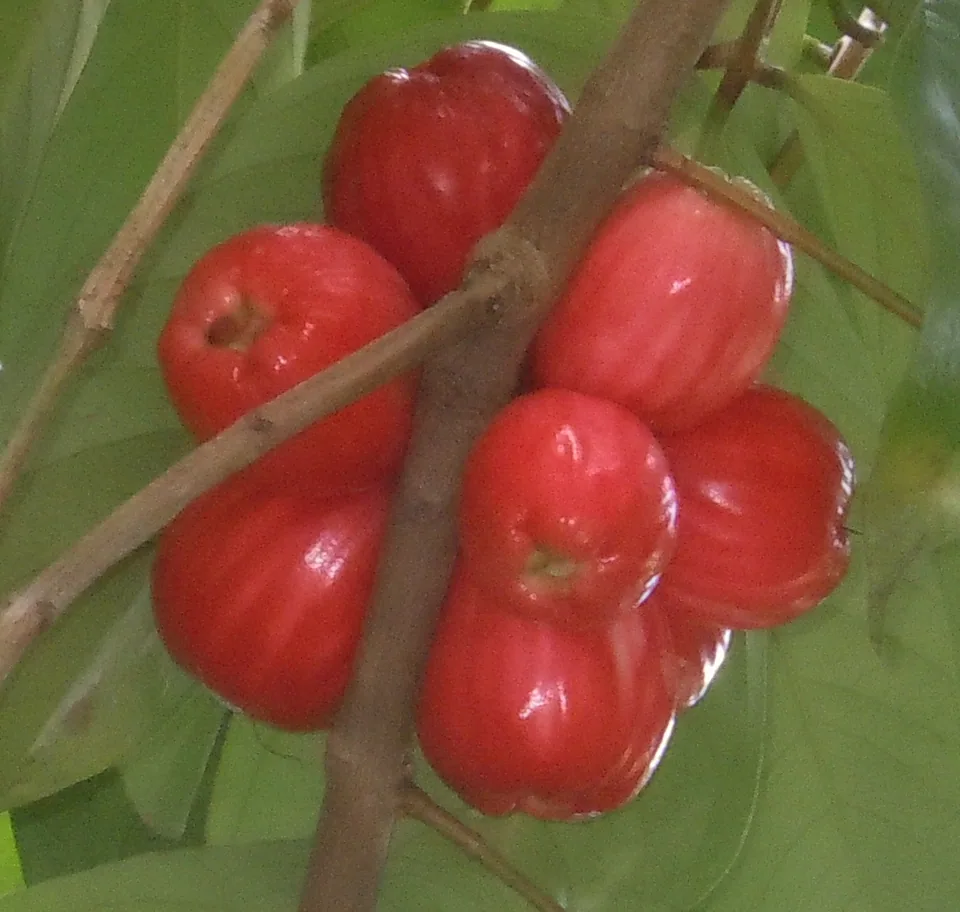
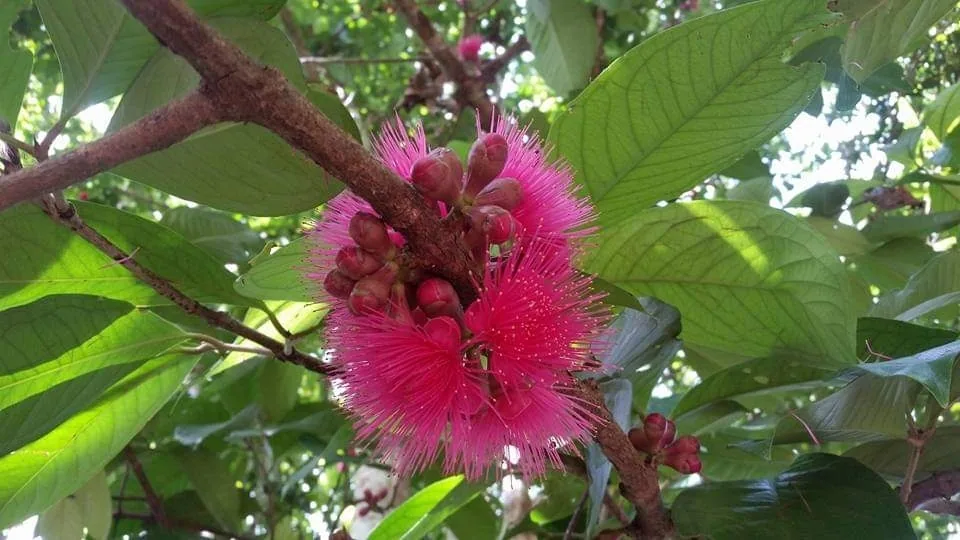

Cómo cultivar y cuidar Manzana de agua
Syzygium malaccense
Escrito por Emilio Marruso · última revisión
Tóxica para: Personas · Por qué
De un vistazo
La pomarrosa de Malaca es un árbol generoso para climas húmedos: crece a pleno sol o en semisombra, y hasta sus flores y brotes tiernos se comen. El fruto madura 60 días después de que las flores se abran del todo; cómelo crudo o guisado con clavo y servido con nata como postre. Solo necesita agua de forma constante.
- Sol
Pleno sol o semisombra
- Riego
Necesita agua constante y abundante con mucha sequía, pero nunca suelo encharcado
Qué dicen las fuentes (6)
Riego: Riego abundante en clima muy seco; se necesita un suministro de agua confiable
and thereafter they require little care except for elimination of weeds and periodic fertilization and plentiful irrigation in very dry weather.
— Malay Apple, Fruits of Warm Climates [2] Mountain apple care includes ridding the areas around the tree of weeds and providing generous irrigation , especially in dry weather.
— Mountain Apple Information - Learn How To Grow Mountain Apples | Gardening Know How [1] The species require a reliable water supply and are often planted along streams or ponds.
— Malay Apple, Syzygium malaccense [5] Notas sobre el riego: Necesita un clima húmedo (precipitación anual de 60 in / 152 cm o más); no tolera el encharcamiento; se desarrolla mal con sequía estacional a menos que se riegue o se cultive cerca del agua
The tree needs a humid climate, with an annual rainfall of 60 in (152 cm) or more.
— Malay Apple, Fruits of Warm Climates [2] Drought tolerance Does not do well in areas with a seasonal drought, unless irrigated during the dry season or grown near a water body
— Malay Apple, Syzygium malaccense [5] Waterlogging Does not tolerate waterlogging 6 Aerosol salt tolerance
— Malay Apple, Syzygium malaccense [5] - Suelo
pH 5,0–8,0, mejor 5,5–6,5; en suelo de pH alto le faltan nutrientes
- Distancia
6–10 m entre árboles
Qué dicen las fuentes (4)
Distancia de plantación: 600-1000 cm (20-33 pies / 6-10 m)
Según NParks: Propagation Method | Seed, Stem Cutting, Grafting, Air-Layering | Planting Distance | 6 m to 8 m
— NParks | Syzygium malaccense [4] Según PROSEA: Tree spacing ranges from 5—7 m for water apple and 6—8 m for Malay apple trees, to 8—10 m for wax jambu trees.
— Syzygium malaccense, PROSEA Foundation [3] India.: In India, Malay apple trees are spaced 26 to 32 feet (8-10 m) apart in fields prepared and enriched as for any other crop
— Malay Apple, Fruits of Warm Climates [2] Plant spacing 20-33 ft (6-10 m) for commercial planting 6 Roots
— Malay Apple, Syzygium malaccense [5] - Plantación
Trasplanta las plántulas con 8 meses y los esquejes 6 semanas después de enraizar
Qué dicen las fuentes (1)
Plantación: Plántulas de vivero trasplantadas al campo a los 8 meses; esquejes enraizados trasplantados 6 semanas después del enraizado
will germinate in 2 to 4 weeks and, if in nurseries, the seedlings are transplanted to the field when 8 months old. Cuttings are ready for transplanting in 6 weeks after rooting.
— Malay Apple, Fruits of Warm Climates [2] - Abonado
Abona con un abono complejo después de la cosecha
- Cosecha
Madura 60 días tras abrirse las flores; cógela a mano, la fruta caída se estropea rápido
Qué dicen las fuentes (4)
Cosecha: Unos 60 días después de que las flores se abren por completo
Java: In Java, the tree flowers in May and June and the fruits ripen in August and September.
— Malay Apple, Fruits of Warm Climates [2] India.: In India, the main crop occurs from May to July and there is often a second crop in November and December.
— Malay Apple, Fruits of Warm Climates [2] Florida: Florida-grown Malay apple trees have been observed to bear two crops annually, one in the fall or winter and another in the spring.
— Malay Apple, Syzygium malaccense [5] Fruits mature in 60 days from the full opening of the flowers and they fall quickly after they become fully ripe and deteriorate rapidly.
— Malay Apple, Fruits of Warm Climates [2] - Multiplicación
Semilla fresca, acodo aéreo, esquejes, injerto de yema o injerto
Qué dicen las fuentes (3)
Propagación: Semilla (siembra fresca); acodo aéreo; esquejes; injerto sobre portainjertos de plántula; injerto
Propagation from seed is common. Seeds are sometimes abortive. Seeds lose their viability quickly and should be sown fresh from the fruit.
— Malay Apple, Syzygium malaccense [5] Clonal propagation through air layers, cuttings or budding is not difficult. Air layering is commonly employed in South-East Asia.
— Malay Apple, Syzygium malaccense [5] Propagation Method | Seed, Stem Cutting, Grafting, Air-Layering | Planting Distance
— NParks | Syzygium malaccense [4] - Seguridad
No se conocen riesgos para las personas
Resumen
Syzygium malaccense es un árbol frutal tropical perenne que alcanza 12-18 m [39,4–59,1 ft] y también se valora como ornamental. [2][5] Necesita un clima húmedo, crece en suelos desde arenosos hasta arcilla pesada y no tolera las heladas. [2][5] Las semillas pierden viabilidad rápidamente y deben sembrarse frescas; el acodo aéreo, los esquejes y el injerto son los métodos clonales. [5]
Citado en inglés, como en la fuente.
Cuidados
Las medidas entre corchetes son nuestra conversión al otro sistema de unidades; el texto citado no cambia.
Riego
Riego
Riego abundante en clima muy seco; se necesita un suministro de agua confiable
Qué dicen las fuentes (3)
and thereafter they require little
care except for elimination of weeds and periodic fertilization and
plentiful irrigation in very dry weather.Mountain apple care includes ridding the areas around the tree of weeds and providing generous irrigation , especially in dry weather.The species require a reliable water
supply and are often planted along streams or ponds.Notas sobre el riego
Necesita un clima húmedo (precipitación anual de 60 in / 152 cm o más); no tolera el encharcamiento; se desarrolla mal con sequía estacional a menos que se riegue o se cultive cerca del agua
Qué dicen las fuentes (3)
The tree needs a humid
climate, with an annual rainfall of 60 in (152 cm) or more.Drought tolerance
Does not do well in areas with a seasonal drought, unless irrigated
during the dry season or grown near a water bodyWaterlogging
Does not tolerate waterlogging 6
Aerosol salt
toleranceLuz
Suelo
pH del suelo, mínimo
5.0
Lo que dice cada fuente
rango preferido: 5.5-6.5
pH del suelo, máximo
8.0
Lo que dice cada fuente
rango preferido: 5.5-6.5
Dónde cultivarla
600-1000 cm (20-33 pies / 6-10 m)
Lo que dice cada fuente
Según NParks: 600-800 cm (6-8 m)
Según PROSEA: 600-800 cm (6-8 m) para manzana malaya
India.: 800-1000 cm (26-32 pies / 8-10 m)
Qué dicen las fuentes (4)
Según NParks: Propagation Method
| Seed, Stem Cutting, Grafting, Air-Layering
| Planting Distance
| 6 m to 8 mSegún PROSEA: Tree
spacing ranges from 5—7 m for water apple and 6—8 m for Malay apple
trees, to 8—10 m for wax jambu trees.India.: In India, Malay
apple trees are spaced 26 to 32 feet (8-10 m) apart in fields prepared
and enriched as for any other cropPlant spacing
20-33 ft (6-10 m) for commercial planting 6
RootsPropagación
Semilla (siembra fresca); acodo aéreo; esquejes; injerto sobre portainjertos de plántula; injerto
Qué dicen las fuentes (3)
Propagation from seed is common. Seeds are sometimes abortive. Seeds
lose their viability quickly and should be sown fresh from the fruit.Clonal propagation through air layers, cuttings or budding is not
difficult. Air layering is commonly employed in South-East Asia.Propagation Method
| Seed, Stem Cutting, Grafting, Air-Layering
| Planting DistanceCultivo
Abonado
Cuándo
Después de la cosecha de fruta
Qué dicen las fuentes (1)
Feed with a compound fertilizer after harvesting the fruits.Abonos minerales
Fertilizante compuesto
Qué dicen las fuentes (1)
Feed with a compound fertilizer after harvesting the fruits.Problemas
Deficiencias por suelo de pH alto
Síntoma: En suelo de pH alto, el árbol desarrolla deficiencias nutricionales.
Qué hacer: Aplicaciones ocasionales de micronutrientes en spray.
Qué dicen las fuentes (1)
in high pH soil it develops nutritional deficiencies that can be overcome with the occasional use of micronutrient sprays.
— Malay Apple, Syzygium malaccense [5] Fruto frágil y de vida corta
Síntoma: Los frutos caen rápidamente después de madurar por completo y se deterioran con rapidez.
Qué hacer: Recoge a mano para una mayor vida útil.
Qué dicen las fuentes (1)
they fall quickly after they become fully ripe and deteriorate rapidly. For marketing, they must be hand-picked to avoid damage and to have longer shelf-life.
— Malay Apple, Fruits of Warm Climates [2]
Remedios
Cada remedio indica qué dicen las fuentes oficiales; los remedios tradicionales sin fuente oficial aparecen marcados. Los perjudiciales están para que sepas evitarlos.
Cuidar la planta
minador de hojas
aplasta las larvas y elimina las hojas minadas No verificado
Remedio tradicional, no verificado por una fuente oficial.
It is unlikely that the leafminer causes sufficient damage on mature trees to warrant control.
— apps.lucidcentral.org [8] Cómo: En árboles jóvenes de vivero, aplasta las larvas en sus galerías con el dedo y el pulgar o retira las hojas infestadas y quémalas.
psílido de las agallas
poda No verificado
Remedio tradicional, no verificado por una fuente oficial.
In other situations, it is unlikely to be beneficial either in terms of appearance of the trees or of economic return.
— apps.lucidcentral.org [9] Cómo: Poda las plantas en viveros o las que se usan como setos.
Toxicidad
Según la fuente, citada textualmente. No es un consejo médico ni veterinario: si una persona o un animal pudo haber ingerido esta planta, contacta con un centro de toxicología o con un veterinario.
Roots Not reported as a problem Invasive potential * None reported Pest resistance Not known as a host for pests 6 Known hazard None
[5]
Calendario
Plantación
Plántulas de vivero trasplantadas al campo a los 8 meses; esquejes enraizados trasplantados 6 semanas después del enraizado
Qué dicen las fuentes (1)
will germinate in 2 to 4 weeks and, if in nurseries, the seedlings are
transplanted to the field when 8 months old. Cuttings are ready for
transplanting in 6 weeks after rooting.Cosecha
Unos 60 días después de que las flores se abren por completo
Lo que dice cada fuente
Java: Florece de mayo a junio; los frutos maduran de agosto a septiembre
India.: Cosecha principal de mayo a julio; segunda cosecha a menudo de noviembre a diciembre
Florida: Dos cosechas al año, una en otoño o invierno y otra en primavera
Qué dicen las fuentes (4)
Java: In Java, the tree
flowers in May and June and the fruits ripen in August and September.India.: In India, the main crop occurs from May
to July and there is often a second crop in November and December.Florida: Florida-grown
Malay apple trees have been observed to bear two crops annually, one in
the fall or winter and another in the spring.Fruits mature in 60
days from the full opening of the flowers and they fall quickly after
they become fully ripe and deteriorate rapidly.Meses tal como los dan las fuentes, en su mayoría de Estados Unidos (hemisferio norte). En el hemisferio sur se desplazan unos seis meses.
Comestibilidad
Según la fuente, citada textualmente. No comas una planta basándote solo en esta página: los errores de identificación pueden ser peligrosos.
The ripe fruit is eaten raw though many people consider it insipid. It is best stewed with cloves or other flavoring and served with cream as dessert.
[2]In Indonesia, the flowers are eaten in salads or are preserved in sirup. Young leaves and shoots, before turning green, are consumed raw with rice or are cooked and eaten as greens.
[2]
Valores orientativos
Valores de una fuente secundaria, no comprobados palabra por palabra como el resto de esta página. Úselos como punto de partida.
- Ciclo de vida
- PerenneValor orientativo, adáptalo a tu clima · Fuente secundaria
- Altura adulta
- 1219.2-1524 cm (40-50 pies)Valor orientativo, adáptalo a tu clima · Fuente secundaria
- Nivel de cuidado
- MedioValor orientativo, adáptalo a tu clima · Fuente secundaria
- Crecimiento
- AltaValor orientativo, adáptalo a tu clima · Fuente secundaria
- Poda
- Junio, julio, marzo, abril, mayo, junio, julio, agosto, septiembreValor orientativo, adáptalo a tu clima · Fuente secundaria
Plantas similares
- Árbol del clavo de olor Syzygium aromaticum
- Abeto de Vancuver Abies grandis
- Abraham Trachystemon orientalis
- Bananero de Etiopía Ensete ventricosum
- Acacia longifolia Acacia longifolia
- Acanthus hungaricus Acanthus hungaricus
- Achlys triphylla Achlys triphylla
- Acónito común Aconitum napellus
Fuentes
Cada valor anterior se cita de estos documentos. Los enlaces llevan al editor original.
- Mountain Apple Information - Learn How To Grow Mountain Apples | Gardening Know How · gardeningknowhow.com, consultado
- Malay Apple, Fruits of Warm Climates · growables.org, consultado
- Syzygium malaccense, PROSEA Foundation · growables.org, consultado
- NParks | Syzygium malaccense · nparks.gov.sg, consultado
- Malay Apple, Syzygium malaccense · growables.org, consultado
- Syzygium malaccense · apps.worldagroforestry.org, consultado
- Syzygium malaccense - Plant Detail - Tropical Plants Database - NTBG Database · ntbg.org, consultado
- apps.lucidcentral.org · apps.lucidcentral.org
- apps.lucidcentral.org · apps.lucidcentral.org
Escrito por Emilio Marruso · última revisión