
How to Grow and Care for Malaysian apple
Syzygium malaccense
Written by Emilio Marruso · last checked
Toxic to: People · Why
At a glance
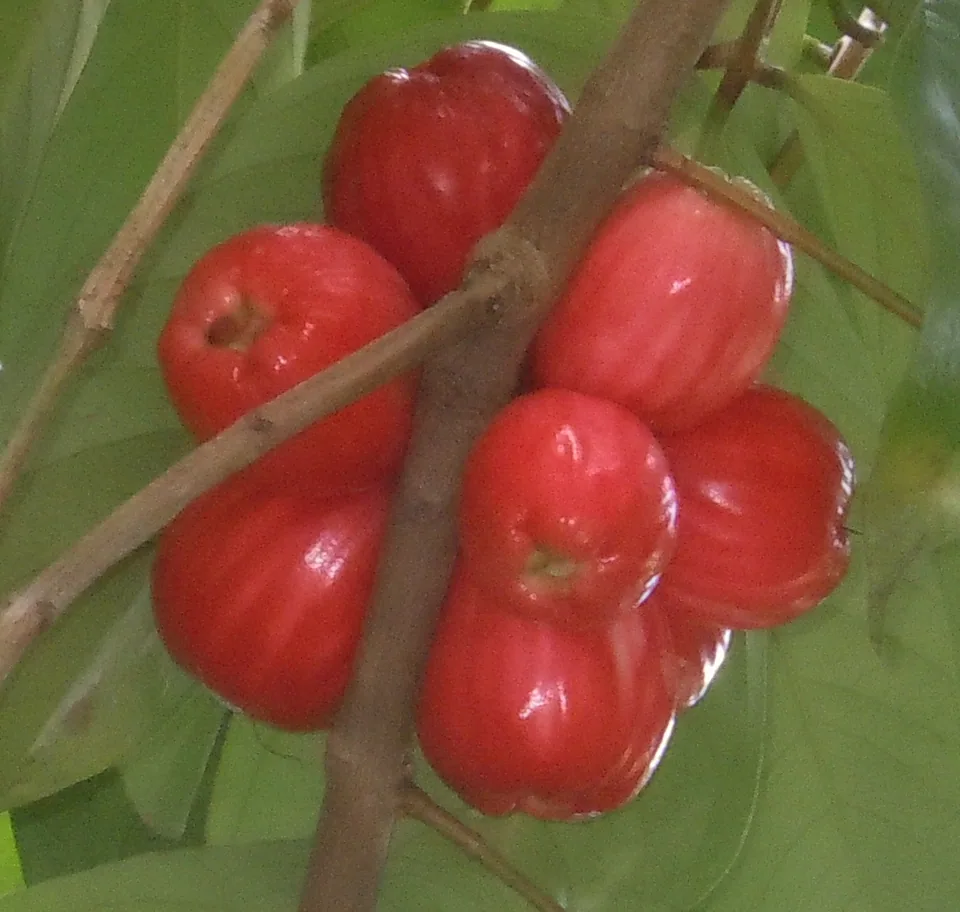
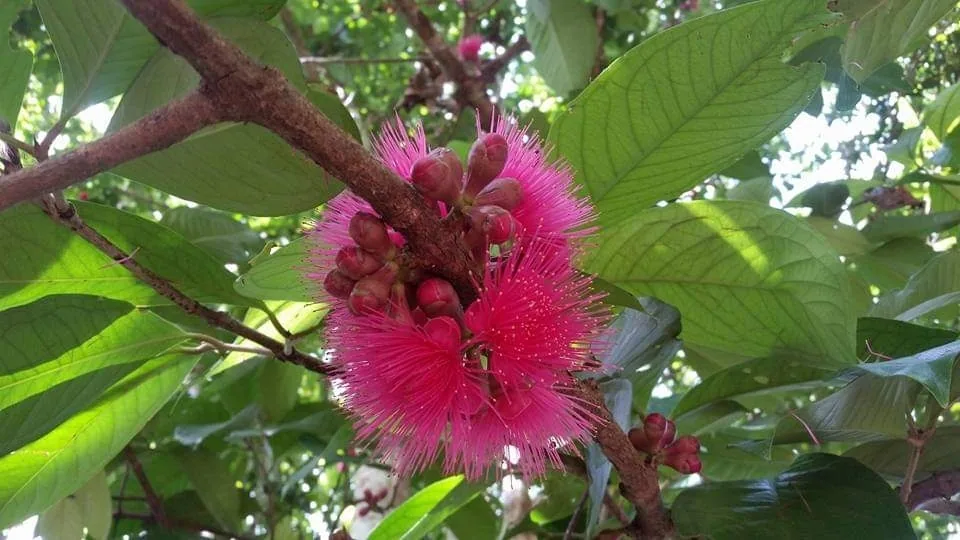
The Malay apple is a generous tree for humid gardens: it grows in full sun or partial shade, and even its flowers and young shoots are edible. The fruit ripens 60 days after the flowers open fully; eat it raw, or stew it with cloves and serve it with cream for a lovely dessert. Just give it a steady supply of water.
- Sun
Full sun to partial shade
- Water
Needs steady water and plenty in very dry weather, but never soggy soil
What the sources say (6)
Watering: Plentiful irrigation in very dry weather; reliable water supply needed
and thereafter they require little care except for elimination of weeds and periodic fertilization and plentiful irrigation in very dry weather.
— Malay Apple, Fruits of Warm Climates [2] Mountain apple care includes ridding the areas around the tree of weeds and providing generous irrigation , especially in dry weather.
— Mountain Apple Information - Learn How To Grow Mountain Apples | Gardening Know How [1] The species require a reliable water supply and are often planted along streams or ponds.
— Malay Apple, Syzygium malaccense [5] Watering notes: Needs a humid climate (annual rainfall of 60 in / 152 cm or more); does not tolerate waterlogging; does poorly with seasonal drought unless irrigated or grown near water
The tree needs a humid climate, with an annual rainfall of 60 in (152 cm) or more.
— Malay Apple, Fruits of Warm Climates [2] Drought tolerance Does not do well in areas with a seasonal drought, unless irrigated during the dry season or grown near a water body
— Malay Apple, Syzygium malaccense [5] Waterlogging Does not tolerate waterlogging 6 Aerosol salt tolerance
— Malay Apple, Syzygium malaccense [5] - Soil
pH 5.0–8.0, best 5.5–6.5; in high-pH soil it lacks nutrients
- Spacing
20–33 ft between trees
What the sources say (4)
Spacing: 600-1000 cm (20-33 ft / 6-10 m)
According to NParks: Propagation Method | Seed, Stem Cutting, Grafting, Air-Layering | Planting Distance | 6 m to 8 m
— NParks | Syzygium malaccense [4] According to PROSEA: Tree spacing ranges from 5—7 m for water apple and 6—8 m for Malay apple trees, to 8—10 m for wax jambu trees.
— Syzygium malaccense, PROSEA Foundation [3] India: In India, Malay apple trees are spaced 26 to 32 feet (8-10 m) apart in fields prepared and enriched as for any other crop
— Malay Apple, Fruits of Warm Climates [2] Plant spacing 20-33 ft (6-10 m) for commercial planting 6 Roots
— Malay Apple, Syzygium malaccense [5] - Planting
Plant out seedlings at 8 months old, rooted cuttings 6 weeks after rooting
What the sources say (1)
Planting: Nursery seedlings transplanted to the field at 8 months old; rooted cuttings transplanted 6 weeks after rooting
will germinate in 2 to 4 weeks and, if in nurseries, the seedlings are transplanted to the field when 8 months old. Cuttings are ready for transplanting in 6 weeks after rooting.
— Malay Apple, Fruits of Warm Climates [2] - Feeding
Feed with an all-purpose fertilizer after the harvest
- Harvest
Ripe 60 days after the flowers open; pick by hand, as fallen fruit spoils fast
What the sources say (4)
Harvest: About 60 days after the flowers open fully
Java: In Java, the tree flowers in May and June and the fruits ripen in August and September.
— Malay Apple, Fruits of Warm Climates [2] India: In India, the main crop occurs from May to July and there is often a second crop in November and December.
— Malay Apple, Fruits of Warm Climates [2] Florida: Florida-grown Malay apple trees have been observed to bear two crops annually, one in the fall or winter and another in the spring.
— Malay Apple, Syzygium malaccense [5] Fruits mature in 60 days from the full opening of the flowers and they fall quickly after they become fully ripe and deteriorate rapidly.
— Malay Apple, Fruits of Warm Climates [2] - Propagation
Fresh seed, air-layering, cuttings, budding or grafting
What the sources say (3)
Propagation: Seed (sown fresh); air-layering; cuttings; budding onto seedling rootstocks; grafting
Propagation from seed is common. Seeds are sometimes abortive. Seeds lose their viability quickly and should be sown fresh from the fruit.
— Malay Apple, Syzygium malaccense [5] Clonal propagation through air layers, cuttings or budding is not difficult. Air layering is commonly employed in South-East Asia.
— Malay Apple, Syzygium malaccense [5] Propagation Method | Seed, Stem Cutting, Grafting, Air-Layering | Planting Distance
— NParks | Syzygium malaccense [4] - Safety
No known hazards to people
Overview
Syzygium malaccense is an evergreen tropical fruit tree that reaches 12-18 m [39.4–59.1 ft] and is also valued as an ornamental. [2][5] It needs a humid climate, grows in soils from sand to heavy clay and does not tolerate frost. [2][5] Seeds lose viability quickly and should be sown fresh; air-layering, cuttings and budding are the clonal methods. [5]
Malaysian apple care
Measurements in square brackets are our conversion into the other unit system; the quoted text is unchanged.
How to water Malaysian apple
Watering
Plentiful irrigation in very dry weather; reliable water supply needed
What the sources say (3)
and thereafter they require little
care except for elimination of weeds and periodic fertilization and
plentiful irrigation in very dry weather.Mountain apple care includes ridding the areas around the tree of weeds and providing generous irrigation , especially in dry weather.The species require a reliable water
supply and are often planted along streams or ponds.Watering notes
Needs a humid climate (annual rainfall of 60 in / 152 cm or more); does not tolerate waterlogging; does poorly with seasonal drought unless irrigated or grown near water
What the sources say (3)
The tree needs a humid
climate, with an annual rainfall of 60 in (152 cm) or more.Drought tolerance
Does not do well in areas with a seasonal drought, unless irrigated
during the dry season or grown near a water bodyWaterlogging
Does not tolerate waterlogging 6
Aerosol salt
toleranceHow much light Malaysian apple needs
Best soil for Malaysian apple
Soil pH, minimum
5.0
What each source says
preferred range: 5.5-6.5
Where to grow Malaysian apple
600-1000 cm (20-33 ft / 6-10 m)
What each source says
According to NParks: 600-800 cm (6-8 m)
According to PROSEA: 600-800 cm (6-8 m) for Malay apple
India: 800-1000 cm (26-32 ft / 8-10 m)
What the sources say (4)
According to NParks: Propagation Method
| Seed, Stem Cutting, Grafting, Air-Layering
| Planting Distance
| 6 m to 8 mAccording to PROSEA: Tree
spacing ranges from 5—7 m for water apple and 6—8 m for Malay apple
trees, to 8—10 m for wax jambu trees.India: In India, Malay
apple trees are spaced 26 to 32 feet (8-10 m) apart in fields prepared
and enriched as for any other cropPlant spacing
20-33 ft (6-10 m) for commercial planting 6
RootsHow to propagate Malaysian apple
Seed (sown fresh); air-layering; cuttings; budding onto seedling rootstocks; grafting
What the sources say (3)
Propagation from seed is common. Seeds are sometimes abortive. Seeds
lose their viability quickly and should be sown fresh from the fruit.Clonal propagation through air layers, cuttings or budding is not
difficult. Air layering is commonly employed in South-East Asia.Propagation Method
| Seed, Stem Cutting, Grafting, Air-Layering
| Planting DistanceHow to grow Malaysian apple
Fertilizing
When
After the fruit harvest
What the sources say (1)
Feed with a compound fertilizer after harvesting the fruits.Mineral fertilizers
Compound fertilizer
What the sources say (1)
Feed with a compound fertilizer after harvesting the fruits.Malaysian apple pests and problems
High-pH soil deficiencies
Symptom: In high pH soil the tree develops nutritional deficiencies.
What to do: Occasional micronutrient sprays.
What the sources say (1)
in high pH soil it develops nutritional deficiencies that can be overcome with the occasional use of micronutrient sprays.
— Malay Apple, Syzygium malaccense [5] Fragile, short-lived fruit
Symptom: The fruits fall quickly after becoming fully ripe and deteriorate rapidly.
What to do: Hand-pick for longer shelf-life.
What the sources say (1)
they fall quickly after they become fully ripe and deteriorate rapidly. For marketing, they must be hand-picked to avoid damage and to have longer shelf-life.
— Malay Apple, Fruits of Warm Climates [2]
Remedies
Each remedy shows what official sources say about it; traditional remedies without an official source are marked as such. Harmful ones are listed so you know to avoid them.
Treating the plant
leafminer
squashing larvae and removing mined leaves Not verified
Traditional remedy, not verified by an official source.
It is unlikely that the leafminer causes sufficient damage on mature trees to warrant control.
— apps.lucidcentral.org [8] How: On young nursery trees, squash the larvae in their tunnels with finger and thumb or remove the infested leaves and burn them.
gall psyllid
pruning Not verified
Traditional remedy, not verified by an official source.
In other situations, it is unlikely to be beneficial either in terms of appearance of the trees or of economic return.
— apps.lucidcentral.org [9] How: Prune plants in nurseries or used as hedges.
Is Malaysian apple poisonous?
Reported by the source, quoted verbatim. This is not medical or veterinary advice: if a person or an animal may have eaten this plant, contact a poison control centre or a veterinarian.
Roots Not reported as a problem Invasive potential * None reported Pest resistance Not known as a host for pests 6 Known hazard None
[5]
Calendar
Planting
Nursery seedlings transplanted to the field at 8 months old; rooted cuttings transplanted 6 weeks after rooting
What the sources say (1)
will germinate in 2 to 4 weeks and, if in nurseries, the seedlings are
transplanted to the field when 8 months old. Cuttings are ready for
transplanting in 6 weeks after rooting.Harvest
About 60 days after the flowers open fully
What each source says
Java: Flowers May-June; fruits ripen August-September
India: Main crop May-July; second crop often November-December
Florida: Two crops a year, one in fall or winter and one in spring
What the sources say (4)
Java: In Java, the tree
flowers in May and June and the fruits ripen in August and September.India: In India, the main crop occurs from May
to July and there is often a second crop in November and December.Florida: Florida-grown
Malay apple trees have been observed to bear two crops annually, one in
the fall or winter and another in the spring.Fruits mature in 60
days from the full opening of the flowers and they fall quickly after
they become fully ripe and deteriorate rapidly.Months as given by the sources, which are mostly from the United States (northern hemisphere). In the southern hemisphere they shift by about six months.
Edibility
Reported by the source, quoted verbatim. Do not eat a plant on the basis of this page alone: identification mistakes can be dangerous.
The ripe fruit is eaten raw though many people consider it insipid. It is best stewed with cloves or other flavoring and served with cream as dessert.
[2]In Indonesia, the flowers are eaten in salads or are preserved in sirup. Young leaves and shoots, before turning green, are consumed raw with rice or are cooked and eaten as greens.
[2]
Indicative values
Values from a secondary source, not checked word for word like the rest of this page. Use them as a starting point.
- Life cycle
- PerennialIndicative value, adapt it to your climate · Secondary source
- Mature height
- 1219.2-1524 cm (40-50 ft)Indicative value, adapt it to your climate · Secondary source
- Care level
- MediumIndicative value, adapt it to your climate · Secondary source
- Growth rate
- HighIndicative value, adapt it to your climate · Secondary source
- Pruning
- June, July, March, April, May, June, July, August, SeptemberIndicative value, adapt it to your climate · Secondary source
Similar plants
- Clove Syzygium aromaticum
- Abies grandis Abies grandis
- Abraham Trachystemon orientalis
- Abyssinian banana Ensete ventricosum
- Acacia longifolia Acacia longifolia
- Acanthus hungaricus Acanthus hungaricus
- Achlys triphylla Achlys triphylla
- Aconite Aconitum napellus
Sources
Every value above is quoted from these documents. Links lead to the original publisher.
- Mountain Apple Information - Learn How To Grow Mountain Apples | Gardening Know How · gardeningknowhow.com, consulted
- Malay Apple, Fruits of Warm Climates · growables.org, consulted
- Syzygium malaccense, PROSEA Foundation · growables.org, consulted
- NParks | Syzygium malaccense · nparks.gov.sg, consulted
- Malay Apple, Syzygium malaccense · growables.org, consulted
- Syzygium malaccense · apps.worldagroforestry.org, consulted
- Syzygium malaccense - Plant Detail - Tropical Plants Database - NTBG Database · ntbg.org, consulted
- apps.lucidcentral.org · apps.lucidcentral.org
- apps.lucidcentral.org · apps.lucidcentral.org
Written by Emilio Marruso · last checked