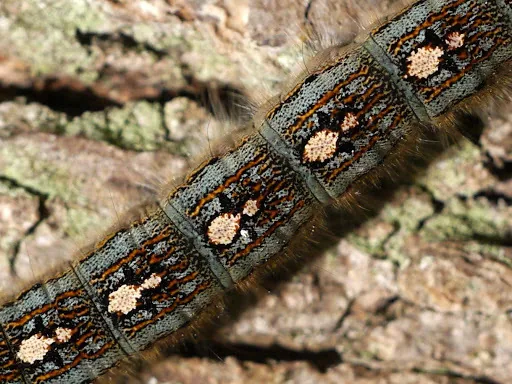
Insect
Tent caterpillars
Malacosoma
Written by Emilio Marruso
Classification: Arthropoda › Hexapoda › Insecta › Lepidoptera › Lasiocampidae
Plants it attacks
Plants in our guide where this problem is reported. Open a plant to see the sources.
- Chokecherry
Symptom: Mass of webbing on branches, light green caterpillars, defoliation and deformation.
- Darlington oak
Symptom: These pests can occur on the tree.
Also reported on: Alder, Cottonwood, Flatwoods Plum, Formosa Sweet Gum, Hawthorn, Quaking Aspen, Red Alder, Southern Crabapple, Sweet almond, Sweet Crabapple
Remedies
What our plant sheets report, with the outcome checked against official sources. Traditional remedies without an official source are flagged.
Treat
Bacillus thuringiensis spray Works
How: Treat when small caterpillars are first observed.
Reported for 1 plant: Flatwoods Plum
destroying tents Works
How: pull out or cut off small tents early in the morning or in the evening, when the caterpillars are inside, and drop them into soapy water; destroy tents on cool days with larvae inside
Reported for 1 plant: Chokecherry
pruning out infestations Works
How: On small trees, cut out and destroy infested twigs.
Reported for 1 plant: Flatwoods Plum
removing egg masses and twigs into soapy water Works
How: remove egg masses; cut out infested twigs and dip in a bucket of soapy water
Reported for 1 plant: Red Alder
removing tents with a broomstick Works
How: remove tents in early morning, late evening or on cool rainy days with a broomstick, forked branch or by hand
Reported for 1 plant: Southern Crabapple
removing the tents by hand Works
How: Remove tents and caterpillars with a broomstick, forked branch or by hand, in early morning, late evening or on cool rainy days.
Reported for 1 plant: Sweet Crabapple
pruning out nests Official source, not independently tested
How: Tent caterpillar nests can be pruned out while still small.
Reported for 2 plants: Hawthorn, Formosa Sweet Gum
pruning out tents Official source, not independently tested
How: If tents are not too numerous and the canopy is accessible, prune out limbs with tents when they first appear.
Reported for 1 plant: Quaking Aspen
removing egg masses with a hand pruner Official source, not independently tested
How: Remove egg masses manually with a hand pruner.
Reported for 1 plant: Alder
removing tents by hand Official source, not independently tested
How: Remove and destroy caterpillar tents, or rip them open with a stick so natural enemies can reach the caterpillars.
Reported for 1 plant: Alder
handpicking Not verified
How: When there are only a few caterpillars on the tree, handpick and dispose of them.
Reported for 1 plant: Sweet almond
removing tents by hand Not verified
How: Remove tents by hand; prune affected branches; encourage natural predators.
Reported for 1 plant: Cottonwood
burned webs Harmful
How: Do not do this: webs burned on the tree damage the tree.
Reported for 1 plant: Alder
burning infested tents Harmful
How: prune and burn the infested branches
Reported for 1 plant: Southern Crabapple
burning the tents Harmful
How: The source advises against it: a dangerous procedure that may injure the tree.
Reported for 1 plant: Sweet Crabapple
Where it is found
Regulated as a quarantine pest in: Argentina, Chile.