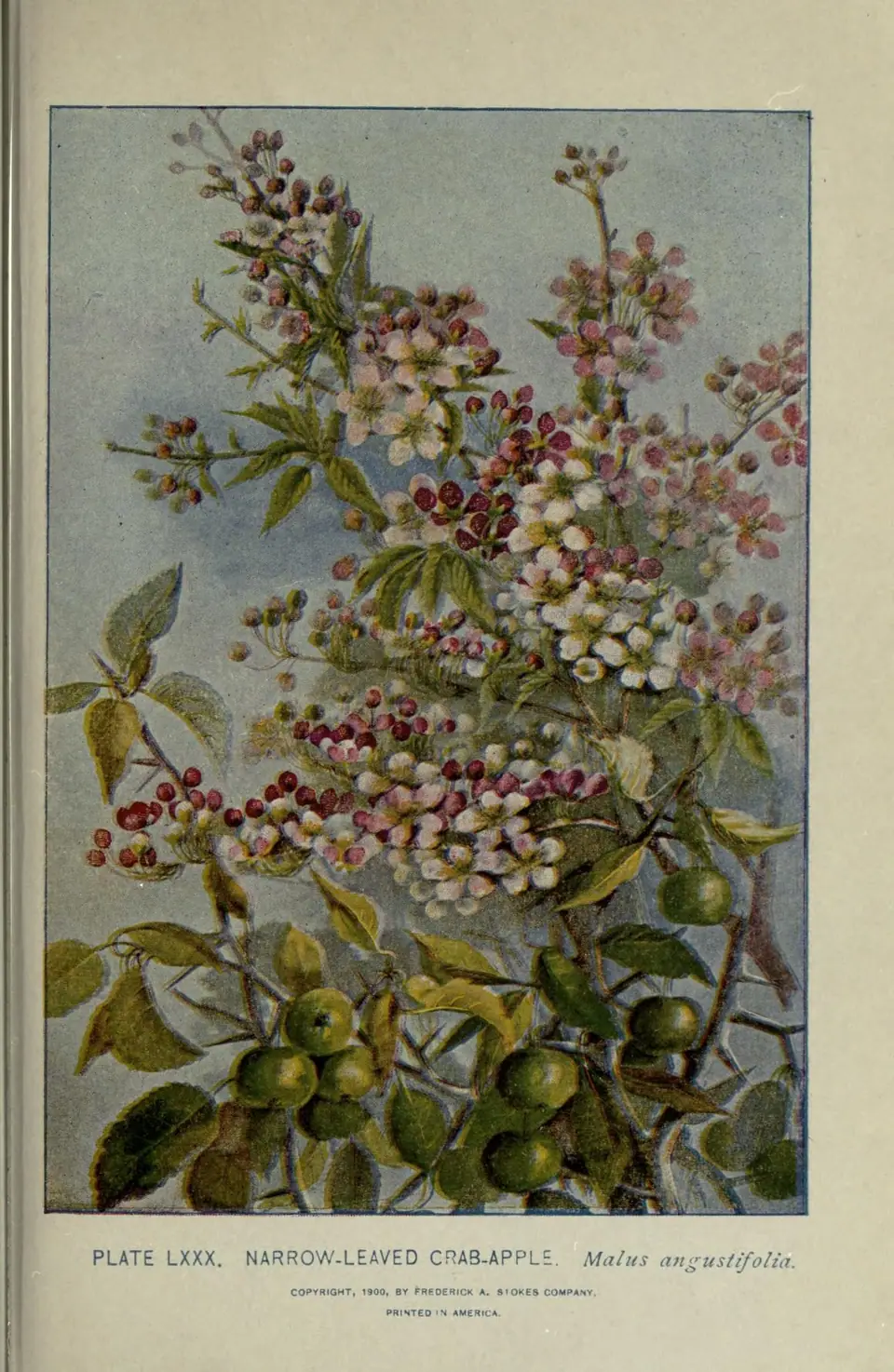


How to Grow and Care for Southern Crabapple
Malus angustifolia
Written by Emilio Marruso · last checked
At a glance
This wild crabapple is a generous tree that grows 20–30 ft tall in full sun or part shade. Give it moist, well-drained soil and a little patience: it starts fruiting after 3–4 years and fruits abundantly by 6–7. From August to September, its fruit is perfect for homemade jelly, preserves and cider.
- Sun
Full sun to part shade
What the sources say (1)
Light: Full sun to part shade
Southern crabapple in full sun or part shade will encourage more blooms and fruiting.
— Malus angustifolia (Narrowleaf Crab, Narrowleaf Crabapple, Southern Crabapple, Wild Crab, Wild Crabapple) | North Carolina Extension Gardener Plant Toolbox [1] - Water
Keep the soil moist but well drained
What the sources say (1)
Watering notes: Well-drained but moist soil
Well-drained, but moist and slightly acid soils are appropriate.
— Malus angustifolia (Narrowleaf Crab, Narrowleaf Crabapple, Southern Crabapple, Wild Crab, Wild Crabapple) | North Carolina Extension Gardener Plant Toolbox [1] - Cold
Survives winters down to −30 °F (−34.4 °C)
Very hardy · USDA 4a · RHS H7 · Z4
What the sources say (2)
Hardiness, coldest zone: 4a [winter low −34.4 to −31.7 °C (−30 to −25 °F)]
USDA Plant Hardiness Zone: 4a, 4b, 5a, 5b, 6a, 6b, 7a, 7b, 8a, 8b, 9a, 9b
— Malus angustifolia (Narrowleaf Crab, Narrowleaf Crabapple, Southern Crabapple, Wild Crab, Wild Crabapple) | North Carolina Extension Gardener Plant Toolbox [1] Hardiness, warmest zone: 9b [winter low −3.9 to −1.1 °C (25 to 30 °F)]
USDA Plant Hardiness Zone: 4a, 4b, 5a, 5b, 6a, 6b, 7a, 7b, 8a, 8b, 9a, 9b
— Malus angustifolia (Narrowleaf Crab, Narrowleaf Crabapple, Southern Crabapple, Wild Crab, Wild Crabapple) | North Carolina Extension Gardener Plant Toolbox [1] - Harvest
Fruit in August–September, first after 3–4 years; good for jelly, preserves and cider
What the sources say (2)
Harvest: Fruits display August to September
They are yellow-green and sour with a long stalk. Fruits display from August to September.
— Malus angustifolia (Narrowleaf Crab, Narrowleaf Crabapple, Southern Crabapple, Wild Crab, Wild Crabapple) | North Carolina Extension Gardener Plant Toolbox [1] Years to first fruit: 3-4 years (abundant by 6-7 years)
Depending on the age of the sapling, crops can begin within 3 to 4 years and reach abundance by 6 or 7 years.
— Malus angustifolia (Narrowleaf Crab, Narrowleaf Crabapple, Southern Crabapple, Wild Crab, Wild Crabapple) | North Carolina Extension Gardener Plant Toolbox [1] - Pests
Mites, aphids, Japanese beetles and borers; fire blight, rust, scab and powdery mildew
What the sources say (2)
Pests: mites, aphids, Japanese beetles, apple tree borer
Insects, Diseases, and Other Plant Problems: fire blight, rust, apple scab and powdery mildew can be problems. Mites, aphids, Japanese beetles and apple tree borer can be problem insects.
— Malus (Apple, Crabapple, Culinary Apple, Eating Apples, Wild Apples) | North Carolina Extension Gardener Plant Toolbox [4] Diseases: fire blight, rust, apple scab, powdery mildew
Insects, Diseases, and Other Plant Problems: fire blight, rust, apple scab and powdery mildew can be problems. Mites, aphids, Japanese beetles and apple tree borer can be problem insects.
— Malus (Apple, Crabapple, Culinary Apple, Eating Apples, Wild Apples) | North Carolina Extension Gardener Plant Toolbox [4] - Size
20 to 30 ft tall
What the sources say (1)
Mature height: 610-914 cm (20-30 ft)
The native Southern crabapple is a shrub or small tree, 20 to 30 feet in height.
— Malus angustifolia (Narrowleaf Crab, Narrowleaf Crabapple, Southern Crabapple, Wild Crab, Wild Crabapple) | North Carolina Extension Gardener Plant Toolbox [1] - Propagation
From root cuttings or seed
What the sources say (1)
Propagation: Root cutting, seed
Recommended Propagation Strategy: Root Cutting Seed Country Or Region Of Origin:
— Malus angustifolia (Narrowleaf Crab, Narrowleaf Crabapple, Southern Crabapple, Wild Crab, Wild Crabapple) | North Carolina Extension Gardener Plant Toolbox [1]
Overview
Southern crabapple is a native shrub or small tree 20 to 30 feet [6.1–9.1 m] in height. [1] It grows in full sun or part shade in well-drained, moist, slightly acid soil. [1] Its small sour fruit is occasionally used for jelly, preserves and cider. [1]
This record is incomplete: the sources we read do not cover every field yet.
Not yet covered by our sources: Watering, Planting, Spacing
Southern Crabapple care
Measurements in square brackets are our conversion into the other unit system; the quoted text is unchanged.
How to water Southern Crabapple
Watering
Not stated in the sources we read.
Watering notes
Well-drained but moist soil
What the sources say (1)
Well-drained, but moist and slightly acid soils are appropriate.How much light Southern Crabapple needs
Full sun to part shade
What the sources say (1)
Southern crabapple in full sun or part shade will encourage more blooms and fruiting.How much cold Southern Crabapple can take
Hardiness, coldest zone
4a [winter low −34.4 to −31.7 °C (−30 to −25 °F)]
What the sources say (1)
USDA Plant Hardiness Zone:
4a, 4b, 5a, 5b, 6a, 6b, 7a, 7b, 8a, 8b, 9a, 9bHardiness, warmest zone
9b [winter low −3.9 to −1.1 °C (25 to 30 °F)]
What the sources say (1)
USDA Plant Hardiness Zone:
4a, 4b, 5a, 5b, 6a, 6b, 7a, 7b, 8a, 8b, 9a, 9bWhere to grow Southern Crabapple
Not stated in the sources we read.
How to propagate Southern Crabapple
Root cutting, seed
What the sources say (1)
Recommended Propagation Strategy:
Root Cutting
Seed
Country Or Region Of Origin:How to grow Southern Crabapple
The plant
Life cycle
perennial
What the sources say (1)
Whole Plant Traits: Plant Type: Edible Native Plant Perennial Tree Woody Plant Leaf Characteristics: DeciduousFamily
Rosaceae
What the sources say (1)
Attributes: Genus: Malus Species: angustifolia Family: Rosaceae Uses (Ethnobotany):Mature height
610-914 cm (20-30 ft)
What the sources say (1)
The native Southern crabapple is a shrub or small tree, 20 to 30 feet in height.Years to first fruit
3-4 years (abundant by 6-7 years)
What the sources say (1)
Depending on the age of the sapling, crops can begin within 3 to 4 years and reach abundance by 6 or 7 years.Pests and diseases
Pests
mites, aphids, Japanese beetles, apple tree borer
What the sources say (1)
Insects, Diseases, and Other Plant Problems: fire blight, rust, apple scab and powdery mildew can be problems. Mites, aphids, Japanese beetles and apple tree borer can be problem insects.Diseases
fire blight, rust, apple scab, powdery mildew
What the sources say (1)
Insects, Diseases, and Other Plant Problems: fire blight, rust, apple scab and powdery mildew can be problems. Mites, aphids, Japanese beetles and apple tree borer can be problem insects.Remedies
Each remedy shows what official sources say about it; traditional remedies without an official source are marked as such. Harmful ones are listed so you know to avoid them.
Treating the plant
aphids
strong water stream Partly works
How: wash aphids from the foliage with a strong stream of water
Wash aphids from foliage with a strong stream of water.
— hortsense.cahnrs.wsu.edu [5] What the evidence says Wash aphids from foliage with a strong stream of water.
— hortsense.cahnrs.wsu.edu [5] hand-wiping or pruning aphids Partly works
How: hand-wipe or prune to control small, localized infestations when practical
Hand-wipe or prune to control small, localized infestations when practical.
— hortsense.cahnrs.wsu.edu [5] What the evidence says Hand-wipe or prune to control small, localized infestations when practical.
— hortsense.cahnrs.wsu.edu [5]
japanese beetles
hand-picking beetles into soapy water Not verified
Traditional remedy, not verified by an official source.
How: shake beetles from the branch in the morning into a container of water and soap solution
tent caterpillars
removing tents with a broomstick Works
How: remove tents in early morning, late evening or on cool rainy days with a broomstick, forked branch or by hand
Tent removal should be done in early morning, late evening, or on cool rainy days when the caterpillars are gathered in their tents. The tents and caterpillars can be removed with a broomstick, forked branch, or by hand.
— yardandgarden.extension.iastate.edu [6] What the evidence says Damage to trees can be minimized by removing and destroying the tents and caterpillars as soon as they are noticed.
— yardandgarden.extension.iastate.edu [6] burning infested tents Harmful
Do not attempt to burn the tents and caterpillars. This is a dangerous procedure that may injure the tree.
— yardandgarden.extension.iastate.edu [6] How: prune and burn the infested branches
Where you can reach, you can also prune and burn the infested branches.
— thriftyfun.com [7] What the evidence says Do not attempt to burn the tents and caterpillars. This is a dangerous procedure that may injure the tree.
— yardandgarden.extension.iastate.edu [6]
apple scab
raking up fallen leaves Partly works
How: remove the overwintering leaves from beneath the tree before budbreak
The disease overwinters on diseased leaves on the ground. Therefore, control measures should begin with the removal of the overwintering leaves from beneath the tree and in the surrounding area before budbreak.
— portal.ct.gov [8] What the evidence says The disease overwinters on diseased leaves on the ground. Therefore, control measures should begin with the removal of the overwintering leaves from beneath the tree and in the surrounding area before budbreak.
— portal.ct.gov [8]
cedar apple rust
removing alternate hosts Partly works
How: remove or do not grow alternate hosts next to crabapples; remove galls from juniper
Remove or do not grow alternate hosts next to crabapple plantings. Separating hosts by 0.5 to 2 miles has been recommended.
— pnwhandbooks.org [9] What the evidence says Remove or do not grow alternate hosts next to crabapple plantings. Separating hosts by 0.5 to 2 miles has been recommended.
— pnwhandbooks.org [9]
fire blight
breaking out blighted shoots by hand Works
How: break out blighted shoots by hand rather than cutting, since pruning tools can spread the bacteria
When pruning out blighted shoots, breaking out the shoots by hand is better than pruning them off since the bacteria that cause fire blight can be spread on pruning tools.
— extension.psu.edu [10] What the evidence says When pruning out blighted shoots, breaking out the shoots by hand is better than pruning them off since the bacteria that cause fire blight can be spread on pruning tools.
— extension.psu.edu [10]
Calendar
Not stated in the sources we read.
Fruits display August to September
What the sources say (1)
They are yellow-green and sour with a long stalk. Fruits display from August to September.Months as given by the sources, which are mostly from the United States (northern hemisphere). In the southern hemisphere they shift by about six months.
Edibility
Reported by the source, quoted verbatim. Do not eat a plant on the basis of this page alone: identification mistakes can be dangerous.
Similar plants
- Apple Malus sylvestris
- Flowering crabapple Malus baccata
- Hall Crabapple Malus halliana
- Malus floribunda Malus floribunda
- Paradise apple Malus domestica
- Sweet Crabapple Malus coronaria
- Tea Crabapple Malus hupehensis
- Yunnan Crabapple Malus yunnanensis
Sources
Every value above is quoted from these documents. Links lead to the original publisher.
- Malus angustifolia (Narrowleaf Crab, Narrowleaf Crabapple, Southern Crabapple, Wild Crab, Wild Crabapple) | North Carolina Extension Gardener Plant Toolbox · plants.ces.ncsu.edu, consulted
- Wild Crabapple - Malus angustifolia | North Carolina Extension Gardener Plant Toolbox · plants.ces.ncsu.edu, consulted
- Narrowleaf Crab - Malus angustifolia | North Carolina Extension Gardener Plant Toolbox · plants.ces.ncsu.edu, consulted
- Malus (Apple, Crabapple, Culinary Apple, Eating Apples, Wild Apples) | North Carolina Extension Gardener Plant Toolbox · plants.ces.ncsu.edu, consulted
- hortsense.cahnrs.wsu.edu · hortsense.cahnrs.wsu.edu
- yardandgarden.extension.iastate.edu · yardandgarden.extension.iastate.edu
- thriftyfun.com · thriftyfun.com
- portal.ct.gov · portal.ct.gov
- pnwhandbooks.org · pnwhandbooks.org
- extension.psu.edu · extension.psu.edu
Written by Emilio Marruso · last checked