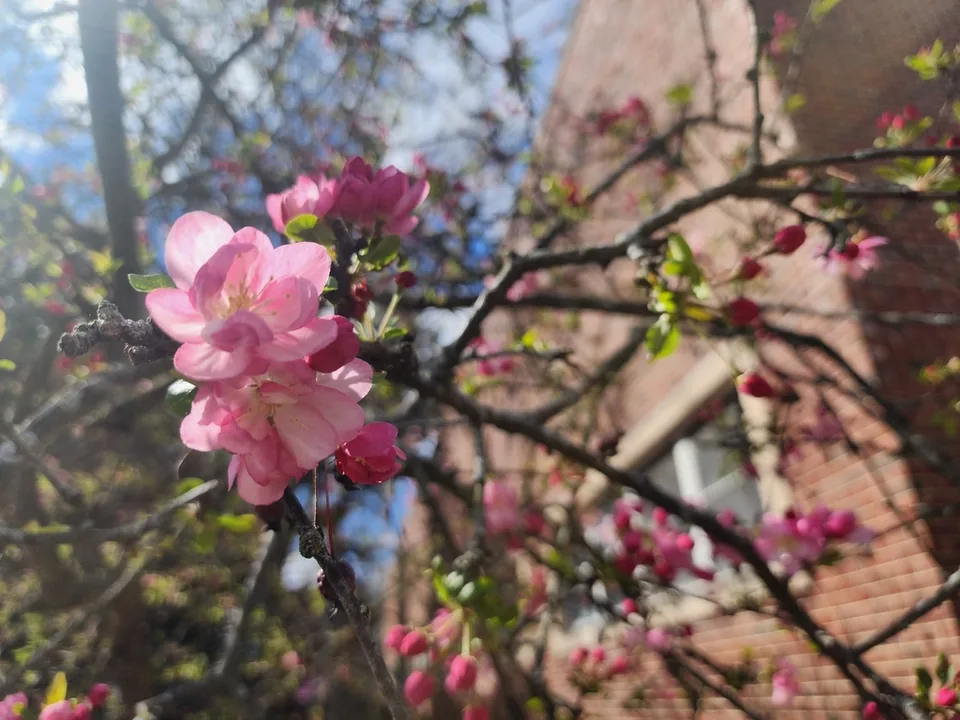
How to Grow and Care for Hall Crabapple
Malus halliana
Written by Emilio Marruso · last checked
Toxic to: Cats, Dogs, People · Why
At a glance
This small apple tree grows 13 to 17 feet tall, a size that fits many yards. Give it full sun and moist, well-drained soil, and from September to October its fruits ripen on the branches. The fruits are edible, just leave the seeds aside, and you can even start new trees from cuttings.
- Sun
Full sun
What the sources say (1)
Light: Full sun
Prefers full sun and moist, well-drained soil. It
— Malus halliana (Adirondak Crabapple, Chinese Flowering Crabapple, Hall Crabapple, Hall Crab Apple, Hall's Crabapple) | North Carolina Extension Gardener Plant Toolbox [1] - Water
Keep the soil moist, but make sure it drains well
What the sources say (1)
Watering: Moist, well-drained soil
Prefers full sun and moist, well-drained soil. It
— Malus halliana (Adirondak Crabapple, Chinese Flowering Crabapple, Hall Crabapple, Hall Crab Apple, Hall's Crabapple) | North Carolina Extension Gardener Plant Toolbox [1] - Cold
Survives winters down to −30 °F (−34.4 °C)
Very hardy · USDA 4a · RHS H7 · Z4
What the sources say (2)
Hardiness, coldest zone: 4a [winter low −34.4 to −31.7 °C (−30 to −25 °F)]
USDA Plant Hardiness Zone: 4a, 4b, 5a, 5b, 6a, 6b, 7a, 7b, 8a, 8b
— Malus halliana (Adirondak Crabapple, Chinese Flowering Crabapple, Hall Crabapple, Hall Crab Apple, Hall's Crabapple) | North Carolina Extension Gardener Plant Toolbox [1] Hardiness, warmest zone: 8b [winter low −9.4 to −6.7 °C (15 to 20 °F)]
USDA Plant Hardiness Zone: 4a, 4b, 5a, 5b, 6a, 6b, 7a, 7b, 8a, 8b
— Malus halliana (Adirondak Crabapple, Chinese Flowering Crabapple, Hall Crabapple, Hall Crab Apple, Hall's Crabapple) | North Carolina Extension Gardener Plant Toolbox [1] - Harvest
Fruits ripen September to October; they are edible, but don't eat the seeds
What the sources say (1)
Harvest: September to October (fruits ripen)
The reddish-purple, edible, pome-like fruits ripen from September to October.
— Malus halliana (Adirondak Crabapple, Chinese Flowering Crabapple, Hall Crabapple, Hall Crab Apple, Hall's Crabapple) | North Carolina Extension Gardener Plant Toolbox [1] - Pests
Aphids, spider mites and scale; cedar-apple rust, apple scab, powdery mildew and fire blight
What the sources say (2)
Pests: aphids, spider mites, scale
Insects, Diseases, and Other Plant Problems: Monitor for aphids, spider mites, and scale.
— Malus halliana (Adirondak Crabapple, Chinese Flowering Crabapple, Hall Crabapple, Hall Crab Apple, Hall's Crabapple) | North Carolina Extension Gardener Plant Toolbox [1] Diseases: cedar-apple rust, apple scab, powdery mildew, fire blight
Susceptible to cedar- apple rust, apple scab, powdery mildew, and fire blight.
— Malus halliana (Adirondak Crabapple, Chinese Flowering Crabapple, Hall Crabapple, Hall Crab Apple, Hall's Crabapple) | North Carolina Extension Gardener Plant Toolbox [1] - Watch out
Deer can damage it
- Size
13 to 17 ft tall and 8 to 12 ft wide
What the sources say (2)
Mature height: 396-518 cm (13 to 17 ft)
The Hall crabapple grows 13 to 17 feet tall, 8 to 12 feet wide, with a spreading habit and gray or purplish-brown fissured bark.
— Malus halliana (Adirondak Crabapple, Chinese Flowering Crabapple, Hall Crabapple, Hall Crab Apple, Hall's Crabapple) | North Carolina Extension Gardener Plant Toolbox [1] Mature width: 244-366 cm (8 to 12 ft)
The Hall crabapple grows 13 to 17 feet tall, 8 to 12 feet wide, with a spreading habit and gray or purplish-brown fissured bark.
— Malus halliana (Adirondak Crabapple, Chinese Flowering Crabapple, Hall Crabapple, Hall Crab Apple, Hall's Crabapple) | North Carolina Extension Gardener Plant Toolbox [1] - Propagation
By grafting or stem cuttings
What the sources say (1)
Propagation: Grafting or stem cutting
Recommended Propagation Strategy: Grafting Stem Cutting Country Or
— Malus halliana (Adirondak Crabapple, Chinese Flowering Crabapple, Hall Crabapple, Hall Crab Apple, Hall's Crabapple) | North Carolina Extension Gardener Plant Toolbox [1] - Safety
Stems, leaves and seeds are toxic to cats and dogs; people can eat the fruit, not the seeds
Overview
Hall crabapple is a small deciduous flowering tree native to Central and Southern China and Southwest Korea. [1] It prefers full sun and moist, well-drained soil. [1] The fruits are edible, but the stems, leaves and seeds contain cyanide and are toxic to cats and dogs. [1]
This record is incomplete: the sources we read do not cover every field yet.
Not yet covered by our sources: Pruning
Hall Crabapple care
How to water Hall Crabapple
Moist, well-drained soil
What the sources say (1)
Prefers full sun and moist, well-drained soil. ItHow much light Hall Crabapple needs
Full sun
What the sources say (1)
Prefers full sun and moist, well-drained soil. ItHow much cold Hall Crabapple can take
Hardiness, coldest zone
4a [winter low −34.4 to −31.7 °C (−30 to −25 °F)]
What the sources say (1)
USDA Plant Hardiness Zone:
4a, 4b, 5a, 5b, 6a, 6b, 7a, 7b, 8a, 8bHardiness, warmest zone
8b [winter low −9.4 to −6.7 °C (15 to 20 °F)]
What the sources say (1)
USDA Plant Hardiness Zone:
4a, 4b, 5a, 5b, 6a, 6b, 7a, 7b, 8a, 8bHow to propagate Hall Crabapple
Grafting or stem cutting
What the sources say (1)
Recommended Propagation Strategy:
Grafting
Stem Cutting
Country OrHow to grow Hall Crabapple
The plant
Life cycle
woody
What the sources say (1)
Genus:
Malus
Species:
halliana
Family:
Rosaceae
Life Cycle:
WoodyFamily
Rosaceae
What the sources say (1)
It is a member of the rose family (Rosaceae).Mature height
396-518 cm (13 to 17 ft)
What the sources say (1)
The Hall crabapple grows 13 to 17 feet tall, 8 to 12 feet wide, with a spreading habit and gray or purplish-brown fissured bark.Mature width
244-366 cm (8 to 12 ft)
What the sources say (1)
The Hall crabapple grows 13 to 17 feet tall, 8 to 12 feet wide, with a spreading habit and gray or purplish-brown fissured bark.Pests and diseases
Pests
aphids, spider mites, scale
What the sources say (1)
Insects, Diseases, and Other Plant Problems: Monitor for aphids, spider mites, and scale.Diseases
cedar-apple rust, apple scab, powdery mildew, fire blight
What the sources say (1)
Susceptible to cedar- apple rust, apple scab, powdery mildew, and fire blight.Hall Crabapple pests and problems
Aphids, spider mites and scale
What to do: Monitor
What the sources say (1)
Monitor for aphids, spider mites, and scale. Susceptible
— Malus halliana (Adirondak Crabapple, Chinese Flowering Crabapple, Hall Crabapple, Hall Crab Apple, Hall's Crabapple) | North Carolina Extension Gardener Plant Toolbox [1] Cedar-apple rust, apple scab, powdery mildew and fire blight
What the sources say (1)
Susceptible to cedar- apple rust, apple scab, powdery mildew, and fire blight.
— Malus halliana (Adirondak Crabapple, Chinese Flowering Crabapple, Hall Crabapple, Hall Crab Apple, Hall's Crabapple) | North Carolina Extension Gardener Plant Toolbox [1] Deer damage
What the sources say (1)
This tree has moderate disease resistance, but deer may damage the tree.
— Malus halliana (Adirondak Crabapple, Chinese Flowering Crabapple, Hall Crabapple, Hall Crab Apple, Hall's Crabapple) | North Carolina Extension Gardener Plant Toolbox [1]
Remedies
Each remedy shows what official sources say about it; traditional remedies without an official source are marked as such. Harmful ones are listed so you know to avoid them.
Treating the plant
aphids
insecticidal soap spray Works
How: spray insecticidal soap on the aphid colonies
Insecticidal soap or 1% horticultural oil sprays will help manage aphids with little impact on beneficial insects.
— hgic.clemson.edu [4] What the evidence says Insecticidal soap or 1% horticultural oil sprays will help manage aphids with little impact on beneficial insects.
— hgic.clemson.edu [4] horticultural oil spray Works
do not spray captan or sulfur within 14 days before or after a horticultural oil spray, as the combination may burn leaves or developing fruit.
— hgic.clemson.edu [4] How: 1% horticultural oil sprays help manage aphids with little impact on beneficial insects
Insecticidal soap or 1% horticultural oil sprays will help manage aphids with little impact on beneficial insects.
— hgic.clemson.edu [4] What the evidence says Insecticidal soap or 1% horticultural oil sprays will help manage aphids with little impact on beneficial insects.
— hgic.clemson.edu [4]
scale
horticultural oil spray Works
do not spray captan or sulfur within 14 days before or after a horticultural oil spray, as the combination may burn leaves or developing fruit.
— hgic.clemson.edu [4] How: thorough spray of 2% horticultural oil on trunk and limbs in late winter or early spring, before the leaf buds begin to open
The best control for scale insects is a thorough spray application of 2% horticultural oil on the trunk and limbs in the late winter or early spring. This should be applied before the leaf buds begin to open.
— hgic.clemson.edu [4] What the evidence says The best control for scale insects is a thorough spray application of 2% horticultural oil on the trunk and limbs in the late winter or early spring. This should be applied before the leaf buds begin to open.
— hgic.clemson.edu [4]
spider mites
strong water jet Official source, not independently tested
How: wash spider mites from plants with a strong stream of water
Wash spider mites from plants with a strong stream of water.
— hortsense.cahnrs.wsu.edu [5] horticultural oil spray Partly works
do not spray captan or sulfur within 14 days before or after a horticultural oil spray, as the combination may burn leaves or developing fruit.
— hgic.clemson.edu [4] How: apply horticultural oil in late spring if mites are present; it works mainly on the egg stage
Horticultural oils are most effective against the egg stage (delayed dormant period) of the mite life cycle and only on European Red mites not on 2-spotted mite.
— hortsense.cahnrs.wsu.edu [5] What the evidence says Horticultural oils are most effective against the egg stage (delayed dormant period) of the mite life cycle and only on European Red mites not on 2-spotted mite.
— hortsense.cahnrs.wsu.edu [5]
fire blight
prune infected branches Works
How: during dormancy, in dry weather, prune infected branches cutting at least 4 inches below the base of the canker and disinfect tools frequently
During dormancy when the weather is dry, prune infected branches, cutting at least 4 inches below the base of the canker.
— extension.psu.edu [6] What the evidence says During dormancy when the weather is dry, prune infected branches, cutting at least 4 inches below the base of the canker.
— extension.psu.edu [6]
apple scab
rake and destroy fallen leaves Works
How: rake and destroy fallen leaves and fruit
Sanitation can help control the disease by removing infected fallen leaves in the fall.
— extension.illinois.edu [7] What the evidence says Grow resistant cultivars (see list below). Rake and destroy fallen leaves and fruit.
— extension.psu.edu [6]
cedar-apple rust
remove nearby junipers and galls Works
How: remove unwanted junipers near crabapples, do not plant junipers close, and remove galls from juniper branches during dormancy
Remove unwanted junipers growing near crabapples. Do not plant junipers close to crabapples. Remove the galls from juniper branches during dormancy.
— extension.psu.edu [6] What the evidence says Remove unwanted junipers growing near crabapples. Do not plant junipers close to crabapples. Remove the galls from juniper branches during dormancy.
— extension.psu.edu [6]
botryosphaeria canker
irrigate and prune infected branches Works
How: irrigate to prevent drought stress and prune infected branches
Trees most susceptible are those under drought stress. Therefore, irrigate to prevent drought stress. Prune infected branches.
— extension.psu.edu [6] What the evidence says Trees most susceptible are those under drought stress. Therefore, irrigate to prevent drought stress. Prune infected branches.
— extension.psu.edu [6]
Is Hall Crabapple toxic to pets?
Reported by the source, quoted verbatim. This is not medical or veterinary advice: if a person or an animal may have eaten this plant, contact a poison control centre or a veterinarian.
Animals
Toxic to cats and dogs: The stems, leaves, and seeds contain cyanide and can cause difficulty breathing, dilated pupils, and shock.
[1]
People
Calendar
September to October (fruits ripen)
What the sources say (1)
The reddish-purple, edible, pome-like fruits ripen from September to October.Not stated in the sources we read.
Months as given by the sources, which are mostly from the United States (northern hemisphere). In the southern hemisphere they shift by about six months.
Edibility
Reported by the source, quoted verbatim. Do not eat a plant on the basis of this page alone: identification mistakes can be dangerous.
The fruits are edible, but the seeds contain cyanogenic glycosides.
[1]
Similar plants
- Apple Malus sylvestris
- Flowering crabapple Malus baccata
- Malus floribunda Malus floribunda
- Paradise apple Malus domestica
- Southern Crabapple Malus angustifolia
- Sweet Crabapple Malus coronaria
- Tea Crabapple Malus hupehensis
- Yunnan Crabapple Malus yunnanensis
Sources
Every value above is quoted from these documents. Links lead to the original publisher.
- Malus halliana (Adirondak Crabapple, Chinese Flowering Crabapple, Hall Crabapple, Hall Crab Apple, Hall's Crabapple) | North Carolina Extension Gardener Plant Toolbox · plants.ces.ncsu.edu, consulted
- Malus (Apple, Crabapple, Culinary Apple, Eating Apples, Wild Apples) | North Carolina Extension Gardener Plant Toolbox · plants.ces.ncsu.edu, consulted
- Crabapple - Malus | North Carolina Extension Gardener Plant Toolbox · plants.ces.ncsu.edu, consulted
- hgic.clemson.edu · hgic.clemson.edu
- hortsense.cahnrs.wsu.edu · hortsense.cahnrs.wsu.edu
- extension.psu.edu · extension.psu.edu
- extension.illinois.edu · extension.illinois.edu
Written by Emilio Marruso · last checked