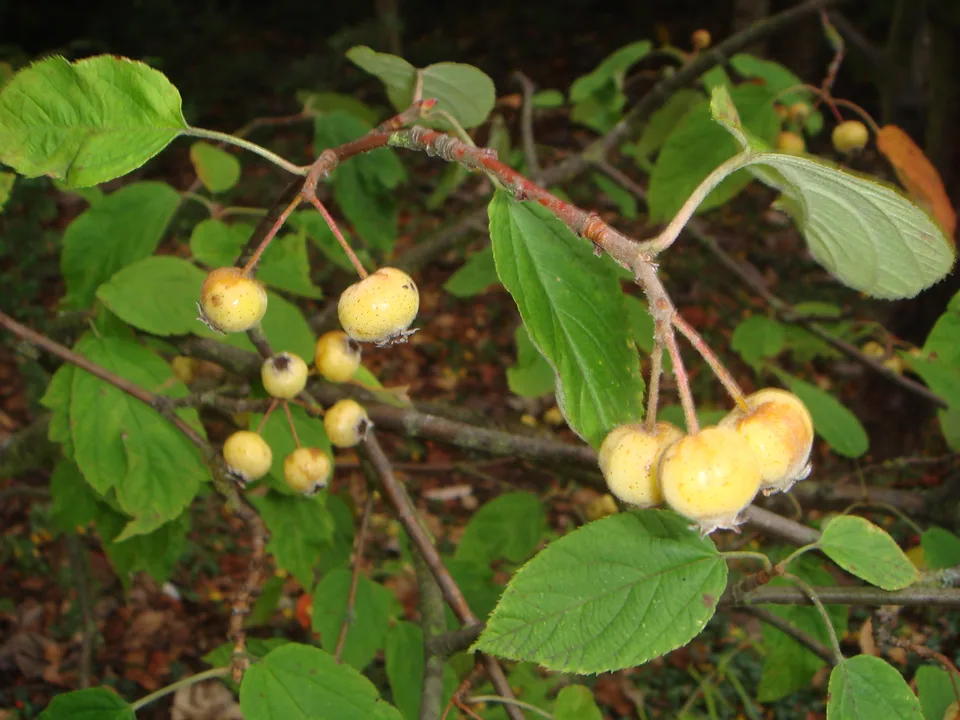

How to Grow and Care for Yunnan Crabapple
Malus yunnanensis
Written by Emilio Marruso · last checked
Toxic to: People · Why
At a glance
The Yunnan crabapple is a perennial tree that can grow 40 feet tall and 19 feet wide, a grand presence for any yard. It is happy in full sun or partial shade, and asks only for soil that stays consistently moist but well drained. Even better, its fruit is safe to eat; just skip the seeds and leaves.
- Sun
Full sun to partial shade
What the sources say (1)
Light: Full sun to partial shade
Yunnan Crabapple does best in consistently moist, well-drained, fertile soil in full sun or partial shade.
— Malus yunnanensis (Yunnan Crabapple) | North Carolina Extension Gardener Plant Toolbox [1] - Water
Keep the soil consistently moist but well drained
What the sources say (1)
Watering: Consistently moist, well-drained soil
Yunnan Crabapple does best in consistently moist, well-drained, fertile soil in full sun or partial shade.
— Malus yunnanensis (Yunnan Crabapple) | North Carolina Extension Gardener Plant Toolbox [1] - Cold
Survives winters down to −40 °F (−40 °C)
Very hardy · USDA 3a · RHS H7 · Z3
What the sources say (2)
Hardiness, coldest zone: 3a [winter low −40 to −37.2 °C (−40 to −35 °F)]
USDA Plant Hardiness Zone: 3a, 3b, 4a, 4b, 5a, 5b, 6a, 6b, 7a, 7b, 8a, 8b
— Malus yunnanensis (Yunnan Crabapple) | North Carolina Extension Gardener Plant Toolbox [1] Hardiness, warmest zone: 8b [winter low −9.4 to −6.7 °C (15 to 20 °F)]
USDA Plant Hardiness Zone: 3a, 3b, 4a, 4b, 5a, 5b, 6a, 6b, 7a, 7b, 8a, 8b
— Malus yunnanensis (Yunnan Crabapple) | North Carolina Extension Gardener Plant Toolbox [1] - Harvest
The fruit is safe to eat
- Pests
Can catch honey fungus, a root rot disease
What the sources say (1)
Diseases: honey fungus
Diseases, Insect Pests, and Other Plant Problems: Modest disease resistance. Susceptible to honey fungus.
— Malus yunnanensis (Yunnan Crabapple) | North Carolina Extension Gardener Plant Toolbox [1] - Size
Up to 40 ft tall and 19 ft wide
What the sources say (2)
Mature height: 1219.2 cm (40 ft)
It has a rounded, upright form with a moderate growth rate and can reach a mature height of 40 feet and 19 foot spread.
— Malus yunnanensis (Yunnan Crabapple) | North Carolina Extension Gardener Plant Toolbox [1] Mature width: 579.12 cm (19 ft)
It has a rounded, upright form with a moderate growth rate and can reach a mature height of 40 feet and 19 foot spread.
— Malus yunnanensis (Yunnan Crabapple) | North Carolina Extension Gardener Plant Toolbox [1] - Propagation
Grows from seed
What the sources say (1)
Propagation: Seed
Recommended Propagation Strategy: Seed
— Malus yunnanensis (Yunnan Crabapple) | North Carolina Extension Gardener Plant Toolbox [1] - Safety
Don't eat the seeds or leaves: they contain a toxin
Overview
Malus yunnanensis is a small deciduous flowering tree native to Tibet and China, with fragrant pink to white spring blossoms. [1] It does best in consistently moist, well-drained, fertile soil in full sun or partial shade. [1] Its seeds and leaves contain a toxin, while the fruit does not. [1]
This record is incomplete: the sources we read do not cover every field yet.
Not yet covered by our sources: Pruning
Yunnan Crabapple care
How to water Yunnan Crabapple
Consistently moist, well-drained soil
What the sources say (1)
Yunnan Crabapple does best in consistently moist, well-drained, fertile soil in full sun or partial shade.How much light Yunnan Crabapple needs
Full sun to partial shade
What the sources say (1)
Yunnan Crabapple does best in consistently moist, well-drained, fertile soil in full sun or partial shade.How much cold Yunnan Crabapple can take
Hardiness, coldest zone
3a [winter low −40 to −37.2 °C (−40 to −35 °F)]
What the sources say (1)
USDA Plant Hardiness Zone:
3a, 3b, 4a, 4b, 5a, 5b, 6a, 6b, 7a, 7b, 8a, 8bHardiness, warmest zone
8b [winter low −9.4 to −6.7 °C (15 to 20 °F)]
What the sources say (1)
USDA Plant Hardiness Zone:
3a, 3b, 4a, 4b, 5a, 5b, 6a, 6b, 7a, 7b, 8a, 8bHow to propagate Yunnan Crabapple
Seed
What the sources say (1)
Recommended Propagation Strategy:
SeedHow to grow Yunnan Crabapple
The plant
Life cycle
perennial
What the sources say (1)
Genus:
Malus
Species:
yunnanensis
Family:
Rosaceae
Life Cycle:
PerennialFamily
Rosaceae
What the sources say (1)
Genus:
Malus
Species:
yunnanensis
Family:
Rosaceae
Life Cycle:
PerennialMature height
1219.2 cm (40 ft)
What the sources say (1)
It has a rounded, upright form with a moderate growth rate and can reach a mature height of 40 feet and 19 foot spread.Mature width
579.12 cm (19 ft)
What the sources say (1)
It has a rounded, upright form with a moderate growth rate and can reach a mature height of 40 feet and 19 foot spread.Pests and diseases
Diseases
honey fungus
What the sources say (1)
Diseases, Insect Pests, and Other Plant Problems:
Modest disease resistance. Susceptible to honey fungus.Yunnan Crabapple pests and problems
Honey fungus
Symptom: Modest disease resistance; susceptible to honey fungus.
What the sources say (1)
Modest disease resistance. Susceptible to honey fungus.
— Malus yunnanensis (Yunnan Crabapple) | North Carolina Extension Gardener Plant Toolbox [1]
Remedies
Each remedy shows what official sources say about it; traditional remedies without an official source are marked as such. Harmful ones are listed so you know to avoid them.
Treating the plant
apple scab
collect and discard foliage Official source, not independently tested
How: For established trees, collect and discard foliage that is shed throughout the growing season to reduce inoculum at the site.
collect and discard foliage that is shed throughout the growing season to reduce inoculum at the site.
— umass.edu [4] sanitation pruning Official source, not independently tested
How: Regular sanitation pruning of suckers and interior canopy shoots on apple and crabapple.
Regular sanitation pruning of suckers and interior canopy shoots on apple and crabapple is necessary to help control apple scab
— umass.edu [4]
aphids
insecticidal soap Official source, not independently tested
How: Insecticidal soap or 1% horticultural oil sprays are used to manage aphids with little impact on beneficial insects.
Insecticidal soap or 1% horticultural oil sprays will help manage aphids with little impact on beneficial insects.
— hgic.clemson.edu [5]
european red mites
horticultural oil spray Works
How: A 2% horticultural oil spray (5 tablespoons oil per gallon of water) applied between the green tip stage and tight cluster, before the blooms open.
The most effective treatment for the European red mites (ERM) is a 2% horticultural oil spray (5 tablespoons oil per gallon of water) applied between the green tip stage and tight cluster
— hgic.clemson.edu [5] What the evidence says The most effective treatment for the European red mites (ERM) is a 2% horticultural oil spray (5 tablespoons oil per gallon of water) applied between the green tip stage and tight cluster
— hgic.clemson.edu [5]
honey fungus
remove and destroy diseased plants Official source, not independently tested
How: Remove and destroy severely diseased plants to prevent the fungus from spreading, removing as much of the root system as possible.
remove and destroy plants which are severely diseased to prevent the fungus from spreading. It is important to remove as much of the root system as possible.
— hortsense.cahnrs.wsu.edu [6] dig a trench Official source, not independently tested
How: Dig a trench to isolate infected soil; a vertical metal barrier can be placed in the trench before refilling.
Dig a trench to isolate infected soil and prevent spread of the disease to adjacent plants. A vertical metal barrier can be placed in the trench prior to refilling to prevent the roots from adjacent healthy plants.
— hortsense.cahnrs.wsu.edu [6]
Is Yunnan Crabapple poisonous?
Reported by the source, quoted verbatim. This is not medical or veterinary advice: if a person or an animal may have eaten this plant, contact a poison control centre or a veterinarian.
Calendar
Pruning
Not stated in the sources we read.
Months as given by the sources, which are mostly from the United States (northern hemisphere). In the southern hemisphere they shift by about six months.
Edibility
Reported by the source, quoted verbatim. Do not eat a plant on the basis of this page alone: identification mistakes can be dangerous.
The fruit does not contain this toxin.
[1]
Similar plants
- Apple Malus sylvestris
- Flowering crabapple Malus baccata
- Hall Crabapple Malus halliana
- Malus floribunda Malus floribunda
- Paradise apple Malus domestica
- Southern Crabapple Malus angustifolia
- Sweet Crabapple Malus coronaria
- Tea Crabapple Malus hupehensis
Sources
Every value above is quoted from these documents. Links lead to the original publisher.
- Malus yunnanensis (Yunnan Crabapple) | North Carolina Extension Gardener Plant Toolbox · plants.ces.ncsu.edu, consulted
- Malus (Apple, Crabapple, Culinary Apple, Eating Apples, Wild Apples) | North Carolina Extension Gardener Plant Toolbox · plants.ces.ncsu.edu, consulted
- Crabapple - Malus | North Carolina Extension Gardener Plant Toolbox · plants.ces.ncsu.edu, consulted
- umass.edu · umass.edu
- hgic.clemson.edu · hgic.clemson.edu
- hortsense.cahnrs.wsu.edu · hortsense.cahnrs.wsu.edu
Written by Emilio Marruso · last checked