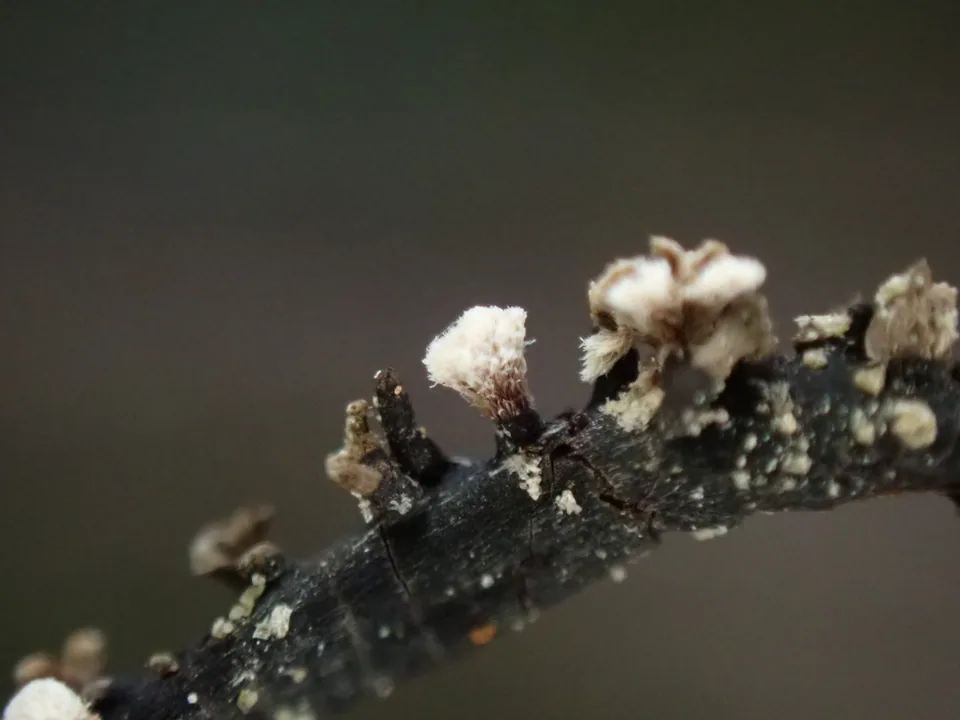
Fungus
Honey fungus
Armillaria
Written by Emilio Marruso
Classification: Basidiomycota › Agaricomycotina › Agaricomycetes › Agaricales › Physalacriaceae
Plants it attacks
Plants in our guide where this problem is reported. Open a plant to see the sources.
- Pawpaw
Symptom: Reported in north Alabama as a devastating disease of mature pawpaw plantings.
- Chinese Tulip Tree
Symptom: Susceptible to honey fungus; aphids, leaf miners, scale, mealybugs, and borers can sometimes be problems.
- Tea Crabapple
Symptom: Plant can be susceptible to fire blight and honey fungus.
- Apple
Symptom: Not described in the source; the plant is listed as susceptible.
- Yunnan Crabapple
Symptom: Modest disease resistance; susceptible to honey fungus.
- Serbian Spruce
Symptom: Aphids, spider mites, budworms and borers; may be susceptible to honey fungus.
- Blackberry
Symptom: Plants in this genus are notably susceptible
- Blackberry
Symptom: Plants in the genus are notably susceptible
- Blackberry
Symptom: Plants in the genus are notably susceptible to honey fungus; thrips may be a problem
- Dewberry
Symptom: Plants in this genus are notably susceptible to honey fungus.
- Hirsute Raspberry
Symptom: Plants in this genus are notably susceptible to honey fungus.
- Strawberry-Raspberry
Symptom: Most Rubus species are susceptible to honey fungus; otherwise there are few problems.
Also reported on: American Wisteria, Arizona Cypress, Blackberry, Blackberry, Blackberry, Canyon Live Oak, Chinese Butterfly Bush, Dewberry, Dragon Spruce, Giant Sequoia, Hungarian Oak, Korean Abelia, Memorial Rose, Privet, Purple Flowering Raspberry, Silverleaf
Remedies
What our plant sheets report, with the outcome checked against official sources. Traditional remedies without an official source are flagged.
Treat
removing and destroying the infected shrub Works
How: Uproot the affected plant right away; remove and destroy the trunk and large roots.
Reported for 1 plant: Privet
removing all root and stump material Partly works
How: When a tree with Armillaria is removed, also remove all root and stump material to reduce the amount of Armillaria present to cause new infections.
Reported for 1 plant: Arizona Cypress
watering during summer droughts Partly works
How: Water during summer droughts and fertilize according to soil test results; good growing conditions are the best defense.
Reported for 1 plant: Silverleaf
watering trees during dry periods Partly works
How: Maintain tree vigor and reduce stress: water trees during dry periods, use mulch and avoid wounding trees.
Reported for 1 plant: Arizona Cypress
excavate and destroy infected root and stump material Official source, not independently tested
How: If honey fungus is confirmed, excavate and destroy by burning or landfill all of the infected root and stump material.
Reported for 2 plants: Korean Abelia, Chinese Butterfly Bush
buried barrier of plastic sheet Official source, not independently tested
How: Bury a vertical strip of butyl rubber (pond lining) or heavy duty plastic sheet 45cm deep, protruding about 1in above soil level, to stop the spread to unaffected areas.
Reported for 1 plant: Chinese Butterfly Bush
buried physical barrier Official source, not independently tested
How: Bury a vertical strip of butyl rubber (pond lining) or heavy duty plastic sheet in the soil to block the rhizomorphs.
Reported for 1 plant: Korean Abelia
dig a trench Official source, not independently tested
How: Dig a trench to isolate infected soil; a vertical metal barrier can be placed in the trench before refilling.
Reported for 1 plant: Yunnan Crabapple
increasing tree vigor with proper irrigation and fertility Official source, not independently tested
How: Eradication is not feasible; management is directed toward increasing tree vigor through proper irrigation and fertility
Reported for 1 plant: Hungarian Oak
not replanting where infected plants were removed Official source, not independently tested
How: If practical, do not replant where infected plants have been removed.
Reported for 1 plant: Blackberry
removing infected roots and stumps Not verified
How: Remove infected roots and stumps to prevent the disease spreading to unaffected plants.
Reported for 2 plants: Chinese Tulip Tree, Strawberry-Raspberry
buried plastic barrier Not verified
How: Insert a vertical physical barrier of butyl rubber (good quality pond liner) or very heavy-duty plastic sheeting 45cm (18in) deep, protruding 2.5-4cm above soil level.
Reported for 1 plant: Strawberry-Raspberry
vertical root barrier Not verified
How: Insert a vertical barrier of pond liner or heavy-duty plastic sheeting 45 cm deep to stop the rhizomorphs spreading.
Reported for 1 plant: Chinese Tulip Tree
7 more remedies are reported in single plant sheets.
Where it is found
No distribution data.