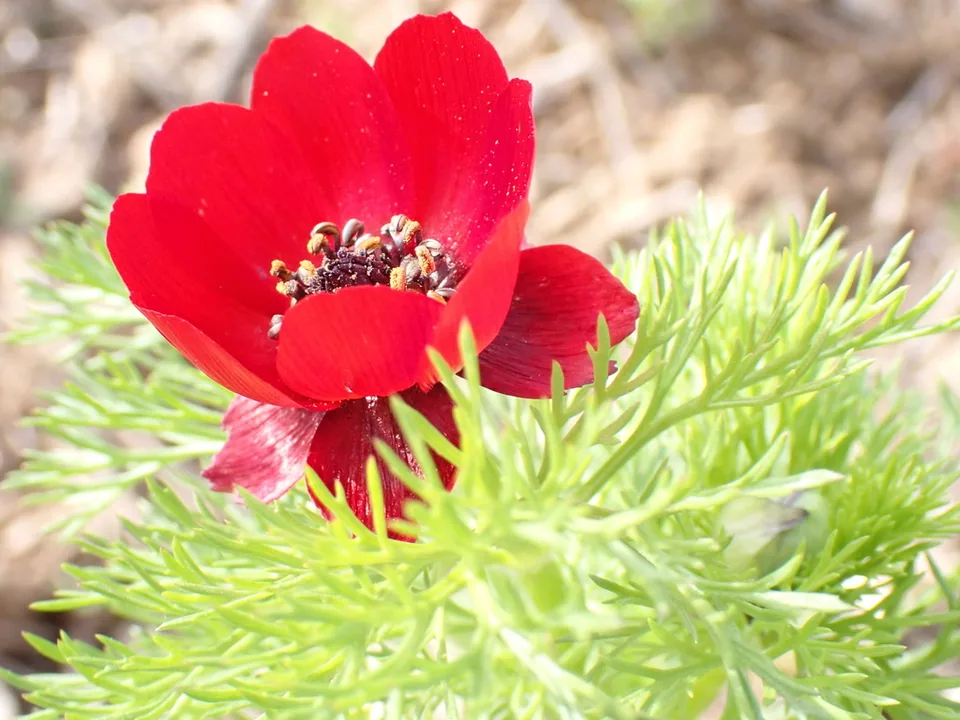
How to Grow and Care for Blooddrops
Adonis annua
Written by Emilio Marruso · last checked
Toxic to: Livestock, People · Why
At a glance
Pheasant's eye is a plant that can take care of its own future: where conditions suit it, it sows itself and comes back on its own year after year. It belongs to the buttercup family. Enjoy it with your eyes, not your plate: every part of the plant is poisonous to people and livestock, so keep children and animals from nibbling it.
- Propagation
Sows itself where conditions suit it
What the sources say (1)
Propagation: Self-sows where conditions suit it
Both Adonis annua and Adonis aestivalis will self sow where conditions suit them, but deadheading will prolong the flowering.
— Adonis - Gardening at USask - College of Agriculture and Bioresources | University of Saskatchewan [3] - Safety
Not edible: every part is poisonous to people and livestock
Overview
Pheasant's eye is an annual herbaceous plant of the buttercup family native to Eurasia. [7] All parts of the plant are poisonous to humans and livestock. [6] It has become rare in cultivated fields, a decline linked to the widespread use of herbicides and fertilisers. [1]
This record is incomplete: the sources we read do not cover every field yet.
Not yet covered by our sources: Watering, Light, Hardiness, coldest zone, Hardiness, warmest zone, Pruning
Blooddrops care
How to water Blooddrops
Not stated in the sources we read.
How much light Blooddrops needs
Not stated in the sources we read.
How much cold Blooddrops can take
Hardiness, coldest zone
Not stated in the sources we read.
Hardiness, warmest zone
Not stated in the sources we read.
How to propagate Blooddrops
Self-sows where conditions suit it
What the sources say (1)
Both Adonis annua and Adonis aestivalis will self sow where conditions suit them, but deadheading will prolong the flowering.How to grow Blooddrops
The plant
Family
Ranunculaceae
What the sources say (1)
Family: RANUNCULACEAE Genus: Adonis Catalan common name: Gota de sang. Ull d'àngel. Ulls de perdiu.Remedies
The sources we checked give no remedies for this plant.
Is Blooddrops toxic to pets?
Reported by the source, quoted verbatim. This is not medical or veterinary advice: if a person or an animal may have eaten this plant, contact a poison control centre or a veterinarian.
Pheasant’s Eye is not edible, all parts of the plant are poisonous to humans and livestock.
[6]- Poisonous parts
glucosides (adonidine) qu’elle contient, présents dans l’intégralité de la plante
[1]- Toxic principle
Plante toxique de par les glucosides (adonidine) qu’elle contient,
[1]- Symptoms
pouvant provoquer des troubles digestifs, cardiaques et rénaux. Il en découle des propriétés pharmacologiques
[1]
Calendar
Pruning
Not stated in the sources we read.
Months as given by the sources, which are mostly from the United States (northern hemisphere). In the southern hemisphere they shift by about six months.
Similar plants
- Pheasant's Eye Adonis aestivalis
- Spring pheasant's eye Adonis vernalis
- Aconite Aconitum napellus
- Arctic violet Pulsatilla vernalis
- Baneberry Actaea pachypoda
- Black caraway Nigella sativa
- Black Cohosh Actaea racemosa
- Blue Jasmine Clematis crispa
Sources
Every value above is quoted from these documents. Links lead to the original publisher.
- L’Adonis d’automne · cbnbrest.fr, consulted
- How to Grow Adonis - Pheasant's Eye · harvesttotable.com, consulted
- Adonis - Gardening at USask - College of Agriculture and Bioresources | University of Saskatchewan · gardening.usask.ca, consulted
- Adonis annua L. subsp. cupaniana (Guss.) C. Steinb. - Herbari Virtual del Mediterrani Occidental · herbarivirtual.uib.cat, consulted
- Adonis annua - Monaco Nature Encyclopedia · monaconatureencyclopedia.com, consulted
- Pheasant’s Eye - Adonis annua, species information page. Also known as Adonis' Flower, Red Chamomile · brickfieldspark.org, consulted
- Pheasant’s-eye | Flower, Buttercup & Herbaceous Plant | Britannica · britannica.com, consulted
- Günther's Site - Photos of European Plants - Adonis annua · guenther-blaich.de, consulted
Written by Emilio Marruso · last checked