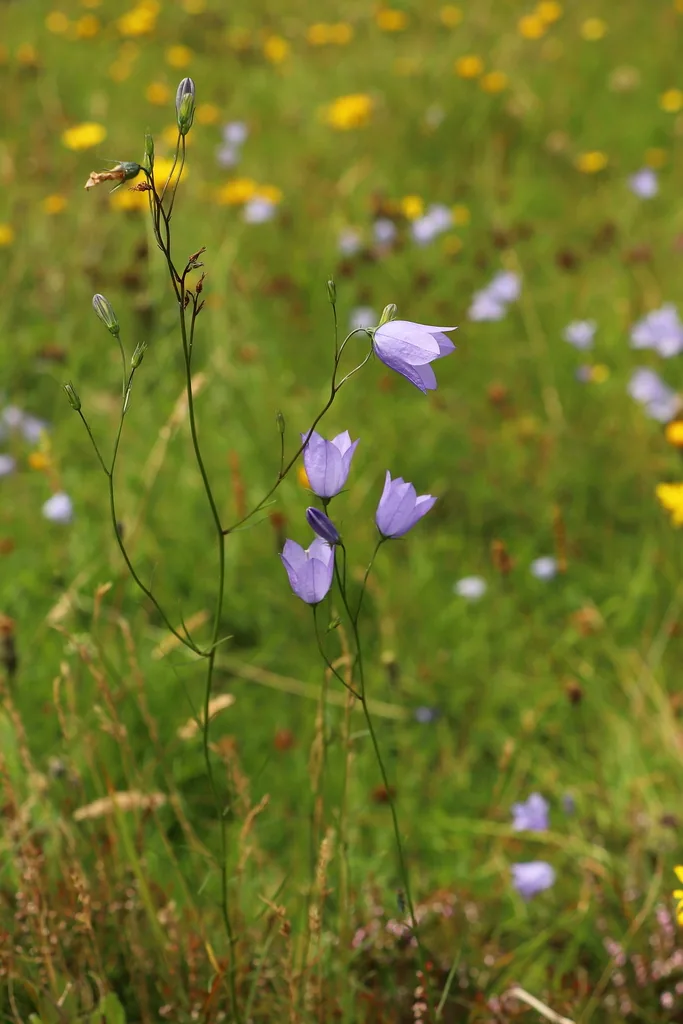
How to Grow and Care for Harebell
Campanula rotundifolia
Written by Emilio Marruso · last checked
Toxic to: People · Why
At a glance
Harebell is a perennial with flowers you can actually eat: add them to salads, and enjoy the leaves raw or steamed. It grows happily in full sun, partial shade or dappled shade, in moist but well-drained soil. Sow it in March or April, plant it out in May or June, and divide it in spring or fall to make more.
- Sun
Full sun, partial shade or dappled shade
What the sources say (2)
Light: Full sun, partial shade or dappled shade
Sun Exposure: Dappled shade, full sun, partial shade
— Campanula rotundifolia (Common Harebell) | BBC Gardeners World Magazine [1] moist but well-drained soil in sun or partial shade
— Campanula rotundifolia (Common Harebell) | BBC Gardeners World Magazine [1] - Water
Keep the soil moist but well drained
What the sources say (1)
Watering: Moist but well-drained soil
Grow Campanula rotundifolia in moist but well-drained soil in sun or partial shade.
— Campanula rotundifolia (Common Harebell) | BBC Gardeners World Magazine [1] - Planting
Plant in May or June
- Harvest
Flowers go in salads; leaves can be eaten raw or steamed
- Propagation
Divide the plant in spring or fall
What the sources say (1)
Propagation: Division in spring or autumn
Propagate by division in spring or autumn.
— Campanula rotundifolia (Common Harebell) | BBC Gardeners World Magazine [1] - Sowing
Sow in March or April
- Safety
No toxic effects known for people
Overview
Common harebell is a clump-forming perennial wildflower with bell-shaped blue flowers from summer to autumn. [1] It is grown in moist but well-drained soil in sun or partial shade. [1] Plants are propagated by division in spring or autumn. [1]
This record is incomplete: the sources we read do not cover every field yet.
Not yet covered by our sources: Hardiness, coldest zone, Hardiness, warmest zone, Pruning
Harebell care
How to water Harebell
Moist but well-drained soil
What the sources say (1)
Grow Campanula rotundifolia in moist but well-drained soil in sun or partial shade.How much light Harebell needs
Full sun, partial shade or dappled shade
How much cold Harebell can take
Hardiness, coldest zone
Not stated in the sources we read.
Hardiness, warmest zone
Not stated in the sources we read.
How to propagate Harebell
Division in spring or autumn
What the sources say (1)
Propagate by division in spring or autumn.How to grow Harebell
The plant
Life cycle
perennial
What the sources say (1)
A perennial herb with basal leaves ovate-cordate, the caulines are more narrow (linear-lanceolate). The inflorescence isFamily
Campanulaceae
What the sources say (1)
Family:
CAMPANULACEAE
Genus:
Campanula
Catalan common name:
CampanetaRemedies
Each remedy shows what official sources say about it; traditional remedies without an official source are marked as such. Harmful ones are listed so you know to avoid them.
Treating the plant
slugs
handpicking slugs and drowning them in soapy water Works
How: Look for slugs on leaf surfaces and underneath leaves as well as under rocks and debris, then drown them in soapy water or crush them.
Look for slugs on leaf surfaces and underneath leaves as well as under rocks and debris. - Drown slugs in soapy water or crush them.
— extension.umn.edu [5] What the evidence says handpicking is an effective mechanical control if it is done on a regular basis.
— ucanr.edu [6] beer or yeast-water trap Partly works
How: Bury a container level with the ground and pour in beer or a water and yeast mixture; slugs fall in and drown. Check the traps several times a week and refill as needed.
Pour beer or a water and yeast mixture (one teaspoon of yeast to three ounces of warm water) or similar fermenting liquid into the container, 6-7 inches deep.
— extension.umn.edu [5] What the evidence says sugar-water yeast mixture. Because the liquid in these traps must be replenished every few days, and will only attract slugs and snails from an area within a few feet, they are not considered to be particularly effective.
— ucanr.edu [6] copper barrier Works
These barriers should be at least four inches wide with the bottom buried in the soil to prevent slugs from crawling under them.
— ucanr.edu [6] How: Copper foil or bands may be used horizontally or vertically, but they must be wide enough to accommodate the whole slug.
Copper has been shown to deter slugs by reacting with their mucous, which gives slugs something like an electrical shock.
— extension.umn.edu [5] What the evidence says Copper has been shown to deter slugs by reacting with their mucous, which gives slugs something like an electrical shock.
— extension.umn.edu [5] wood ash barrier Harmful
How: Dry ashes can be piled as a barrier about one inch high and 3 inches wide.
Dry ashes or other abrasives such as diatomaceous earth can also be used as barriers for slugs and snails. Such abrasives should be piled about one inch high and 3 inches wide to be effective.
— ucanr.edu [6] What the evidence says Another drawback of wood ashes is that they are quite alkaline and can have a detrimental effect on soil pH.
— ucanr.edu [6] salt Harmful
How: Salt is sometimes used to kill slugs and snails.
Do not use salt to kill slugs and snails because is harmful to the soil.
— ucanr.edu [6] What the evidence says Do not use salt to kill slugs and snails because is harmful to the soil.
— ucanr.edu [6]
Is Harebell poisonous?
Reported by the source, quoted verbatim. This is not medical or veterinary advice: if a person or an animal may have eaten this plant, contact a poison control centre or a veterinarian.
Calendar
March - April
What each source says
According to BBC Gardeners World Magazine: March - April
May - June
What each source says
According to BBC Gardeners World Magazine: May - June
Not stated in the sources we read.
Months as given by the sources, which are mostly from the United States (northern hemisphere). In the southern hemisphere they shift by about six months.
Edibility
Reported by the source, quoted verbatim. Do not eat a plant on the basis of this page alone: identification mistakes can be dangerous.
Indicative values
Values from a secondary source, not checked word for word like the rest of this page. Use them as a starting point.
- Mature height
- 30.5-45.7 cm (1-1.5 ft)Indicative value, adapt it to your climate · Secondary source
- Hours of sun
- 4-6 hoursIndicative value, adapt it to your climate · Secondary source
- Soil
- Loamy RockyIndicative value, adapt it to your climate · Secondary source
- Soil pH
- 6-7.5Indicative value, adapt it to your climate · Secondary source
- USDA hardiness zones
- 3-6 [winter low −40 to −17.8 °C (−40 to 0 °F)]Indicative value, adapt it to your climate · Secondary source
- Care level
- MediumIndicative value, adapt it to your climate · Secondary source
- Growth rate
- LowIndicative value, adapt it to your climate · Secondary source
- Pruning
- AugustIndicative value, adapt it to your climate · Secondary source
Similar plants
- Appalachian Bellflower Campanula divaricata
- Bellflower Campanula glomerata
- Canterbury Bells Campanula medium
- Creeping Bellflower Campanula rapunculoides
- Italian Bellflower Campanula isophylla
- Nettle-leaved Bellflower Campanula trachelium
- Peach-leaved Bellflower Campanula persicifolia
- Spotted Bellflower Campanula punctata
Sources
Every value above is quoted from these documents. Links lead to the original publisher.
- Campanula rotundifolia (Common Harebell) | BBC Gardeners World Magazine · gardenersworld.com, consulted
- Campanula rotundifolia - Useful Temperate Plants · temperate.theferns.info, consulted
- · naturblick.museumfuernaturkunde.berlin, consulted
- Campanula rotundifolia L. - Herbari Virtual del Mediterrani Occidental · herbarivirtual.uib.cat, consulted
- extension.umn.edu · extension.umn.edu
- ucanr.edu · ucanr.edu
Written by Emilio Marruso · last checked