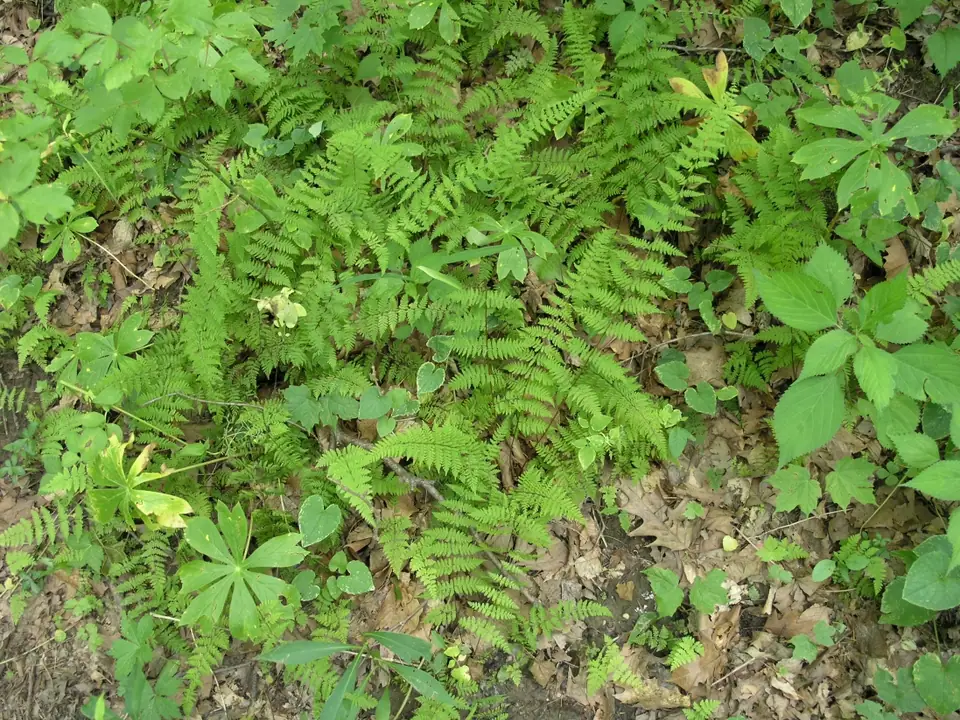


How to Grow and Care for Bulblet Bladder Fern
Cystopteris bulbifera
Written by Emilio Marruso · last checked
At a glance
This fern is a gift for the shady corners of your garden: it is happy in partial to deep shade, where many plants struggle. Give it soil that stays consistently moist and it comes back year after year, growing 1 to 2 feet tall and wide. When it gets bigger, divide it to make new plants and share them.
- Sun
Partial to deep shade
What the sources say (1)
Light: Partial to deep shade
The bulblet bladder fern prefers partial to deep shade in moist, humusy rocky limestone or neutral soils in a humid protected environment.
— Cystopteris bulbifera (Berry Bladder Fern, Bulblet Bladder Fern, Bulblet Cystopteris, Bulblet Fern) | North Carolina Extension Gardener Plant Toolbox [1] - Water
Keep the soil moist all the time
What the sources say (1)
Watering: Provide consistent moisture
Use this plant in a woodland setting and provide consistent moisture.
— Cystopteris bulbifera (Berry Bladder Fern, Bulblet Bladder Fern, Bulblet Cystopteris, Bulblet Fern) | North Carolina Extension Gardener Plant Toolbox [1] - Cold
Survives winters down to −30 °F (−34.4 °C)
Very hardy · USDA 4a · RHS H7 · Z4
What the sources say (2)
Hardiness, coldest zone: 4a [winter low −34.4 to −31.7 °C (−30 to −25 °F)]
USDA Plant Hardiness Zone: 4a, 4b, 5a, 5b, 6a, 6b, 7a, 7b, 8a, 8b
— Cystopteris bulbifera (Berry Bladder Fern, Bulblet Bladder Fern, Bulblet Cystopteris, Bulblet Fern) | North Carolina Extension Gardener Plant Toolbox [1] Hardiness, warmest zone: 8b [winter low −9.4 to −6.7 °C (15 to 20 °F)]
USDA Plant Hardiness Zone: 4a, 4b, 5a, 5b, 6a, 6b, 7a, 7b, 8a, 8b
— Cystopteris bulbifera (Berry Bladder Fern, Bulblet Bladder Fern, Bulblet Cystopteris, Bulblet Fern) | North Carolina Extension Gardener Plant Toolbox [1] - Soil
Slightly acidic to alkaline soil, pH 6.0–8.0
What the sources say (2)
Soil pH, minimum: 6.0
Soil pH: Neutral (6.0-8.0) Soil Drainage: Good Drainage Moist
— Cystopteris bulbifera (Berry Bladder Fern, Bulblet Bladder Fern, Bulblet Cystopteris, Bulblet Fern) | North Carolina Extension Gardener Plant Toolbox [1] Soil pH, maximum: 8.0
Soil pH: Neutral (6.0-8.0) Soil Drainage: Good Drainage Moist
— Cystopteris bulbifera (Berry Bladder Fern, Bulblet Bladder Fern, Bulblet Cystopteris, Bulblet Fern) | North Carolina Extension Gardener Plant Toolbox [1] - Size
1 to 2 ft tall and 1 to 2 ft wide
What the sources say (2)
Mature height: 30-61 cm (1 to 2 ft)
The bulblet bladder fern prefers partial to deep shade in moist, humusy rocky limestone or neutral soils in a humid protected environment. It grows 1 to 2 feet tall and wide
— Cystopteris bulbifera (Berry Bladder Fern, Bulblet Bladder Fern, Bulblet Cystopteris, Bulblet Fern) | North Carolina Extension Gardener Plant Toolbox [1] Mature width: 30-61 cm (1 to 2 ft)
The bulblet bladder fern prefers partial to deep shade in moist, humusy rocky limestone or neutral soils in a humid protected environment. It grows 1 to 2 feet tall and wide
— Cystopteris bulbifera (Berry Bladder Fern, Bulblet Bladder Fern, Bulblet Cystopteris, Bulblet Fern) | North Carolina Extension Gardener Plant Toolbox [1] - Propagation
Make new plants by dividing the clump
What the sources say (1)
Propagation: Division
Recommended Propagation Strategy: Division Country Or Region Of Origin:
— Cystopteris bulbifera (Berry Bladder Fern, Bulblet Bladder Fern, Bulblet Cystopteris, Bulblet Fern) | North Carolina Extension Gardener Plant Toolbox [1]
Overview
Bulblet bladder fern is a rhizomatous, herbaceous perennial fern native to eastern and central North America. [1] It prefers partial to deep shade in moist, humusy soils and needs consistent moisture. [1] It is used in woodland, native, rock and shade gardens and has no serious insect or disease problems. [1]
This record is incomplete: the sources we read do not cover every field yet.
Not yet covered by our sources: Pruning
Bulblet Bladder Fern care
How to water Bulblet Bladder Fern
Provide consistent moisture
What the sources say (1)
Use this plant in a woodland setting and provide consistent moisture.How much light Bulblet Bladder Fern needs
Partial to deep shade
What the sources say (1)
The bulblet bladder fern prefers partial to deep shade in moist, humusy rocky limestone or neutral soils in a humid protected environment.How much cold Bulblet Bladder Fern can take
Hardiness, coldest zone
4a [winter low −34.4 to −31.7 °C (−30 to −25 °F)]
What the sources say (1)
USDA Plant Hardiness Zone:
4a, 4b, 5a, 5b, 6a, 6b, 7a, 7b, 8a, 8bHardiness, warmest zone
8b [winter low −9.4 to −6.7 °C (15 to 20 °F)]
What the sources say (1)
USDA Plant Hardiness Zone:
4a, 4b, 5a, 5b, 6a, 6b, 7a, 7b, 8a, 8bBest soil for Bulblet Bladder Fern
Soil pH, minimum
6.0
What the sources say (1)
Soil pH:
Neutral (6.0-8.0)
Soil Drainage:
Good Drainage
MoistSoil pH, maximum
8.0
What the sources say (1)
Soil pH:
Neutral (6.0-8.0)
Soil Drainage:
Good Drainage
MoistHow to propagate Bulblet Bladder Fern
Division
What the sources say (1)
Recommended Propagation Strategy:
Division
Country Or Region Of Origin:How to grow Bulblet Bladder Fern
The plant
Life cycle
perennial
What the sources say (1)
The bulblet bladder fern is a rhizomatous, herbaceous perennial fern in the spleenwort family (Aspleniaceae).Family
Aspleniaceae
What the sources say (1)
The bulblet bladder fern is a rhizomatous, herbaceous perennial fern in the spleenwort family (Aspleniaceae).Mature height
30-61 cm (1 to 2 ft)
What the sources say (1)
The bulblet bladder fern prefers partial to deep shade in moist, humusy rocky limestone or neutral soils in a humid protected environment. It grows 1 to 2 feet tall and wideMature width
30-61 cm (1 to 2 ft)
What the sources say (1)
The bulblet bladder fern prefers partial to deep shade in moist, humusy rocky limestone or neutral soils in a humid protected environment. It grows 1 to 2 feet tall and wideRemedies
Each remedy shows what official sources say about it; traditional remedies without an official source are marked as such. Harmful ones are listed so you know to avoid them.
Treating the plant
slugs
handpicking Works
How: Water in the afternoon to encourage them to come out after dark, then pick them up and seal them in a plastic bag or drop them in a bucket of soapy water.
Handpicking is a time consuming but effective method of controlling slugs and snails when done regularly.
— extension.usu.edu [3] What the evidence says Handpicking is a time consuming but effective method of controlling slugs and snails when done regularly.
— extension.usu.edu [3] beer trap Works
How: Use a pie plate with the edges buried at ground level and fill it with beer or yeast water; remove the carcasses to keep the trap attractive.
Bait traps using beer, yeast water or even plain water also attract slugs. Use a pie plate with the edges buried at ground level so the pests crawl in and are drowned.
— extension.usu.edu [3] What the evidence says Bait traps using beer, yeast water or even plain water also attract slugs. Use a pie plate with the edges buried at ground level so the pests crawl in and are drowned.
— extension.usu.edu [3] copper barrier Partly works
How: Use mesh copper screens or sheeting 8 inches wide around small, selected areas.
Mesh copper screens or sheeting 8 inches wide make effective barriers.
— extension.usu.edu [3] What the evidence says They do not like to slide over the copper so it keeps them out of small, selected areas and prevents damage to valuable plants.
— extension.usu.edu [3] salt Harmful
How: Salt put directly on slugs is a promoted method.
One often promoted method of controlling the pests is to put salt on them. This is not recommended because salt is very damaging to plants and might build up in the soil.
— extension.usu.edu [3] What the evidence says This is not recommended because salt is very damaging to plants and might build up in the soil.
— extension.usu.edu [3]
Calendar
Pruning
Not stated in the sources we read.
Months as given by the sources, which are mostly from the United States (northern hemisphere). In the southern hemisphere they shift by about six months.
Similar plants
- Brittle Bladder Fern Cystopteris fragilis
- Southern Fragile Fern Cystopteris protrusa
- Broad Beech Fern Phegopteris hexagonoptera
- Cliff Fern Woodsia obtusa
- Deer Fern Blechnum spicant
- Glade Fern Homalosorus pycnocarpos
- Kunth's Maiden Fern Thelypteris kunthii
- Maidenhair Spleenwort Asplenium trichomanes
Sources
Every value above is quoted from these documents. Links lead to the original publisher.
- Cystopteris bulbifera (Berry Bladder Fern, Bulblet Bladder Fern, Bulblet Cystopteris, Bulblet Fern) | North Carolina Extension Gardener Plant Toolbox · plants.ces.ncsu.edu, consulted
- Bulblet Fern - Cystopteris bulbifera | North Carolina Extension Gardener Plant Toolbox · plants.ces.ncsu.edu, consulted
- extension.usu.edu · extension.usu.edu
Written by Emilio Marruso · last checked