
How to Grow and Care for Black Mulberry
Morus nigra
Written by Emilio Marruso · last checked
At a glance
Black mulberry is a generous tree for a sunny, sheltered spot. One tree is enough for a good crop in August and September, and the fruit is delicious eaten raw or turned into aromatic jam. Be patient: it takes 8 years to fruit, but once settled it needs very little pruning and water only in long dry spells.
- Sun
Sunny, sheltered spot
What the sources say (1)
Light: Sunny, sheltered position
Choose a sunny, sheltered planting spot, where the tree will have plenty of room to develop its wide shape
— How to grow mulberries | RHS Guide [2] - Water
Water young trees in dry spells for the first few years; later only in long dry spells
What the sources say (1)
Watering: Water newly planted trees during dry spells for the first few years; afterwards no routine watering except in prolonged dry spells or very free-draining soil
Water newly-planted mulberry trees during dry spells for the first few years. After that, they shouldn't need routine watering, except during prolonged dry spells or where they are grown in very free-draining soil.
— How to grow mulberries | RHS Guide [2] - Planting
Plant while dormant, from fall to spring; spring is best, as the soil warms
What the sources say (1)
Planting: Autumn to spring while dormant; best in spring as the soil warms
and container-grown trees are best planted while dormant, from autumn to spring, but should settle in best in spring as the soil is warming up.
— How to grow mulberries | RHS Guide [2] - Feeding
Usually none if mulched; feed in early spring only if harvests are poor
What the sources say (4)
When: Early spring, only if harvests are poor or the tree shows nutrient deficiency
in containers: Mulberries in containers benefit from regular feeding. Either apply a balanced or high-potassium organic liquid fertiliser fortnightly through the growing season
— How to grow mulberries | RHS Guide [2] Mulberry trees growing in regularly mulched soil shouldn't need any additional feeding. However, if harvests are especially poor or your tree is showing signs of nutrient deficiency, apply an organic granular fertiliser to the soil in early spring.
— How to grow mulberries | RHS Guide [2] How often: Usually none in regularly mulched soil; feed only when harvests are poor or deficiency appears
in containers: Mulberries in containers benefit from regular feeding. Either apply a balanced or high-potassium organic liquid fertiliser fortnightly through the growing season
— How to grow mulberries | RHS Guide [2] Mulberry trees growing in regularly mulched soil shouldn't need any additional feeding. However, if harvests are especially poor or your tree is showing signs of nutrient deficiency, apply an organic granular fertiliser to the soil in early spring.
— How to grow mulberries | RHS Guide [2] - Pruning
Prune only while dormant, from leaf fall to midwinter, or it bleeds a lot of sap
What the sources say (4)
When to prune: While dormant, between leaf fall in autumn and mid-winter, because mulberries bleed a lot of sap if pruned at other times; established free-standing trees need very little pruning.
espalier: shorten the new side-shoots that sprout from branches to three or four leaves, to produce short fruiting spurs. Do this in late summer, just as growth is slowing down.
— How to grow mulberries | RHS Guide [2] Pruning is best done while the tree is dormant, between leaf fall in autumn and mid-winter, as mulberries bleed a lot of sap
— How to grow mulberries | RHS Guide [2] Established free-standing mulberries need very little pruning and can be left to develop a naturally wide shape, often rather crooked as they age.
— How to grow mulberries | RHS Guide [2] Pruning: While dormant, between leaf fall in autumn and mid-winter
Pruning is best done while the tree is dormant, between leaf fall in autumn and mid-winter, as mulberries bleed a lot of sap
— How to grow mulberries | RHS Guide [2] - Harvest
August and September; pick ripe fruit with gloves, or shake branches over a sheet
What the sources say (2)
Harvest: August and September
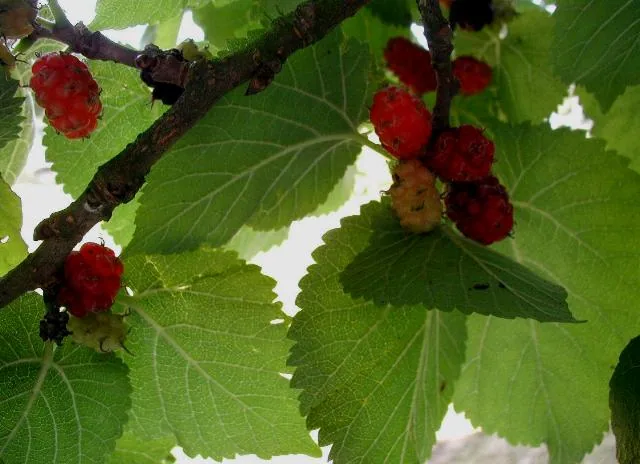
The main harvesting season is August and September. Pick the fruits on the lower branches individually when ripe, wearing gloves if you want to avoid staining your hands.
— How to grow mulberries | RHS Guide [2] How to harvest: Pick ripe fruits on the lower branches individually, wearing gloves to avoid staining; for large trees, shake the branches over a sheet spread on the ground.
Pick the fruits on the lower branches individually when ripe, wearing gloves if you want to avoid staining your hands. The easiest way to gather fruit from large trees is by shaking the branches over a sheet spread on the ground.
— How to grow mulberries | RHS Guide [2] - Pollination
Self-fertile: one tree is enough for a good crop
What the sources say (2)
Fruit set: Self-fertile: sets fruit with its own pollen
Mulberry trees are self-fertile, so you only need one to produce a good crop.
— How to grow mulberries | RHS Guide [2] What it needs: One tree is enough for a good crop.
Mulberry trees are self-fertile, so you only need one to produce a good crop.
— How to grow mulberries | RHS Guide [2] - Pests
Birds; leaf spot, coral spot and powdery mildew
What the sources say (4)
Pests: birds
Birds will help themselves to the berries too, but will hopefully leave plenty, hidden among the leaves, for you to enjoy.
— How to grow mulberries | RHS Guide [2] Diseases: fungal leaf spot, coral spot, powdery mildews
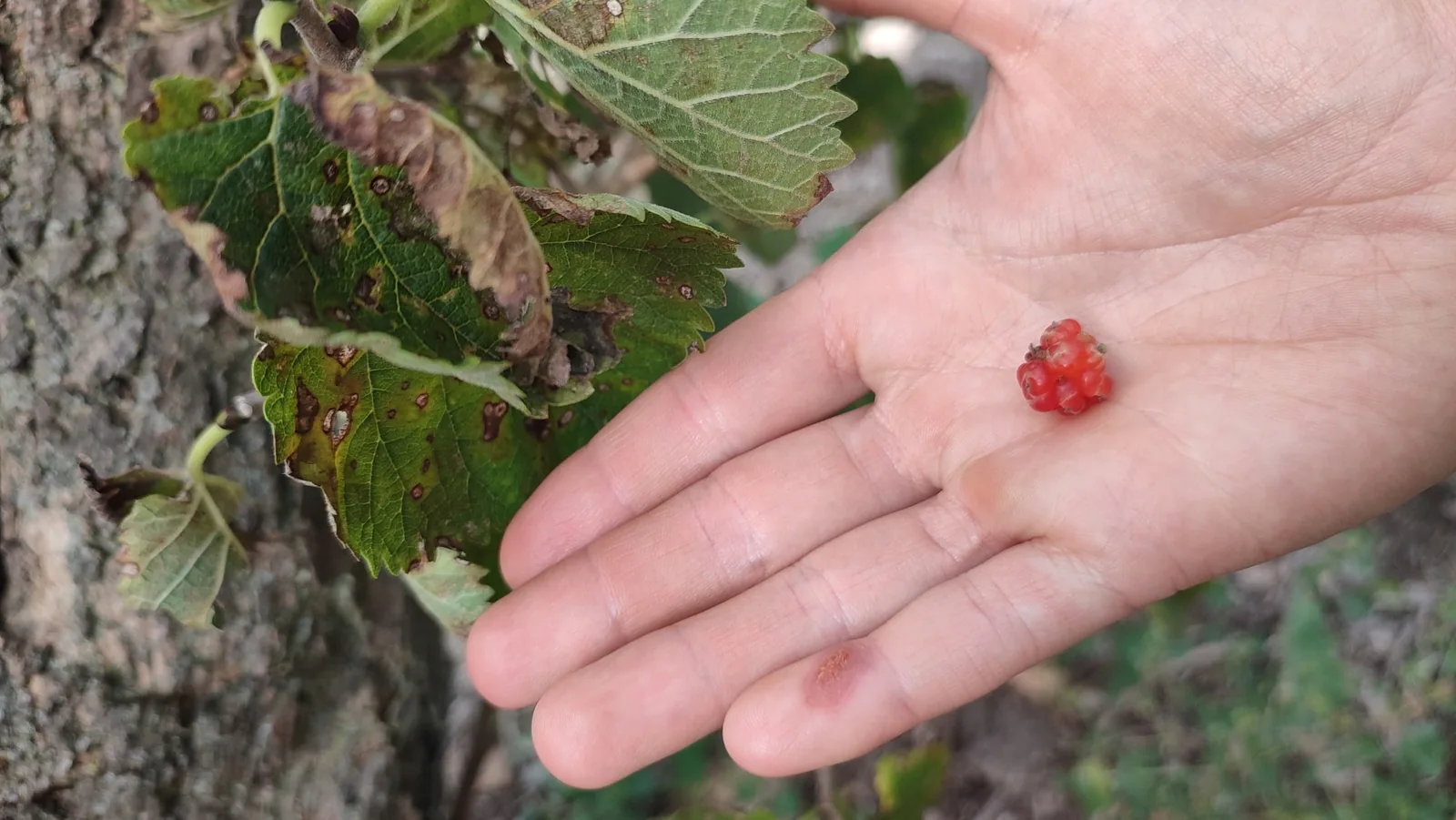
Mulberry trees bear attractive leaves and tasty fruit but can be affected by a number of diseases, such as fungal leaf spot.
— How to grow mulberries | RHS Guide [2] Coral spot is a fungal disease of woody plants causing branches to die back.
— How to grow mulberries | RHS Guide [2] Powdery mildews are a group of related fungi which attack a wide range of plants, causing a white, dusty coating on leaves, stems and flowers.
— How to grow mulberries | RHS Guide [2] - Watch out
Be patient: the first fruit comes after 8 years
What the sources say (1)
Years to first fruit: around 8 years
Black mulberry trees can be slow to start fruiting, taking around eight years, but are well worth the wait, and its varieties often fruit more quickly.
— How to grow mulberries | RHS Guide [2] - Size
33–49 ft tall and up to 33 ft wide
What the sources say (2)
Mature height: 1000-1500 cm (10-15 m)
The species typically grows to a height of 10–15 metres, with a crown diameter of up to 10 metres, forming a dense canopy that provides both shade and ornamental value in urban and rural landscapes
— Morus nigra - EUFORGEN European forest genetic resources programme [1] Mature width: up to 1000 cm (10 m, crown diameter)
The species typically grows to a height of 10–15 metres, with a crown diameter of up to 10 metres, forming a dense canopy that provides both shade and ornamental value in urban and rural landscapes
— Morus nigra - EUFORGEN European forest genetic resources programme [1] - Propagation
Hardwood cuttings, from mid-fall to late winter
What the sources say (2)
Propagation: Hardwood cuttings taken between mid-autumn and late winter
To make new mulberry trees from an existing one, take hardwood cuttings
— How to grow mulberries | RHS Guide [2] between mid-autumn and late winter. Root these either into pots of peat-free cuttings
— How to grow mulberries | RHS Guide [2] - Containers
Grows in containers; keep it moist and feed every two weeks while growing
What the sources say (5)
In containers: Yes
Compact mulberry trees are suitable for growing in large containers, ideally 50cm (20in) wide and deep, or larger.
— How to grow mulberries | RHS Guide [2] Watering notes: Container-grown trees need a steady supply of moisture through the growing season; water early in the morning or in the evening
Mulberry trees in containers need a steady supply of moisture throughout the growing season
— How to grow mulberries | RHS Guide [2] Try to water early in the morning or in the evening to limit moisture loss from evaporation, ideally using stored rainwater.
— How to grow mulberries | RHS Guide [2] How often: Usually none in regularly mulched soil; feed only when harvests are poor or deficiency appears
in containers: Mulberries in containers benefit from regular feeding. Either apply a balanced or high-potassium organic liquid fertiliser fortnightly through the growing season
— How to grow mulberries | RHS Guide [2] Mulberry trees growing in regularly mulched soil shouldn't need any additional feeding. However, if harvests are especially poor or your tree is showing signs of nutrient deficiency, apply an organic granular fertiliser to the soil in early spring.
— How to grow mulberries | RHS Guide [2]
Overview
Black mulberry is a long-lived deciduous fruit tree that grows large and can be planted as a lawn centrepiece or against a warm wall. [2][1] Newly planted trees need water in dry spells for the first few years, and pruning is done while the tree is dormant because it bleeds sap. [2]
This record is incomplete: the sources we read do not cover every field yet.
Not yet covered by our sources: Spacing
Black Mulberry care
How to water Black Mulberry
Watering
Water newly planted trees during dry spells for the first few years; afterwards no routine watering except in prolonged dry spells or very free-draining soil
What the sources say (1)
Water newly-planted mulberry trees during dry spells for the first few years. After that, they shouldn't need routine watering, except during prolonged dry spells or where they are grown in very free-draining soil.Watering notes
Container-grown trees need a steady supply of moisture through the growing season; water early in the morning or in the evening
What the sources say (2)
Mulberry trees in containers need a steady supply of moisture throughout the growing seasonTry to water early in the morning or in the evening to limit moisture loss from evaporation, ideally using stored rainwater.How much light Black Mulberry needs
Sunny, sheltered position
What the sources say (1)
Choose a sunny, sheltered planting spot, where the tree will have plenty of room to develop its wide shapeWhere to grow Black Mulberry
In containers
Yes
What the sources say (1)
Compact mulberry trees are suitable for growing in large containers, ideally 50cm (20in) wide and deep, or larger.Spacing
Not stated in the sources we read.
How to propagate Black Mulberry
Hardwood cuttings taken between mid-autumn and late winter
How to grow Black Mulberry
The plant
Family
Moraceae
What the sources say (1)
Black mulberry ( Morus nigra ) is a long-lived deciduous fruit tree belonging to the Moraceae family.Mature height
1000-1500 cm (10-15 m)
What the sources say (1)
The species typically grows to a height of 10–15 metres, with a crown diameter of up to 10 metres, forming a dense canopy that provides both shade and ornamental value in urban and rural landscapesMature width
up to 1000 cm (10 m, crown diameter)
What the sources say (1)
The species typically grows to a height of 10–15 metres, with a crown diameter of up to 10 metres, forming a dense canopy that provides both shade and ornamental value in urban and rural landscapesYears to first fruit
around 8 years
What the sources say (1)
Black mulberry trees can be slow to start fruiting, taking around eight years, but are well worth the wait, and its varieties often fruit more quickly.Harvest and storage
How to harvest
Pick ripe fruits on the lower branches individually, wearing gloves to avoid staining; for large trees, shake the branches over a sheet spread on the ground.
What the sources say (1)
Pick the fruits on the lower branches individually when ripe, wearing gloves if you want to avoid staining your hands. The easiest way to gather fruit from large trees is by shaking the branches over a sheet spread on the ground.Pests and diseases
Pests
birds
What the sources say (1)
Birds will help themselves to the berries too, but will hopefully leave plenty, hidden among the leaves, for you to enjoy.Diseases
fungal leaf spot, coral spot, powdery mildews
What the sources say (3)
Mulberry trees bear attractive leaves and tasty fruit but can be affected by a number of diseases, such as fungal leaf spot.Coral spot is a fungal disease of woody plants causing branches to die back.Powdery mildews are a group of related fungi which attack a wide range of plants, causing a white, dusty coating on leaves, stems and flowers.Fertilizing
When
Early spring, only if harvests are poor or the tree shows nutrient deficiency
What each source says
in containers: Through the growing season
What the sources say (2)
in containers: Mulberries in containers benefit from regular feeding. Either apply a balanced or high-potassium organic liquid fertiliser fortnightly through the growing seasonMulberry trees growing in regularly mulched soil shouldn't need any additional feeding. However, if harvests are especially poor or your tree is showing signs of nutrient deficiency, apply an organic granular fertiliser to the soil in early spring.How often
Usually none in regularly mulched soil; feed only when harvests are poor or deficiency appears
What each source says
in containers: Every two weeks through the growing season
What the sources say (2)
in containers: Mulberries in containers benefit from regular feeding. Either apply a balanced or high-potassium organic liquid fertiliser fortnightly through the growing seasonMulberry trees growing in regularly mulched soil shouldn't need any additional feeding. However, if harvests are especially poor or your tree is showing signs of nutrient deficiency, apply an organic granular fertiliser to the soil in early spring.Natural fertilizers
Garden compost or well-rotted manure in the planting hole on poor soil; organic granular fertiliser when needed
What each source says
in containers: Balanced or high-potassium organic liquid fertiliser
What the sources say (3)
in containers: Mulberries in containers benefit from regular feeding. Either apply a balanced or high-potassium organic liquid fertiliser fortnightly through the growing seasonIf your soil is poor, add a bucketful of garden compost or well-rotted manure to the soil you remove from your planting hole, and use this to backfill after planting.Mulberry trees growing in regularly mulched soil shouldn't need any additional feeding. However, if harvests are especially poor or your tree is showing signs of nutrient deficiency, apply an organic granular fertiliser to the soil in early spring.Pollination
Fruit set
Self-fertile: sets fruit with its own pollen
What the sources say (1)
Mulberry trees are self-fertile, so you only need one to produce a good crop.What it needs
One tree is enough for a good crop.
What the sources say (1)
Mulberry trees are self-fertile, so you only need one to produce a good crop.Pruning
When to prune
While dormant, between leaf fall in autumn and mid-winter, because mulberries bleed a lot of sap if pruned at other times; established free-standing trees need very little pruning.
What each source says
espalier: In late summer, shorten the new side-shoots to three or four leaves to produce short fruiting spurs.
What the sources say (3)
espalier: shorten the new side-shoots that sprout from branches to three or four leaves, to produce short fruiting spurs. Do this in late summer, just as growth is slowing down.Pruning is best done while the tree is dormant, between leaf fall in autumn and mid-winter, as mulberries bleed a lot of sapEstablished free-standing mulberries need very little pruning and can be left to develop a naturally wide shape, often rather crooked as they age.Winter chill
Chill hours
400–450 hours between 0 and 7.2 °C [32–45 °F]
What each source says
coltura «Mulberry»: 400–450 hours
What the sources say (3)
coltura «Mulberry»: Mulberry Chill hours: 400 to 450 The mulberry tree that is most commonly seen in the San Francisco Bay Area is fruitless white mulberry (Morus alba).Mulberry Chill hours: 400 to 450 The mulberry tree that is most commonly seen in the San Francisco Bay Area is fruitless white mulberry (Morus alba).Chill hours are accumulated from November through February when temperatures are between 32° and 45°F.Black Mulberry pests and problems
Coral spot
Symptom: Branches die back
What the sources say (1)
Coral spot is a fungal disease of woody plants causing branches to die back.
— How to grow mulberries | RHS Guide [2]
Remedies
Each remedy shows what official sources say about it; traditional remedies without an official source are marked as such. Harmful ones are listed so you know to avoid them.
Treating the plant
mulberry leaf spot
collect and dispose of fallen leaves Official source, not independently tested
Homemade products are not recommended as they are unregulated and usually untested.
— rhs.org.uk [4] How: Collect leaves that fall prematurely from an affected tree and dispose of them by burning, burial or green waste, together with all the other leaves when they fall in autumn.
Ensure that any leaves falling prematurely from an affected tree are collected and disposed of (by burning, burial or consigning to the council green waste
— rhs.org.uk [4]
bacterial leaf spot
cut out and burn affected shoots Official source, not independently tested
How: Cut out the affected shoots and burn them; collect and dispose of the fallen leaves.
Oozing bacterial slime may be visible in wet weather causing dieback of the shoots. The affected shoots should be cut out and burned.
— rhs.org.uk [4]
Calendar
Autumn to spring while dormant; best in spring as the soil warms
What the sources say (1)
and container-grown trees are best planted while dormant, from autumn to spring, but should settle in best in spring as the soil is warming up.August and September
What the sources say (1)
The main harvesting season is August and September. Pick the fruits on the lower branches individually when ripe, wearing gloves if you want to avoid staining your hands.While dormant, between leaf fall in autumn and mid-winter
What the sources say (1)
Pruning is best done while the tree is dormant, between leaf fall in autumn and mid-winter, as mulberries bleed a lot of sapMonths as given by the sources, which are mostly from the United States (northern hemisphere). In the southern hemisphere they shift by about six months.
Edibility
Reported by the source, quoted verbatim. Do not eat a plant on the basis of this page alone: identification mistakes can be dangerous.
Mulberries are delicious eaten raw, or can be turned into aromatic jam
[2]
Similar plants
- Mulberry Morus rubra
- White Mulberry Morus alba
- Bengal Fig Ficus benghalensis
- Breadfruit Artocarpus altilis
- Creeping Fig Ficus pumila
- Ficus religiosa Ficus religiosa
- Fig Ficus carica
- Ginseng Ficus Ficus microcarpa
Sources
Every value above is quoted from these documents. Links lead to the original publisher.
- Morus nigra - EUFORGEN European forest genetic resources programme · euforgen.org, consulted
- How to grow mulberries | RHS Guide · rhs.org.uk, consulted
- escholarship.org · escholarship.org
- rhs.org.uk · rhs.org.uk
Written by Emilio Marruso · last checked