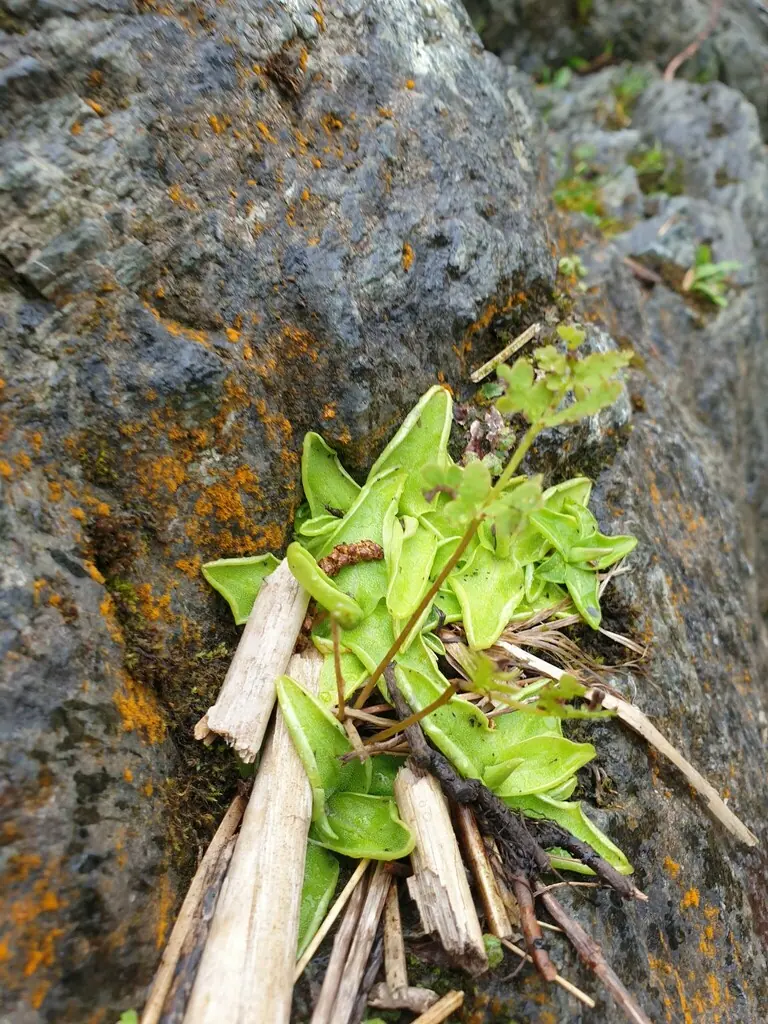
How to Grow and Care for Common butterwort
Pinguicula vulgaris
Written by Emilio Marruso · last checked
At a glance
Butterwort is a perennial that loves wet feet: keep its soil always very damp and it comes back year after year. Sow the seeds outdoors at the beginning of fall where winters are cold, since they need a cold spell to sprout. Its leaves even have a traditional use: they curdle milk into something thick like yogurt, said to be delicious.
- Water
Keep the soil always very damp
What the sources say (2)
- Harvest
The leaves curdle milk; after a day or two it turns thick like yogurt
- Propagation
From seed that has had a cold spell, or by separating crowded plants after the first winter
What the sources say (2)
Propagation: Seed (cold-stratified); separating crowded plants after the first winter
Cold temperate Pinguicula seeds need temperatures from -10°C to 5°C (14°F to 40°F) for 8 to 12 weeks to germinate.
— Growing cold temperate Pinguicula | ICPS [3] After the first winter of growing, the plants should be separated when growing too near to each other.
— Growing cold temperate Pinguicula | ICPS [3] - Sowing
Sow outdoors at the beginning of fall where winters are cold; the seeds need cold
What the sources say (3)
Sowing: Beginning of autumn (outdoors, in regions with cold winters)
CP-growers in regions with cold winters can sow the seed outside in pots on there preferred soil mixture at the beginning of autumn.
— Growing cold temperate Pinguicula | ICPS [3] Propagation: Seed (cold-stratified); separating crowded plants after the first winter
Cold temperate Pinguicula seeds need temperatures from -10°C to 5°C (14°F to 40°F) for 8 to 12 weeks to germinate.
— Growing cold temperate Pinguicula | ICPS [3] After the first winter of growing, the plants should be separated when growing too near to each other.
— Growing cold temperate Pinguicula | ICPS [3]
Overview
Common butterwort is a widespread cold temperate carnivorous Pinguicula that forms winter buds in autumn. [3] It needs cold winters to survive and its soil must always be very damp. [3]
This record is incomplete: the sources we read do not cover every field yet.
Not yet covered by our sources: Light, Hardiness, coldest zone, Hardiness, warmest zone, Pruning
Common butterwort care
How to water Common butterwort
Keep the soil always very damp
How much light Common butterwort needs
Not stated in the sources we read.
How much cold Common butterwort can take
Hardiness, coldest zone
Not stated in the sources we read.
Hardiness, warmest zone
Not stated in the sources we read.
How to propagate Common butterwort
Seed (cold-stratified); separating crowded plants after the first winter
What the sources say (2)
Cold temperate Pinguicula seeds need temperatures from -10°C to 5°C (14°F to 40°F) for 8 to 12 weeks to germinate.After the first winter of growing, the plants should be separated when growing too near to each other.How to grow Common butterwort
The plant
Life cycle
perennial
What the sources say (1)
It is a perennial and grows primarily in the subalpine or subarctic biome.Family
Lentibulariaceae
What the sources say (1)
Lentibulariaceae Pinguicula ## Pinguicula vulgaris L. First published in Sp. Pl.: 17 (1753) This species is acceptedRemedies
The sources we checked give no remedies for this plant.
Calendar
Sowing
Beginning of autumn (outdoors, in regions with cold winters)
What the sources say (1)
CP-growers in regions with cold winters can sow the seed outside in pots on there preferred soil mixture at the beginning of autumn.Pruning
Not stated in the sources we read.
Months as given by the sources, which are mostly from the United States (northern hemisphere). In the southern hemisphere they shift by about six months.
Edibility
Reported by the source, quoted verbatim. Do not eat a plant on the basis of this page alone: identification mistakes can be dangerous.
The milk is then left for a day or two until it sours when it becomes solid like yoghurt and is considered to be most delicious.
[2]
Similar plants
- Blue Butterwort Pinguicula caerulea
- Yellow Butterwort Pinguicula lutea
- Floating Bladderwort Utricularia gibba
- Purple Bladderwort Utricularia purpurea
- Slender Bladderwort Utricularia subulata
- Swollen Bladderwort Utricularia inflata
- Aaron's Beard Hypericum calycinum
- Abies grandis Abies grandis
Sources
Every value above is quoted from these documents. Links lead to the original publisher.
- Pinguicula vulgaris L. | Plants of the World Online | Kew Science · powo.science.kew.org, consulted
- Pinguicula vulgaris - Useful Temperate Plants · temperate.theferns.info, consulted
- Growing cold temperate Pinguicula | ICPS · carnivorousplants.org, consulted
- British Wild Plant: Pinguicula vulgaris Common Butterwort · ukwildflowers.com, consulted
- How to Grow and Care for Butterworts | Gardener’s Path · gardenerspath.com, consulted
- Technical Refereed Contribution · butbn.cas.cz, consulted
- Günther's Site - Photos of European Plants - Pinguicula vulgaris · guenther-blaich.de, consulted
- Common butterwort (Pinguicula vulgaris) - Garden.org · garden.org, consulted
Written by Emilio Marruso · last checked