
How to Grow and Care for Chinese rhubarb
Rheum palmatum
Written by Emilio Marruso · last checked
Toxic to: People · Why
At a glance
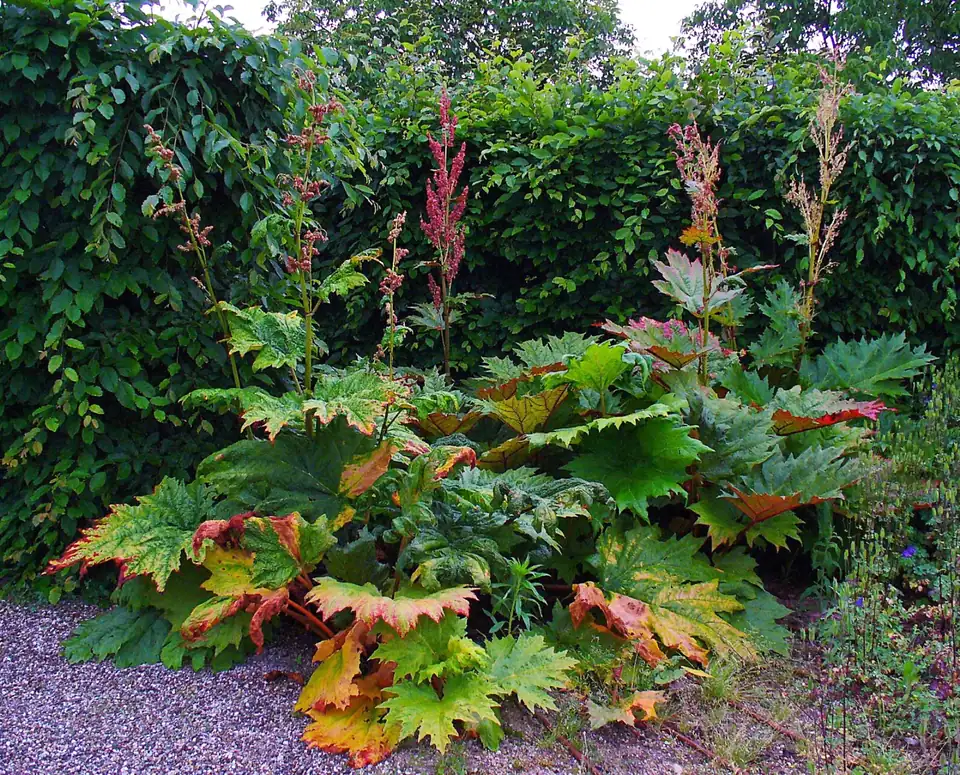
Chinese rhubarb is a striking perennial that grows 7 to 10 feet tall when it flowers, so give it room: 6 feet each way. It is happy in full sun or partial shade as long as the soil stays moist, with a yearly mulch to keep its roots cool in summer. Its pleasantly sour leaf stems can be eaten raw or cooked.
- Sun
Full sun to partial shade
What the sources say (3)
Light: Full sun to partial shade
Grow Rheum palmatum in humus-rich, acid to neutral, moist soil in full sun to partial shade.
— Rheum palmatum (Ornamental Rhubarb) | BBC Gardeners World Magazine [2] Full sun only if soil kept moist, Part sun/part shade
— Chinese rhubarb - KPU Plant DB [5] Light full sun Shade tolerance light shade
— Turkey Rhubarb (Rheum palmatum) — Practical Plants [4] - Water
Keep the soil moist with regular watering; mulch every year to keep the roots cool
What the sources say (5)
Watering: Keep the soil moist; water regularly; not drought tolerant
Grow Rheum palmatum in humus-rich, acid to neutral, moist soil in full sun to partial shade.
— Rheum palmatum (Ornamental Rhubarb) | BBC Gardeners World Magazine [2] If not, find the right sunny spot and be prepared to water regularly.
— What Is Chinese Rhubarb – Learn About Growing Ornamental Rhubarb | Gardening Know How [3] Tolerates Nutritionally Poor Soil No Drought intolerant
— Turkey Rhubarb (Rheum palmatum) — Practical Plants [4] Watering notes: Mulch annually to conserve moisture and keep roots cool in summer
Cut down flowering stems after blooming and mulch annually to conserve moisture.
— Rheum palmatum (Ornamental Rhubarb) | BBC Gardeners World Magazine [2] An attractive covering of mulch helps retain moisture and keep roots cool in summer.
— What Is Chinese Rhubarb – Learn About Growing Ornamental Rhubarb | Gardening Know How [3] - Spacing
6 ft apart each way
What the sources say (1)
Spacing: 180 cm (1.8 metres apart each way)
Other forms can also be used, they are best planted about 1.8 metres apart each way
— Turkey Rhubarb (Rheum palmatum) — Practical Plants [4] - Planting
Plant divisions in late spring or early summer, seedlings in spring
What the sources say (1)
Planting: Late spring or early summer (divisions); spring (seedlings)
until they are well established before planting them out in late spring or early summer.
— Turkey Rhubarb (Rheum palmatum) — Practical Plants [4] - Pruning
Cut down the flower stems after flowering
What the sources say (1)
Pruning: After flowering (cut down flowering stems)
Cut down flowering stems after blooming and mulch annually to conserve moisture.
— Rheum palmatum (Ornamental Rhubarb) | BBC Gardeners World Magazine [2] - Harvest
Leaf stems are eaten raw or cooked; roots are dug in October from plants 6 years or older
What the sources say (1)
Harvest: Roots (medicinal): October, from plants at least six years old
The roots are harvested in October from plants that are at least six years old, they are then dried for later use [19] .
— Turkey Rhubarb (Rheum palmatum) — Practical Plants [4] - Size
7 to 10 ft tall when in flower
What the sources say (1)
Mature height: 200-300 cm (2-3 m, during flowering)
Habit: Imposing perennial herbaceous plant, capable of reaching 2–3 metres in height during flowering.
— Rheum palmatum L. – Giardino della Flora Appenninica [1] - Propagation
From seed or by dividing the plant
What the sources say (2)
Propagation: Seed; division
Multiplying from a single plant is possible by seed or division, called splitting.
— What Is Chinese Rhubarb – Learn About Growing Ornamental Rhubarb | Gardening Know How [3] Division in early spring or autumn [1] [3] .
— Turkey Rhubarb (Rheum palmatum) — Practical Plants [4] - Sowing
Sow in a cold frame in spring, or in fall in a shaded one
What the sources say (1)
Sowing: Autumn in a shaded cold frame; spring in a cold frame
Seed - best sown in autumn in a shaded cold frame [10] . The seed can also be sown in spring in a cold frame.
— Turkey Rhubarb (Rheum palmatum) — Practical Plants [4] - Safety
Never eat the leaves: they are poisonous; only the leaf stems are eaten
Overview
Chinese rhubarb is a large ornamental perennial for moist, humus-rich soil in sun or partial shade. [2][3] It is propagated by seed or by division of the rootstock. [3][4] Only the petioles are used in cooking; the leaves are poisonous because of oxalic acid. [1][4]
This record is incomplete: the sources we read do not cover every field yet.
Not yet covered by our sources: Hardiness, warmest zone
Chinese rhubarb care
How to water Chinese rhubarb
Watering
Keep the soil moist; water regularly; not drought tolerant
What the sources say (3)
Grow Rheum palmatum in humus-rich, acid to neutral, moist soil in full sun to partial shade.If not, find the right sunny spot and be prepared to water regularly.Tolerates Nutritionally Poor Soil
No
Drought
intolerantWatering notes
Mulch annually to conserve moisture and keep roots cool in summer
What the sources say (2)
Cut down flowering stems after blooming and mulch annually to conserve moisture.An attractive covering of mulch helps retain moisture and keep roots cool in summer.How much light Chinese rhubarb needs
Full sun to partial shade
What the sources say (3)
Grow Rheum palmatum in humus-rich, acid to neutral, moist soil in full sun to partial shade.Full sun only if soil kept moist, Part sun/part shadeLight
full sun
Shade tolerance
light shadeHow much cold Chinese rhubarb can take
Hardiness, coldest zone
The sources give different values depending on region, zone or growing conditions.
What each source says
According to KPU Plant Database: 5 [winter low −28.9 to −23.3 °C (−20 to −10 °F)]
According to Practical Plants: 7 [winter low −17.8 to −12.2 °C (0 to 10 °F)]
Hardiness, warmest zone
Not stated in the sources we read.
Where to grow Chinese rhubarb
180 cm (1.8 metres apart each way)
What the sources say (1)
Other forms can also be used, they are best planted about 1.8 metres apart each wayHow to propagate Chinese rhubarb
Seed; division
How to grow Chinese rhubarb
The plant
Life cycle
perennial
What the sources say (1)
Habit: Imposing perennial herbaceous plant, capable of reaching 2–3 metres in height during flowering.Family
Polygonaceae
What the sources say (1)
Scientific name: Rheum palmatum L. Common name: Rhubarb Family: PolygonaceaeMature height
200-300 cm (2-3 m, during flowering)
What the sources say (1)
Habit: Imposing perennial herbaceous plant, capable of reaching 2–3 metres in height during flowering.Chinese rhubarb pests and problems
Oxalic acid in the leaves
Symptom: Leaves can be toxic if eaten in quantity
What to do: Do not eat the leaf blades
What the sources say (1)
However, the oxalic acid in the leaves can create problems when consumed in quantity and was often found to be toxic.
— What Is Chinese Rhubarb – Learn About Growing Ornamental Rhubarb | Gardening Know How [3]
Remedies
Each remedy shows what official sources say about it; traditional remedies without an official source are marked as such. Harmful ones are listed so you know to avoid them.
First aid
First aid: not a substitute for a doctor
skin or eye contact with the leaves
flush with water Official source, not independently tested
Seek immediate medical help. DO NOT make a person throw up unless told to do so by poison control or a health care provider.
— medlineplus.gov [6] How: Flush the skin and eyes with lots of water, if the plant touched these areas.
Flush the skin and eyes with lots of water, if the plant touched these areas.
— medlineplus.gov [6]
Is Chinese rhubarb poisonous?
Reported by the source, quoted verbatim. This is not medical or veterinary advice: if a person or an animal may have eaten this plant, contact a poison control centre or a veterinarian.
Calendar
Sowing
Autumn in a shaded cold frame; spring in a cold frame
What the sources say (1)
Seed - best sown in autumn in a shaded cold frame [10] . The seed can also be sown in spring in a cold frame.Planting
Late spring or early summer (divisions); spring (seedlings)
What the sources say (1)
until they are well established before planting them out in late spring or early summer.Harvest
Roots (medicinal): October, from plants at least six years old
What the sources say (1)
The roots are harvested in October from plants that are at least six years old, they are then dried for later use [19] .Pruning
After flowering (cut down flowering stems)
What the sources say (1)
Cut down flowering stems after blooming and mulch annually to conserve moisture.Months as given by the sources, which are mostly from the United States (northern hemisphere). In the southern hemisphere they shift by about six months.
Edibility
Reported by the source, quoted verbatim. Do not eat a plant on the basis of this page alone: identification mistakes can be dangerous.
Indicative values
Values from a secondary source, not checked word for word like the rest of this page. Use them as a starting point.
- Hours of sun
- 6-8 hoursIndicative value, adapt it to your climate · Secondary source
- Soil
- Bog, Humus richIndicative value, adapt it to your climate · Secondary source
- Soil pH
- 5.5-7Indicative value, adapt it to your climate · Secondary source
- Care level
- MediumIndicative value, adapt it to your climate · Secondary source
- Growth rate
- HighIndicative value, adapt it to your climate · Secondary source
- Pests
- Beetles, weevils, Pest resistant, Disease resistant, Deer resistant, Rabbit resistantIndicative value, adapt it to your climate · Secondary source
Similar plants
- Rhubarb Rheum rhabarbarum
- Rheum australe Rheum australe
- Bitter Dock Rumex obtusifolius
- Bloody Dock Rumex sanguineus
- Coral Vine Antigonon leptopus
- Desert Trumpet Eriogonum inflatum
- Jumpseed Persicaria virginiana
- Sheep Sorrel Rumex acetosella
Sources
Every value above is quoted from these documents. Links lead to the original publisher.
- Rheum palmatum L. – Giardino della Flora Appenninica · giardinocapracotta.unimol.it, consulted
- Rheum palmatum (Ornamental Rhubarb) | BBC Gardeners World Magazine · gardenersworld.com, consulted
- What Is Chinese Rhubarb – Learn About Growing Ornamental Rhubarb | Gardening Know How · gardeningknowhow.com, consulted
- Turkey Rhubarb (Rheum palmatum) — Practical Plants · practicalplants.org, consulted
- Chinese rhubarb - KPU Plant DB · plantdatabase.kpu.ca, consulted
- medlineplus.gov · medlineplus.gov
Written by Emilio Marruso · last checked