
How to Grow and Care for Rheum australe
Rheum australe
Written by Emilio Marruso · last checked
Toxic to: People · Why
At a glance
This rhubarb has leaf stalks with an excellent flavor, something like apples, that you can eat raw or boiled with a sprinkle of salt and pepper, or even pickled. Give it full sun or partial shade, moist but well-drained soil and moderate, steady watering. Sow the seeds in a cold frame, then plant out in spring after their first winter.
- Sun
Full sun to partial shade
What the sources say (3)
Light: Full sun to partial shade
Himalayan rhubarb will grow well in full sun , but also tolerates partial shade
— Himalayan Rhubarb Information: How To Grow Himalayan Rhubarb Plants | Gardening Know How [5] Light full sun Shade tolerance light shade Water moderate
— Himalayan Rhubarb (Rheum australe) — Practical Plants [2] Humus-rich, porous and well-drained soil and exposed or partially shaded habitat are more suitable for its cultivation
—  [4] - Water
Moderate water; it does not handle drought
What the sources say (1)
Watering: Moderate water; not drought tolerant
Water moderate Hardiness Zone 6+ Soil textures loamy, clay, heavy clay Soil pH acid, neutral, alkaline Drainage well drained Tolerates Nutritionally Poor Soil No Drought intolerant
— Himalayan Rhubarb (Rheum australe) — Practical Plants [2] - Cold
Survives winters down to −10 °F (−23.3 °C)
Very hardy · USDA 6 · RHS H7 · Z6
What the sources say (1)
Hardiness, coldest zone: 6 [winter low −23.3 to −17.8 °C (−10 to 0 °F)]
Shade tolerance light shade Water moderate Hardiness Zone 6+
— Himalayan Rhubarb (Rheum australe) — Practical Plants [2] - Soil
Soil that holds moisture but drains well
What the sources say (3)
Watering notes: Moisture-retentive but well-drained soil
Prefers a deep, fertile, moderately heavy, humus rich, moisture retentive, well-drained soil in sun or semi-shade
— Himalayan Rhubarb (Rheum australe) — Practical Plants [2] It prefers soil that is well-drained and rich in nutrients, but unlike some plants, will tolerate heavy soils rich in clay
— Himalayan Rhubarb Information: How To Grow Himalayan Rhubarb Plants | Gardening Know How [5] Humus-rich, porous and well-drained soil and exposed or partially shaded habitat are more suitable for its cultivation
—  [4] - Spacing
2 ft between plants in every direction
What the sources say (2)
- Planting
Plant out in spring, after the seedlings' first winter
What the sources say (4)
Planting: Spring (March-April at lower altitude)
According to Practical Plants: prick the seedlings out into individual pots and grow them on in the greenhouse or cold frame for their first winter, planting them out in the spring.
— Himalayan Rhubarb (Rheum australe) — Practical Plants [2] lower altitude (Garhwal Himalaya): Since the seedlings are transplanted during March–April at lower altitude, best seed sowing time was observed during October just after collecting and drying the seeds
—  [4] prick the seedlings out into individual pots and grow them on in the greenhouse or cold frame for their first winter, planting them out in the spring.
— Himalayan Rhubarb (Rheum australe) — Practical Plants [2] Since the seedlings are transplanted during March–April at lower altitude, best seed sowing time was observed during October just after collecting and drying the seeds
—  [4] - Harvest
Eat the leaf stalks raw, boiled or pickled; they taste a bit like apples
- Propagation
Grow it from seed or by dividing the roots
What the sources say (2)
Propagation: Seed, division of the rootstock
Plant propagation is done by seeds and intact or chopped rootstocks
—  [4] Division in early spring or autumn [1] [3] . Divide up the rootstock with a sharp spade or knife, making sure that there is at least one growth bud on each division.
— Himalayan Rhubarb (Rheum australe) — Practical Plants [2] - Sowing
Sow in autumn in a shaded cold frame, or in spring in a cold frame
What the sources say (4)
Sowing: Autumn (October), also spring, in a cold frame
According to Practical Plants: Seed - best sown in autumn in a shaded cold frame [7] . The seed can also be sown in spring in a cold frame.
— Himalayan Rhubarb (Rheum australe) — Practical Plants [2] lower altitude (Garhwal Himalaya): Since the seedlings are transplanted during March–April at lower altitude, best seed sowing time was observed during October just after collecting and drying the seeds
—  [4] Seed - best sown in autumn in a shaded cold frame [7] . The seed can also be sown in spring in a cold frame.
— Himalayan Rhubarb (Rheum australe) — Practical Plants [2] Since the seedlings are transplanted during March–April at lower altitude, best seed sowing time was observed during October just after collecting and drying the seeds
—  [4] - Safety
If you have gout, arthritis or kidney stones, be careful eating it: it can make them worse
Overview
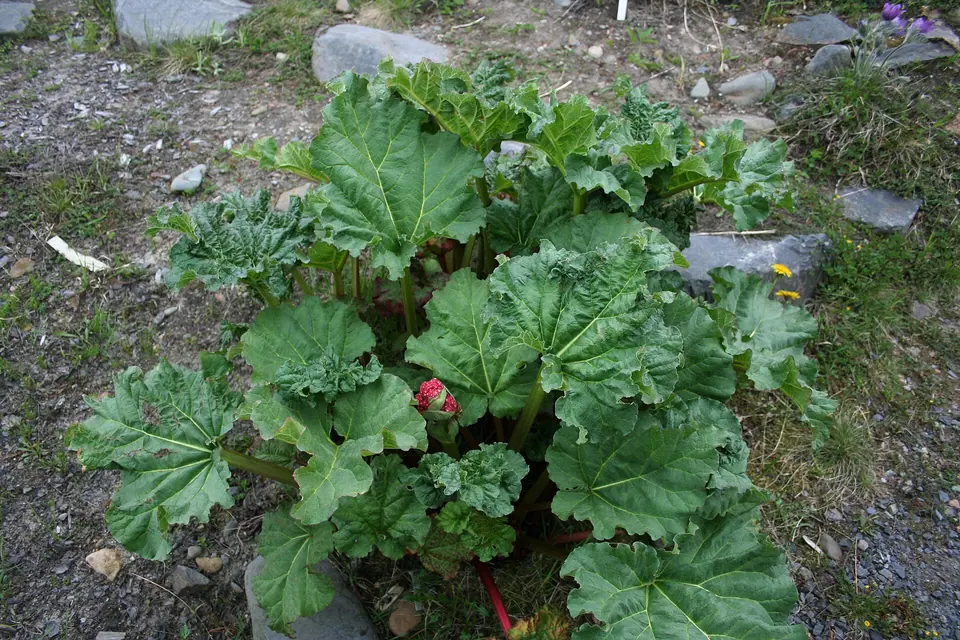
Rheum australe produces a basal clump of large leaves and, in summer, flowering stems up to 150-200 cm [59–79 in] tall. [1] It is grown mostly as an ornamental, and its leaf stalks are eaten. [5][4] The plant, especially the leaf blades, contains toxic compounds. [1]
This record is incomplete: the sources we read do not cover every field yet.
Not yet covered by our sources: Hardiness, warmest zone, Pruning
Rheum australe care
Measurements in square brackets are our conversion into the other unit system; the quoted text is unchanged.
How to water Rheum australe
Watering
Moderate water; not drought tolerant
What the sources say (1)
Water
moderate
Hardiness
Zone 6+
Soil textures
loamy, clay, heavy clay
Soil pH
acid, neutral, alkaline
Drainage
well drained
Tolerates Nutritionally Poor Soil
No
Drought
intolerantWatering notes
Moisture-retentive but well-drained soil
What the sources say (3)
Prefers a deep, fertile, moderately heavy, humus rich, moisture retentive, well-drained soil in sun or semi-shadeIt prefers soil that is well-drained and rich in nutrients, but unlike some plants, will tolerate heavy soils rich in clayHumus-rich, porous and well-drained soil and exposed or partially shaded habitat are more suitable for its cultivationHow much light Rheum australe needs
Full sun to partial shade
What the sources say (3)
Himalayan rhubarb will grow well in full sun , but also tolerates partial shadeLight
full sun
Shade tolerance
light shade
Water
moderateHumus-rich, porous and well-drained soil and exposed or partially shaded habitat are more suitable for its cultivationHow much cold Rheum australe can take
Hardiness, coldest zone
6 [winter low −23.3 to −17.8 °C (−10 to 0 °F)]
What the sources say (1)
Shade tolerance
light shade
Water
moderate
Hardiness
Zone 6+Hardiness, warmest zone
Not stated in the sources we read.
Where to grow Rheum australe
60 x 60 cm [24 in]
What each source says
cultivation trial, Rahla (Manali), Himachal Pradesh: 60 x 60 cm [24 in]
How to propagate Rheum australe
Seed, division of the rootstock
What the sources say (2)
Plant propagation is done by seeds and intact or chopped rootstocksDivision in early spring or autumn [1] [3] . Divide up the rootstock with a sharp spade or knife, making sure that there is at least one growth bud on each division.Remedies
Each remedy shows what official sources say about it; traditional remedies without an official source are marked as such. Harmful ones are listed so you know to avoid them.
First aid
First aid: not a substitute for a doctor
swallowed plant
wash out child's mouth Official source, not independently tested
Call the Poisons Information Centre on 13 11 26 for further information.
— poisonsinfo.nsw.gov.au [6] How: If the plant was swallowed, remove remaining pieces and wash out child's mouth.
If the plant was swallowed, remove remaining pieces and wash out child's mouth.
— poisonsinfo.nsw.gov.au [6]
Is Rheum australe poisonous?
Reported by the source, quoted verbatim. This is not medical or veterinary advice: if a person or an animal may have eaten this plant, contact a poison control centre or a veterinarian.
People with a tendency to rheumatism, arthritis, gout, kidney stones or hyperacidity should take especial caution if including this plant in their diet since it can aggravate their condition
[1]- Poisonous parts
Just remember that only the stalks of rhubarb are edible. The leaves and roots are toxic
[5]- Toxic principle
The plant, but especially the leaf blades, contains several toxic compounds, particularly anthraquinone glycosides, but also soluble oxalates and calcium oxylate crystals
[1]- Symptoms
At lower doses these can cause abdominal cramps, burning of the mouth and throat, headache, weakness, nausea and vomiting
[1]- Severity
In larger, quantities it can lead to coma and death, though generally very large quantities need to be eaten for the plant to be fatal
[1]
Calendar
Autumn (October), also spring, in a cold frame
What each source says
According to Practical Plants: Autumn in a shaded cold frame; also spring in a cold frame
lower altitude (Garhwal Himalaya): October
What the sources say (4)
According to Practical Plants: Seed - best sown in autumn in a shaded cold frame [7] . The seed can also be sown in spring in a cold frame.lower altitude (Garhwal Himalaya): Since the seedlings are transplanted during March–April at lower altitude, best seed sowing time was observed during October just after collecting and drying the seedsSeed - best sown in autumn in a shaded cold frame [7] . The seed can also be sown in spring in a cold frame.Since the seedlings are transplanted during March–April at lower altitude, best seed sowing time was observed during October just after collecting and drying the seedsSpring (March-April at lower altitude)
What each source says
According to Practical Plants: Spring, after the first winter
lower altitude (Garhwal Himalaya): March-April
What the sources say (4)
According to Practical Plants: prick the seedlings out into individual pots and grow them on in the greenhouse or cold frame for their first winter, planting them out in the spring.lower altitude (Garhwal Himalaya): Since the seedlings are transplanted during March–April at lower altitude, best seed sowing time was observed during October just after collecting and drying the seedsprick the seedlings out into individual pots and grow them on in the greenhouse or cold frame for their first winter, planting them out in the spring.Since the seedlings are transplanted during March–April at lower altitude, best seed sowing time was observed during October just after collecting and drying the seedsNot stated in the sources we read.
Months as given by the sources, which are mostly from the United States (northern hemisphere). In the southern hemisphere they shift by about six months.
Edibility
Reported by the source, quoted verbatim. Do not eat a plant on the basis of this page alone: identification mistakes can be dangerous.
Leaf stalks are eaten either raw or boiled, sprinkled with salt and pepper
[4]Leaf stem - raw or cooked [8] [2] [5] . An excellent flavour that is something like apples
[2]Leaf stalks are eaten either raw or boiled, sprinkled with salt and pepper. Leaves and flowers are also edible; Rhizomes roots are purgative, astringent, tonic, stomachic and aperient. The petioles are pickled
[4]
Indicative values
Values from a secondary source, not checked word for word like the rest of this page. Use them as a starting point.
- Life cycle
- Herbaceous PerennialIndicative value, adapt it to your climate · Secondary source
- Mature height
- 121.9-213.4 cm (4-7 ft)Indicative value, adapt it to your climate · Secondary source
- Hours of sun
- 6-8 hoursIndicative value, adapt it to your climate · Secondary source
- Drought tolerant
- yesIndicative value, adapt it to your climate · Secondary source
- Soil pH
- 5.5-7Indicative value, adapt it to your climate · Secondary source
- Care level
- MediumIndicative value, adapt it to your climate · Secondary source
- Growth rate
- LowIndicative value, adapt it to your climate · Secondary source
- Pruning
- February, March, April, MayIndicative value, adapt it to your climate · Secondary source
Similar plants
- Chinese rhubarb Rheum palmatum
- Rhubarb Rheum rhabarbarum
- Abies grandis Abies grandis
- Abraham Trachystemon orientalis
- Abyssinian banana Ensete ventricosum
- Acacia longifolia Acacia longifolia
- Acanthus hungaricus Acanthus hungaricus
- Achlys triphylla Achlys triphylla
Sources
Every value above is quoted from these documents. Links lead to the original publisher.
- Rheum australe - Useful Temperate Plants · temperate.theferns.info, consulted
- Himalayan Rhubarb (Rheum australe) — Practical Plants · practicalplants.org, consulted
- Rheum australe (Himalayan rhubarb) · florafinder.org, consulted
-  · ojs.pphouse.org, consulted
- Himalayan Rhubarb Information: How To Grow Himalayan Rhubarb Plants | Gardening Know How · gardeningknowhow.com, consulted
- poisonsinfo.nsw.gov.au · poisonsinfo.nsw.gov.au
Written by Emilio Marruso · last checked