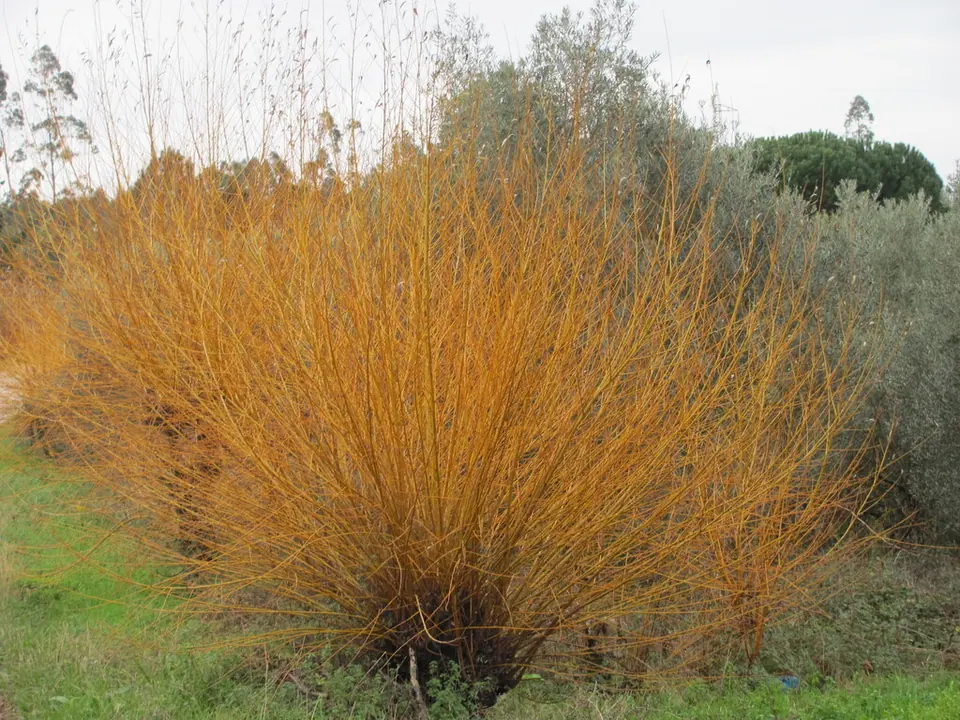
How to Grow and Care for Common osier
Salix viminalis
Written by Emilio Marruso · last checked
At a glance
Osier willow is a sun lover that thrives where many plants struggle: damp, heavy ground, even soil that is wet, poorly drained or flooded now and then. It asks for little food, just a mulch of compost or well-rotted manure. New plants are easy to start from cuttings in winter or summer. Give it at least 20 feet of room and watch it flourish.
- Sun
Sunny spot; it dislikes deep shade
- Water
Likes damp soil and does poorly in dry ground
What the sources say (3)
Watering: Prefers a damp, heavy soil; dislikes dry soils
but prefers a damp, heavy soil in a sunny position
— Salix viminalis - Useful Temperate Plants [1] Dislikes heavy shade and dry soils
— Salix viminalis - Useful Temperate Plants [1] Dislikes heavy shade and dry soils [6] .
— Osier (Salix viminalis) — Practical Plants [4] - Cold
Survives winters down to −30 °F (−34.4 °C)
Very hardy · USDA 4 · RHS H7 · Z4
What the sources say (1)
Hardiness, coldest zone: 4 [winter low −34.4 to −28.9 °C (−30 to −20 °F)]
Light full sun Shade tolerance no shade Water high Hardiness Zone 4+ Soil textures sandy, loamy, clay, heavy clay
— Osier (Salix viminalis) — Practical Plants [4] - Soil
Grows in most soils, best in heavy ones; even wet, poorly drained or sometimes flooded ground
What the sources say (4)
Watering: Prefers a damp, heavy soil; dislikes dry soils
but prefers a damp, heavy soil in a sunny position
— Salix viminalis - Useful Temperate Plants [1] Dislikes heavy shade and dry soils
— Salix viminalis - Useful Temperate Plants [1] Dislikes heavy shade and dry soils [6] .
— Osier (Salix viminalis) — Practical Plants [4] Watering notes: Succeeds in most soils, including wet, ill-drained or intermittently flooded soils
Succeeds in most soils, including wet, ill-drained or intermittently flooded soils
— Salix viminalis - Useful Temperate Plants [1] - Spacing
At least 20 ft between plants
What the sources say (1)
Spacing: 600 cm (6 m minimum)
Écartement minimum de 6 m Approvisionnement en pépinière
— Salix viminalis [7] - Feeding
No regular feeding; mulch with compost or well-rotted manure, feed only if it looks starved
What the sources say (2)
How often: Not routinely; feed only if the tree shows signs of nutrient deficiency
Most willow trees are robust and vigorous and shouldn’t need feeding unless they are showing signs of nutrient deficiencies
— [8] Natural fertilizers: Mulch the soil beneath the tree with well-rotted organic matter such as garden compost or farmyard manure
Most willow trees are robust and vigorous and shouldn’t need feeding unless they are showing signs of nutrient deficiencies - Mulching around the tree with well-rotted organic matter , such as garden compost or farmyard manure
— [8] - Propagation
Cuttings of mature wood from November to February, or half-ripe ones June to August in a frame
What the sources say (3)
Propagation: Seed (surface sown as soon as ripe); cuttings of mature wood, November to February; cuttings of half-ripe wood, June to August in a frame
Seed - must be surface sown as soon as it is ripe in late spring.
— Osier (Salix viminalis) — Practical Plants [4] Cuttings of mature wood of the current year's growth, November to February in a sheltered outdoor bed or planted straight into their permanent position
— Osier (Salix viminalis) — Practical Plants [4] Cuttings of half-ripe wood, June to August in a frame.
— Osier (Salix viminalis) — Practical Plants [4] - Sowing
Sow on the soil surface as soon as the seed is ripe, in late spring
What the sources say (1)
Sowing: Surface sow as soon as ripe, in late spring
Seed - must be surface sown as soon as it is ripe in late spring.
— Osier (Salix viminalis) — Practical Plants [4]
Overview
Salix viminalis is an erect, much-branched deciduous shrub or small tree, one of the most important basket-making willows. [1][2] It prefers a damp, heavy soil in a sunny position and dislikes heavy shade and dry soils. [1]
This record is incomplete: the sources we read do not cover every field yet.
Not yet covered by our sources: Hardiness, warmest zone, Pruning
Common osier care
How to water Common osier
Watering
Prefers a damp, heavy soil; dislikes dry soils
Watering notes
Succeeds in most soils, including wet, ill-drained or intermittently flooded soils
What the sources say (1)
Succeeds in most soils, including wet, ill-drained or intermittently flooded soilsHow much light Common osier needs
How much cold Common osier can take
Hardiness, coldest zone
4 [winter low −34.4 to −28.9 °C (−30 to −20 °F)]
What the sources say (1)
Light
full sun
Shade tolerance
no shade
Water
high
Hardiness
Zone 4+
Soil textures
sandy, loamy, clay, heavy clayHardiness, warmest zone
Not stated in the sources we read.
Where to grow Common osier
600 cm (6 m minimum)
What the sources say (1)
Écartement minimum de 6 m Approvisionnement en pépinièreHow to propagate Common osier
Seed (surface sown as soon as ripe); cuttings of mature wood, November to February; cuttings of half-ripe wood, June to August in a frame
What the sources say (3)
Seed - must be surface sown as soon as it is ripe in late spring.Cuttings of mature wood of the current year's growth, November to February in a sheltered outdoor bed or planted straight into their permanent positionCuttings of half-ripe wood, June to August in a frame.How to grow Common osier
Fertilizing
How often
Not routinely; feed only if the tree shows signs of nutrient deficiency
What the sources say (1)
Most willow trees are robust and vigorous and shouldn’t need feeding unless they are showing signs of nutrient deficienciesNatural fertilizers
Mulch the soil beneath the tree with well-rotted organic matter such as garden compost or farmyard manure
What the sources say (1)
Most willow trees are robust and vigorous and shouldn’t need feeding unless they are showing signs of nutrient deficiencies
- Mulching around the tree with well-rotted organic matter , such as garden compost or farmyard manureMineral fertilizers
The sources give different values depending on region, zone or growing conditions.
What each source says
shrub willow grown as a short-rotation bioenergy crop: Few fertilizer inputs; nitrogen fertilizer as needed
What the sources say (1)
shrub willow grown as a short-rotation bioenergy crop: No annual maintenance of the crop should be necessary, and compared to other crops, willow requires few fertilizer inputs, but nitrogen fertilizer can be applied as needed.Remedies
Each remedy shows what official sources say about it; traditional remedies without an official source are marked as such. Harmful ones are listed so you know to avoid them.
Treating the plant
aphids
oystershell scale
dormant horticultural oil spray Works
How: A dormant application of horticultural oil will control overwintering scales.
A dormant application of horticultural oil will control overwintering scales.
— portal.ct.gov [10] What the evidence says A dormant application of horticultural oil will control overwintering scales.
— portal.ct.gov [10] insecticidal soap spray on crawlers Works
How: Spraying about June 15 kills the young crawlers; wrap black tape smeared with [nome commerciale] around infested limbs to see when crawlers are active.
Spraying with malathion, ultrafine oil, or insecticidal soap, which are among the compounds registered for control of this pest in Connecticut, about June 15 kills the young crawlers.
— portal.ct.gov [10] What the evidence says Spraying with malathion, ultrafine oil, or insecticidal soap, which are among the compounds registered for control of this pest in Connecticut, about June 15 kills the young crawlers.
— portal.ct.gov [10]
willow scab and black canker
pruning and disposing of infected wood Partly works
How: Prune and dispose of infected wood in early spring.
The diseases may be reduced by pruning and disposing of infected wood in early spring.
— portal.ct.gov [10] What the evidence says The diseases may be reduced by pruning and disposing of infected wood in early spring.
— portal.ct.gov [10] raking fallen leaves in autumn Partly works
How: In autumn, rake and dispose of fallen leaves.
In autumn, rake and dispose of fallen leaves to reduce the chance of infection in the following season.
— portal.ct.gov [10] What the evidence says In autumn, rake and dispose of fallen leaves to reduce the chance of infection in the following season.
— portal.ct.gov [10]
tar spot
rust
mixed-culture planting Works
How: Plant shrub willow in mixed-culture stands, which reduces inocula and slows the build-up of the disease.
In Northern Ireland, planting shrub willow in mixed-culture stands has effectively reduced inocula and has proven to be an effective method of non-fungicide control of rust disease.
— willow.cals.cornell.edu [11] What the evidence says In Northern Ireland, planting shrub willow in mixed-culture stands has effectively reduced inocula and has proven to be an effective method of non-fungicide control of rust disease.
— willow.cals.cornell.edu [11]
imported willow leaf beetle
bacillus thuringiensis with horticultural oil Partly works
How: Combine Bacillus thuringiensis var san diego with ultrafine horticultural oil, timed to the activity of young larvae.
Control of willow leaf beetles with Bacillus thuringiensis var san diego may be improved when combined with ultrafine horticultural oil and timed to coincide with the activity of young larvae.
— portal.ct.gov [10] What the evidence says Control of willow leaf beetles with Bacillus thuringiensis var san diego may be improved when combined with ultrafine horticultural oil and timed to coincide with the activity of young larvae.
— portal.ct.gov [10]
spiny elm caterpillar
clipping off twigs and crushing caterpillars Works
How: Clip off the twig as soon as caterpillars are noticed and crush the caterpillars.
Clipping off the twig as soon as caterpillars are noticed and crushing the caterpillars will control this pest.
— portal.ct.gov [10] What the evidence says Clipping off the twig as soon as caterpillars are noticed and crushing the caterpillars will control this pest.
— portal.ct.gov [10]
willow shoot sawfly
cutting and disposing of wilted shoots Partly works
How: Cut and dispose of the wilted shoots.
Cutting and disposing of the wilted shoots will be helpful in controlling this insect.
— portal.ct.gov [10] What the evidence says Cutting and disposing of the wilted shoots will be helpful in controlling this insect.
— portal.ct.gov [10]
fall webworm
pruning out and destroying nests Works
How: In light infestations, prune the nests and destroy them.
In light infestations, the webworms can be destroyed by pruning the nests and destroying them.
— portal.ct.gov [10] What the evidence says In light infestations, the webworms can be destroyed by pruning the nests and destroying them.
— portal.ct.gov [10]
Getting rid of it
willow seedlings
hand pulling seedlings Works
In wet areas machinery pushes broken branches into the ground which produces many new plants.
— weeds.dpi.nsw.gov.au [12] How: Dig out or hand pull rooted branches and small seedlings up to 0.5 m tall; small roots left in the ground do not usually regrow.
Hand pulling of seedlings less than 0.5 m tall is the most practical and environmentally safe way of removing young plants.
— weeds.dpi.nsw.gov.au [12] What the evidence says Hand pulling of seedlings less than 0.5 m tall is the most practical and environmentally safe way of removing young plants.
— weeds.dpi.nsw.gov.au [12]
Calendar
Sowing
Surface sow as soon as ripe, in late spring
What the sources say (1)
Seed - must be surface sown as soon as it is ripe in late spring.Pruning
Not stated in the sources we read.
Months as given by the sources, which are mostly from the United States (northern hemisphere). In the southern hemisphere they shift by about six months.
Similar plants
- Black Willow Salix nigra
- Carolina Willow Salix caroliniana
- Elaeagnus willow Salix eleagnos
- European Pussy Willow Salix caprea
- Japanese Pussy Willow Salix chaenomeloides
- Narrowleaf willow Salix exigua
- Purple Osier Willow Salix purpurea
- Pussy Willow Salix discolor
Sources
Every value above is quoted from these documents. Links lead to the original publisher.
- Salix viminalis - Useful Temperate Plants · temperate.theferns.info, consulted
- Salix viminalis - Trees and Shrubs Online · treesandshrubsonline.org, consulted
- Flora of the Burren and Southeast Connemara: Salix viminalis · flora-burren.linnaeus.naturalis.nl, consulted
- Osier (Salix viminalis) — Practical Plants · practicalplants.org, consulted
- Salix viminalis L. · pollichia.de, consulted
- Coppice Case Study: All About Willow, Eigg - Coppice - Reforesting Scotland Community Hub · hub.reforestingscotland.org, consulted
- Salix viminalis · opendata.paris.fr, consulted
- rhs.org.uk · rhs.org.uk
- extension.psu.edu · extension.psu.edu
- portal.ct.gov · portal.ct.gov
- willow.cals.cornell.edu · willow.cals.cornell.edu
- weeds.dpi.nsw.gov.au · weeds.dpi.nsw.gov.au
Written by Emilio Marruso · last checked