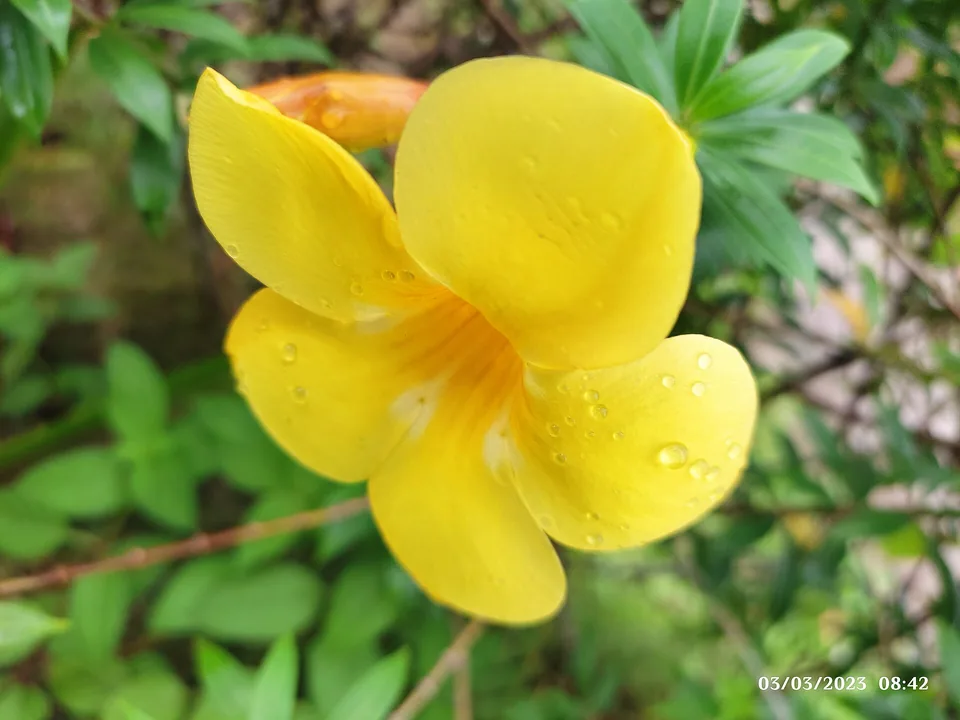


Cómo cultivar y cuidar Jazmín de Cuba
Allamanda cathartica
Escrito por Emilio Marruso · última revisión
Tóxica para: Personas · Por qué
De un vistazo
Esta perenne amante del sol crece feliz en maceta: fuera cuando hace calor y dentro cuando las noches refrescan. Dale sol pleno, riego profundo y regular, y abono cada 2–3 semanas mientras florece con fuerza. En invierno, déjala descansar con menos agua y pódala en primavera, justo antes de que vuelva a brotar.
- Sol
Sol pleno; en interior, al menos 4 horas de sol directo al día
Qué dicen las fuentes (5)
Luz: Pleno sol; en interiores, al menos 4 horas de luz solar directa diariamente.
en interiores: When grown indoors, provide at least 4 hours of direct sunlight daily.
— Golden Trumpet, Allamanda cathartica – Wisconsin Horticulture [2] Según Wisconsin Horticulture: Golden Trumpeet does best with full sun, in fertile, well-drained soil and plenty of
— Golden Trumpet, Allamanda cathartica – Wisconsin Horticulture [2] Según NC State Extension: Light: Full sun (6 or more hours of direct sunlight a day)
— Allamanda cathartica (Allamanda, Golden-Trumpet, Golden Trumpet Vine, Yellow Allamanda) | North Carolina Extension Gardener Plant Toolbox [1] Golden Trumpeet does best with full sun, in fertile, well-drained soil and plenty of moisture during the growing season.
— Golden Trumpet, Allamanda cathartica – Wisconsin Horticulture [2] When grown indoors, provide at least 4 hours of direct sunlight daily.
— Golden Trumpet, Allamanda cathartica – Wisconsin Horticulture [2] - Riego
Riega a fondo; deja secar un poco la tierra, nunca del todo; en invierno, riega menos
Qué dicen las fuentes (4)
Riego: Riega regularmente y en profundidad, dejando que el suelo se seque ligeramente entre riegos (pero no completamente seco); requiere mucha humedad y buen drenaje.
Water regularly and deeply, allowing the soil to dry slightly between waterings (but not completely dry, which will cause premature flower drop).
— Golden Trumpet, Allamanda cathartica – Wisconsin Horticulture [2] Whether indoors or out, the plant does require ample moisture and good drainage.
— Allamanda cathartica (Allamanda, Golden-Trumpet, Golden Trumpet Vine, Yellow Allamanda) | North Carolina Extension Gardener Plant Toolbox [1] Notas sobre el riego: Reduce el riego cuando cese la floración, manteniendo la planta en el lado seco durante el invierno; susceptible a la pudrición de raíces cuando se riega en exceso.
Also cut back watering when flowering ceases, keeping the plant on the dry side for the winter.
— Golden Trumpet, Allamanda cathartica – Wisconsin Horticulture [2] This plant is susceptible to root rot when overwatered.
— Golden Trumpet, Allamanda cathartica – Wisconsin Horticulture [2] - Frío
Aguanta inviernos de hasta −1,1 °C (30 °F)
Semirrústica: inviernos suaves o invernadero sin calefacción · USDA 10a · RHS H3 · Z10
Qué dicen las fuentes (1)
Rusticidad, zona más fría: 10a [mínima invernal de −1,1 a 1,7 °C (de 30 a 35 °F)]
This tender (zone 10a) evergreen plant, native to northern South America can be grown in a greenhouse in cool climates or as a summer annual
— Golden Trumpet, Allamanda cathartica – Wisconsin Horticulture [2] - Plantación
Saca la maceta cuando el calor sea constante; métela dentro si de noche baja a 4 °C
Qué dicen las fuentes (2)
Plantación: Las plantas en maceta se pueden mover al exterior cuando el clima es constantemente cálido; muévelas al interior cuando las noches bajen a 40 °F [4 °C].
Potted plants can be moved outside when the weather is consistently warm, but need to be gradually acclimated to higher light levels.
— Golden Trumpet, Allamanda cathartica – Wisconsin Horticulture [2] Move plants inside when nights get down to 40 °F.
— Golden Trumpet, Allamanda cathartica – Wisconsin Horticulture [2] - Abonado
Cada 2–3 semanas desde abril; reduce a finales de agosto y para a finales de septiembre
Qué dicen las fuentes (4)
Cuándo: Desde abril, cuando el crecimiento se reanuda, hasta la temporada de crecimiento; reduce a fines de agosto y detén a fines de septiembre
Resume fertilization in April as the plant resumes growth
— Golden Trumpet, Allamanda cathartica – Wisconsin Horticulture [2] Reduce the frequency of feeding plants in late August and stop fertilization in late September.
— Golden Trumpet, Allamanda cathartica – Wisconsin Horticulture [2] Frecuencia: Cada 2 a 3 semanas durante la temporada de crecimiento, especialmente cuando florece abundantemente
Fertilize regularly (every 2 to 3 weeks) during the growing season, especially when blooming heavily.
— Golden Trumpet, Allamanda cathartica – Wisconsin Horticulture [2] Evitar: Abonar durante el reposo invernal: detente a fines de septiembre
Allow the plant to rest during the winter months. Reduce the frequency of feeding plants in late August and stop fertilization in late September.
— Golden Trumpet, Allamanda cathartica – Wisconsin Horticulture [2] - Poda
En primavera, justo antes de que rebrote, corta dejando 1 o 2 nudos
Qué dicen las fuentes (1)
Poda: Primavera, justo antes de que se reanude el crecimiento (poda hasta 1 o 2 nudos).
Plants can be cut back to 1 or 2 nodes in the spring just before growth resumes to promote a more compact habit and flowering.
— Golden Trumpet, Allamanda cathartica – Wisconsin Horticulture [2] - Plagas
Cochinillas algodonosas, moscas blancas, cochinillas y araña roja; el exceso de riego pudre las raíces
Qué dicen las fuentes (2)
Notas sobre el riego: Reduce el riego cuando cese la floración, manteniendo la planta en el lado seco durante el invierno; susceptible a la pudrición de raíces cuando se riega en exceso.
Also cut back watering when flowering ceases, keeping the plant on the dry side for the winter.
— Golden Trumpet, Allamanda cathartica – Wisconsin Horticulture [2] This plant is susceptible to root rot when overwatered.
— Golden Trumpet, Allamanda cathartica – Wisconsin Horticulture [2] - Atención
En climas cálidos puede volverse invasora
- Tamaño
Alcanza 4,6 m de alto
Qué dicen las fuentes (1)
Altura adulta: 457 cm (15 pies)
The plant is a vigorous, rambling woody climber that can reach 15 feet tall
— Golden Trumpet, Allamanda cathartica – Wisconsin Horticulture [2] - Multiplicación
Esquejes semileñosos a finales de primavera, con calor de fondo y tapados para mantener la humedad
Qué dicen las fuentes (2)
Propagación: Esquejes semimaduros tomados a fines de primavera, con calor de fondo y encerrados para alta humedad.
Golden trumpet can easily be propagated by half-hardened cuttings taken in late spring .
— Golden Trumpet, Allamanda cathartica – Wisconsin Horticulture [2] Provide bottom heat and enclose the cuttings to provide high humidity.
— Golden Trumpet, Allamanda cathartica – Wisconsin Horticulture [2] - Maceta
Crece bien en maceta, también en interior
Qué dicen las fuentes (2)
En maceta: Sí
As a container plant it can be trained on a trellis to work as a screen, or it can be an accent or specimen plant on its own.
— Allamanda cathartica (Allamanda, Golden-Trumpet, Golden Trumpet Vine, Yellow Allamanda) | North Carolina Extension Gardener Plant Toolbox [1] En interior: Sí
In temperate regions, they are grown as greenhouse plants or houseplants for their freely produced, brightly coloured, golden yellow flowers
— Allamanda cathartica (Allamanda, Golden-Trumpet, Golden Trumpet Vine, Yellow Allamanda) | North Carolina Extension Gardener Plant Toolbox [1] - Seguridad
Toda la planta es tóxica si se ingiere; su savia lechosa puede irritar la piel y los ojos
Resumen
La alamanda es una enredadera perenne, tropical y siempreverde, cultivada por sus flores amarillo dorado. [1] Le va mejor a pleno sol con suelo fértil y bien drenado y abundante humedad durante la temporada de crecimiento. [2] Todas las partes de la planta son venenosas si se ingieren y la savia lechosa puede irritar la piel y los ojos. [2]
Citado en inglés, como en la fuente.
Esta ficha está incompleta: las fuentes consultadas aún no cubren todos los campos.
Aún no cubierto por nuestras fuentes: Rusticidad, zona más cálida
Cuidados
Las medidas entre corchetes son nuestra conversión al otro sistema de unidades; el texto citado no cambia.
Riego
Riego
Riega regularmente y en profundidad, dejando que el suelo se seque ligeramente entre riegos (pero no completamente seco); requiere mucha humedad y buen drenaje.
Qué dicen las fuentes (2)
Water regularly and deeply, allowing the soil to dry slightly between waterings (but not completely dry, which will cause premature flower drop).Whether indoors or out, the plant does require ample moisture and good drainage.Notas sobre el riego
Reduce el riego cuando cese la floración, manteniendo la planta en el lado seco durante el invierno; susceptible a la pudrición de raíces cuando se riega en exceso.
Qué dicen las fuentes (2)
Also cut back watering when flowering ceases, keeping the plant on the dry side for the winter.This plant is susceptible to root rot when overwatered.Luz
Pleno sol; en interiores, al menos 4 horas de luz solar directa diariamente.
Lo que dice cada fuente
en interiores: Al menos 4 horas de luz solar directa diariamente.
Según Wisconsin Horticulture: Pleno sol
Según NC State Extension: Pleno sol
Qué dicen las fuentes (5)
en interiores: When grown indoors, provide at least 4 hours of direct sunlight daily.Según Wisconsin Horticulture: Golden Trumpeet does best with full sun, in fertile, well-drained soil and plenty ofSegún NC State Extension: Light:
Full sun (6 or more hours of direct sunlight a day)Golden Trumpeet does best with full sun, in fertile, well-drained soil and plenty of moisture during the growing season.When grown indoors, provide at least 4 hours of direct sunlight daily.Clima y frío
Rusticidad, zona más fría
10a [mínima invernal de −1,1 a 1,7 °C (de 30 a 35 °F)]
Qué dicen las fuentes (1)
This tender (zone 10a) evergreen plant, native to northern South America can be grown in a greenhouse in cool climates or as a summer annualRusticidad, zona más cálida
No figura en las fuentes consultadas.
Dónde cultivarla
En interior
Sí
Qué dicen las fuentes (1)
In temperate regions, they are grown as greenhouse plants or houseplants for their freely produced, brightly coloured, golden yellow flowersEn maceta
Sí
Qué dicen las fuentes (1)
As a container plant it can be trained on a trellis to work as a screen, or it can be an accent or specimen plant on its own.Propagación
Esquejes semimaduros tomados a fines de primavera, con calor de fondo y encerrados para alta humedad.
Qué dicen las fuentes (2)
Golden trumpet can easily be propagated by half-hardened cuttings taken in late spring .Provide bottom heat and enclose the cuttings to provide high humidity.Cultivo
La planta
Ciclo de vida
perenne
Qué dicen las fuentes (1)
Allamanda is a tropical, evergreen, perennial vine in the dogbane family (Apocynaceae).Familia
Apocynaceae
Qué dicen las fuentes (1)
Allamanda is a tropical, evergreen, perennial vine in the dogbane family (Apocynaceae).Altura adulta
457 cm (15 pies)
Qué dicen las fuentes (1)
The plant is a vigorous, rambling woody climber that can reach 15 feet tallPlagas y enfermedades
Plagas
Las fuentes no coinciden:
Diseases, Insect Pests, and Other Plant Problems: No known diseases or insect pests.
[1]
Enfermedades
Las fuentes no coinciden:
Diseases, Insect Pests, and Other Plant Problems: No known diseases or insect pests.
[1]
Abonado
Cuándo
Desde abril, cuando el crecimiento se reanuda, hasta la temporada de crecimiento; reduce a fines de agosto y detén a fines de septiembre
Qué dicen las fuentes (2)
Resume fertilization in April as the plant resumes growthReduce the frequency of feeding plants in late August and stop fertilization in late September.Frecuencia
Cada 2 a 3 semanas durante la temporada de crecimiento, especialmente cuando florece abundantemente
Qué dicen las fuentes (1)
Fertilize regularly (every 2 to 3 weeks) during the growing season, especially when blooming heavily.Evitar
Abonar durante el reposo invernal: detente a fines de septiembre
Qué dicen las fuentes (1)
Allow the plant to rest during the winter months. Reduce the frequency of feeding plants in late August and stop fertilization in late September.Problemas
Podredumbre de la raíz
Síntoma: Se pudre cuando se riega en exceso.
Qué hacer: Evita el riego excesivo; asegura un buen drenaje.
Qué dicen las fuentes (1)
This plant is susceptible to root rot when overwatered.
— Golden Trumpet, Allamanda cathartica – Wisconsin Horticulture [2] Insectos plaga
Síntoma: Infestación de cochinillas harinosas, moscas blancas, cochinillas y arañitas rojas
Qué hacer: No indicado
Qué dicen las fuentes (1)
Insect pests include mealybugs , whiteflies , scales , and spider mites .
— Golden Trumpet, Allamanda cathartica – Wisconsin Horticulture [2] Caída prematura de las flores
Síntoma: Las flores se caen temprano cuando el suelo se seca por completo
Qué hacer: Deja que el suelo se seque ligeramente, pero no por completo, entre riegos.
Qué dicen las fuentes (1)
Water regularly and deeply, allowing the soil to dry slightly between waterings (but not completely dry, which will cause premature flower drop).
— Golden Trumpet, Allamanda cathartica – Wisconsin Horticulture [2] Invasividad en Florida
Síntoma: Clasificado como Alto Riesgo de Invasión por UF/IFAS
Qué hacer: UF/IFAS no recomienda la planta
Qué dicen las fuentes (1)
the University of Florida classifies this native of South and Central America as a “High Invasion Risk” in all of Florida.
— Master Gardener Volunteers on... the all-too-troublesome allamanda - UF/IFAS Extension Sarasota County [3]
Remedios
Cada remedio indica qué dicen las fuentes oficiales; los remedios tradicionales sin fuente oficial aparecen marcados. Los perjudiciales están para que sepas evitarlos.
Cuidar la planta
cochinillas harinosas
chorro fuerte de agua No verificado
Remedio tradicional, no verificado por una fuente oficial.
Cómo: Rocía la planta con un chorro fuerte de agua de la manguera de jardín.
alcohol isopropílico en un hisopo de algodón No verificado
Remedio tradicional, no verificado por una fuente oficial.
Pretest: Before applying any remedy to the entire plant, test a small area to ensure it doesn't cause phytotoxicity.
— jardineriaon.com [5] Cómo: Moja un hisopo de algodón en alcohol isopropílico y aplica sobre los grupos de cochinillas harinosas en el follaje, los tallos y la fruta.
spray de jabón para platos No demostrado
Pretest: Before applying any remedy to the entire plant, test a small area to ensure it doesn't cause phytotoxicity.
— jardineriaon.com [5] Cómo: Mezcla 4 cucharaditas de jabón líquido para platos con 1 cuarto de galón de agua del grifo y rocía directamente sobre las cochinillas harinosas.
Spritz the soapy insecticide directly onto mealybugs. The soap kills on contact. Coat all affected parts of your infected plants.
— hunker.com [6] Qué dicen las pruebas Despite being made of common household materials like dish soap and vinegar and having seemingly fewer risks, these concoctions may have unforeseen consequences and cannot be relied upon to have the same effectiveness as a registered pesticide.
— extension.unh.edu [7] spray de aceite de neem Funciona en parte
Despite these being biological pesticides, it is important to read the directions on the label and wear safety equipment.
— extension.illinois.edu [8] Cómo: Diluye 10 a 15 ml de aceite de neem en 1 litro de agua, añade unas gotas de jabón líquido neutro para mejorar la emulsión.
Extracted from the Azadirachta indica tree , neem oil acts as a systemic insecticide and is effective against aphids, mites, mealybugs, thrips, and fungi .
— jardineriaon.com [5] Qué dicen las pruebas Neem oil is found in the seeds of the neem tree. The active component found in this biological pesticide reduces insect feeding, interferes with hormones -- making it hard to grow or lay eggs -- and acts as a repellent.
— extension.illinois.edu [8]
Cómo eliminarla
alámanda invasora
Excavando. Fuente oficial, sin prueba independiente
If stems are cut, stump must be treated with suitable herbicide to prevent reshooting.
— business.qld.gov.au [9] Cómo: Excava las zonas grandes con una horca de jardín y un azadón, asegurándote de quitar todas las raíces y fragmentos de tallo.
Dig out large areas using garden fork and mattock, making sure to remove all roots and stem fragments.
— business.qld.gov.au [9]
Toxicidad
Según la fuente, citada textualmente. No es un consejo médico ni veterinario: si una persona o un animal pudo haber ingerido esta planta, contacta con un centro de toxicología o con un veterinario.
All parts of the plant are mildly toxic if ingested , and strong alkaloids in the milky latex sap can irritate the skin or eyes .
[2]TOXIC ONLY IF LARGE QUANTITIES EATEN; SKIN IRRITATION MINOR OR LASTING ONLY FOR A FEW MINUTES.
[1]- Partes venenosas
Poison Part: Bark Flowers Fruits Leaves Roots Seeds Stems Download Print-Friendly QR Code
[1]- Principio tóxico
Poison Toxic Principle: Unknown Causes Contact Dermatitis: Yes Poison Part:
[1]- Síntomas
Symptoms may include fever, swollen lips, thirst, nausea, diarrhea; skin irritation upon contact with cell sap.
[1]- Gravedad
Poison Severity: Low Poison Symptoms: Poisonous through: Ingestion, dermatitis. Sap causes skin
[1]
And, like all allamandas, all parts of the plant are poisonous.
[3]- Partes venenosas
The milky sap is typical of all allamandas. And, like all allamandas, all parts of the
[3]
Calendario
Plantación
Las plantas en maceta se pueden mover al exterior cuando el clima es constantemente cálido; muévelas al interior cuando las noches bajen a 40 °F [4 °C].
Qué dicen las fuentes (2)
Potted plants can be moved outside when the weather is consistently warm, but need to be gradually acclimated to higher light levels.Move plants inside when nights get down to 40 °F.Poda
Primavera, justo antes de que se reanude el crecimiento (poda hasta 1 o 2 nudos).
Qué dicen las fuentes (1)
Plants can be cut back to 1 or 2 nodes in the spring just before growth resumes to promote a more compact habit and flowering.Meses tal como los dan las fuentes, en su mayoría de Estados Unidos (hemisferio norte). En el hemisferio sur se desplazan unos seis meses.
Plantas similares
- Bush allamanda Allamanda schottii
- Jazmín asiático Trachelospermum asiaticum
- Jazmín de Tucumán Araujia sericifera
- Blue Star Amsonia ciliata
- Blue Star Amsonia hubrichtii
- Butterfly Weed Asclepias tuberosa
- Clasping Milkweed Asclepias amplexicaulis
- Sabi star Adenium obesum
Fuentes
Cada valor anterior se cita de estos documentos. Los enlaces llevan al editor original.
- Allamanda cathartica (Allamanda, Golden-Trumpet, Golden Trumpet Vine, Yellow Allamanda) | North Carolina Extension Gardener Plant Toolbox · plants.ces.ncsu.edu, consultado
- Golden Trumpet, Allamanda cathartica – Wisconsin Horticulture · hort.extension.wisc.edu, consultado
- Master Gardener Volunteers on... the all-too-troublesome allamanda - UF/IFAS Extension Sarasota County · blogs.ifas.ufl.edu, consultado
- The only allamanda you will ever need - UF/IFAS Extension Charlotte County · blogs.ifas.ufl.edu, consultado
- jardineriaon.com · jardineriaon.com
- hunker.com · hunker.com
- extension.unh.edu · extension.unh.edu
- extension.illinois.edu · extension.illinois.edu
- business.qld.gov.au · business.qld.gov.au
Escrito por Emilio Marruso · última revisión