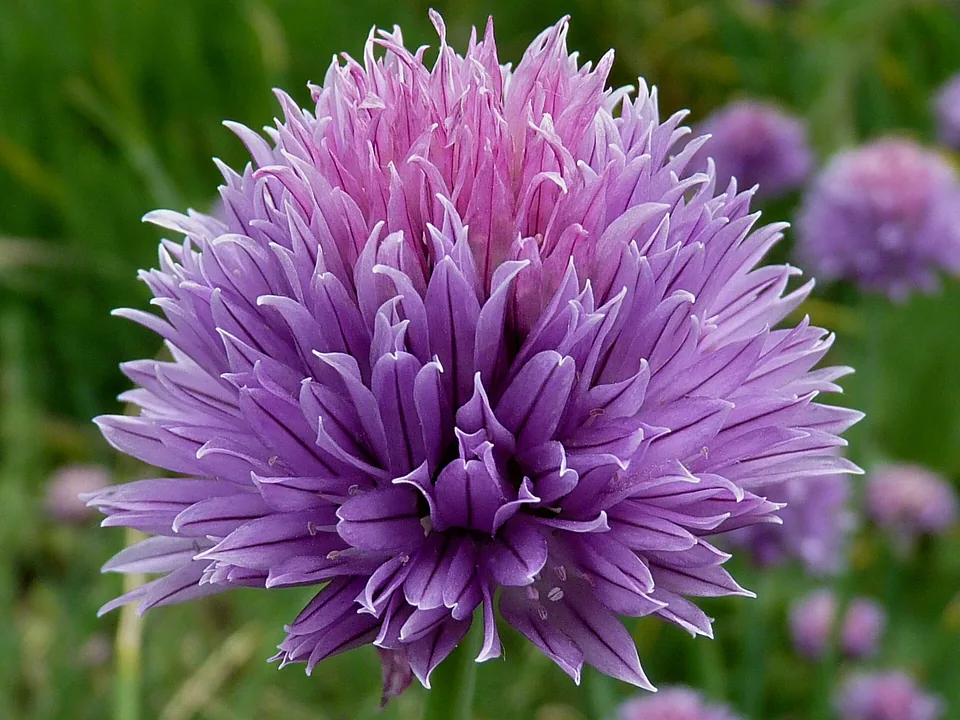


Cómo cultivar y cuidar Cebollino
Allium schoenoprasum
Escrito por Emilio Marruso · última revisión
Tóxica para: Gatos, Perros, Caballos, Personas · Por qué
De un vistazo
El cebollino es una aromática perenne que crece a pleno sol o en semisombra, en el huerto, en maceta o incluso dentro de casa. Cuando las hojas alcanzan 15 cm, córtalas con tijeras durante toda la temporada y volverán a brotar. Se comen tanto las hojas como las flores, de sabor ligeramente amargo, ideales con huevos, sopas, ensaladas y mantequilla.
- Sol
Pleno sol o semisombra
Qué dicen las fuentes (1)
Luz: Pleno sol a semisombra
Plant chives in average well-drained soils in full sun to partial shade.
— Allium schoenoprasum (Chives, Flowering Onion, Wild Chives) | North Carolina Extension Gardener Plant Toolbox [1] - Riego
Empapa bien la tierra al regar; aguanta la sequía, pero crece mejor con humedad constante
Qué dicen las fuentes (3)
Notas sobre el riego: Humedece el suelo a fondo al regar; los cebollines sobreviven períodos de estrés por sequía, pero el crecimiento y la productividad disminuyen
Moisten the soil thoroughly when watering. Chives will survive periods of drought stress but growth and productivity will decrease.
— How to Grow Chives in Your Garden | USU [7] Sequía: Tolerante a la sequía una vez establecida, pero crece mejor con humedad constante; sobrevive al estrés por sequía con crecimiento y productividad reducidos.
Chives are drought tolerant once established , although they will grow best when given consistent moisture.
— Chives, Allium schoenoprasum – Wisconsin Horticulture [2] Chives will survive periods of drought stress but growth and productivity will decrease.
— How to Grow Chives in Your Garden | USU [7] - Suelo
Suelo con pH 6,0–7,0; evita la tierra encharcada, que pudre las raíces
Qué dicen las fuentes (2)
pH del suelo, mínimo: 6.0
Chives have an optimal pH range of 6.0 to 7.0.
— Spice Up Your Life: A Beginners Guide to Growing Chives - UF/IFAS Extension Pasco County [5] pH del suelo, máximo: 7.0
Chives have an optimal pH range of 6.0 to 7.0.
— Spice Up Your Life: A Beginners Guide to Growing Chives - UF/IFAS Extension Pasco County [5] - Plantación
Planta a finales de abril o principios de mayo; en climas cálidos, de agosto a marzo
Qué dicen las fuentes (4)
Plantación: Finales de abril o principios de mayo (Utah); agosto hasta marzo (Florida)
Utah: Transplants or divisions can be planted in late April or early May.
— How to Grow Chives in Your Garden | USU [7] Florida: The best time to plant chives in Florida is August through March.
— Spice Up Your Life: A Beginners Guide to Growing Chives - UF/IFAS Extension Pasco County [5] Transplants or divisions can be planted in late April or early May.
— How to Grow Chives in Your Garden | USU [7] The best time to plant chives in Florida is August through March.
— Spice Up Your Life: A Beginners Guide to Growing Chives - UF/IFAS Extension Pasco County [5] - Abonado
Abona en mayo y julio; el exceso de abono da muchas hojas con menos sabor
Qué dicen las fuentes (4)
Cuándo: Durante la temporada de crecimiento; abona en mayo y julio
Chives need little additional fertilizer for optimum yields. Sidedress in May and July with 1 teaspoon of 21-0-0 fertilizer per square foot to ensure good growth and high yields.
— How to Grow Chives in Your Garden | USU [7] Plants that are harvested frequently benefit from supplemental fertilizer during the season.
— Chives | Herbs | Illinois Extension | Illinois [3] Evitar: Exceso de fertilización
Avoid over-fertilizing, as it can lead to excessive foliage growth, reduced flavor, plant injury, and plant death.
— Spice Up Your Life: A Beginners Guide to Growing Chives - UF/IFAS Extension Pasco County [5] Signos de exceso: Crecimiento excesivo del follaje, sabor reducido, daño a la planta y muerte
Avoid over-fertilizing, as it can lead to excessive foliage growth, reduced flavor, plant injury, and plant death.
— Spice Up Your Life: A Beginners Guide to Growing Chives - UF/IFAS Extension Pasco County [5] - Poda
Corta cada 2–3 semanas, recórtalo tras la floración y limpia los restos secos a finales de invierno
Qué dicen las fuentes (3)
Poda: Regularmente durante la temporada de crecimiento (cada 2-3 semanas); poda después de la floración; elimina los restos viejos de la planta a fines del invierno antes de que el crecimiento se reanude a principios de la primavera
Aim to prune your chives every 2-3 weeks, removing no more than one-third of the foliage at a time.
— Spice Up Your Life: A Beginners Guide to Growing Chives - UF/IFAS Extension Pasco County [5] Plants can be cut back to about 3 inches high after flowering to force the plant to produce new, tender leaves.
— Chives, Allium schoenoprasum – Wisconsin Horticulture [2] Remove old plant remains in late winter before growth resumes in early spring.
— Chives, Allium schoenoprasum – Wisconsin Horticulture [2] - Cosecha
Cuando las hojas midan 15 cm, córtalas a 3–5 cm de la base; las flores también se comen
Qué dicen las fuentes (5)
Cosecha: Desde 60 días después de la siembra o 30 días después del trasplante; en cualquier momento durante la temporada de crecimiento una vez que las hojas tengan aproximadamente 6 pulgadas [15 cm] de largo
Chives may be harvested as early as 60 days after seeding or 30 days after transplanting.
— How to Grow Chives in Your Garden | USU [7] Chives can be harvested any time during the growing season after the leaves are about 6 inches long, although the older leaves will be tougher than the new ones.
— Chives, Allium schoenoprasum – Wisconsin Horticulture [2] Cómo cosechar: Corta las hojas con tijeras o un cuchillo a unos 1-2 pulgadas (2.5-5 cm) de la base, una vez que las hojas tengan unas 6 pulgadas (15 cm) de largo; corta solo algunas de las hojas de cada macolla para cosechar de forma continua
Snip with scissors or use a knife to cut the leaves about 2 inches from the base.
— Chives, Allium schoenoprasum – Wisconsin Horticulture [2] Harvest the leaves with scissors or a knife, cutting the plants back to within 1-2 inches of the soil.
— How to Grow Chives in Your Garden | USU [7] Chives can be harvested any time during the growing season after the leaves are about 6 inches long, although the older leaves will be tougher than the new ones.
— Chives, Allium schoenoprasum – Wisconsin Horticulture [2] - Plagas
Pulgones y trips; podredumbre de raíz, oídio y mildiu
Qué dicen las fuentes (5)
Plagas: pulgones, trips
While chives are relatively pest-resistant, they can be susceptible to pests like aphids and thrips, as well as diseases like leaf spot and powdery mildew.
— Spice Up Your Life: A Beginners Guide to Growing Chives - UF/IFAS Extension Pasco County [5] Enfermedades: pudrición de raíz, mancha foliar, mildiu polvoriento, pudrición rosada de la raíz, mildiu velloso
No serious problems. Root rot may occur in poorly drained soil. Chives are deer and drought resistant.
— Allium schoenoprasum (Chives, Flowering Onion, Wild Chives) | North Carolina Extension Gardener Plant Toolbox [1] While chives are relatively pest-resistant, they can be susceptible to pests like aphids and thrips, as well as diseases like leaf spot and powdery mildew.
— Spice Up Your Life: A Beginners Guide to Growing Chives - UF/IFAS Extension Pasco County [5] Pink Root | Fungal disease that changes roots to a pink color. Roots eventually die and yields severely reduced.
— How to Grow Chives in Your Garden | USU [7] Downey Mildew | Fungal disease that turns leaves a light tan to brown color.
— How to Grow Chives in Your Garden | USU [7] - Atención
Raíces superficiales: escarda con cuidado cerca de la planta o usa acolchado
Qué dicen las fuentes (1)
Sistema radicular: Tiene raíces bastante superficiales: cultiva con cuidado cerca de las plantas o usa mantillo para controlar las malas hierbas.
Since chives are fairly shallow-rooted be careful when cultivating around the plants, or use mulch for weed control.
— Chives, Allium schoenoprasum – Wisconsin Horticulture [2] - Tamaño
25–30 cm de alto y hasta 30 cm de ancho
Qué dicen las fuentes (3)
Altura adulta: 25-30 cm (10-12 pulgadas)
They are a hardy, drought-tolerant perennial growing to about 10-12 inches tall. They grow in clumps from underground bulbs and produce round, hollow leaves that are much finer than onion.
— Chives | Herbs | Illinois Extension | Illinois [3] Chives are small, dainty, onion-like plants that grow in clumps, reaching about 10 inches in height. They are hardy perennials with decorative, light purple flowers.
— Chives | University of Maryland Extension [8] Anchura adulta: casi 30 cm (1 pie)
Over time, chives will form a clump that is 8-10 inches tall and may spread nearly one foot across.
— How to Grow Chives in Your Garden | USU [7] - Multiplicación
Divide las matas o siémbralo de semilla
Qué dicen las fuentes (2)
- Siembra
Siembra a medio centímetro en interior 8–10 semanas antes de la última helada; germina despacio
Qué dicen las fuentes (4)
Siembra: Siembra en interiores de ocho a diez semanas antes de la última fecha de helada, o siembra directa después de la última fecha de helada
Seeds can be started indoors eight to ten weeks before the last frost date or directly sown in full sun after the last frost date.
— Allium schoenoprasum (Chives, Flowering Onion, Wild Chives) | North Carolina Extension Gardener Plant Toolbox [1] Profundidad de siembra: 0.6 cm (1/4 pulgada)
Seeds should be planted ¼ inch deep and final plant spacing should be 4-6 inches apart in all directions.
— How to Grow Chives in Your Garden | USU [7] Germinación: La semilla tarda en germinar y tarda de 4 a 6 semanas en producir trasplantes; siembra a 0.6 cm [0,2 in] de profundidad.
Seed may be slow to germinate and take 4-6 weeks to produce transplants.
— Chives | Herbs | Illinois Extension | Illinois [3] Seeds should be planted ¼ inch deep and thinned to 4-6 inches in all directions after emergence.
— How to Grow Chives in Your Garden | USU [7] - Maceta
Crece bien en maceta, incluso dentro de casa
Qué dicen las fuentes (2)
En maceta: Sí
Try combining small clumps in containers with ornamentals or other culinary herbs, such as basil and parsley, for a container herb garden.
— Chives, Allium schoenoprasum – Wisconsin Horticulture [2] En interior: Sí
They can also be potted up and grown on a patio or in a sunny window indoors.
— Allium schoenoprasum (Chives, Flowering Onion, Wild Chives) | North Carolina Extension Gardener Plant Toolbox [1] - Seguridad
Es perjudicial para gatos, perros y caballos: mantén alejados a los animales
Resumen
Los cebollinos son una perenne bulbosa cultivada como hierba culinaria y ornamental. [1] Crecen a pleno sol o semisombra en suelo bien drenado y son tolerantes a la sequía una vez establecidos. [1][2] Se cultivan fácilmente a partir de semillas o de divisiones. [2]
Citado en inglés, como en la fuente.
Cuidados
Las medidas entre corchetes son nuestra conversión al otro sistema de unidades; el texto citado no cambia.
Riego
Riego
Las fuentes dan valores distintos según la región, la zona o las condiciones de cultivo.
Lo que dice cada fuente
Según UW-Madison Extension: Tolerante a la sequía una vez establecido; crece mejor con humedad constante
Según Utah State University Extension: Riego regular durante el crecimiento; suelos mantenidos cerca de la capacidad de campo
Qué dicen las fuentes (4)
Según UW-Madison Extension: Chives are drought tolerant once established , although they will grow best when given consistent moisture.Según Utah State University Extension: Chives require regular watering throughout growth for best production. Soils need to be maintained near field capacity.Chives are drought tolerant once established , although they will grow best when given consistent moisture.Chives require regular watering throughout growth for best production. Soils need to be maintained near field capacity.Notas sobre el riego
Humedece el suelo a fondo al regar; los cebollines sobreviven períodos de estrés por sequía, pero el crecimiento y la productividad disminuyen
Qué dicen las fuentes (1)
Moisten the soil thoroughly when watering. Chives will survive periods of drought stress but growth and productivity will decrease.Luz
Pleno sol a semisombra
Qué dicen las fuentes (1)
Plant chives in average well-drained soils in full sun to partial shade.Clima y frío
Rusticidad, zona más fría
Las fuentes dan valores distintos según la región, la zona o las condiciones de cultivo.
Lo que dice cada fuente
Según NC State Extension: 4a [mínima invernal de −34,4 a −31,7 °C (de −30 a −25 °F)]
Según UW-Madison Extension: 4a [mínima invernal de −34,4 a −31,7 °C (de −30 a −25 °F)]
Según UF/IFAS Extension: 3 [mínima invernal de −40 a −34,4 °C (de −40 a −30 °F)]
Qué dicen las fuentes (4)
Según NC State Extension: USDA Plant Hardiness Zone:
4a, 4b, 5a, 5b, 6a, 6b, 7a, 7b, 8a, 8bSegún UW-Madison Extension: This plant, hardy to zone 4a , isSegún UF/IFAS Extension: USDA Hardiness Zone: 3 to 9.
- GrowingUSDA Plant Hardiness Zone:
4a, 4b, 5a, 5b, 6a, 6b, 7a, 7b, 8a, 8bRusticidad, zona más cálida
Las fuentes dan valores distintos según la región, la zona o las condiciones de cultivo.
Lo que dice cada fuente
Según NC State Extension: 8b [mínima invernal de −9,4 a −6,7 °C (de 15 a 20 °F)]
Según UF/IFAS Extension: 9 [mínima invernal de −6,7 a −1,1 °C (de 20 a 30 °F)]
Qué dicen las fuentes (3)
Según NC State Extension: USDA Plant Hardiness Zone:
4a, 4b, 5a, 5b, 6a, 6b, 7a, 7b, 8a, 8bSegún UF/IFAS Extension: USDA Hardiness Zone: 3 to 9.
- GrowingUSDA Plant Hardiness Zone:
4a, 4b, 5a, 5b, 6a, 6b, 7a, 7b, 8a, 8bSuelo
pH del suelo, mínimo
6.0
Qué dicen las fuentes (1)
Chives have an optimal pH range of 6.0 to 7.0.pH del suelo, máximo
7.0
Qué dicen las fuentes (1)
Chives have an optimal pH range of 6.0 to 7.0.Dónde cultivarla
En interior
Sí
Qué dicen las fuentes (1)
They can also be potted up and grown on a patio or in a sunny window indoors.En maceta
Sí
Qué dicen las fuentes (1)
Try combining small clumps in containers with ornamentals or other culinary herbs, such as basil and parsley, for a container herb garden.Distancia de plantación
Las fuentes dan valores distintos según la región, la zona o las condiciones de cultivo.
Lo que dice cada fuente
Según UW-Madison Extension: 30.5-50.8 cm (12 a 20 pulgadas) entre macizos
Según Utah State University Extension: 10.2-15.2 cm (4-6 pulgadas)
Según University of Maryland Extension: 30.5 cm (12 pulgadas) entre hileras y plantas
Qué dicen las fuentes (3)
Según UW-Madison Extension: Space the clumps 12 to 20 inches apart. Divide plants every 2 to 3 years to prevent overcrowding.Según Utah State University Extension: Chives, regardless of planting method (seeds or transplants), should be spaced 4-6 inches apart.Según University of Maryland Extension: Leave 12" between rows and plants. Can be grown indoors.Propagación
Cultivo
La planta
Ciclo de vida
perenne
Qué dicen las fuentes (1)
Chives are a bulbous perennial used as ornamental or culinary herbs. Chives have edible flowers and leaves used for flavoring with eggs, soups, salads, butter, cheese, dips and spreads.Familia
Las fuentes no coinciden:
Chives are from the amaryllis family (Amaryllidaceae) and native to a broad range of the temperate northern hemisphere including northern United States, Canada, northern Europe, Mongolia, Japan and almost all other northern hemispheric countries.
[1]Chives, Allium schoenoprasum , is a species in the lily family (Liliaceae) native to Europe and Asia (and possibly North America, but there is some dissention on whether it is truly native or just naturalized there).
[2]
Altura adulta
25-30 cm (10-12 pulgadas)
Qué dicen las fuentes (2)
They are a hardy, drought-tolerant perennial growing to about 10-12 inches tall. They grow in clumps from underground bulbs and produce round, hollow leaves that are much finer than onion.Chives are small, dainty, onion-like plants that grow in clumps, reaching about 10 inches in height. They are hardy perennials with decorative, light purple flowers.Anchura adulta
casi 30 cm (1 pie)
Qué dicen las fuentes (1)
Over time, chives will form a clump that is 8-10 inches tall and may spread nearly one foot across.Siembra y crecimiento
Profundidad de siembra
0.6 cm (1/4 pulgada)
Qué dicen las fuentes (1)
Seeds should be planted ¼ inch deep and final plant spacing should be 4-6 inches apart in all directions.Distancia entre hileras
Las fuentes no coinciden:
Chives demand little care other than dividing when they become overcrowded. They are easily propagated by division or from seed and make attractive border plants. Leave 12" between rows and plants. Can be grown indoors.
[8]Seeds should be planted ¼ inch deep and final plant spacing should be 4-6 inches apart in all directions.
[7]
Días hasta la madurez
60 días desde la siembra o 30 días desde el trasplante hasta la primera cosecha
Qué dicen las fuentes (1)
Chives may be harvested as early as 60 days after seeding or 30 days after transplanting.Cosecha y conservación
Cómo cosechar
Corta las hojas con tijeras o un cuchillo a unos 1-2 pulgadas (2.5-5 cm) de la base, una vez que las hojas tengan unas 6 pulgadas (15 cm) de largo; corta solo algunas de las hojas de cada macolla para cosechar de forma continua
Qué dicen las fuentes (3)
Snip with scissors or use a knife to cut the leaves about 2 inches from the base.Harvest the leaves with scissors or a knife, cutting the plants back to within 1-2 inches of the soil.Chives can be harvested any time during the growing season after the leaves are about 6 inches long, although the older leaves will be tougher than the new ones.Conservación
Refrigéralas hasta por una semana; también se pueden congelar o secar, aunque las hojas secas pierden gran parte de su sabor
Qué dicen las fuentes (1)
Harvested chives can be used immediately or stored under refrigeration for up to a week . Chives can also be frozen or dried for later use , but the leaves lose a lot of their flavor when dried.Plagas y enfermedades
Plagas
pulgones, trips
Qué dicen las fuentes (1)
While chives are relatively pest-resistant, they can be susceptible to pests like aphids and thrips, as well as diseases like leaf spot and powdery mildew.Enfermedades
pudrición de raíz, mancha foliar, mildiu polvoriento, pudrición rosada de la raíz, mildiu velloso
Qué dicen las fuentes (4)
No serious problems. Root rot may occur in poorly drained soil. Chives are deer and drought resistant.While chives are relatively pest-resistant, they can be susceptible to pests like aphids and thrips, as well as diseases like leaf spot and powdery mildew.Pink Root | Fungal disease that changes roots to a pink color. Roots eventually die and yields severely reduced.Downey Mildew | Fungal disease that turns leaves a light tan to brown color.Abonado
Cuándo
Durante la temporada de crecimiento; abona en mayo y julio
Qué dicen las fuentes (2)
Chives need little additional fertilizer for optimum yields. Sidedress in May and July with 1 teaspoon of 21-0-0 fertilizer per square foot to ensure good growth and high yields.Plants that are harvested frequently benefit from supplemental fertilizer during the season.Frecuencia
Abonos naturales
Compost u otra materia orgánica incorporada antes de plantar: no más de 2.54 cm [1 in] de materia orgánica bien compostada por 9.29 m²; los mantillos orgánicos también aportan nutrientes
Qué dicen las fuentes (3)
Before planting or transplanting your chives, amend the soil with compost or organic matter.If you fertilize with compost, apply no more than 1 inch of well-composted organic matter per 100 square feet of garden area.Organic mulches help conserve water, supply extra nutrients, and reduce weeding.Abonos minerales
Fertilizante nitrogenado 21-0-0 aplicado en abono lateral a 4.9 mL por 0.093 m², o un fertilizante equilibrado a la dosis indicada en la etiqueta
Qué dicen las fuentes (2)
Sidedress in May and July with 1 teaspoon of 21-0-0 fertilizer per square foot to ensure good growth and high yields.Fertilize a balanced fertilizer (follow the label directions), especially during the growing season.Evitar
Exceso de fertilización
Qué dicen las fuentes (1)
Avoid over-fertilizing, as it can lead to excessive foliage growth, reduced flavor, plant injury, and plant death.Signos de exceso
Crecimiento excesivo del follaje, sabor reducido, daño a la planta y muerte
Qué dicen las fuentes (1)
Avoid over-fertilizing, as it can lead to excessive foliage growth, reduced flavor, plant injury, and plant death.Distancias
Entre plantas
Las fuentes dan valores distintos según la región, la zona o las condiciones de cultivo.
Lo que dice cada fuente
grupos establecidos (Wisconsin): Grupos separados 30-51 cm [12–20 in]
semillas o trasplantes (Wisconsin): 10-15 cm [3,9–5,9 in] de separación en todas direcciones
Qué dicen las fuentes (2)
grupos establecidos (Wisconsin): Space the clumps 12 to 20 inches apart. Divide plants every 2 to 3 years to prevent overcrowding.semillas o trasplantes (Wisconsin): Chives, regardless of planting method (seeds or transplants), should be spaced 4-6 inches apart.Raíces
Sistema radicular
Tiene raíces bastante superficiales: cultiva con cuidado cerca de las plantas o usa mantillo para controlar las malas hierbas.
Qué dicen las fuentes (1)
Since chives are fairly shallow-rooted be careful when cultivating around the plants, or use mulch for weed control.Propagación
Germinación
La semilla tarda en germinar y tarda de 4 a 6 semanas en producir trasplantes; siembra a 0.6 cm [0,2 in] de profundidad.
Tras la cosecha
Conservación
Las hojas frescas se conservan en refrigeración hasta una semana; para almacenarlas más tiempo, córtalas y congélalas en un recipiente hermético, o sécalas y guárdalas en un recipiente resellable en un lugar fresco y seco.
Qué dicen las fuentes (3)
Harvested chives can be used immediately or stored under refrigeration for up to a week .To freeze chives, chop them into small pieces and store them in an airtight container in the freezer.Store dried chives in a resealable container in a cool, dry place.Calor y sequía
Sequía
Tolerante a la sequía una vez establecida, pero crece mejor con humedad constante; sobrevive al estrés por sequía con crecimiento y productividad reducidos.
Qué dicen las fuentes (2)
Chives are drought tolerant once established , although they will grow best when given consistent moisture.Chives will survive periods of drought stress but growth and productivity will decrease.Problemas
Podredumbre de la raíz
Síntoma: La pudrición de la raíz puede ocurrir en suelos con mal drenaje.
Qué hacer: No se indica más allá de evitar suelos con mal drenaje; la fuente solo da la condición.
Qué dicen las fuentes (1)
No serious problems. Root rot may occur in poorly drained soil. Chives are deer and drought resistant.
— Allium schoenoprasum (Chives, Flowering Onion, Wild Chives) | North Carolina Extension Gardener Plant Toolbox [1] Trips
Síntoma: Insectos diminutos y delgados que se alimentan de las hojas; las hojas se vuelven plateadas o grises, pueden torcerse y morir.
Qué hacer: Rocía con productos químicos registrados.
Qué dicen las fuentes (1)
Tiny, slender insects that feed on leaves. Leaves turn silver or gray, may twist and die. Thrips hide near where the leaf and bulb meet.
— How to Grow Chives in Your Garden | USU [7] Raíz rosada
Síntoma: Enfermedad fúngica que cambia las raíces a un color rosado; las raíces eventualmente mueren y los rendimientos se reducen severamente.
Qué hacer: Usa rotación de cultivos de 5 años y solariza el suelo donde se plantarán los cebollinos.
Qué dicen las fuentes (1)
Fungal disease that changes roots to a pink color. Roots eventually die and yields severely reduced.
— How to Grow Chives in Your Garden | USU [7] Mildiú velloso
Síntoma: Enfermedad fúngica que vuelve las hojas de color marrón claro a marrón; un crecimiento velloso grisáceo violáceo puede aparecer en las hojas infectadas en períodos húmedos.
Qué hacer: Las prácticas culturales que facilitan el movimiento del aire y el secado de las hojas reducen la severidad; se pueden usar fungicidas registrados.
Qué dicen las fuentes (1)
Fungal disease that turns leaves a light tan to brown color.
— How to Grow Chives in Your Garden | USU [7]
Remedios
Cada remedio indica qué dicen las fuentes oficiales; los remedios tradicionales sin fuente oficial aparecen marcados. Los perjudiciales están para que sepas evitarlos.
Cuidar la planta
pulgones
chorro de agua fuerte Funciona
Cómo: Un fuerte chorro de agua con una manguera los derriba de los tallos y las hojas de las plantas.
For smaller pests like aphids or spider mites, a strong burst of water from a hose often knocks them off plant stems and leaves, reducing their populations without causing harm.
— cultivatedearth.com [9] Qué dicen las pruebas Spray the plant with a strong jet of water to dislodge them or use Neem or insecticidal soap according to label instructions.
— Spice Up Your Life: A Beginners Guide to Growing Chives - UF/IFAS Extension Pasco County [5] spray de jabón insecticida Funciona
When “oils and soaps” are mentioned in UC IPM publications, we are referring to commercially available oils and soaps that are formulated specifically for use as pesticides- not household oils and soaps meant for cooking, cleaning, or other purposes.
— ucanr.edu [11] Cómo: Comprados en la tienda o hechos en casa con jabón de castilla puro y agua.
Insecticidal soaps, either store-bought or homemade using pure castile soap and water, are gentle on plants but deadly to soft-bodied insects like aphids and whiteflies.
— cultivatedearth.com [9] Qué dicen las pruebas Use insecticidal soap or neem oil to control thrips, ensuring thorough coverage of affected plants.
— Spice Up Your Life: A Beginners Guide to Growing Chives - UF/IFAS Extension Pasco County [5] rociado de ajo No verificado
Remedio tradicional, no verificado por una fuente oficial.
Penn State Extension does not recommend using home remedies for many reasons. They do not come with precise instructions on how to use; they may not be effective; they have the potential to harm humans, pets, and plants; and their use can violate federal law.
— extension.psu.edu [10] Cómo: Mezcla unos dientes de ajo con agua, cuela la mezcla y aplícala con un rociador.
trips
spray de aceite de neem Funciona
Penn State Extension does not recommend using home remedies for many reasons. They do not come with precise instructions on how to use; they may not be effective; they have the potential to harm humans, pets, and plants; and their use can violate federal law.
— extension.psu.edu [10] Cómo: Mezcla un par de cucharaditas con agua y unas gotas de jabón suave, y luego rocía la mezcla sobre las plantas afectadas.
Neem oil acts as a natural insect repellent and disrupts pest life cycles. Mix a couple of teaspoons with water and a few drops of mild soap, then spray it on affected plants.
— cultivatedearth.com [9] Qué dicen las pruebas Use insecticidal soap or neem oil to control thrips, ensuring thorough coverage of affected plants.
— Spice Up Your Life: A Beginners Guide to Growing Chives - UF/IFAS Extension Pasco County [5]
orugas
recolección manual No verificado
Remedio tradicional, no verificado por una fuente oficial.
Cómo: Recoge las plagas más grandes temprano en la mañana cuando están lentas y colócalas en un cubo de agua jabonosa.
Cómo eliminarla
propagación por auto-siembra
Desentierra las plantas No verificado
Remedio tradicional, no verificado por una fuente oficial.
Cómo: Desentierra y traslada las plantas que invaden otras partes del jardín.
Venenosa para los animales
Según la fuente, citada textualmente. No es un consejo médico ni veterinario: si una persona o un animal pudo haber ingerido esta planta, contacta con un centro de toxicología o con un veterinario.
Animales
#problem for cats #problem for dogs #problem for horses
[1]La fuente señala el riesgo para este animal pero no explica por qué.
Personas
However, the plant also has poisonous characteristics as noted in the "Poisonous to Humans" section of this record.
[1]- Partes venenosas
Poison Part: Bark Flowers Fruits Leaves Roots Seeds Stems
[4]- Principio tóxico
Poison Toxic Principle: Sulfides Causes Contact Dermatitis: No
[4]- Síntomas
If eaten in large quantities symptoms may include nausea, vomiting, and diarrhea.
[4]- Gravedad
Poison Severity: Low Poison Symptoms: If eaten in
[4]
Calendario
Siembra
Siembra en interiores de ocho a diez semanas antes de la última fecha de helada, o siembra directa después de la última fecha de helada
Qué dicen las fuentes (1)
Seeds can be started indoors eight to ten weeks before the last frost date or directly sown in full sun after the last frost date.Plantación
Finales de abril o principios de mayo (Utah); agosto hasta marzo (Florida)
Lo que dice cada fuente
Utah: Finales de abril o principios de mayo
Florida: Agosto hasta marzo
Qué dicen las fuentes (4)
Utah: Transplants or divisions can be planted in late April or early May.Florida: The best time to plant chives in Florida is August through March.Transplants or divisions can be planted in late April or early May.The best time to plant chives in Florida is August through March.Cosecha
Desde 60 días después de la siembra o 30 días después del trasplante; en cualquier momento durante la temporada de crecimiento una vez que las hojas tengan aproximadamente 6 pulgadas [15 cm] de largo
Qué dicen las fuentes (2)
Chives may be harvested as early as 60 days after seeding or 30 days after transplanting.Chives can be harvested any time during the growing season after the leaves are about 6 inches long, although the older leaves will be tougher than the new ones.Poda
Regularmente durante la temporada de crecimiento (cada 2-3 semanas); poda después de la floración; elimina los restos viejos de la planta a fines del invierno antes de que el crecimiento se reanude a principios de la primavera
Qué dicen las fuentes (3)
Aim to prune your chives every 2-3 weeks, removing no more than one-third of the foliage at a time.Plants can be cut back to about 3 inches high after flowering to force the plant to produce new, tender leaves.Remove old plant remains in late winter before growth resumes in early spring.Meses tal como los dan las fuentes, en su mayoría de Estados Unidos (hemisferio norte). En el hemisferio sur se desplazan unos seis meses.
Respecto a las heladas
Estimación menos precisa: no hay ninguna estación meteorológica a menos de 300 km.
Busca las fechas de heladas por código postal o ciudad
Siembra en interior: de 8 a 10 semanas antes de la última helada
Seeds can be started indoors eight to ten weeks before the last frost date or directly sown in full sun after the last frost date.
— Allium schoenoprasum (Chives, Flowering Onion, Wild Chives) | North Carolina Extension Gardener Plant Toolbox [1] Siembra al aire libre: hacia la última helada
Seeds can be started indoors eight to ten weeks before the last frost date or directly sown in full sun after the last frost date.
— Allium schoenoprasum (Chives, Flowering Onion, Wild Chives) | North Carolina Extension Gardener Plant Toolbox [1]
Cuenta desde las fechas medias de las heladas de tu zona.
Comestibilidad
Según la fuente, citada textualmente. No comas una planta basándote solo en esta página: los errores de identificación pueden ser peligrosos.
Chives have edible flowers and leaves used for flavoring with eggs, soups, salads, butter, cheese, dips and spreads.
[1]Flowers have a mildly bitter flavor and like young leaves can be eaten in small quantities raw in salads and sandwiches or cooked in tea and soups.
[1]Leaves can be used to flavor salads, dips, soups, stews, vinegars, cheese dishes sour cream and butter.
[3]
Valores orientativos
Valores de una fuente secundaria, no comprobados palabra por palabra como el resto de esta página. Úselos como punto de partida.
- Suelo
- Rocoso, con grava, seco, bien drenadoValor orientativo, adáptalo a tu clima · Fuente secundaria
- Nivel de cuidado
- MedioValor orientativo, adáptalo a tu clima · Fuente secundaria
- Crecimiento
- AltaValor orientativo, adáptalo a tu clima · Fuente secundaria
Plantas similares
- Allium schubertii Allium schubertii
- Allium siculum Allium siculum
- Allium triquetrum Allium triquetrum
- Blue Globe Onion Allium caeruleum
- Ajoporro Allium ampeloprasum
- Ajo Allium sativum
- Ajo salvaje Allium vineale
- Garlic Chives Allium tuberosum
Fuentes
Cada valor anterior se cita de estos documentos. Los enlaces llevan al editor original.
- Allium schoenoprasum (Chives, Flowering Onion, Wild Chives) | North Carolina Extension Gardener Plant Toolbox · plants.ces.ncsu.edu, consultado
- Chives, Allium schoenoprasum – Wisconsin Horticulture · hort.extension.wisc.edu, consultado
- Chives | Herbs | Illinois Extension | Illinois · extension.illinois.edu, consultado
- Allium (Onion, Ornamental Onions) | North Carolina Extension Gardener Plant Toolbox · plants.ces.ncsu.edu, consultado
- Spice Up Your Life: A Beginners Guide to Growing Chives - UF/IFAS Extension Pasco County · blogs.ifas.ufl.edu, consultado
- How to grow garlic chives (Allium tuberosum) | Extension · extension.unh.edu, consultado
- How to Grow Chives in Your Garden | USU · extension.usu.edu, consultado
- Chives | University of Maryland Extension · extension.umd.edu, consultado
- cultivatedearth.com · cultivatedearth.com
- extension.psu.edu · extension.psu.edu
- ucanr.edu · ucanr.edu
Escrito por Emilio Marruso · última revisión