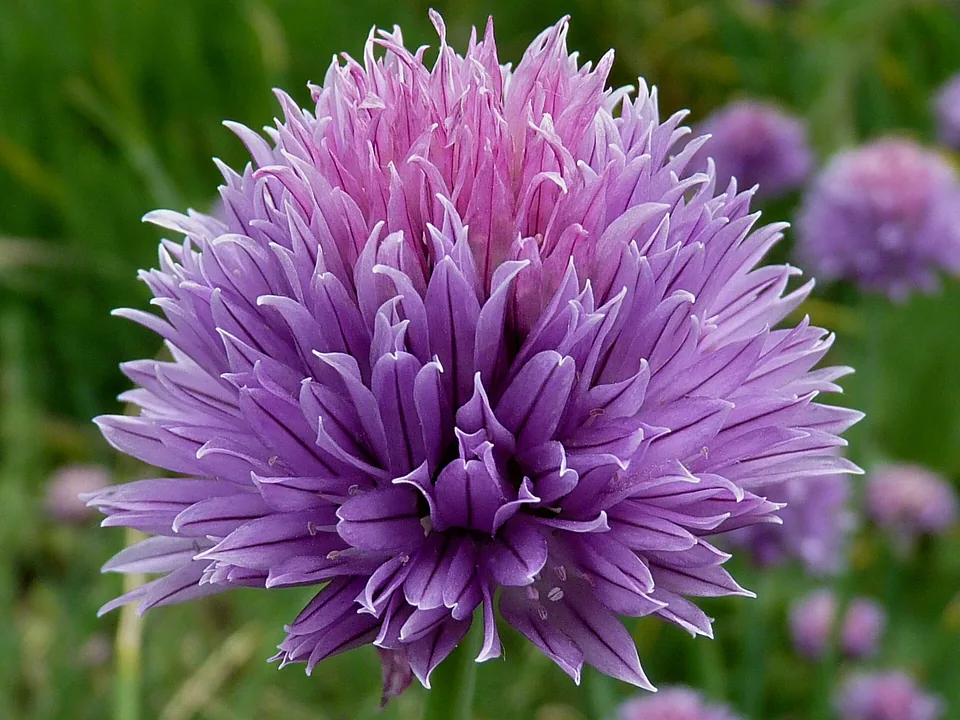


How to Grow and Care for Chives
Allium schoenoprasum
Written by Emilio Marruso · last checked
Toxic to: Cats, Dogs, Horses, People · Why
At a glance
Chives are a perennial herb that grows happily in full sun or partial shade, in the garden, in a pot or even indoors. Once the leaves reach 6 inches, snip them with scissors all season long and they keep coming back. Both the leaves and the mildly bitter flowers are edible, perfect with eggs, soups, salads and butter.
- Sun
Full sun to partial shade
What the sources say (1)
Light: Full sun to partial shade
Plant chives in average well-drained soils in full sun to partial shade.
— Allium schoenoprasum (Chives, Flowering Onion, Wild Chives) | North Carolina Extension Gardener Plant Toolbox [1] - Water
Soak the soil well when you water; it survives drought but grows best kept evenly moist
What the sources say (3)
Watering notes: Moisten the soil thoroughly when watering; chives survive periods of drought stress but growth and productivity decrease
Moisten the soil thoroughly when watering. Chives will survive periods of drought stress but growth and productivity will decrease.
— How to Grow Chives in Your Garden | USU [7] Drought: Drought tolerant once established, but grows best with consistent moisture; it survives drought stress with reduced growth and productivity.
Chives are drought tolerant once established , although they will grow best when given consistent moisture.
— Chives, Allium schoenoprasum – Wisconsin Horticulture [2] Chives will survive periods of drought stress but growth and productivity will decrease.
— How to Grow Chives in Your Garden | USU [7] - Soil
Soil with pH 6.0–7.0; avoid soggy, poorly drained soil, which rots the roots
What the sources say (2)
Soil pH, minimum: 6.0
Chives have an optimal pH range of 6.0 to 7.0.
— Spice Up Your Life: A Beginners Guide to Growing Chives - UF/IFAS Extension Pasco County [5] Soil pH, maximum: 7.0
Chives have an optimal pH range of 6.0 to 7.0.
— Spice Up Your Life: A Beginners Guide to Growing Chives - UF/IFAS Extension Pasco County [5] - Planting
Plant in late April or early May; in warm climates, from August through March
What the sources say (4)
Planting: Late April or early May (Utah); August through March (Florida)
Utah: Transplants or divisions can be planted in late April or early May.
— How to Grow Chives in Your Garden | USU [7] Florida: The best time to plant chives in Florida is August through March.
— Spice Up Your Life: A Beginners Guide to Growing Chives - UF/IFAS Extension Pasco County [5] Transplants or divisions can be planted in late April or early May.
— How to Grow Chives in Your Garden | USU [7] The best time to plant chives in Florida is August through March.
— Spice Up Your Life: A Beginners Guide to Growing Chives - UF/IFAS Extension Pasco County [5] - Feeding
Feed in May and July; too much fertilizer means lots of leaves with less flavor
What the sources say (4)
When: During the growing season; side-dress in May and July
Chives need little additional fertilizer for optimum yields. Sidedress in May and July with 1 teaspoon of 21-0-0 fertilizer per square foot to ensure good growth and high yields.
— How to Grow Chives in Your Garden | USU [7] Plants that are harvested frequently benefit from supplemental fertilizer during the season.
— Chives | Herbs | Illinois Extension | Illinois [3] Avoid: Over-fertilizing
Avoid over-fertilizing, as it can lead to excessive foliage growth, reduced flavor, plant injury, and plant death.
— Spice Up Your Life: A Beginners Guide to Growing Chives - UF/IFAS Extension Pasco County [5] Signs of excess: Excessive foliage growth, reduced flavor, plant injury and death
Avoid over-fertilizing, as it can lead to excessive foliage growth, reduced flavor, plant injury, and plant death.
— Spice Up Your Life: A Beginners Guide to Growing Chives - UF/IFAS Extension Pasco County [5] - Pruning
Cut every 2–3 weeks, cut back after flowering, clear old growth in late winter
What the sources say (3)
Pruning: Regularly through the growing season (every 2-3 weeks); cut back after flowering; remove old plant remains in late winter before growth resumes in early spring
Aim to prune your chives every 2-3 weeks, removing no more than one-third of the foliage at a time.
— Spice Up Your Life: A Beginners Guide to Growing Chives - UF/IFAS Extension Pasco County [5] Plants can be cut back to about 3 inches high after flowering to force the plant to produce new, tender leaves.
— Chives, Allium schoenoprasum – Wisconsin Horticulture [2] Remove old plant remains in late winter before growth resumes in early spring.
— Chives, Allium schoenoprasum – Wisconsin Horticulture [2] - Harvest
Once leaves are 6 in long, snip them 1–2 in above the base; flowers are edible too
What the sources say (5)
Harvest: From 60 days after seeding or 30 days after transplanting; any time during the growing season once the leaves are about 6 inches [15 cm] long
Chives may be harvested as early as 60 days after seeding or 30 days after transplanting.
— How to Grow Chives in Your Garden | USU [7] Chives can be harvested any time during the growing season after the leaves are about 6 inches long, although the older leaves will be tougher than the new ones.
— Chives, Allium schoenoprasum – Wisconsin Horticulture [2] How to harvest: Cut leaves with scissors or a knife about 1-2 in (2.5-5 cm) from the base, once leaves are about 6 in (15 cm) long; cut just some of the leaves in a clump for continuous harvest
Snip with scissors or use a knife to cut the leaves about 2 inches from the base.
— Chives, Allium schoenoprasum – Wisconsin Horticulture [2] Harvest the leaves with scissors or a knife, cutting the plants back to within 1-2 inches of the soil.
— How to Grow Chives in Your Garden | USU [7] Chives can be harvested any time during the growing season after the leaves are about 6 inches long, although the older leaves will be tougher than the new ones.
— Chives, Allium schoenoprasum – Wisconsin Horticulture [2] - Pests
Aphids and thrips; root rot, powdery mildew and downy mildew
What the sources say (5)
Pests: aphids, thrips
While chives are relatively pest-resistant, they can be susceptible to pests like aphids and thrips, as well as diseases like leaf spot and powdery mildew.
— Spice Up Your Life: A Beginners Guide to Growing Chives - UF/IFAS Extension Pasco County [5] Diseases: root rot, leaf spot, powdery mildew, pink root, downy mildew
No serious problems. Root rot may occur in poorly drained soil. Chives are deer and drought resistant.
— Allium schoenoprasum (Chives, Flowering Onion, Wild Chives) | North Carolina Extension Gardener Plant Toolbox [1] While chives are relatively pest-resistant, they can be susceptible to pests like aphids and thrips, as well as diseases like leaf spot and powdery mildew.
— Spice Up Your Life: A Beginners Guide to Growing Chives - UF/IFAS Extension Pasco County [5] Pink Root | Fungal disease that changes roots to a pink color. Roots eventually die and yields severely reduced.
— How to Grow Chives in Your Garden | USU [7] Downey Mildew | Fungal disease that turns leaves a light tan to brown color.
— How to Grow Chives in Your Garden | USU [7] - Watch out
Shallow roots: weed gently near the plants or use mulch instead
What the sources say (1)
Root system: Fairly shallow-rooted: cultivate carefully near the plants or use mulch for weed control.
Since chives are fairly shallow-rooted be careful when cultivating around the plants, or use mulch for weed control.
— Chives, Allium schoenoprasum – Wisconsin Horticulture [2] - Size
10–12 in tall and up to 1 ft wide
What the sources say (3)
Mature height: 25-30 cm (10-12 in)
They are a hardy, drought-tolerant perennial growing to about 10-12 inches tall. They grow in clumps from underground bulbs and produce round, hollow leaves that are much finer than onion.
— Chives | Herbs | Illinois Extension | Illinois [3] Chives are small, dainty, onion-like plants that grow in clumps, reaching about 10 inches in height. They are hardy perennials with decorative, light purple flowers.
— Chives | University of Maryland Extension [8] Mature width: nearly 30 cm (1 ft)
Over time, chives will form a clump that is 8-10 inches tall and may spread nearly one foot across.
— How to Grow Chives in Your Garden | USU [7] - Propagation
Divide the clumps or grow from seed
- Sowing
Sow 1/4 in deep indoors 8–10 weeks before the last frost; seeds sprout slowly
What the sources say (4)
Sowing: Indoors eight to ten weeks before the last frost date, or direct sown after the last frost date
Seeds can be started indoors eight to ten weeks before the last frost date or directly sown in full sun after the last frost date.
— Allium schoenoprasum (Chives, Flowering Onion, Wild Chives) | North Carolina Extension Gardener Plant Toolbox [1] Sowing depth: 0.6 cm (1/4 in)
Seeds should be planted ¼ inch deep and final plant spacing should be 4-6 inches apart in all directions.
— How to Grow Chives in Your Garden | USU [7] Germination: Seed is slow to germinate and takes 4-6 weeks to produce transplants; sow 0.6 cm [0.2 in] deep.
Seed may be slow to germinate and take 4-6 weeks to produce transplants.
— Chives | Herbs | Illinois Extension | Illinois [3] Seeds should be planted ¼ inch deep and thinned to 4-6 inches in all directions after emergence.
— How to Grow Chives in Your Garden | USU [7] - Containers
Grows well in pots, even indoors
What the sources say (2)
In containers: Yes
Try combining small clumps in containers with ornamentals or other culinary herbs, such as basil and parsley, for a container herb garden.
— Chives, Allium schoenoprasum – Wisconsin Horticulture [2] Indoors: Yes
They can also be potted up and grown on a patio or in a sunny window indoors.
— Allium schoenoprasum (Chives, Flowering Onion, Wild Chives) | North Carolina Extension Gardener Plant Toolbox [1] - Safety
Harmful to cats, dogs and horses: keep pets away
Overview
Chives are a bulbous perennial grown as a culinary and ornamental herb. [1] They grow in full sun to partial shade in well-drained soil and are drought tolerant once established. [1][2] They are easily grown from seed or from divisions. [2]
Chives care
Measurements in square brackets are our conversion into the other unit system; the quoted text is unchanged.
How to water Chives
Watering
The sources give different values depending on region, zone or growing conditions.
What each source says
According to UW-Madison Extension: Drought tolerant once established; grows best with consistent moisture
According to Utah State University Extension: Regular watering throughout growth; soils maintained near field capacity
What the sources say (4)
According to UW-Madison Extension: Chives are drought tolerant once established , although they will grow best when given consistent moisture.According to Utah State University Extension: Chives require regular watering throughout growth for best production. Soils need to be maintained near field capacity.Chives are drought tolerant once established , although they will grow best when given consistent moisture.Chives require regular watering throughout growth for best production. Soils need to be maintained near field capacity.Watering notes
Moisten the soil thoroughly when watering; chives survive periods of drought stress but growth and productivity decrease
What the sources say (1)
Moisten the soil thoroughly when watering. Chives will survive periods of drought stress but growth and productivity will decrease.How much light Chives needs
Full sun to partial shade
What the sources say (1)
Plant chives in average well-drained soils in full sun to partial shade.How much cold Chives can take
Hardiness, coldest zone
The sources give different values depending on region, zone or growing conditions.
What each source says
According to NC State Extension: 4a [winter low −34.4 to −31.7 °C (−30 to −25 °F)]
According to UW-Madison Extension: 4a [winter low −34.4 to −31.7 °C (−30 to −25 °F)]
According to UF/IFAS Extension: 3 [winter low −40 to −34.4 °C (−40 to −30 °F)]
What the sources say (4)
According to NC State Extension: USDA Plant Hardiness Zone:
4a, 4b, 5a, 5b, 6a, 6b, 7a, 7b, 8a, 8bAccording to UW-Madison Extension: This plant, hardy to zone 4a , isAccording to UF/IFAS Extension: USDA Hardiness Zone: 3 to 9.
- GrowingUSDA Plant Hardiness Zone:
4a, 4b, 5a, 5b, 6a, 6b, 7a, 7b, 8a, 8bHardiness, warmest zone
The sources give different values depending on region, zone or growing conditions.
What each source says
According to NC State Extension: 8b [winter low −9.4 to −6.7 °C (15 to 20 °F)]
According to UF/IFAS Extension: 9 [winter low −6.7 to −1.1 °C (20 to 30 °F)]
What the sources say (3)
According to NC State Extension: USDA Plant Hardiness Zone:
4a, 4b, 5a, 5b, 6a, 6b, 7a, 7b, 8a, 8bAccording to UF/IFAS Extension: USDA Hardiness Zone: 3 to 9.
- GrowingUSDA Plant Hardiness Zone:
4a, 4b, 5a, 5b, 6a, 6b, 7a, 7b, 8a, 8bBest soil for Chives
Soil pH, minimum
6.0
What the sources say (1)
Chives have an optimal pH range of 6.0 to 7.0.Soil pH, maximum
7.0
What the sources say (1)
Chives have an optimal pH range of 6.0 to 7.0.Where to grow Chives
Indoors
Yes
What the sources say (1)
They can also be potted up and grown on a patio or in a sunny window indoors.In containers
Yes
What the sources say (1)
Try combining small clumps in containers with ornamentals or other culinary herbs, such as basil and parsley, for a container herb garden.Spacing
The sources give different values depending on region, zone or growing conditions.
What each source says
According to UW-Madison Extension: 30.5-50.8 cm (12 to 20 in) between clumps
According to Utah State University Extension: 10.2-15.2 cm (4-6 in)
According to University of Maryland Extension: 30.5 cm (12 in) between rows and plants
What the sources say (3)
According to UW-Madison Extension: Space the clumps 12 to 20 inches apart. Divide plants every 2 to 3 years to prevent overcrowding.According to Utah State University Extension: Chives, regardless of planting method (seeds or transplants), should be spaced 4-6 inches apart.According to University of Maryland Extension: Leave 12" between rows and plants. Can be grown indoors.How to propagate Chives
How to grow Chives
The plant
Life cycle
perennial
What the sources say (1)
Chives are a bulbous perennial used as ornamental or culinary herbs. Chives have edible flowers and leaves used for flavoring with eggs, soups, salads, butter, cheese, dips and spreads.Family
The sources disagree:
Chives are from the amaryllis family (Amaryllidaceae) and native to a broad range of the temperate northern hemisphere including northern United States, Canada, northern Europe, Mongolia, Japan and almost all other northern hemispheric countries.
[1]Chives, Allium schoenoprasum , is a species in the lily family (Liliaceae) native to Europe and Asia (and possibly North America, but there is some dissention on whether it is truly native or just naturalized there).
[2]
Mature height
25-30 cm (10-12 in)
What the sources say (2)
They are a hardy, drought-tolerant perennial growing to about 10-12 inches tall. They grow in clumps from underground bulbs and produce round, hollow leaves that are much finer than onion.Chives are small, dainty, onion-like plants that grow in clumps, reaching about 10 inches in height. They are hardy perennials with decorative, light purple flowers.Mature width
nearly 30 cm (1 ft)
What the sources say (1)
Over time, chives will form a clump that is 8-10 inches tall and may spread nearly one foot across.Sowing and growth
Sowing depth
0.6 cm (1/4 in)
What the sources say (1)
Seeds should be planted ¼ inch deep and final plant spacing should be 4-6 inches apart in all directions.Row spacing
The sources disagree:
Chives demand little care other than dividing when they become overcrowded. They are easily propagated by division or from seed and make attractive border plants. Leave 12" between rows and plants. Can be grown indoors.
[8]Seeds should be planted ¼ inch deep and final plant spacing should be 4-6 inches apart in all directions.
[7]
Days to maturity
60 days from seeding or 30 days from transplanting to first harvest
What the sources say (1)
Chives may be harvested as early as 60 days after seeding or 30 days after transplanting.Harvest and storage
How to harvest
Cut leaves with scissors or a knife about 1-2 in (2.5-5 cm) from the base, once leaves are about 6 in (15 cm) long; cut just some of the leaves in a clump for continuous harvest
What the sources say (3)
Snip with scissors or use a knife to cut the leaves about 2 inches from the base.Harvest the leaves with scissors or a knife, cutting the plants back to within 1-2 inches of the soil.Chives can be harvested any time during the growing season after the leaves are about 6 inches long, although the older leaves will be tougher than the new ones.Storage
Refrigerate for up to a week; can also be frozen or dried, though dried leaves lose much flavor
What the sources say (1)
Harvested chives can be used immediately or stored under refrigeration for up to a week . Chives can also be frozen or dried for later use , but the leaves lose a lot of their flavor when dried.Pests and diseases
Pests
aphids, thrips
What the sources say (1)
While chives are relatively pest-resistant, they can be susceptible to pests like aphids and thrips, as well as diseases like leaf spot and powdery mildew.Diseases
root rot, leaf spot, powdery mildew, pink root, downy mildew
What the sources say (4)
No serious problems. Root rot may occur in poorly drained soil. Chives are deer and drought resistant.While chives are relatively pest-resistant, they can be susceptible to pests like aphids and thrips, as well as diseases like leaf spot and powdery mildew.Pink Root | Fungal disease that changes roots to a pink color. Roots eventually die and yields severely reduced.Downey Mildew | Fungal disease that turns leaves a light tan to brown color.Fertilizing
When
During the growing season; side-dress in May and July
What the sources say (2)
Chives need little additional fertilizer for optimum yields. Sidedress in May and July with 1 teaspoon of 21-0-0 fertilizer per square foot to ensure good growth and high yields.Plants that are harvested frequently benefit from supplemental fertilizer during the season.How often
Natural fertilizers
Compost or other organic matter worked in before planting: no more than 2.54 cm [1 in] of well-composted organic matter per 9.29 m²; organic mulches also supply nutrients
What the sources say (3)
Before planting or transplanting your chives, amend the soil with compost or organic matter.If you fertilize with compost, apply no more than 1 inch of well-composted organic matter per 100 square feet of garden area.Organic mulches help conserve water, supply extra nutrients, and reduce weeding.Mineral fertilizers
Nitrogen fertilizer 21-0-0 side-dressed at 4.9 mL per 0.093 m², or a balanced fertilizer at label rate
What the sources say (2)
Sidedress in May and July with 1 teaspoon of 21-0-0 fertilizer per square foot to ensure good growth and high yields.Fertilize a balanced fertilizer (follow the label directions), especially during the growing season.Avoid
Over-fertilizing
What the sources say (1)
Avoid over-fertilizing, as it can lead to excessive foliage growth, reduced flavor, plant injury, and plant death.Signs of excess
Excessive foliage growth, reduced flavor, plant injury and death
What the sources say (1)
Avoid over-fertilizing, as it can lead to excessive foliage growth, reduced flavor, plant injury, and plant death.Spacing
Between plants
The sources give different values depending on region, zone or growing conditions.
What each source says
established clumps (Wisconsin): Clumps 30-51 cm [12–20 in] apart
seeds or transplants (Utah): 10-15 cm [3.9–5.9 in] apart in all directions
What the sources say (2)
established clumps (Wisconsin): Space the clumps 12 to 20 inches apart. Divide plants every 2 to 3 years to prevent overcrowding.seeds or transplants (Utah): Chives, regardless of planting method (seeds or transplants), should be spaced 4-6 inches apart.Roots
Root system
Fairly shallow-rooted: cultivate carefully near the plants or use mulch for weed control.
What the sources say (1)
Since chives are fairly shallow-rooted be careful when cultivating around the plants, or use mulch for weed control.Propagation
Germination
Seed is slow to germinate and takes 4-6 weeks to produce transplants; sow 0.6 cm [0.2 in] deep.
After harvest
Storage
Fresh leaves keep under refrigeration for up to a week; for longer storage chop and freeze them in an airtight container, or dry them and keep them in a resealable container in a cool, dry place.
What the sources say (3)
Harvested chives can be used immediately or stored under refrigeration for up to a week .To freeze chives, chop them into small pieces and store them in an airtight container in the freezer.Store dried chives in a resealable container in a cool, dry place.Heat and drought
Drought
Drought tolerant once established, but grows best with consistent moisture; it survives drought stress with reduced growth and productivity.
What the sources say (2)
Chives are drought tolerant once established , although they will grow best when given consistent moisture.Chives will survive periods of drought stress but growth and productivity will decrease.Chives pests and problems
Root rot
Symptom: Root rot may occur in poorly drained soil.
What to do: Not stated beyond avoiding poorly drained soil; the source gives the condition only.
What the sources say (1)
No serious problems. Root rot may occur in poorly drained soil. Chives are deer and drought resistant.
— Allium schoenoprasum (Chives, Flowering Onion, Wild Chives) | North Carolina Extension Gardener Plant Toolbox [1] Thrips
Symptom: Tiny, slender insects that feed on leaves; leaves turn silver or gray, may twist and die.
What to do: Spray with registered chemicals.
What the sources say (1)
Tiny, slender insects that feed on leaves. Leaves turn silver or gray, may twist and die. Thrips hide near where the leaf and bulb meet.
— How to Grow Chives in Your Garden | USU [7] Pink root
Symptom: Fungal disease that changes roots to a pink color; roots eventually die and yields are severely reduced.
What to do: Use 5-year crop rotation and solarize the soil where chives are to be planted.
What the sources say (1)
Fungal disease that changes roots to a pink color. Roots eventually die and yields severely reduced.
— How to Grow Chives in Your Garden | USU [7] Downy mildew
Symptom: Fungal disease that turns leaves light tan to brown; furry grayish violet growth may show on infected leaves in moist periods.
What to do: Cultural practices that facilitate air movement and drying of leaves reduce severity; registered fungicides may be used.
What the sources say (1)
Fungal disease that turns leaves a light tan to brown color.
— How to Grow Chives in Your Garden | USU [7]
Remedies
Each remedy shows what official sources say about it; traditional remedies without an official source are marked as such. Harmful ones are listed so you know to avoid them.
Treating the plant
aphids
strong water jet Works
How: A strong burst of water from a hose knocks them off plant stems and leaves.
For smaller pests like aphids or spider mites, a strong burst of water from a hose often knocks them off plant stems and leaves, reducing their populations without causing harm.
— cultivatedearth.com [9] What the evidence says Spray the plant with a strong jet of water to dislodge them or use Neem or insecticidal soap according to label instructions.
— Spice Up Your Life: A Beginners Guide to Growing Chives - UF/IFAS Extension Pasco County [5] insecticidal soap spray Works
When “oils and soaps” are mentioned in UC IPM publications, we are referring to commercially available oils and soaps that are formulated specifically for use as pesticides- not household oils and soaps meant for cooking, cleaning, or other purposes.
— ucanr.edu [11] How: Store-bought or homemade using pure castile soap and water.
Insecticidal soaps, either store-bought or homemade using pure castile soap and water, are gentle on plants but deadly to soft-bodied insects like aphids and whiteflies.
— cultivatedearth.com [9] What the evidence says Use insecticidal soap or neem oil to control thrips, ensuring thorough coverage of affected plants.
— Spice Up Your Life: A Beginners Guide to Growing Chives - UF/IFAS Extension Pasco County [5] garlic spray Not verified
Traditional remedy, not verified by an official source.
Penn State Extension does not recommend using home remedies for many reasons. They do not come with precise instructions on how to use; they may not be effective; they have the potential to harm humans, pets, and plants; and their use can violate federal law.
— extension.psu.edu [10] How: Blend a few cloves of garlic with water, strain the mixture, and apply it with a spray bottle.
thrips
neem oil spray Works
Penn State Extension does not recommend using home remedies for many reasons. They do not come with precise instructions on how to use; they may not be effective; they have the potential to harm humans, pets, and plants; and their use can violate federal law.
— extension.psu.edu [10] How: Mix a couple of teaspoons with water and a few drops of mild soap, then spray it on affected plants.
Neem oil acts as a natural insect repellent and disrupts pest life cycles. Mix a couple of teaspoons with water and a few drops of mild soap, then spray it on affected plants.
— cultivatedearth.com [9] What the evidence says Use insecticidal soap or neem oil to control thrips, ensuring thorough coverage of affected plants.
— Spice Up Your Life: A Beginners Guide to Growing Chives - UF/IFAS Extension Pasco County [5]
caterpillars
handpicking Not verified
Traditional remedy, not verified by an official source.
How: Pick larger pests early in the morning when they are sluggish and drop them into a bucket of soapy water.
Getting rid of it
self-seeding spread
digging up the plants Not verified
Traditional remedy, not verified by an official source.
How: Dig up and move plants that invade other parts of the garden.
Is Chives toxic to pets?
Reported by the source, quoted verbatim. This is not medical or veterinary advice: if a person or an animal may have eaten this plant, contact a poison control centre or a veterinarian.
Animals
#problem for cats #problem for dogs #problem for horses
[1]The source flags the risk for this animal but does not explain why.
People
However, the plant also has poisonous characteristics as noted in the "Poisonous to Humans" section of this record.
[1]- Poisonous parts
Poison Part: Bark Flowers Fruits Leaves Roots Seeds Stems
[4]- Toxic principle
Poison Toxic Principle: Sulfides Causes Contact Dermatitis: No
[4]- Symptoms
If eaten in large quantities symptoms may include nausea, vomiting, and diarrhea.
[4]- Severity
Poison Severity: Low Poison Symptoms: If eaten in
[4]
Calendar
Sowing
Indoors eight to ten weeks before the last frost date, or direct sown after the last frost date
What the sources say (1)
Seeds can be started indoors eight to ten weeks before the last frost date or directly sown in full sun after the last frost date.Planting
Late April or early May (Utah); August through March (Florida)
What each source says
Utah: Late April or early May
Florida: August through March
What the sources say (4)
Utah: Transplants or divisions can be planted in late April or early May.Florida: The best time to plant chives in Florida is August through March.Transplants or divisions can be planted in late April or early May.The best time to plant chives in Florida is August through March.Harvest
From 60 days after seeding or 30 days after transplanting; any time during the growing season once the leaves are about 6 inches [15 cm] long
What the sources say (2)
Chives may be harvested as early as 60 days after seeding or 30 days after transplanting.Chives can be harvested any time during the growing season after the leaves are about 6 inches long, although the older leaves will be tougher than the new ones.Pruning
Regularly through the growing season (every 2-3 weeks); cut back after flowering; remove old plant remains in late winter before growth resumes in early spring
What the sources say (3)
Aim to prune your chives every 2-3 weeks, removing no more than one-third of the foliage at a time.Plants can be cut back to about 3 inches high after flowering to force the plant to produce new, tender leaves.Remove old plant remains in late winter before growth resumes in early spring.Months as given by the sources, which are mostly from the United States (northern hemisphere). In the southern hemisphere they shift by about six months.
Relative to frost
Less precise estimate: there is no weather station within 300 km.
Find frost dates by ZIP code or city
Sow indoors: 8 to 10 weeks before the last frost
Seeds can be started indoors eight to ten weeks before the last frost date or directly sown in full sun after the last frost date.
— Allium schoenoprasum (Chives, Flowering Onion, Wild Chives) | North Carolina Extension Gardener Plant Toolbox [1] Sow outdoors: around the last frost
Seeds can be started indoors eight to ten weeks before the last frost date or directly sown in full sun after the last frost date.
— Allium schoenoprasum (Chives, Flowering Onion, Wild Chives) | North Carolina Extension Gardener Plant Toolbox [1]
Count from the average frost dates where you live.
Edibility
Reported by the source, quoted verbatim. Do not eat a plant on the basis of this page alone: identification mistakes can be dangerous.
Chives have edible flowers and leaves used for flavoring with eggs, soups, salads, butter, cheese, dips and spreads.
[1]Flowers have a mildly bitter flavor and like young leaves can be eaten in small quantities raw in salads and sandwiches or cooked in tea and soups.
[1]Leaves can be used to flavor salads, dips, soups, stews, vinegars, cheese dishes sour cream and butter.
[3]
Indicative values
Values from a secondary source, not checked word for word like the rest of this page. Use them as a starting point.
- Soil
- Rocky, gravelly, dry, Well-drainedIndicative value, adapt it to your climate · Secondary source
- Care level
- MediumIndicative value, adapt it to your climate · Secondary source
- Growth rate
- HighIndicative value, adapt it to your climate · Secondary source
Similar plants
- Allium schubertii Allium schubertii
- Allium siculum Allium siculum
- Allium triquetrum Allium triquetrum
- Blue Globe Onion Allium caeruleum
- Broadleaf wild leek Allium ampeloprasum
- Cultivated garlic Allium sativum
- Field Garlic Allium vineale
- Garlic Chives Allium tuberosum
Sources
Every value above is quoted from these documents. Links lead to the original publisher.
- Allium schoenoprasum (Chives, Flowering Onion, Wild Chives) | North Carolina Extension Gardener Plant Toolbox · plants.ces.ncsu.edu, consulted
- Chives, Allium schoenoprasum – Wisconsin Horticulture · hort.extension.wisc.edu, consulted
- Chives | Herbs | Illinois Extension | Illinois · extension.illinois.edu, consulted
- Allium (Onion, Ornamental Onions) | North Carolina Extension Gardener Plant Toolbox · plants.ces.ncsu.edu, consulted
- Spice Up Your Life: A Beginners Guide to Growing Chives - UF/IFAS Extension Pasco County · blogs.ifas.ufl.edu, consulted
- How to grow garlic chives (Allium tuberosum) | Extension · extension.unh.edu, consulted
- How to Grow Chives in Your Garden | USU · extension.usu.edu, consulted
- Chives | University of Maryland Extension · extension.umd.edu, consulted
- cultivatedearth.com · cultivatedearth.com
- extension.psu.edu · extension.psu.edu
- ucanr.edu · ucanr.edu
Written by Emilio Marruso · last checked