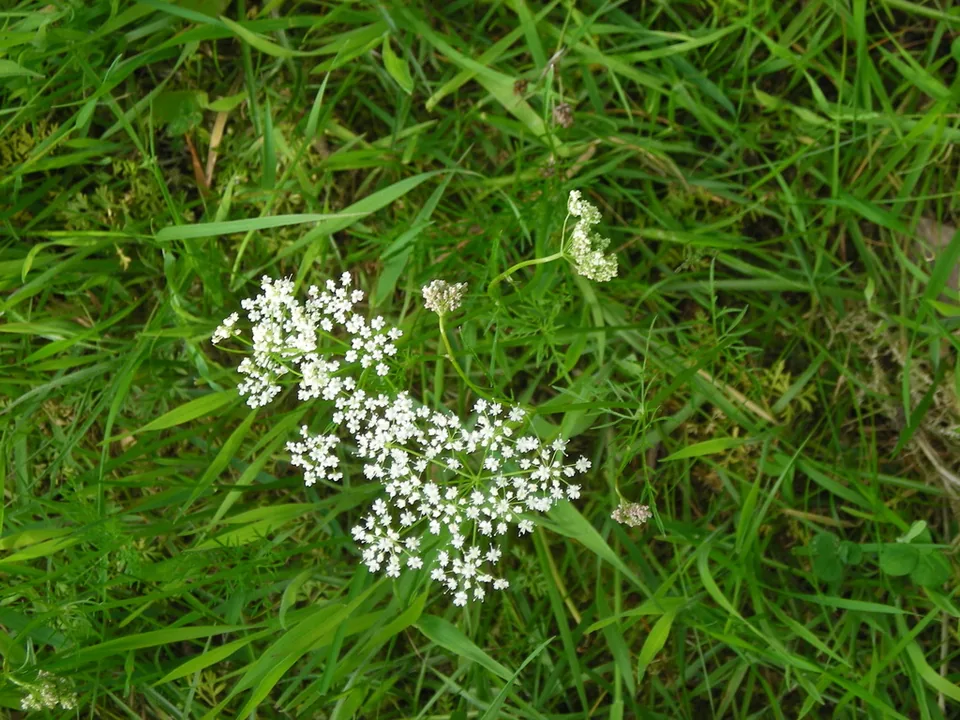
Cómo cultivar y cuidar Castañuela
Conopodium majus
Escrito por Emilio Marruso · última revisión
De un vistazo
La castaña de tierra esconde una sorpresa bajo tierra: pequeños tubérculos que puedes comer crudos o cocinados, con un sabor a fruto seco entre el boniato y la avellana. Dale sol pleno o sombra ligera y un riego moderado, porque no soporta la sequía. Siémbrala en primavera en cajonera fría, trasplanta las plántulas a principios de verano y recoge los tubérculos con más facilidad en primavera y verano.
- Sol
Sol pleno; también aguanta la sombra ligera
Qué dicen las fuentes (1)
Luz: Pleno sol; tolera semisombra
Light full sun Shade tolerance light shade Water moderate Soil textures sandy, loamy, clay
— Pignut (Conopodium majus) — Practical Plants [4] - Riego
Riego moderado; no dejes que se seque, no soporta la sequía
Qué dicen las fuentes (2)
Riego: Moderado
Shade tolerance light shade Water moderate Soil textures sandy, loamy, clay Soil pH acid, neutral Tolerates Nutritionally Poor Soil No Drought intolerant
— Pignut (Conopodium majus) — Practical Plants [4] Notas sobre el riego: Intolerante a la sequía
Shade tolerance light shade Water moderate Soil textures sandy, loamy, clay Soil pH acid, neutral Tolerates Nutritionally Poor Soil No Drought intolerant
— Pignut (Conopodium majus) — Practical Plants [4] - Plantación
Trasplanta las plántulas a principios de verano
Qué dicen las fuentes (2)
Plantación: A principios del verano (plántulas)
Seed - sow spring in a cold frame. Germination is usually quick and good[K]. Prick out the seedlings into individual pots as soon as they are large enough to handle and plant them out when in early summer.
— Pignut (Conopodium majus) — Practical Plants [4] Prick out the seedlings into individual pots as soon as they are large enough to handle and plant them out when in early summer.
— Conopodium majus - Useful Temperate Plants [3] - Cosecha
Tubérculos con sabor a fruto seco, crudos o cocinados; todo el año, mejor en primavera y verano
Qué dicen las fuentes (1)
Cosecha: Todo el año; los tubérculos se recolectan más fácilmente en primavera y verano
The tubers can be harvested throughout the year however they would be most easily collected in spring and summer when the plants’ above ground tissue is visible (Fairbairn 1999).
— Archaeobotany - Conopodium Majus [2] - Multiplicación
Por semilla, o divide la planta a finales de verano, cuando se seca
Qué dicen las fuentes (2)
Propagación: Semilla (marco frío o siembra directa); división a finales del verano cuando la planta se marchita
Seed - sow spring in a cold frame. Germination is usually quick and good[K]. Prick out the seedlings into individual pots as soon as they are large enough to handle and plant them out when in early summer.
— Pignut (Conopodium majus) — Practical Plants [4] It is also possible to sow in situ, though this requires a lot more seed to produce the same amount of plants from a protected sowing. Division in late summer as the plant dies down.
— Pignut (Conopodium majus) — Practical Plants [4] - Siembra
Siembra en primavera en cajonera fría o directamente en su sitio
Qué dicen las fuentes (3)
Siembra: Primavera (en un marco frío)
Seed - sow spring in a cold frame. Germination is usually quick and good[K]. Prick out the seedlings into individual pots as soon as they are large enough to handle and plant them out when in early summer.
— Pignut (Conopodium majus) — Practical Plants [4] Propagación: Semilla (marco frío o siembra directa); división a finales del verano cuando la planta se marchita
Seed - sow spring in a cold frame. Germination is usually quick and good[K]. Prick out the seedlings into individual pots as soon as they are large enough to handle and plant them out when in early summer.
— Pignut (Conopodium majus) — Practical Plants [4] It is also possible to sow in situ, though this requires a lot more seed to produce the same amount of plants from a protected sowing. Division in late summer as the plant dies down.
— Pignut (Conopodium majus) — Practical Plants [4]
Resumen
El pignut es una planta perenne de la familia de las zanahorias que crece a partir de un tubérculo globular subterráneo; se encuentra en bosques, brezales, prados y pastizales. [5] Su único tubérculo pequeño se come crudo o cocido y se recolecta de la naturaleza para uso local. [3][2] La especie responde al cultivo produciendo tubérculos más grandes. [3]
Citado en inglés, como en la fuente.
Esta ficha está incompleta: las fuentes consultadas aún no cubren todos los campos.
Aún no cubierto por nuestras fuentes: Distancia de plantación
Cuidados
Riego
Riego
Moderado
Qué dicen las fuentes (1)
Shade tolerance
light shade
Water
moderate
Soil textures
sandy, loamy, clay
Soil pH
acid, neutral
Tolerates Nutritionally Poor Soil
No
Drought
intolerantNotas sobre el riego
Intolerante a la sequía
Qué dicen las fuentes (1)
Shade tolerance
light shade
Water
moderate
Soil textures
sandy, loamy, clay
Soil pH
acid, neutral
Tolerates Nutritionally Poor Soil
No
Drought
intolerantLuz
Pleno sol; tolera semisombra
Qué dicen las fuentes (1)
Light
full sun
Shade tolerance
light shade
Water
moderate
Soil textures
sandy, loamy, clayDónde cultivarla
No figura en las fuentes consultadas.
Propagación
Semilla (marco frío o siembra directa); división a finales del verano cuando la planta se marchita
Qué dicen las fuentes (2)
Seed - sow spring in a cold frame. Germination is usually quick and good[K]. Prick out the seedlings into individual pots as soon as they are large enough to handle and plant them out when in early summer.It is also possible to sow in situ, though this requires a lot more seed to produce the same amount of plants from a protected sowing.
Division in late summer as the plant dies down.Cultivo
La planta
Familia
Apiaceae
Qué dicen las fuentes (1)
Apiaceae - Conopodium majus (Gouan) Loret subsp. majus; Pignatti 1982: n. 2452; Conopodium majus (Gouan) LoretRemedios
Las fuentes consultadas no dan remedios para esta planta.
Calendario
Siembra
Primavera (en un marco frío)
Qué dicen las fuentes (1)
Seed - sow spring in a cold frame. Germination is usually quick and good[K]. Prick out the seedlings into individual pots as soon as they are large enough to handle and plant them out when in early summer.Plantación
A principios del verano (plántulas)
Qué dicen las fuentes (2)
Seed - sow spring in a cold frame. Germination is usually quick and good[K]. Prick out the seedlings into individual pots as soon as they are large enough to handle and plant them out when in early summer.Prick out the seedlings into individual pots as soon as they are large enough to handle and plant them out when in early summer.Cosecha
Todo el año; los tubérculos se recolectan más fácilmente en primavera y verano
Qué dicen las fuentes (1)
The tubers can be harvested throughout the year however they would be most easily collected in spring and summer when the plants’ above ground tissue is visible (Fairbairn 1999).Meses tal como los dan las fuentes, en su mayoría de Estados Unidos (hemisferio norte). En el hemisferio sur se desplazan unos seis meses.
Comestibilidad
Según la fuente, citada textualmente. No comas una planta basándote solo en esta página: los errores de identificación pueden ser peligrosos.
Tubers - raw or cooked [5] [6] [3] [4] [7] [1] . A very pleasant food with a flavour somewhat between a sweet potato and hazelnuts
[4]This storage organ is edible with a nutty flavour similar to chestnut and available all year round.
[2]Pignut tubers can be eaten raw or cooked and have a nutty flavour.
[2]
Plantas similares
- Apio caballar Smyrnium olusatrum
- Angélica Angelica archangelica
- Cilantro Coriandrum sativum
- Echinophora spinosa Echinophora spinosa
- Hinojo Foeniculum vulgare
- Apio de monte Levisticum officinale
- Bulbocastaña Bunium bulbocastanum
- Perejil japonés Cryptotaenia japonica
Fuentes
Cada valor anterior se cita de estos documentos. Los enlaces llevan al editor original.
- FuD.WE.PIC. · fudwepic.unipa.it, consultado
- Archaeobotany - Conopodium Majus · sites.google.com, consultado
- Conopodium majus - Useful Temperate Plants · temperate.theferns.info, consultado
- Pignut (Conopodium majus) — Practical Plants · practicalplants.org, consultado
- Flora of the Burren and Southeast Connemara: Conopodium majus · flora-burren.linnaeus.naturalis.nl, consultado
- Seed ecology of the geophyte Conopodium majus (Apiaceae), indicator species of ancient woodland understories and oligotrophic meadows - PMC · ncbi.nlm.nih.gov, consultado
Escrito por Emilio Marruso · última revisión