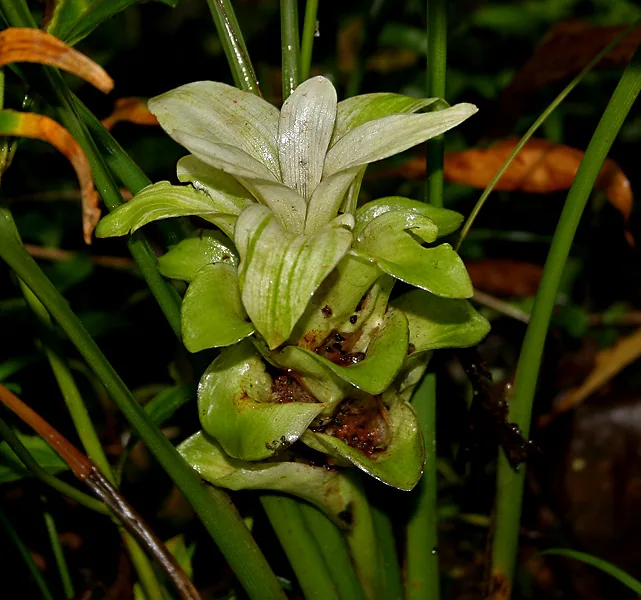


Cómo cultivar y cuidar Cúrcuma
Curcuma longa
Escrito por Emilio Marruso · última revisión
Tóxica para: Personas · Por qué
De un vistazo
La cúrcuma es una perenne que premia la paciencia: planta los rizomas a principios de primavera, mantén la tierra húmeda pero nunca empapada y mírala crecer hasta 1,2 m. En otoño, cuando las hojas amarillean y se secan, desentierra la planta entera. Los rizomas se convierten en la especia que conoces, y puedes usarlos frescos en casi cualquier receta.
- Sol
Sol por la mañana y sombra por la tarde; también crece en semisombra o sombra
Qué dicen las fuentes (5)
Luz: Pleno sol por la mañana y sombra por la tarde; también se dice que crece bien en semisombra o sombra completa.
Según NC State Extension: Common Turmeric grows best in hot, humid conditions with full sun in the morning and afternoon shade.
— Curcuma longa (Common Turmeric, Turmeric) | North Carolina Extension Gardener Plant Toolbox [1] Según UF/IFAS Gardening Solutions: It grows well in partial to full shade in soil that has been amended with organic matter.
— Turmeric – Gardening Solutions [5] cultivado en interiores (UVM Extension): When they do, move the pot to a sunny spot near a window. If necessary, supplement with a grow light.
— Growing Ginger and Turmeric Indoors | University of… [4] Common Turmeric grows best in hot, humid conditions with full sun in the morning and afternoon shade.
— Curcuma longa (Common Turmeric, Turmeric) | North Carolina Extension Gardener Plant Toolbox [1] It grows well in partial to full shade in soil that has been amended with organic matter.
— Turmeric – Gardening Solutions [5] - Riego
Mantén la tierra húmeda pero no empapada; riega con moderación hasta que broten
Qué dicen las fuentes (6)
Riego: Riego frecuente; en macetas interiores mantén el suelo húmedo pero no mojado y nebuliza a menudo si el aire está seco; los contenedores necesitan riego adicional
Según Penn State Extension: Typically growing during the monsoon season in India, it needs frequent watering.
— 2026 Herb of the Year: Turmeric [3] cultivado en interiores en macetas (UVM Extension): Water as needed to keep the soil moist (not wet), and mist often if the air is dry.
— Growing Ginger and Turmeric Indoors | University of… [4] Typically growing during the monsoon season in India, it needs frequent watering.
— 2026 Herb of the Year: Turmeric [3] Water as needed to keep the soil moist (not wet), and mist often if the air is dry.
— Growing Ginger and Turmeric Indoors | University of… [4] If grown in containers, be aware that the rhizomes get thick and the plant may need to be repotted frequently. Containers will need extra watering.
— 2026 Herb of the Year: Turmeric [3] Notas sobre el riego: Riega con moderación hasta que aparezcan los brotes; demasiada humedad puede pudrir el rizoma
Water sparingly until sprouts appear. The soil should be moist, but never wet. Too much moisture may rot the rhizome.
— Growing Ginger and Turmeric Indoors | University of… [4] - Frío
Aguanta inviernos de hasta −12,2 °C (10 °F)
Rústica en inviernos fríos · USDA 8a · RHS H5 · Z8
Qué dicen las fuentes (8)
Rusticidad, zona más fría: 8a [mínima invernal de −12,2 a −9,4 °C (de 10 a 15 °F)]
Según NC State Extension: USDA Plant Hardiness Zone: 8a, 8b, 9a, 9b, 10a, 10b, 11a, 11b
— Curcuma longa (Common Turmeric, Turmeric) | North Carolina Extension Gardener Plant Toolbox [1] Según Penn State Extension: Turmeric is a perennial plant in hot and humid regions (USDA Plant Hardiness Zones 8-11).
— 2026 Herb of the Year: Turmeric [3] cultivadas en interiores en climas más fríos (UVM Extension): it's possible to grow tropical spices like ginger and turmeric (U.S. hardiness zones 8-10).
— Growing Ginger and Turmeric Indoors | University of… [4] 8a, 8b, 9a, 9b, 10a, 10b, 11a, 11b
— Curcuma longa (Common Turmeric, Turmeric) | North Carolina Extension Gardener Plant Toolbox [1] Rusticidad, zona más cálida:
Según NC State Extension: USDA Plant Hardiness Zone: 8a, 8b, 9a, 9b, 10a, 10b, 11a, 11b
— Curcuma longa (Common Turmeric, Turmeric) | North Carolina Extension Gardener Plant Toolbox [1] Según Penn State Extension: Turmeric is a perennial plant in hot and humid regions (USDA Plant Hardiness Zones 8-11).
— 2026 Herb of the Year: Turmeric [3] cultivadas en interiores en climas más fríos (UVM Extension): it's possible to grow tropical spices like ginger and turmeric (U.S. hardiness zones 8-10).
— Growing Ginger and Turmeric Indoors | University of… [4] 8a, 8b, 9a, 9b, 10a, 10b, 11a, 11b
— Curcuma longa (Common Turmeric, Turmeric) | North Carolina Extension Gardener Plant Toolbox [1] - Distancia
38 cm entre hileras
Qué dicen las fuentes (1)
Distancia entre hileras: 38 cm (15 pulgadas)
Space them 15 inches in the row and 15 inches between the row.
— Turmeric – Gardening Solutions [5] - Plantación
Planta a principios de primavera
Qué dicen las fuentes (3)
Plantación: Principios de primavera
Según UF/IFAS Gardening Solutions: Early in the spring is the best time to plant.
— Turmeric – Gardening Solutions [5] Según Penn State Extension: Replant 1- to 1.5-inch-long rhizomes that have at least one bud, or "eye", in the spring.
— 2026 Herb of the Year: Turmeric [3] Early in the spring is the best time to plant.
— Turmeric – Gardening Solutions [5] - Abonado
Abona la tierra al plantar y después en varias dosis pequeñas
Qué dicen las fuentes (2)
Cuándo: En la preparación del terreno o al plantar como abono basal; fertilizante mineral en dosis divididas
Farm yard manure or compost is applied at 30-40t/ha is applied by broadcasting and ploughed at the time of preparation of land or as basal dressing by spreading over the beds at the time of planting.
— [6] Fertilizers are applied at 60kgN, 50kg P2O5 and 120kg k2O per hectare in split doses.
— [6] - Cosecha
Cosecha en otoño cuando las hojas amarillean y se secan; desentierra la planta entera
Qué dicen las fuentes (8)
Cosecha: Otoño, cuando el follaje comienza a marchitarse y secarse (finales de otoño o principios de invierno en Florida); plantas cultivadas en interiores después de 8-10 meses cuando la planta se ha amarilleado y secado
Según NC State Extension: The rhizomes are harvested in the fall when the foliage begins to wilt and dry out.
— Curcuma longa (Common Turmeric, Turmeric) | North Carolina Extension Gardener Plant Toolbox [1] Según UF/IFAS Gardening Solutions: Turmeric prolifically produces rhizomes that are ready for harvest generally in late fall or early winter; you’ll know it’s ready when the plant goes dormant.
— Turmeric – Gardening Solutions [5] cultivado en interiores en macetas (UVM Extension): After 8-10 months, the foliage will begin to fade. When the plant has yellowed and dried out, it's time to harvest.
— Growing Ginger and Turmeric Indoors | University of… [4] The rhizomes are harvested in the fall when the foliage begins to wilt and dry out.
— Curcuma longa (Common Turmeric, Turmeric) | North Carolina Extension Gardener Plant Toolbox [1] Turmeric prolifically produces rhizomes that are ready for harvest generally in late fall or early winter; you’ll know it’s ready when the plant goes dormant.
— Turmeric – Gardening Solutions [5] After 8-10 months, the foliage will begin to fade. When the plant has yellowed and dried out, it's time to harvest.
— Growing Ginger and Turmeric Indoors | University of… [4] Cómo cosechar: Cosecha cuando el follaje se vuelve amarillo, se marchita y se seca (en otoño): desentierra la planta entera, quita la tierra de los rizomas con un cepillo y corta el tallo.
When the plant has yellowed and dried out, it's time to harvest. Simply dig up the entire plant, brush the soil away from the rhizomes, and cut the stalk off.
— Growing Ginger and Turmeric Indoors | University of… [4] In the fall, when the leaves begin to dry out and wilt, dig up and harvest the rhizomes.
— 2026 Herb of the Year: Turmeric [3] - Plagas
Araña roja, babosas y caracoles
Qué dicen las fuentes (1)
Plagas: arañitas rojas, babosas, caracoles
Red spider mites can occur in older plants and if the soil is too dry. Young leaves may be troubled by slugs and snails.
— Curcuma longa (Common Turmeric, Turmeric) | North Carolina Extension Gardener Plant Toolbox [1] - Atención
El exceso de agua pudre el rizoma; deja secar varios días los trozos cortados antes de plantar
- Tamaño
De 0,9 a 1,2 m de alto y de ancho
Qué dicen las fuentes (4)
Altura adulta: 91-122 cm (3 a 4 pies)
Height: 3 ft. 0 in. - 4 ft. 0 in.
— Curcuma longa (Common Turmeric, Turmeric) | North Carolina Extension Gardener Plant Toolbox [1] turmeric plants are relatively care free with ginger growing 2-3 feet in height and turmeric 3-4 feet.
— Growing Ginger and Turmeric Indoors | University of… [4] - Multiplicación
Divide los rizomas
Qué dicen las fuentes (2)
Propagación: División de rizomas
Turmeric is reproduced from its rhizomes. Division of the rhizomes is best done in the spring or summer months.
— Curcuma longa (Common Turmeric, Turmeric) | North Carolina Extension Gardener Plant Toolbox [1] Both ginger and turmeric grow from a rhizome (a fleshy root) that is the edible part of the plant.
— Growing Ginger and Turmeric Indoors | University of… [4] - Maceta
Crece en maceta y en interior
Qué dicen las fuentes (3)
En maceta: Sí
Common Turmeric may be grown in containers or herb gardens.
— Curcuma longa (Common Turmeric, Turmeric) | North Carolina Extension Gardener Plant Toolbox [1] are easy to grow in containers and adapt well to living inside although they do benefit from time outside during the warm weather months.
— Growing Ginger and Turmeric Indoors | University of… [4] En interior: Sí
are easy to grow in containers and adapt well to living inside although they do benefit from time outside during the warm weather months.
— Growing Ginger and Turmeric Indoors | University of… [4] - Seguridad
Las raíces cortadas sueltan un tinte amarillo que mancha manos y ropa; a algunos les da alergia en la piel
Resumen
La cúrcuma es una hierba perenne erecta de la familia del jengibre cuyos rizomas son la fuente de una especia culinaria de color amarillo anaranjado brillante. [1] Crece mejor en condiciones cálidas y húmedas y puede cultivarse como anual donde no sea resistente al invierno. [1] Los rizomas cortados manchan las manos y la ropa, y algunas personas pueden desarrollar una reacción alérgica en la piel por el tinte. [1]
Citado en inglés, como en la fuente.
Cuidados
Riego
Riego
Riego frecuente; en macetas interiores mantén el suelo húmedo pero no mojado y nebuliza a menudo si el aire está seco; los contenedores necesitan riego adicional
Lo que dice cada fuente
Según Penn State Extension: Riego frecuente; los contenedores necesitan riego adicional.
cultivado en interiores en macetas (UVM Extension): Mantén el suelo húmedo pero no mojado; nebuliza a menudo si el aire está seco
Qué dicen las fuentes (5)
Según Penn State Extension: Typically growing during the monsoon season in India, it needs frequent watering.cultivado en interiores en macetas (UVM Extension): Water as needed to keep the soil moist (not wet), and mist often if the air is dry.Typically growing during the monsoon season in India, it needs frequent watering.Water as needed to keep the soil moist (not wet), and mist often if the air is dry.If grown in containers, be aware that the rhizomes get thick and the plant may need to be repotted frequently. Containers will need extra watering.Notas sobre el riego
Riega con moderación hasta que aparezcan los brotes; demasiada humedad puede pudrir el rizoma
Qué dicen las fuentes (1)
Water sparingly until sprouts appear. The soil should be moist, but never wet. Too much moisture may rot the rhizome.Luz
Pleno sol por la mañana y sombra por la tarde; también se dice que crece bien en semisombra o sombra completa.
Lo que dice cada fuente
Según NC State Extension: Pleno sol por la mañana y sombra por la tarde.
Según UF/IFAS Gardening Solutions: Sombra parcial a sombra completa.
cultivado en interiores (UVM Extension): Lugar soleado cerca de una ventana, complementado con una luz de cultivo si es necesario.
Qué dicen las fuentes (5)
Según NC State Extension: Common Turmeric grows best in hot, humid conditions with full sun in the morning and afternoon shade.Según UF/IFAS Gardening Solutions: It grows well in partial to full shade in soil that has been amended with organic matter.cultivado en interiores (UVM Extension): When they do, move the pot to a sunny spot near a window. If necessary, supplement with a grow light.Common Turmeric grows best in hot, humid conditions with full sun in the morning and afternoon shade.It grows well in partial to full shade in soil that has been amended with organic matter.Clima y frío
Rusticidad, zona más fría
8a [mínima invernal de −12,2 a −9,4 °C (de 10 a 15 °F)]
Lo que dice cada fuente
Según NC State Extension: 8a [mínima invernal de −12,2 a −9,4 °C (de 10 a 15 °F)]
Según Penn State Extension: 8 [mínima invernal de −12,2 a −6,7 °C (de 10 a 20 °F)]
cultivadas en interiores en climas más fríos (UVM Extension): 8 [mínima invernal de −12,2 a −6,7 °C (de 10 a 20 °F)]
Qué dicen las fuentes (4)
Según NC State Extension: USDA Plant Hardiness Zone: 8a, 8b, 9a, 9b, 10a, 10b, 11a, 11bSegún Penn State Extension: Turmeric is a perennial plant in hot and humid regions (USDA Plant Hardiness Zones 8-11).cultivadas en interiores en climas más fríos (UVM Extension): it's possible to grow tropical spices like ginger and turmeric (U.S. hardiness zones 8-10).8a, 8b, 9a, 9b, 10a, 10b, 11a, 11bRusticidad, zona más cálida
Las fuentes dan valores distintos según la región, la zona o las condiciones de cultivo.
Lo que dice cada fuente
Según NC State Extension: 11b [mínima invernal de 7,2 a 10 °C (de 45 a 50 °F)]
Según Penn State Extension: 11 [mínima invernal de 4,4 a 10 °C (de 40 a 50 °F)]
cultivadas en interiores en climas más fríos (UVM Extension): 10 [mínima invernal de −1,1 a 4,4 °C (de 30 a 40 °F)]
Qué dicen las fuentes (4)
Según NC State Extension: USDA Plant Hardiness Zone: 8a, 8b, 9a, 9b, 10a, 10b, 11a, 11bSegún Penn State Extension: Turmeric is a perennial plant in hot and humid regions (USDA Plant Hardiness Zones 8-11).cultivadas en interiores en climas más fríos (UVM Extension): it's possible to grow tropical spices like ginger and turmeric (U.S. hardiness zones 8-10).8a, 8b, 9a, 9b, 10a, 10b, 11a, 11bDónde cultivarla
En interior
Sí
Qué dicen las fuentes (1)
are easy to grow in containers and adapt well to living inside although they do benefit from time outside during the warm weather months.En maceta
Sí
Qué dicen las fuentes (2)
Common Turmeric may be grown in containers or herb gardens.are easy to grow in containers and adapt well to living inside although they do benefit from time outside during the warm weather months.Distancia de plantación
Las fuentes dan valores distintos según la región, la zona o las condiciones de cultivo.
Lo que dice cada fuente
Según UF/IFAS Gardening Solutions: 38.1 cm (15 pulgadas) en la fila y 38.1 cm (15 pulgadas) entre filas
Según Penn State Extension (grown in the ground): 182.9-365.8 cm (6 a 12 pies)
Qué dicen las fuentes (3)
Según UF/IFAS Gardening Solutions: Space them 15 inches in the row and 15 inches between the row.Según Penn State Extension (grown in the ground): Turmeric grows 3 to 4 feet high, 3 to 4 feet wide, and needs a spacing of 6 to 12 feet when grown in the ground.In your prepared bed, insert each piece and cover with about 1 inch of soil. Space them 15 inches in the row and 15 inches between the row.Propagación
División de rizomas
Qué dicen las fuentes (2)
Turmeric is reproduced from its rhizomes. Division of the rhizomes is best done in the spring or summer months.Both ginger and turmeric grow from a rhizome (a fleshy root) that is the edible part of the plant.Cultivo
La planta
Ciclo de vida
perenne
Lo que dice cada fuente
:
Qué dicen las fuentes (4)
: The plant can be grown as an annual in the ground or in a container in other areas.Common Turmeric is an upright perennial herb with rhizomes that grow about 40 inches tall.Turmeric is a perennial plant in hot and humid regions (USDA Plant Hardiness Zones 8-11).A perennial, turmeric dies back during winter freezes but will return reliably in late spring.Familia
Zingiberaceae (familia del jengibre)
Qué dicen las fuentes (2)
The plant is a member of the Zingiberaceae or ginger family.Turmeric ( Curcuma longa ) is a member of the Zingiberaceae family which also includes ginger, cardamom, and galangal.Altura adulta
91-122 cm (3 a 4 pies)
Qué dicen las fuentes (2)
Height: 3 ft. 0 in. - 4 ft. 0 in.turmeric plants are relatively care free with ginger growing 2-3 feet in height and turmeric 3-4 feet.Siembra y crecimiento
Días de germinación
21-56 (brotación del rizoma, 3 a 8 semanas)
Qué dicen las fuentes (1)
It will take 3-8 weeks for sprouts to appear.Profundidad de siembra
Las fuentes no coinciden:
Place the rhizome horizontally on the surface with the eyes facing up. Cover with about 2 inches of soil.
[4]In your prepared bed, insert each piece and cover with about 1 inch of soil.
[5]Plant them buds up, 2 to 4 inches deep.
[3]When planting the rhizomes, they needed to be planted at a depth of 4 inches.
[2]
Distancia entre hileras
38 cm (15 pulgadas)
Qué dicen las fuentes (1)
Space them 15 inches in the row and 15 inches between the row.Días hasta la madurez
8-10 meses (cultivado en interiores, hasta que el follaje se amarillece y se seca)
Qué dicen las fuentes (1)
After 8-10 months, the foliage will begin to fade. When the plant has yellowed and dried out, it's time to harvest.Cosecha y conservación
Cómo cosechar
Cosecha cuando el follaje se vuelve amarillo, se marchita y se seca (en otoño): desentierra la planta entera, quita la tierra de los rizomas con un cepillo y corta el tallo.
Qué dicen las fuentes (2)
When the plant has yellowed and dried out, it's time to harvest. Simply dig up the entire plant, brush the soil away from the rhizomes, and cut the stalk off.In the fall, when the leaves begin to dry out and wilt, dig up and harvest the rhizomes.Conservación
Los rizomas enteros se conservan en el refrigerador hasta 3 meses; los trozos cortados, en el congelador hasta 6 meses; lávalos, pélalos y congélalos; o guárdalos en un lugar fresco y seco, fuera de la luz solar directa.
Qué dicen las fuentes (3)
The whole rhizome can be stored in the refrigerator for up to three months, or cut in pieces and stored in the freezer for up to six months.Fortunately, turmeric keeps well when frozen. Simply wash, peel, and freeze the rhizomes.Use or store them in a cool, dry place out of direct sunlight.Plagas y enfermedades
Plagas
arañitas rojas, babosas, caracoles
Qué dicen las fuentes (1)
Red spider mites can occur in older plants and if the soil is too dry. Young leaves may be troubled by slugs and snails.Abonado
Cuándo
En la preparación del terreno o al plantar como abono basal; fertilizante mineral en dosis divididas
Qué dicen las fuentes (2)
Farm yard manure or compost is applied at 30-40t/ha is applied by broadcasting and
ploughed at the time of preparation of land or as basal dressing by spreading over the
beds at the time of planting.Fertilizers are applied at 60kgN, 50kg P2O5 and 120kg k2O
per hectare in split doses.Abonos naturales
Las fuentes dan valores distintos según la región, la zona o las condiciones de cultivo.
Lo que dice cada fuente
producción en campo: Estiércol de granja o compost a 30-40 t/ha, distribuido y incorporado con arado en la preparación del terreno o esparcido sobre los lechos al plantar
Qué dicen las fuentes (1)
producción en campo: Farm yard manure or compost is applied at 30-40t/ha is applied by broadcasting and
ploughed at the time of preparation of land or as basal dressing by spreading over the
beds at the time of planting.Abonos minerales
Las fuentes dan valores distintos según la región, la zona o las condiciones de cultivo.
Lo que dice cada fuente
producción en campo: 60 kg [132,3 lb] N, 50 kg [110,2 lb] P2O5 y 120 kg [264,6 lb] K2O por hectárea, en dosis divididas
Qué dicen las fuentes (1)
producción en campo: Fertilizers are applied at 60kgN, 50kg P2O5 and 120kg k2O
per hectare in split doses.Problemas
Arañitas rojas, babosas y caracoles
Síntoma: Las arañitas rojas pueden aparecer en plantas más viejas y si el suelo está demasiado seco; las hojas jóvenes pueden ser afectadas por babosas y caracoles.
Qué dicen las fuentes (1)
Red spider mites can occur in older plants and if the soil is too dry. Young leaves may be troubled by slugs and snails.
— Curcuma longa (Common Turmeric, Turmeric) | North Carolina Extension Gardener Plant Toolbox [1] Podredumbre de rizomas
Síntoma: El exceso de humedad puede pudrir el rizoma.
Qué hacer: Riega con moderación hasta que aparezcan los brotes; mantén la tierra húmeda pero nunca empapada; deja secar los cortes de los rizomas unos días antes de plantarlos.
Qué dicen las fuentes (2)
Water sparingly until sprouts appear. The soil should be moist, but never wet. Too much moisture may rot the rhizome.
— Growing Ginger and Turmeric Indoors | University of… [4] Do this a few days ahead of planting to allow the cut surfaces to dry, reducing chances of rotting.
— Turmeric – Gardening Solutions [5]
Remedios
Las fuentes consultadas no dan remedios para esta planta.
Toxicidad
Según la fuente, citada textualmente. No es un consejo médico ni veterinario: si una persona o un animal pudo haber ingerido esta planta, contacta con un centro de toxicología o con un veterinario.
Caution: If the roots are cut open, the yellow dye will stain your hands and clothing. Some people may also develop an allergic skin reaction from the dye.
[1]
Calendario
Plantación
Principios de primavera
Lo que dice cada fuente
Según UF/IFAS Gardening Solutions: A principios de la primavera
Según Penn State Extension: Primavera
Qué dicen las fuentes (3)
Según UF/IFAS Gardening Solutions: Early in the spring is the best time to plant.Según Penn State Extension: Replant 1- to 1.5-inch-long rhizomes that have at least one bud, or "eye", in the spring.Early in the spring is the best time to plant.Cosecha
Otoño, cuando el follaje comienza a marchitarse y secarse (finales de otoño o principios de invierno en Florida); plantas cultivadas en interiores después de 8-10 meses cuando la planta se ha amarilleado y secado
Lo que dice cada fuente
Según NC State Extension: Otoño, cuando el follaje comienza a marchitarse y secarse
Según UF/IFAS Gardening Solutions: Generalmente a finales de otoño o principios de invierno, cuando la planta entra en dormancia
cultivado en interiores en macetas (UVM Extension): Después de 8-10 meses, cuando el follaje se ha amarilleado y secado
Qué dicen las fuentes (6)
Según NC State Extension: The rhizomes are harvested in the fall when the foliage begins to wilt and dry out.Según UF/IFAS Gardening Solutions: Turmeric prolifically produces rhizomes that are ready for harvest generally in late fall or early winter; you’ll know it’s ready when the plant goes dormant.cultivado en interiores en macetas (UVM Extension): After 8-10 months, the foliage will begin to fade. When the plant has yellowed and dried out, it's time to harvest.The rhizomes are harvested in the fall when the foliage begins to wilt and dry out.Turmeric prolifically produces rhizomes that are ready for harvest generally in late fall or early winter; you’ll know it’s ready when the plant goes dormant.After 8-10 months, the foliage will begin to fade. When the plant has yellowed and dried out, it's time to harvest.Meses tal como los dan las fuentes, en su mayoría de Estados Unidos (hemisferio norte). En el hemisferio sur se desplazan unos seis meses.
Comestibilidad
Según la fuente, citada textualmente. No comas una planta basándote solo en esta página: los errores de identificación pueden ser peligrosos.
The rhizomes are the edible part of the plant and are boiled, dried, peeled, and then ground to produce the spice used for cooking.
[3]The turmeric you find in the spice aisle in the grocery store is the plant’s rhizomes, dried and ground into a powder, but you can substitute fresh turmeric into most any recipe.
[5]Turmeric leaves can be used as a wrap the same way you would use cabbage, banana, or grape leaves.
[5]
Valores orientativos
Valores de una fuente secundaria, no comprobados palabra por palabra como el resto de esta página. Úselos como punto de partida.
- pH del suelo
- 5.5-7Valor orientativo, adáptalo a tu clima · Fuente secundaria
- Crecimiento
- BajoValor orientativo, adáptalo a tu clima · Fuente secundaria
- Poda
- Marzo, Abril, AgostoValor orientativo, adáptalo a tu clima · Fuente secundaria
Plantas similares
- Curcuma petiolata Curcuma petiolata
- Abeto de Vancuver Abies grandis
- Abraham Trachystemon orientalis
- Bananero de Etiopía Ensete ventricosum
- Acacia longifolia Acacia longifolia
- Acanthus hungaricus Acanthus hungaricus
- Achlys triphylla Achlys triphylla
- Palma de aguja Yucca flaccida
Fuentes
Cada valor anterior se cita de estos documentos. Los enlaces llevan al editor original.
- Curcuma longa (Common Turmeric, Turmeric) | North Carolina Extension Gardener Plant Toolbox · plants.ces.ncsu.edu, consultado
- Curcuma | North Carolina Extension Gardener Plant Toolbox · plants.ces.ncsu.edu, consultado
- 2026 Herb of the Year: Turmeric · extension.psu.edu, consultado
- Growing Ginger and Turmeric Indoors | University of… · uvm.edu, consultado
- Turmeric – Gardening Solutions · gardeningsolutions.ifas.ufl.edu, consultado
- nihort.gov.ng · nihort.gov.ng
Escrito por Emilio Marruso · última revisión