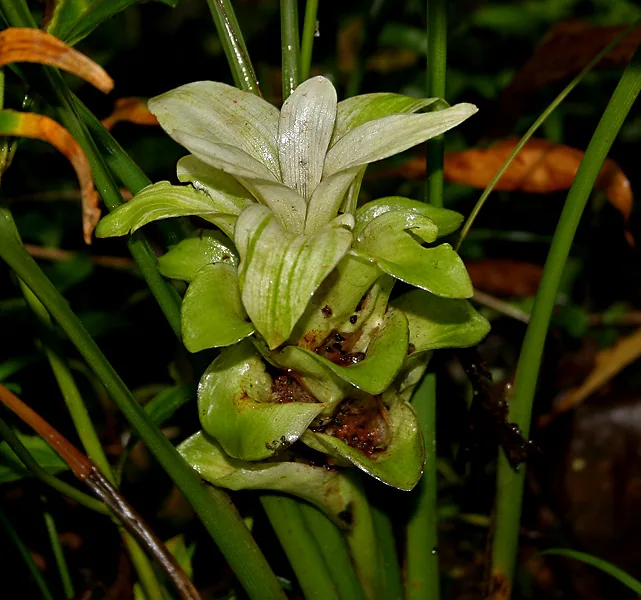


How to Grow and Care for Common turmeric
Curcuma longa
Written by Emilio Marruso · last checked
Toxic to: People · Why
At a glance
Turmeric is a perennial that rewards patience: plant the rhizomes in early spring, keep the soil moist but never wet, and watch it grow 3 to 4 feet tall. In fall, when the leaves yellow and dry, dig up the whole plant. The rhizomes become the spice you know, and you can use them fresh in almost any recipe.
- Sun
Morning sun, afternoon shade; also grows in partial to full shade
What the sources say (5)
Light: Full sun in the morning and shade in the afternoon; also reported to grow well in partial to full shade
According to NC State Extension: Common Turmeric grows best in hot, humid conditions with full sun in the morning and afternoon shade.
— Curcuma longa (Common Turmeric, Turmeric) | North Carolina Extension Gardener Plant Toolbox [1] According to UF/IFAS Gardening Solutions: It grows well in partial to full shade in soil that has been amended with organic matter.
— Turmeric – Gardening Solutions [5] grown indoors (UVM Extension): When they do, move the pot to a sunny spot near a window. If necessary, supplement with a grow light.
— Growing Ginger and Turmeric Indoors | University of… [4] Common Turmeric grows best in hot, humid conditions with full sun in the morning and afternoon shade.
— Curcuma longa (Common Turmeric, Turmeric) | North Carolina Extension Gardener Plant Toolbox [1] It grows well in partial to full shade in soil that has been amended with organic matter.
— Turmeric – Gardening Solutions [5] - Water
Keep the soil moist but not wet; water sparingly until sprouts appear
What the sources say (6)
Watering: Frequent watering; in indoor pots keep the soil moist but not wet and mist often if the air is dry; containers need extra watering
According to Penn State Extension: Typically growing during the monsoon season in India, it needs frequent watering.
— 2026 Herb of the Year: Turmeric [3] grown indoors in pots (UVM Extension): Water as needed to keep the soil moist (not wet), and mist often if the air is dry.
— Growing Ginger and Turmeric Indoors | University of… [4] Typically growing during the monsoon season in India, it needs frequent watering.
— 2026 Herb of the Year: Turmeric [3] Water as needed to keep the soil moist (not wet), and mist often if the air is dry.
— Growing Ginger and Turmeric Indoors | University of… [4] If grown in containers, be aware that the rhizomes get thick and the plant may need to be repotted frequently. Containers will need extra watering.
— 2026 Herb of the Year: Turmeric [3] Watering notes: Water sparingly until sprouts appear; too much moisture may rot the rhizome
Water sparingly until sprouts appear. The soil should be moist, but never wet. Too much moisture may rot the rhizome.
— Growing Ginger and Turmeric Indoors | University of… [4] - Cold
Survives winters down to 10 °F (−12.2 °C)
Hardy in cold winters · USDA 8a · RHS H5 · Z8
What the sources say (8)
Hardiness, coldest zone: 8a [winter low −12.2 to −9.4 °C (10 to 15 °F)]
According to NC State Extension: USDA Plant Hardiness Zone: 8a, 8b, 9a, 9b, 10a, 10b, 11a, 11b
— Curcuma longa (Common Turmeric, Turmeric) | North Carolina Extension Gardener Plant Toolbox [1] According to Penn State Extension: Turmeric is a perennial plant in hot and humid regions (USDA Plant Hardiness Zones 8-11).
— 2026 Herb of the Year: Turmeric [3] grown indoors in colder climates (UVM Extension): it's possible to grow tropical spices like ginger and turmeric (U.S. hardiness zones 8-10).
— Growing Ginger and Turmeric Indoors | University of… [4] 8a, 8b, 9a, 9b, 10a, 10b, 11a, 11b
— Curcuma longa (Common Turmeric, Turmeric) | North Carolina Extension Gardener Plant Toolbox [1] Hardiness, warmest zone:
According to NC State Extension: USDA Plant Hardiness Zone: 8a, 8b, 9a, 9b, 10a, 10b, 11a, 11b
— Curcuma longa (Common Turmeric, Turmeric) | North Carolina Extension Gardener Plant Toolbox [1] According to Penn State Extension: Turmeric is a perennial plant in hot and humid regions (USDA Plant Hardiness Zones 8-11).
— 2026 Herb of the Year: Turmeric [3] grown indoors in colder climates (UVM Extension): it's possible to grow tropical spices like ginger and turmeric (U.S. hardiness zones 8-10).
— Growing Ginger and Turmeric Indoors | University of… [4] 8a, 8b, 9a, 9b, 10a, 10b, 11a, 11b
— Curcuma longa (Common Turmeric, Turmeric) | North Carolina Extension Gardener Plant Toolbox [1] - Spacing
15 in between rows
What the sources say (1)
Row spacing: 38 cm (15 in)
Space them 15 inches in the row and 15 inches between the row.
— Turmeric – Gardening Solutions [5] - Planting
Plant in early spring
What the sources say (3)
Planting: Early spring
According to UF/IFAS Gardening Solutions: Early in the spring is the best time to plant.
— Turmeric – Gardening Solutions [5] According to Penn State Extension: Replant 1- to 1.5-inch-long rhizomes that have at least one bud, or "eye", in the spring.
— 2026 Herb of the Year: Turmeric [3] Early in the spring is the best time to plant.
— Turmeric – Gardening Solutions [5] - Feeding
Mix fertilizer into the soil at planting, then feed in small split doses
What the sources say (2)
When: At land preparation or at planting as a basal dressing; mineral fertilizer in split doses
Farm yard manure or compost is applied at 30-40t/ha is applied by broadcasting and ploughed at the time of preparation of land or as basal dressing by spreading over the beds at the time of planting.
— [6] Fertilizers are applied at 60kgN, 50kg P2O5 and 120kg k2O per hectare in split doses.
— [6] - Harvest
Harvest in fall when leaves yellow and dry; dig up the whole plant
What the sources say (8)
Harvest: Fall, when the foliage begins to wilt and dry out (late fall or early winter in Florida); indoor-grown plants after 8-10 months when the plant has yellowed and dried out
According to NC State Extension: The rhizomes are harvested in the fall when the foliage begins to wilt and dry out.
— Curcuma longa (Common Turmeric, Turmeric) | North Carolina Extension Gardener Plant Toolbox [1] According to UF/IFAS Gardening Solutions: Turmeric prolifically produces rhizomes that are ready for harvest generally in late fall or early winter; you’ll know it’s ready when the plant goes dormant.
— Turmeric – Gardening Solutions [5] grown indoors in pots (UVM Extension): After 8-10 months, the foliage will begin to fade. When the plant has yellowed and dried out, it's time to harvest.
— Growing Ginger and Turmeric Indoors | University of… [4] The rhizomes are harvested in the fall when the foliage begins to wilt and dry out.
— Curcuma longa (Common Turmeric, Turmeric) | North Carolina Extension Gardener Plant Toolbox [1] Turmeric prolifically produces rhizomes that are ready for harvest generally in late fall or early winter; you’ll know it’s ready when the plant goes dormant.
— Turmeric – Gardening Solutions [5] After 8-10 months, the foliage will begin to fade. When the plant has yellowed and dried out, it's time to harvest.
— Growing Ginger and Turmeric Indoors | University of… [4] How to harvest: Harvest when the foliage yellows, wilts and dries out (fall): dig up the whole plant, brush the soil off the rhizomes and cut the stalk off.
When the plant has yellowed and dried out, it's time to harvest. Simply dig up the entire plant, brush the soil away from the rhizomes, and cut the stalk off.
— Growing Ginger and Turmeric Indoors | University of… [4] In the fall, when the leaves begin to dry out and wilt, dig up and harvest the rhizomes.
— 2026 Herb of the Year: Turmeric [3] - Pests
Red spider mites, slugs, and snails
What the sources say (1)
Pests: red spider mites, slugs, snails
Red spider mites can occur in older plants and if the soil is too dry. Young leaves may be troubled by slugs and snails.
— Curcuma longa (Common Turmeric, Turmeric) | North Carolina Extension Gardener Plant Toolbox [1] - Watch out
Too much water rots the rhizome; let cut pieces dry a few days before planting
- Size
3–4 ft tall and wide
What the sources say (4)
Mature height: 91-122 cm (3 to 4 ft)
Height: 3 ft. 0 in. - 4 ft. 0 in.
— Curcuma longa (Common Turmeric, Turmeric) | North Carolina Extension Gardener Plant Toolbox [1] turmeric plants are relatively care free with ginger growing 2-3 feet in height and turmeric 3-4 feet.
— Growing Ginger and Turmeric Indoors | University of… [4] - Propagation
Divide the rhizomes
What the sources say (2)
Propagation: Division of rhizomes
Turmeric is reproduced from its rhizomes. Division of the rhizomes is best done in the spring or summer months.
— Curcuma longa (Common Turmeric, Turmeric) | North Carolina Extension Gardener Plant Toolbox [1] Both ginger and turmeric grow from a rhizome (a fleshy root) that is the edible part of the plant.
— Growing Ginger and Turmeric Indoors | University of… [4] - Containers
Grows in containers and indoors
What the sources say (3)
In containers: Yes
Common Turmeric may be grown in containers or herb gardens.
— Curcuma longa (Common Turmeric, Turmeric) | North Carolina Extension Gardener Plant Toolbox [1] are easy to grow in containers and adapt well to living inside although they do benefit from time outside during the warm weather months.
— Growing Ginger and Turmeric Indoors | University of… [4] Indoors: Yes
are easy to grow in containers and adapt well to living inside although they do benefit from time outside during the warm weather months.
— Growing Ginger and Turmeric Indoors | University of… [4] - Safety
Cut roots release a yellow dye that stains hands and clothes; some people get skin allergies
Overview
Turmeric is an upright perennial herb of the ginger family whose rhizomes are the source of a bright yellow-orange culinary spice. [1] It grows best in hot, humid conditions and may be grown as an annual where it is not winter hardy. [1] Cut rhizomes stain hands and clothing, and some people may develop an allergic skin reaction from the dye. [1]
Common turmeric care
How to water Common turmeric
Watering
Frequent watering; in indoor pots keep the soil moist but not wet and mist often if the air is dry; containers need extra watering
What each source says
According to Penn State Extension: Frequent watering; containers need extra watering
grown indoors in pots (UVM Extension): Keep the soil moist but not wet; mist often if the air is dry
What the sources say (5)
According to Penn State Extension: Typically growing during the monsoon season in India, it needs frequent watering.grown indoors in pots (UVM Extension): Water as needed to keep the soil moist (not wet), and mist often if the air is dry.Typically growing during the monsoon season in India, it needs frequent watering.Water as needed to keep the soil moist (not wet), and mist often if the air is dry.If grown in containers, be aware that the rhizomes get thick and the plant may need to be repotted frequently. Containers will need extra watering.Watering notes
Water sparingly until sprouts appear; too much moisture may rot the rhizome
What the sources say (1)
Water sparingly until sprouts appear. The soil should be moist, but never wet. Too much moisture may rot the rhizome.How much light Common turmeric needs
Full sun in the morning and shade in the afternoon; also reported to grow well in partial to full shade
What each source says
According to NC State Extension: Full sun in the morning and afternoon shade
According to UF/IFAS Gardening Solutions: Partial to full shade
grown indoors (UVM Extension): Sunny spot near a window, supplemented with a grow light if necessary
What the sources say (5)
According to NC State Extension: Common Turmeric grows best in hot, humid conditions with full sun in the morning and afternoon shade.According to UF/IFAS Gardening Solutions: It grows well in partial to full shade in soil that has been amended with organic matter.grown indoors (UVM Extension): When they do, move the pot to a sunny spot near a window. If necessary, supplement with a grow light.Common Turmeric grows best in hot, humid conditions with full sun in the morning and afternoon shade.It grows well in partial to full shade in soil that has been amended with organic matter.How much cold Common turmeric can take
Hardiness, coldest zone
8a [winter low −12.2 to −9.4 °C (10 to 15 °F)]
What each source says
According to NC State Extension: 8a [winter low −12.2 to −9.4 °C (10 to 15 °F)]
According to Penn State Extension: 8 [winter low −12.2 to −6.7 °C (10 to 20 °F)]
grown indoors in colder climates (UVM Extension): 8 [winter low −12.2 to −6.7 °C (10 to 20 °F)]
What the sources say (4)
According to NC State Extension: USDA Plant Hardiness Zone: 8a, 8b, 9a, 9b, 10a, 10b, 11a, 11bAccording to Penn State Extension: Turmeric is a perennial plant in hot and humid regions (USDA Plant Hardiness Zones 8-11).grown indoors in colder climates (UVM Extension): it's possible to grow tropical spices like ginger and turmeric (U.S. hardiness zones 8-10).8a, 8b, 9a, 9b, 10a, 10b, 11a, 11bHardiness, warmest zone
The sources give different values depending on region, zone or growing conditions.
What each source says
According to NC State Extension: 11b [winter low 7.2 to 10 °C (45 to 50 °F)]
According to Penn State Extension: 11 [winter low 4.4 to 10 °C (40 to 50 °F)]
grown indoors in colder climates (UVM Extension): 10 [winter low −1.1 to 4.4 °C (30 to 40 °F)]
What the sources say (4)
According to NC State Extension: USDA Plant Hardiness Zone: 8a, 8b, 9a, 9b, 10a, 10b, 11a, 11bAccording to Penn State Extension: Turmeric is a perennial plant in hot and humid regions (USDA Plant Hardiness Zones 8-11).grown indoors in colder climates (UVM Extension): it's possible to grow tropical spices like ginger and turmeric (U.S. hardiness zones 8-10).8a, 8b, 9a, 9b, 10a, 10b, 11a, 11bWhere to grow Common turmeric
Indoors
Yes
What the sources say (1)
are easy to grow in containers and adapt well to living inside although they do benefit from time outside during the warm weather months.In containers
Yes
What the sources say (2)
Common Turmeric may be grown in containers or herb gardens.are easy to grow in containers and adapt well to living inside although they do benefit from time outside during the warm weather months.Spacing
The sources give different values depending on region, zone or growing conditions.
What each source says
According to UF/IFAS Gardening Solutions: 38.1 cm (15 in) in the row and 38.1 cm (15 in) between rows
According to Penn State Extension (grown in the ground): 182.9-365.8 cm (6 to 12 ft)
What the sources say (3)
According to UF/IFAS Gardening Solutions: Space them 15 inches in the row and 15 inches between the row.According to Penn State Extension (grown in the ground): Turmeric grows 3 to 4 feet high, 3 to 4 feet wide, and needs a spacing of 6 to 12 feet when grown in the ground.In your prepared bed, insert each piece and cover with about 1 inch of soil. Space them 15 inches in the row and 15 inches between the row.How to propagate Common turmeric
Division of rhizomes
What the sources say (2)
Turmeric is reproduced from its rhizomes. Division of the rhizomes is best done in the spring or summer months.Both ginger and turmeric grow from a rhizome (a fleshy root) that is the edible part of the plant.How to grow Common turmeric
The plant
Life cycle
perennial
What each source says
:
What the sources say (4)
: The plant can be grown as an annual in the ground or in a container in other areas.Common Turmeric is an upright perennial herb with rhizomes that grow about 40 inches tall.Turmeric is a perennial plant in hot and humid regions (USDA Plant Hardiness Zones 8-11).A perennial, turmeric dies back during winter freezes but will return reliably in late spring.Family
Zingiberaceae (ginger family)
What the sources say (2)
The plant is a member of the Zingiberaceae or ginger family.Turmeric ( Curcuma longa ) is a member of the Zingiberaceae family which also includes ginger, cardamom, and galangal.Mature height
91-122 cm (3 to 4 ft)
What the sources say (2)
Height: 3 ft. 0 in. - 4 ft. 0 in.turmeric plants are relatively care free with ginger growing 2-3 feet in height and turmeric 3-4 feet.Sowing and growth
Days to germination
21-56 (rhizome sprouting, 3 to 8 weeks)
What the sources say (1)
It will take 3-8 weeks for sprouts to appear.Sowing depth
The sources disagree:
Place the rhizome horizontally on the surface with the eyes facing up. Cover with about 2 inches of soil.
[4]In your prepared bed, insert each piece and cover with about 1 inch of soil.
[5]Plant them buds up, 2 to 4 inches deep.
[3]When planting the rhizomes, they needed to be planted at a depth of 4 inches.
[2]
Row spacing
38 cm (15 in)
What the sources say (1)
Space them 15 inches in the row and 15 inches between the row.Days to maturity
8-10 months (indoor-grown, until the foliage yellows and dries)
What the sources say (1)
After 8-10 months, the foliage will begin to fade. When the plant has yellowed and dried out, it's time to harvest.Harvest and storage
How to harvest
Harvest when the foliage yellows, wilts and dries out (fall): dig up the whole plant, brush the soil off the rhizomes and cut the stalk off.
What the sources say (2)
When the plant has yellowed and dried out, it's time to harvest. Simply dig up the entire plant, brush the soil away from the rhizomes, and cut the stalk off.In the fall, when the leaves begin to dry out and wilt, dig up and harvest the rhizomes.Storage
Whole rhizomes keep in the refrigerator up to 3 months; cut pieces in the freezer up to 6 months; wash, peel and freeze; or store in a cool, dry place out of direct sunlight.
What the sources say (3)
The whole rhizome can be stored in the refrigerator for up to three months, or cut in pieces and stored in the freezer for up to six months.Fortunately, turmeric keeps well when frozen. Simply wash, peel, and freeze the rhizomes.Use or store them in a cool, dry place out of direct sunlight.Pests and diseases
Pests
red spider mites, slugs, snails
What the sources say (1)
Red spider mites can occur in older plants and if the soil is too dry. Young leaves may be troubled by slugs and snails.Fertilizing
When
At land preparation or at planting as a basal dressing; mineral fertilizer in split doses
What the sources say (2)
Farm yard manure or compost is applied at 30-40t/ha is applied by broadcasting and
ploughed at the time of preparation of land or as basal dressing by spreading over the
beds at the time of planting.Fertilizers are applied at 60kgN, 50kg P2O5 and 120kg k2O
per hectare in split doses.Natural fertilizers
The sources give different values depending on region, zone or growing conditions.
What each source says
field production: Farmyard manure or compost at 30-40 t/ha, broadcast and ploughed in at land preparation or spread over the beds at planting
What the sources say (1)
field production: Farm yard manure or compost is applied at 30-40t/ha is applied by broadcasting and
ploughed at the time of preparation of land or as basal dressing by spreading over the
beds at the time of planting.Mineral fertilizers
The sources give different values depending on region, zone or growing conditions.
What each source says
field production: 60 kg [132.3 lb] N, 50 kg [110.2 lb] P2O5 and 120 kg [264.6 lb] K2O per hectare, in split doses
What the sources say (1)
field production: Fertilizers are applied at 60kgN, 50kg P2O5 and 120kg k2O
per hectare in split doses.Common turmeric pests and problems
Red spider mites, slugs and snails
Symptom: Red spider mites can occur in older plants and if the soil is too dry; young leaves may be troubled by slugs and snails.
What the sources say (1)
Red spider mites can occur in older plants and if the soil is too dry. Young leaves may be troubled by slugs and snails.
— Curcuma longa (Common Turmeric, Turmeric) | North Carolina Extension Gardener Plant Toolbox [1] Rhizome rot
Symptom: Too much moisture may rot the rhizome.
What to do: Water sparingly until sprouts appear; keep the soil moist but never wet; allow cut surfaces of rhizome pieces to dry a few days before planting.
What the sources say (2)
Water sparingly until sprouts appear. The soil should be moist, but never wet. Too much moisture may rot the rhizome.
— Growing Ginger and Turmeric Indoors | University of… [4] Do this a few days ahead of planting to allow the cut surfaces to dry, reducing chances of rotting.
— Turmeric – Gardening Solutions [5]
Remedies
The sources we checked give no remedies for this plant.
Is Common turmeric poisonous?
Reported by the source, quoted verbatim. This is not medical or veterinary advice: if a person or an animal may have eaten this plant, contact a poison control centre or a veterinarian.
Caution: If the roots are cut open, the yellow dye will stain your hands and clothing. Some people may also develop an allergic skin reaction from the dye.
[1]
Calendar
Planting
Early spring
What each source says
According to UF/IFAS Gardening Solutions: Early in the spring
According to Penn State Extension: Spring
What the sources say (3)
According to UF/IFAS Gardening Solutions: Early in the spring is the best time to plant.According to Penn State Extension: Replant 1- to 1.5-inch-long rhizomes that have at least one bud, or "eye", in the spring.Early in the spring is the best time to plant.Harvest
Fall, when the foliage begins to wilt and dry out (late fall or early winter in Florida); indoor-grown plants after 8-10 months when the plant has yellowed and dried out
What each source says
According to NC State Extension: Fall, when the foliage begins to wilt and dry out
According to UF/IFAS Gardening Solutions: Generally late fall or early winter, when the plant goes dormant
grown indoors in pots (UVM Extension): After 8-10 months, when the foliage has yellowed and dried out
What the sources say (6)
According to NC State Extension: The rhizomes are harvested in the fall when the foliage begins to wilt and dry out.According to UF/IFAS Gardening Solutions: Turmeric prolifically produces rhizomes that are ready for harvest generally in late fall or early winter; you’ll know it’s ready when the plant goes dormant.grown indoors in pots (UVM Extension): After 8-10 months, the foliage will begin to fade. When the plant has yellowed and dried out, it's time to harvest.The rhizomes are harvested in the fall when the foliage begins to wilt and dry out.Turmeric prolifically produces rhizomes that are ready for harvest generally in late fall or early winter; you’ll know it’s ready when the plant goes dormant.After 8-10 months, the foliage will begin to fade. When the plant has yellowed and dried out, it's time to harvest.Months as given by the sources, which are mostly from the United States (northern hemisphere). In the southern hemisphere they shift by about six months.
Edibility
Reported by the source, quoted verbatim. Do not eat a plant on the basis of this page alone: identification mistakes can be dangerous.
The rhizomes are the edible part of the plant and are boiled, dried, peeled, and then ground to produce the spice used for cooking.
[3]The turmeric you find in the spice aisle in the grocery store is the plant’s rhizomes, dried and ground into a powder, but you can substitute fresh turmeric into most any recipe.
[5]Turmeric leaves can be used as a wrap the same way you would use cabbage, banana, or grape leaves.
[5]
Indicative values
Values from a secondary source, not checked word for word like the rest of this page. Use them as a starting point.
- Soil pH
- 5.5-7Indicative value, adapt it to your climate · Secondary source
- Growth rate
- LowIndicative value, adapt it to your climate · Secondary source
- Pruning
- March, April, AugustIndicative value, adapt it to your climate · Secondary source
Similar plants
- Curcuma petiolata Curcuma petiolata
- Abies grandis Abies grandis
- Abraham Trachystemon orientalis
- Abyssinian banana Ensete ventricosum
- Acacia longifolia Acacia longifolia
- Acanthus hungaricus Acanthus hungaricus
- Achlys triphylla Achlys triphylla
- Adam's Needle Yucca flaccida
Sources
Every value above is quoted from these documents. Links lead to the original publisher.
- Curcuma longa (Common Turmeric, Turmeric) | North Carolina Extension Gardener Plant Toolbox · plants.ces.ncsu.edu, consulted
- Curcuma | North Carolina Extension Gardener Plant Toolbox · plants.ces.ncsu.edu, consulted
- 2026 Herb of the Year: Turmeric · extension.psu.edu, consulted
- Growing Ginger and Turmeric Indoors | University of… · uvm.edu, consulted
- Turmeric – Gardening Solutions · gardeningsolutions.ifas.ufl.edu, consulted
- nihort.gov.ng · nihort.gov.ng
Written by Emilio Marruso · last checked