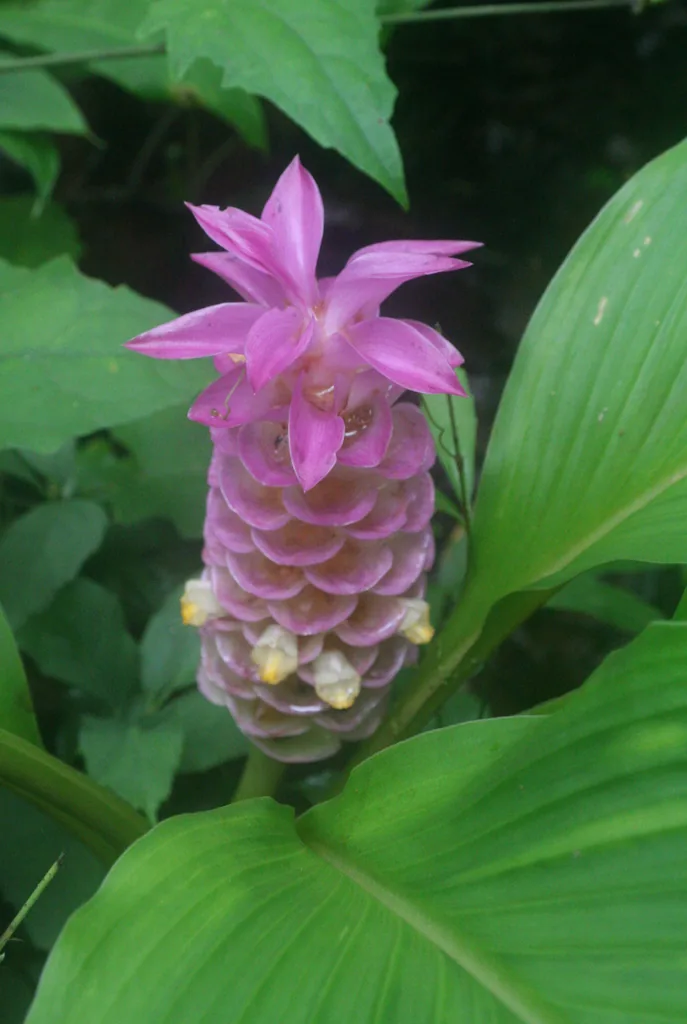
How to Grow and Care for Curcuma petiolata
Curcuma petiolata
Written by Emilio Marruso · last checked
At a glance
This curcuma is a perennial that flowers in summer and multiplies easily when you divide its clumps of rhizomes. Give it part shade to sun, with afternoon shade where summers are hot, and keep the soil moist while it blooms. In winter it rests: cut back watering and trim the yellowing leaves. It grows 1–3 ft tall and is happy in a container too.
- Sun
Part shade to sun; in hot climates, morning sun and afternoon shade
What the sources say (4)
Light: Part shade to sun; morning sun with afternoon partial shade in hot climates
South Carolina: Due to South Carolina’s hot, humid summers, plant hidden ginger in morning sun with partial shade in the afternoon.
— Hidden Ginger | Home & Garden Information Center [1] zones 8 and higher: In zones 8 and higher, grow queen lily ginger outside in part-shade to sun (err on the side of shade in hotter climates)
— Queen Lily Ginger (Curcuma petiolata) Flower Care - Birds and Blooms [5] plant hidden ginger in morning sun with partial shade in the afternoon.
— Hidden Ginger | Home & Garden Information Center [1] grow queen lily ginger outside in part-shade to sun (err on the side of shade in hotter climates)
— Queen Lily Ginger (Curcuma petiolata) Flower Care - Birds and Blooms [5] - Water
Keep soil moist and water regularly in summer; in winter, just enough so it never dries out
What the sources say (4)
Watering: Keep soil moist; water regularly while flowering in summer
They must be planted in organically rich, well-drained, moist soil.
— Hidden Ginger | Home & Garden Information Center [1] Move it outside for the summer months while it’s flowering and water regularly.
— Queen Lily Ginger (Curcuma petiolata) Flower Care - Birds and Blooms [5] Watering notes: Root rot and bacterial wilt if kept too wet; in winter dormancy cut back watering, just enough to keep soil from drying out entirely
Root rot and bacterial wilt can be a problem if kept too wet.
— Hidden Ginger | Home & Garden Information Center [1] Bring containers indoors for the winter and cut back on watering, providing just enough to keep the soil from drying out entirely.
— Queen Lily Ginger (Curcuma petiolata) Flower Care - Birds and Blooms [5] - Planting
Plant after the last spring frost
What the sources say (1)
Planting: After the last spring frost
Plant the rhizomes after the fear of the last spring frost has passed.
— Hidden Ginger | Home & Garden Information Center [1] - Pruning
Cut back in winter, when the leaves turn yellow or die back
What the sources say (1)
Pruning: Winter dormancy, when foliage yellows or dies back
Foliage may yellow or die back, even in warmer zones, and you can trim it back if you prefer a tidier look.
— Queen Lily Ginger (Curcuma petiolata) Flower Care - Birds and Blooms [5] - Pests
Slugs and snails eat new leaves; soggy soil causes root rot and wilt
What the sources say (2)
Pests: slugs, snails
It is deer-resistant, but slugs and snails may feed on new, tender foliage.
— Hidden Ginger | Home & Garden Information Center [1] Diseases: root rot, bacterial wilt
Root rot and bacterial wilt can be a problem if kept too wet.
— Hidden Ginger | Home & Garden Information Center [1] - Size
1–3 ft tall and 1–1.5 ft wide
What the sources say (2)
Mature height: 30-91 cm (1-3 ft)
Hidden ginger grows 1 to 3 feet tall and is a slow spreader from 1 to 1 ½ feet wide.
— Hidden Ginger | Home & Garden Information Center [1] Mature width: 30-46 cm (1-1.5 ft)
Hidden ginger grows 1 to 3 feet tall and is a slow spreader from 1 to 1 ½ feet wide.
— Hidden Ginger | Home & Garden Information Center [1] - Propagation
Divide the clumps of rhizomes
What the sources say (1)
Propagation: Division of rhizome clumps
It spreads by rhizomes and clumps may be divided after several years.
— Queen Lily Ginger (Curcuma petiolata) Flower Care - Birds and Blooms [5] - Containers
Grows in containers too
What the sources say (2)
In containers: Yes
Hidden ginger can be mixed in borders or planted in containers to add a tropical flair to your landscape.
— Hidden Ginger | Home & Garden Information Center [1] can be successfully grown as a container plant in colder regions.
— Queen Lily Ginger (Curcuma petiolata) Flower Care - Birds and Blooms [5]
Overview
Hidden ginger (queen lily) is a herbaceous perennial of the ginger family native to Malaysia, grown as an ornamental and described as non-edible. [1] It needs rich, moist, well-drained soil and goes dormant in winter. [1][5] In colder regions it is grown in containers and brought indoors for winter. [5]
Curcuma petiolata care
How to water Curcuma petiolata
Watering
Keep soil moist; water regularly while flowering in summer
Watering notes
Root rot and bacterial wilt if kept too wet; in winter dormancy cut back watering, just enough to keep soil from drying out entirely
What the sources say (2)
Root rot and bacterial wilt can be a problem if kept too wet.Bring containers indoors for the winter and cut back on watering, providing just enough to keep the soil from drying out entirely.How much light Curcuma petiolata needs
Part shade to sun; morning sun with afternoon partial shade in hot climates
What each source says
South Carolina: Morning sun with partial shade in the afternoon
zones 8 and higher: Part shade to sun (more shade in hotter climates)
What the sources say (4)
South Carolina: Due to South Carolina’s hot, humid summers, plant hidden ginger in morning sun with partial shade in the afternoon.zones 8 and higher: In zones 8 and higher, grow queen lily ginger outside in part-shade to sun (err on the side of shade in hotter climates)plant hidden ginger in morning sun with partial shade in the afternoon.grow queen lily ginger outside in part-shade to sun (err on the side of shade in hotter climates)How much cold Curcuma petiolata can take
Hardiness, coldest zone
The sources give different values depending on region, zone or growing conditions.
What each source says
According to Clemson HGIC: 8-10 [winter low −12.2 to 4.4 °C (10 to 40 °F)]
According to UGA CAES: 7 [winter low −17.8 to −12.2 °C (0 to 10 °F)]
zones 8 and higher: 8 [winter low −12.2 to −6.7 °C (10 to 20 °F)]
What the sources say (3)
According to Clemson HGIC: They will grow well and overwinter in USDA planting zones 8 to 10.According to UGA CAES: There is also a wonderful variegated form called ‘Emperor.’ These two curcumas are cold hardy to Zone 7.zones 8 and higher: In zones 8 and higher, grow queen lily ginger outside in part-shade to sunHardiness, warmest zone
10 [winter low −1.1 to 4.4 °C (30 to 40 °F)]
What the sources say (1)
They will grow well and overwinter in USDA planting zones 8 to 10.Where to grow Curcuma petiolata
Yes
What the sources say (2)
Hidden ginger can be mixed in borders or planted in containers to add a tropical flair to your landscape.can be successfully grown as a container plant in colder regions.How to propagate Curcuma petiolata
Division of rhizome clumps
What the sources say (1)
It spreads by rhizomes and clumps may be divided after several years.How to grow Curcuma petiolata
The plant
Life cycle
perennial
What the sources say (1)
These tropical beauties are herbaceous perennials that are native to Malaysia.Family
Zingiberaceae
What the sources say (1)
Hidden ginger is in the Zingiberaceae family. It is in the same genus Curcuma as turmeric but is hardier, non-edible, and used as an ornamental.Mature height
30-91 cm (1-3 ft)
What the sources say (1)
Hidden ginger grows 1 to 3 feet tall and is a slow spreader from 1 to 1 ½ feet wide.Mature width
30-46 cm (1-1.5 ft)
What the sources say (1)
Hidden ginger grows 1 to 3 feet tall and is a slow spreader from 1 to 1 ½ feet wide.Pests and diseases
Pests
slugs, snails
What the sources say (1)
It is deer-resistant, but slugs and snails may feed on new, tender foliage.Diseases
root rot, bacterial wilt
What the sources say (1)
Root rot and bacterial wilt can be a problem if kept too wet.Curcuma petiolata pests and problems
Slugs and snails
Symptom: Feeding on new, tender foliage
What the sources say (1)
It is deer-resistant, but slugs and snails may feed on new, tender foliage.
— Hidden Ginger | Home & Garden Information Center [1] Root rot and bacterial wilt
Symptom: Occur when soil is kept too wet
What to do: Avoid keeping the soil too wet
What the sources say (1)
Root rot and bacterial wilt can be a problem if kept too wet.
— Hidden Ginger | Home & Garden Information Center [1]
Remedies
The sources we checked give no remedies for this plant.
Calendar
Planting
After the last spring frost
What the sources say (1)
Plant the rhizomes after the fear of the last spring frost has passed.Pruning
Winter dormancy, when foliage yellows or dies back
What the sources say (1)
Foliage may yellow or die back, even in warmer zones, and you can trim it back if you prefer a tidier look.Months as given by the sources, which are mostly from the United States (northern hemisphere). In the southern hemisphere they shift by about six months.
Relative to frost
Less precise estimate: there is no weather station within 300 km.
Find frost dates by ZIP code or city
Plant: around the last frost
Plant the rhizomes after the fear of the last spring frost has passed.
— Hidden Ginger | Home & Garden Information Center [1]
Count from the average frost dates where you live.
Indicative values
Values from a secondary source, not checked word for word like the rest of this page. Use them as a starting point.
- Hours of sun
- 6-8 hoursIndicative value, adapt it to your climate · Secondary source
- Drought tolerant
- yesIndicative value, adapt it to your climate · Secondary source
- Soil pH
- 6-7Indicative value, adapt it to your climate · Secondary source
- Care level
- MediumIndicative value, adapt it to your climate · Secondary source
- Growth rate
- LowIndicative value, adapt it to your climate · Secondary source
Similar plants
- Common turmeric Curcuma longa
- Butterfly Ginger Hedychium coronarium
- Cardamom Elettaria cardamomum
- Japanese ginger Zingiber mioga
- Kahili Ginger Hedychium gardnerianum
- Shampoo Ginger Zingiber zerumbet
- Pink porcelain lily Alpinia zerumbet
- Black cardamom Amomum subulatum
Sources
Every value above is quoted from these documents. Links lead to the original publisher.
- Hidden Ginger | Home & Garden Information Center · hgic.clemson.edu, consulted
- Q: Could you identify this plant for me and tell me how to take care of it? - UF/IFAS Extension Nassau County · blogs.ifas.ufl.edu, consulted
- Curcuma petiolata (PROSEA) - Pl@ntUse · uses.plantnet-project.org, consulted
- Curcuma gingers are the crown jewels of the plant world | CAES Field Report · fieldreport.caes.uga.edu, consulted
- Queen Lily Ginger (Curcuma petiolata) Flower Care - Birds and Blooms · birdsandblooms.com, consulted
Written by Emilio Marruso · last checked