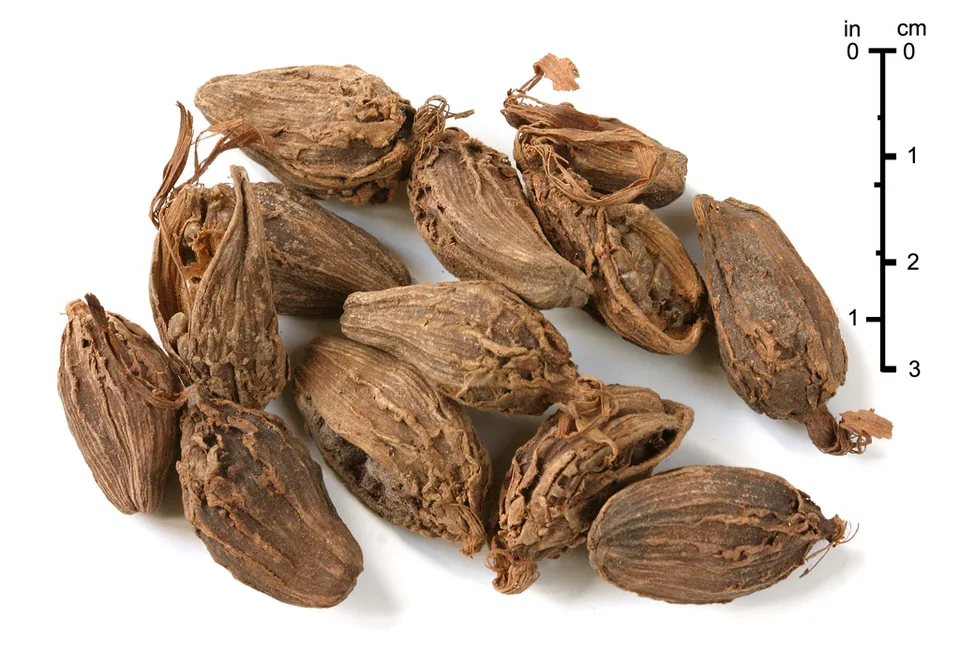

How to Grow and Care for Black cardamom
Amomum subulatum
Written by Emilio Marruso · last checked
At a glance
Black cardamom is a true shade lover: it thrives anywhere from dappled sunlight to deep shade, in the ground or in a pot, even indoors. Keep the soil evenly moist and be patient, because up to four years may pass before the first harvest. Then you pick it by hand in late fall, and its seeds become a spice for soups, stews, lentils and curries.
- Sun
Dappled sunlight to deep shade
What the sources say (1)
Light: Dappled sunlight to deep shade
Light: Dappled Sunlight (Shade through upper canopy all day) Deep shade (Less than 2 hours to no direct sunlight)
— Amomum subulatum (Bengal Cardamom, Big Cardamon, Black Cardamom, Brown Cardamom, Greater Cardamon, Hill Cardamon, Indian Cardamom, Nepal Cardamom, Winged Cardamom) | North Carolina Extension Gardener Plant Toolbox [1] - Water
Keep the soil evenly moist; never let it dry out
What the sources say (1)
Watering: Keep evenly moist and never allow to dry out
The soil needs to be kept evenly moist, and never allowed to dry out.
— Amomum subulatum (Bengal Cardamom, Big Cardamon, Black Cardamom, Brown Cardamom, Greater Cardamon, Hill Cardamon, Indian Cardamom, Nepal Cardamom, Winged Cardamom) | North Carolina Extension Gardener Plant Toolbox [1] - Cold
Survives winters down to 20 °F (−6.7 °C)
Hardy in average winters · USDA 9a · RHS H4 · Z9
What the sources say (2)
Hardiness, coldest zone: 9a [winter low −6.7 to −3.9 °C (20 to 25 °F)]
USDA Plant Hardiness Zone: 9a, 9b, 10a, 10b, 11a, 11b
— Amomum subulatum (Bengal Cardamom, Big Cardamon, Black Cardamom, Brown Cardamom, Greater Cardamon, Hill Cardamon, Indian Cardamom, Nepal Cardamom, Winged Cardamom) | North Carolina Extension Gardener Plant Toolbox [1] Hardiness, warmest zone: 11b [winter low 7.2 to 10 °C (45 to 50 °F)]
USDA Plant Hardiness Zone: 9a, 9b, 10a, 10b, 11a, 11b
— Amomum subulatum (Bengal Cardamom, Big Cardamon, Black Cardamom, Brown Cardamom, Greater Cardamon, Hill Cardamon, Indian Cardamom, Nepal Cardamom, Winged Cardamom) | North Carolina Extension Gardener Plant Toolbox [1] - Soil
Acidic soil, pH 6.0 or lower
What the sources say (1)
Soil pH, maximum: 6.0
Soil Texture: High Organic Matter Loam (Silt) Sand Soil pH: Acid (<6.0)
— Amomum subulatum (Bengal Cardamom, Big Cardamon, Black Cardamom, Brown Cardamom, Greater Cardamon, Hill Cardamon, Indian Cardamom, Nepal Cardamom, Winged Cardamom) | North Carolina Extension Gardener Plant Toolbox [1] - Spacing
18 in between plants
What the sources say (1)
Spacing: 45.7 cm (18 in)
To grow from seed, plant 1 to 2 inches deep and 18 inches apart, and fertilize with a high nitrogen, low potassium fertilizer.
— Amomum subulatum (Bengal Cardamom, Big Cardamon, Black Cardamom, Brown Cardamom, Greater Cardamon, Hill Cardamon, Indian Cardamom, Nepal Cardamom, Winged Cardamom) | North Carolina Extension Gardener Plant Toolbox [1] - Feeding
Use a fertilizer high in nitrogen and low in potassium
What the sources say (1)
Mineral fertilizers: High-nitrogen, low-potassium fertilizer
To grow from seed, plant 1 to 2 inches deep and 18 inches apart, and fertilize with a high nitrogen, low potassium fertilizer.
— Amomum subulatum (Bengal Cardamom, Big Cardamon, Black Cardamom, Brown Cardamom, Greater Cardamon, Hill Cardamon, Indian Cardamom, Nepal Cardamom, Winged Cardamom) | North Carolina Extension Gardener Plant Toolbox [1] - Harvest
Pick by hand in late fall, five months after flowering; the first harvest can take up to 4 years
What the sources say (4)
Harvest: Late fall; fruiting takes about five months from flowering, and up to four years may pass before the first harvest
It takes up to four years to receive a harvest from the plant. Fruiting takes about five months from flowering, making harvesting time in late fall.
— Amomum subulatum (Bengal Cardamom, Big Cardamon, Black Cardamom, Brown Cardamom, Greater Cardamon, Hill Cardamon, Indian Cardamom, Nepal Cardamom, Winged Cardamom) | North Carolina Extension Gardener Plant Toolbox [1] How to harvest: picked by hand, in late fall, about five months after flowering
Fruiting takes about five months from flowering, making harvesting time in late fall.
— Amomum subulatum (Bengal Cardamom, Big Cardamon, Black Cardamom, Brown Cardamom, Greater Cardamon, Hill Cardamon, Indian Cardamom, Nepal Cardamom, Winged Cardamom) | North Carolina Extension Gardener Plant Toolbox [1] Cardamom is harvested by hand, and is the world’s 3rd most expensive spice per weight.
— Amomum subulatum (Bengal Cardamom, Big Cardamon, Black Cardamom, Brown Cardamom, Greater Cardamon, Hill Cardamon, Indian Cardamom, Nepal Cardamom, Winged Cardamom) | North Carolina Extension Gardener Plant Toolbox [1] Years to first fruit: up to 4 years to first harvest
It takes up to four years to receive a harvest from the plant.
— Amomum subulatum (Bengal Cardamom, Big Cardamon, Black Cardamom, Brown Cardamom, Greater Cardamon, Hill Cardamon, Indian Cardamom, Nepal Cardamom, Winged Cardamom) | North Carolina Extension Gardener Plant Toolbox [1] - Pests
Aphids, mealybugs, scale, thrips, caterpillars and borers
What the sources say (1)
Pests: stem borer, shoot fly, lacewings, fruit borer, aphids, mealy bugs, caterpillars, scale, grasshoppers, rhizome weevil, thrips
Susceptible to stem borer, shoot fly, lacewings, fruit borer, aphids, mealy bugs, caterpillars, scale, grasshoppers, rhizome weevil, and thrips.
— Amomum subulatum (Bengal Cardamom, Big Cardamon, Black Cardamom, Brown Cardamom, Greater Cardamon, Hill Cardamon, Indian Cardamom, Nepal Cardamom, Winged Cardamom) | North Carolina Extension Gardener Plant Toolbox [1] - Watch out
Outside the tropics or in pots it may not flower or fruit, but it stays a lovely leafy plant
- Size
Up to 5 ft tall
What the sources say (1)
Mature height: up to 152 cm (5 ft)
Stem Description: Red stem grow up to 5 feet tall. After a few years the old stems die down.
— Amomum subulatum (Bengal Cardamom, Big Cardamon, Black Cardamom, Brown Cardamom, Greater Cardamon, Hill Cardamon, Indian Cardamom, Nepal Cardamom, Winged Cardamom) | North Carolina Extension Gardener Plant Toolbox [1] - Propagation
Divide the thick underground stems or grow from seed
What the sources say (1)
Propagation: Division of rhizomes; seed
Propagation is by division of the rhizomes or from seeds. Seed germination is poor,
— Amomum subulatum (Bengal Cardamom, Big Cardamon, Black Cardamom, Brown Cardamom, Greater Cardamon, Hill Cardamon, Indian Cardamom, Nepal Cardamom, Winged Cardamom) | North Carolina Extension Gardener Plant Toolbox [1] - Sowing
Sow seeds 1–2 inches deep
What the sources say (1)
Sowing depth: 2.5-5 cm (1 to 2 inches)
To grow from seed, plant 1 to 2 inches deep and 18 inches apart, and fertilize with a high nitrogen, low potassium fertilizer.
— Amomum subulatum (Bengal Cardamom, Big Cardamon, Black Cardamom, Brown Cardamom, Greater Cardamon, Hill Cardamon, Indian Cardamom, Nepal Cardamom, Winged Cardamom) | North Carolina Extension Gardener Plant Toolbox [1] - Containers
Grows in pots, even indoors
What the sources say (2)
In containers: Yes
In moderate climates, cardamom can be planted in containers and brought into a greenhouse,
— Amomum subulatum (Bengal Cardamom, Big Cardamon, Black Cardamom, Brown Cardamom, Greater Cardamon, Hill Cardamon, Indian Cardamom, Nepal Cardamom, Winged Cardamom) | North Carolina Extension Gardener Plant Toolbox [1] Indoors: Yes
Whole Plant Traits: Plant Type: Edible Herbaceous Perennial Houseplant
— Amomum subulatum (Bengal Cardamom, Big Cardamon, Black Cardamom, Brown Cardamom, Greater Cardamon, Hill Cardamon, Indian Cardamom, Nepal Cardamom, Winged Cardamom) | North Carolina Extension Gardener Plant Toolbox [1]
Overview
Black cardamom is a spice plant in the ginger family, native to the Himalayan slopes of Sikkim, India and Nepal. [1] It grows best in hot, humid, shady tropical conditions and can be kept in containers in moderate climates. [1]
This record is incomplete: the sources we read do not cover every field yet.
Not yet covered by our sources: Sowing / Planting
Black cardamom care
How to water Black cardamom
Keep evenly moist and never allow to dry out
What the sources say (1)
The soil needs to be kept evenly moist, and never allowed to dry out.How much light Black cardamom needs
Dappled sunlight to deep shade
What the sources say (1)
Light:
Dappled Sunlight (Shade through upper canopy all day)
Deep shade (Less than 2 hours to no direct sunlight)How much cold Black cardamom can take
Hardiness, coldest zone
9a [winter low −6.7 to −3.9 °C (20 to 25 °F)]
What the sources say (1)
USDA Plant Hardiness Zone:
9a, 9b, 10a, 10b, 11a, 11bHardiness, warmest zone
11b [winter low 7.2 to 10 °C (45 to 50 °F)]
What the sources say (1)
USDA Plant Hardiness Zone:
9a, 9b, 10a, 10b, 11a, 11bBest soil for Black cardamom
6.0
What the sources say (1)
Soil Texture:
High Organic Matter
Loam (Silt)
Sand
Soil pH:
Acid (<6.0)Where to grow Black cardamom
Indoors
Yes
What the sources say (1)
Whole Plant Traits:
Plant Type:
Edible
Herbaceous Perennial
HouseplantIn containers
Yes
What the sources say (1)
In moderate climates, cardamom can be planted in containers and brought into a greenhouse,Spacing
45.7 cm (18 in)
What the sources say (1)
To grow from seed, plant 1 to 2 inches deep and 18 inches apart, and fertilize with a high nitrogen, low potassium fertilizer.How to propagate Black cardamom
Division of rhizomes; seed
What the sources say (1)
Propagation is by division of the rhizomes or from seeds. Seed germination is poor,How to grow Black cardamom
The plant
Life cycle
perennial
What the sources say (1)
Life Cycle: Perennial Recommended Propagation Strategy: Division Seed Country Or Region Of Origin: Nepal to Central ChinaFamily
Zingiberaceae
What the sources say (1)
Genus: Amomum Species: subulatum Family: Zingiberaceae Uses (Ethnobotany): Cardamom was used in food preparation as far back as the sixth century BCMature height
up to 152 cm (5 ft)
What the sources say (1)
Stem Description: Red stem grow up to 5 feet tall. After a few years the old stems die down.Years to first fruit
up to 4 years to first harvest
What the sources say (1)
It takes up to four years to receive a harvest from the plant.Sowing and growth
Sowing depth
2.5-5 cm (1 to 2 inches)
What the sources say (1)
To grow from seed, plant 1 to 2 inches deep and 18 inches apart, and fertilize with a high nitrogen, low potassium fertilizer.Harvest and storage
How to harvest
picked by hand, in late fall, about five months after flowering
What the sources say (2)
Fruiting takes about five months from flowering, making harvesting time in late fall.Cardamom is harvested by hand, and is the world’s 3rd most expensive spice per weight.Pests and diseases
Pests
stem borer, shoot fly, lacewings, fruit borer, aphids, mealy bugs, caterpillars, scale, grasshoppers, rhizome weevil, thrips
What the sources say (1)
Susceptible to stem borer, shoot fly, lacewings, fruit borer, aphids, mealy bugs, caterpillars, scale, grasshoppers, rhizome weevil, and thrips.Fertilizing
Mineral fertilizers
High-nitrogen, low-potassium fertilizer
What the sources say (1)
To grow from seed, plant 1 to 2 inches deep and 18 inches apart, and fertilize with a high nitrogen, low potassium fertilizer.Black cardamom pests and problems
Insect pests
Symptom: Susceptible to stem borer, shoot fly, lacewings, fruit borer, aphids, mealy bugs, caterpillars, scale, grasshoppers, rhizome weevil and thrips.
What the sources say (1)
Susceptible to stem borer, shoot fly, lacewings, fruit borer, aphids, mealy bugs, caterpillars, scale, grasshoppers, rhizome weevil, and thrips.
— Amomum subulatum (Bengal Cardamom, Big Cardamon, Black Cardamom, Brown Cardamom, Greater Cardamon, Hill Cardamon, Indian Cardamom, Nepal Cardamom, Winged Cardamom) | North Carolina Extension Gardener Plant Toolbox [1] No flowering or fruiting outside the tropics
Symptom: Plants may not flower or fruit in less than tropical climates or in pots, but remain an interesting foliage plant.
What the sources say (1)
Plants may not flower or fruit when grown in less that tropical climates or when grown in pots,
— Amomum subulatum (Bengal Cardamom, Big Cardamon, Black Cardamom, Brown Cardamom, Greater Cardamon, Hill Cardamon, Indian Cardamom, Nepal Cardamom, Winged Cardamom) | North Carolina Extension Gardener Plant Toolbox [1]
Remedies
Each remedy shows what official sources say about it; traditional remedies without an official source are marked as such. Harmful ones are listed so you know to avoid them.
Treating the plant
root-knot nematodes
solarizing the soil Official source, not independently tested
How: Check roots of plants mid-season or sooner if symptoms indicate nematodes; solarizing soil can reduce nematode populations in the soil and levels of inoculum of many other pathogens
solarizing soil can reduce nematode populations in the soil and levels of inoculum of many other pathogens
— plantvillage.psu.edu [5]
rhizome rot
removing infected clumps Official source, not independently tested
How: all infected clumps, including rhizomes must be removed and destroyed
all infected clumps, including rhizomes must be removed and destroyed
— plantvillage.psu.edu [5]
Calendar
Sowing
Not stated in the sources we read.
Planting
Not stated in the sources we read.
Harvest
Late fall; fruiting takes about five months from flowering, and up to four years may pass before the first harvest
What the sources say (1)
It takes up to four years to receive a harvest from the plant. Fruiting takes about five months from flowering, making harvesting time in late fall.Months as given by the sources, which are mostly from the United States (northern hemisphere). In the southern hemisphere they shift by about six months.
Edibility
Reported by the source, quoted verbatim. Do not eat a plant on the basis of this page alone: identification mistakes can be dangerous.
Cardamom seeds are a popular spice used in flavoring spicy and rustic dishes, such as long simmering soups and stews, lentils, rice, pasta, curries, and meat dishes.
[1]Leaves of the plant can also be cooked and consumed as greens, the roots can be boiled and eaten like potatoes, the flowers can be used as a garnish and the pods are used in beef and chicken curries.
[1]Leaves of the plant can also be cooked and consumed as greens, the roots can be boiled and eaten like potatoes, the flowers can be used as a garnish and the pods are used in beef and chicken curries.
[1]Leaves of the plant can also be cooked and consumed as greens, the roots can be boiled and eaten like potatoes, the flowers can be used as a garnish and the pods are used in beef and chicken curries.
[1]Leaves of the plant can also be cooked and consumed as greens, the roots can be boiled and eaten like potatoes, the flowers can be used as a garnish and the pods are used in beef and chicken curries.
[1]
Similar plants
- Cardamom Elettaria cardamomum
- Ginger Zingiber officinale
- Greater galangal Alpinia galanga
- Shampoo Ginger Zingiber zerumbet
- Butterfly Ginger Hedychium coronarium
- Curcuma petiolata Curcuma petiolata
- Japanese ginger Zingiber mioga
- Kahili Ginger Hedychium gardnerianum
Sources
Every value above is quoted from these documents. Links lead to the original publisher.
- Amomum subulatum (Bengal Cardamom, Big Cardamon, Black Cardamom, Brown Cardamom, Greater Cardamon, Hill Cardamon, Indian Cardamom, Nepal Cardamom, Winged Cardamom) | North Carolina Extension Gardener Plant Toolbox · plants.ces.ncsu.edu, consulted
- Brown Cardamom - Amomum subulatum | North Carolina Extension Gardener Plant Toolbox · plants.ces.ncsu.edu, consulted
- Black Cardamom - Amomum subulatum | North Carolina Extension Gardener Plant Toolbox · plants.ces.ncsu.edu, consulted
- Greater Cardamon - Amomum subulatum | North Carolina Extension Gardener Plant Toolbox · plants.ces.ncsu.edu, consulted
- plantvillage.psu.edu · plantvillage.psu.edu
Written by Emilio Marruso · last checked