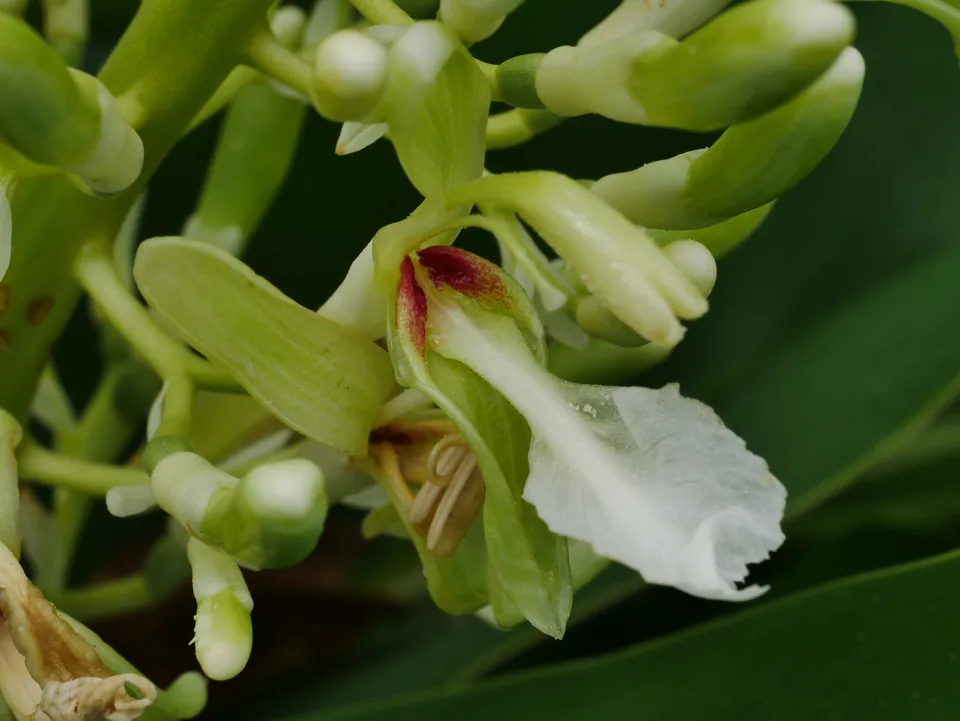
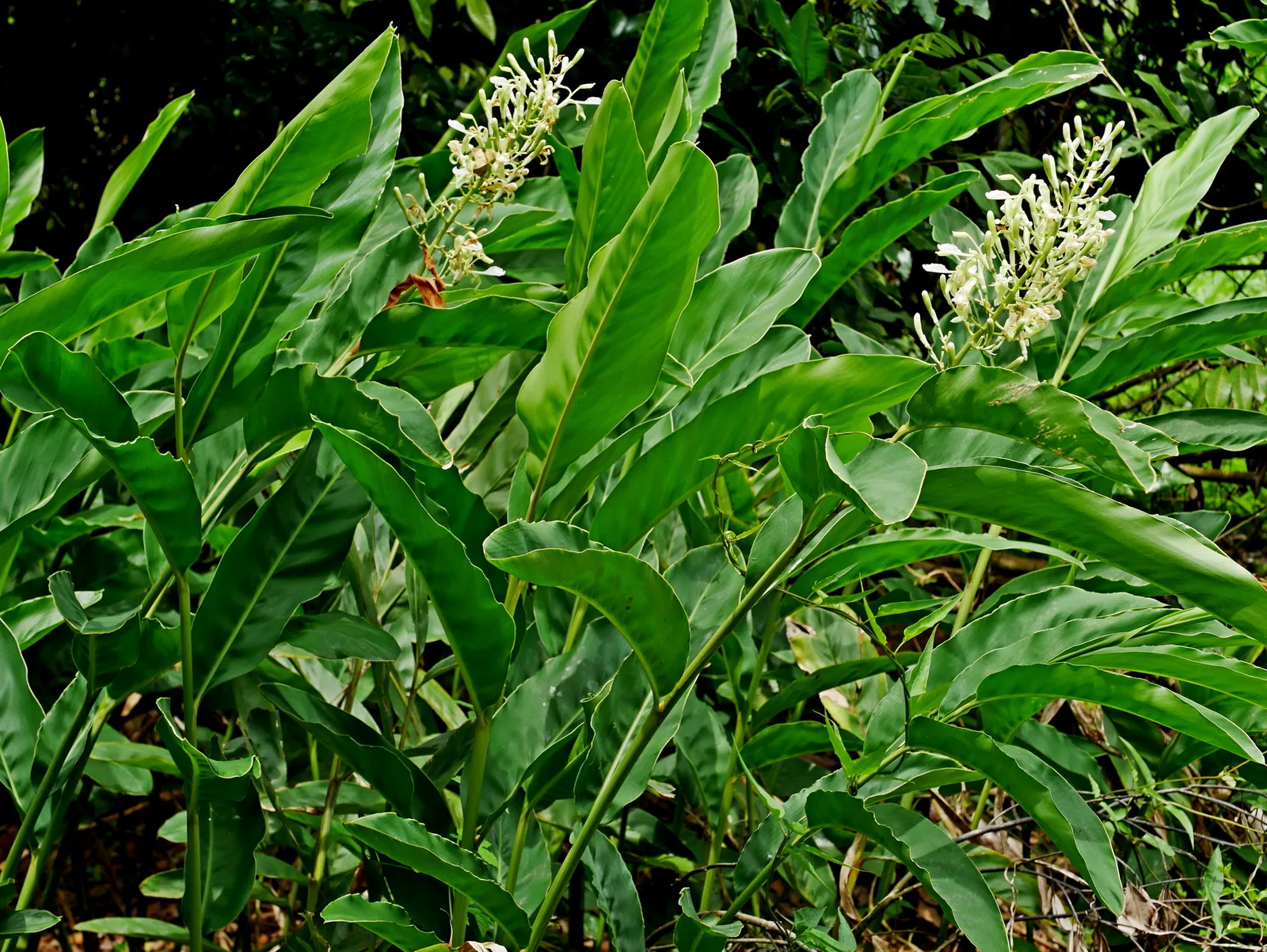
How to Grow and Care for Greater galangal
Alpinia galanga
Written by Emilio Marruso · last checked
At a glance
Galangal is a perennial whose rhizomes are said to be indispensable in everyday cooking across South and Southeast Asia, and its fragrant yellow-white flowers are edible too. Plant it in spring in full sun or partial shade, keep the soil moist but never waterlogged, and you can dig up fresh rhizomes four months later.
- Sun
Full sun to partial shade; give it some shade in strong heat
What the sources say (4)
Light: Full sun to partial shade
Florida (UF/IFAS, summer): Ginger and galangal thus require 25% to 40% shade in Florida during the summer
— ENH1374 [4] Galanga requires sunny or moderately shady locations.
— PROSEA - Plant Resources of South East Asia [6] Full Sun, Semi-Shade
— NParks | Alpinia galanga (L) Willd [8] Select a location that is well-drained and partly shady.
— Gingers for Your Central Florida Garden - UF/IFAS Extension Osceola County [5] - Water
Keep the soil moist but never soggy; a compost mulch keeps the roots moist and cool
What the sources say (5)
Watering: Moderate water; keep soil moist but not swampy or waterlogged
Water Preference | Moderate Water
— NParks | Alpinia galanga (L) Willd [8] Soils should be fertile, moist but not swampy.
— PROSEA - Plant Resources of South East Asia [6] Regular moisture is important, but gingers cannot tolerate soggy roots.
— Gingers for Your Central Florida Garden - UF/IFAS Extension Osceola County [5] Watering notes: Mulch with compost to keep the roots moist and cool; drain the field after rain because rhizomes do not develop under waterlogged conditions
fertile soil. Apply compost as a mulch to help keep the roots moist and cool.
— NParks | Alpinia galanga (L) Willd [8] Often, trenches are dug to drain the field after rainfall, as rhizomes do not develop under waterlogged conditions.
— PROSEA - Plant Resources of South East Asia [6] - Soil
Slightly acidic soil, pH 5.5–6.5
- Spacing
20–39 in between plants in every direction
What the sources say (1)
Spacing: 50-100 cm (0.5-1 m square)
Galanga is usually planted along the borders of gardens, in rows at distances of 0.5-1 m square.
— PROSEA - Plant Resources of South East Asia [6] - Planting
Plant in spring
What the sources say (2)
Planting: Spring
Central Florida: Spring is the best time to plant gingers in Central Florida
— Gingers for Your Central Florida Garden - UF/IFAS Extension Osceola County [5] Spring is the best time to plant gingers in Central Florida
— Gingers for Your Central Florida Garden - UF/IFAS Extension Osceola County [5] - Feeding
Feed at planting and twice more while it grows; never in winter, when it rests
What the sources say (6)
When: At planting and during active growth; not in winter dormancy
three applications (at planting and two subsequent ap-plications) with an organic poultry-based granular 7-5-10 (N-P2O5-K2O) fertilizer at 100 grams (3.3 oz.) per plant
— ENH1374 [4] Avoid fertilization in the winter when plants go dormant and are not actively taking up nutrients.
— ENH1374 [4] How often: Three applications of granular fertilizer (at planting and two later), or water-soluble fertilizer with each irrigation; moderate to high requirement
three applications (at planting and two subsequent ap-plications) with an organic poultry-based granular 7-5-10 (N-P2O5-K2O) fertilizer at 100 grams (3.3 oz.) per plant
— ENH1374 [4] water-soluble fertilizer such a 15-5-15 at 100 ppm nitro-gen with each irrigation.
— ENH1374 [4] Plants have a moderate to high fertilizer requirement.
— ENH1374 [4] Avoid: Fertilizing in winter, when plants are dormant and not taking up nutrients
Avoid fertilization in the winter when plants go dormant and are not actively taking up nutrients.
— ENH1374 [4] - Harvest
Dig fresh rhizomes four months after planting; flowers and young shoots are edible too
What the sources say (1)
Days to maturity: four months after planting (fresh rhizomes)
Rhizomes of galangal develop quickly and for fresh produce they should be harvested approximately four months after planting, otherwise they become very fibrous.
— ENH1374 [4] - Pests
Soggy soil makes the rhizomes rot; throw away plants with rotten rhizomes
- Size
Grows up to 8 ft tall
What the sources say (1)
Mature height: 243.84 cm (8 ft)
The plant does well planted directly in the landscape; it grows to 8 ft. tall and will form a large clump if not harvested regularly.
— Gingers for Your Central Florida Garden - UF/IFAS Extension Osceola County [5] - Propagation
Plant pieces of rhizome or divide the clump
What the sources say (3)
Propagation: Rhizome pieces (long tips); division; tissue culture plants
Long tips of rhizomes of galanga are used for propagation.
— PROSEA - Plant Resources of South East Asia [6] Propagation Method | Division
— NParks | Alpinia galanga (L) Willd [8] Plants can be started from either tissue culture plants (Figure 5) or rhizomes (Figure 6)
— ENH1374 [4] - Containers
Grows in containers too
What the sources say (1)
In containers: Yes
This publication describes production in containers or the field under Florida conditions to help guide growers interested in ginger, turmeric, and galangal production or expanding their market.
— ENH1374 [4]
Overview
Greater galangal is a tall rhizomatous herb grown mainly for its spicy rhizomes in sun to partial shade on moist, well-drained, fertile soil. [6][8] It is propagated from rhizome pieces or tissue-culture plants and does not tolerate waterlogging. [6][4] Fresh rhizomes are harvested when young because older rhizomes become fibrous. [4][6]
Greater galangal care
How to water Greater galangal
Watering
Moderate water; keep soil moist but not swampy or waterlogged
What the sources say (3)
Water Preference
| Moderate WaterSoils should be fertile, moist but not swampy.Regular moisture is important, but gingers cannot tolerate soggy roots.Watering notes
Mulch with compost to keep the roots moist and cool; drain the field after rain because rhizomes do not develop under waterlogged conditions
What the sources say (2)
fertile soil. Apply compost as a mulch to help keep the roots moist and cool.Often, trenches are dug to drain the field after rainfall, as rhizomes do not develop under waterlogged conditions.How much light Greater galangal needs
Full sun to partial shade
What each source says
Florida (UF/IFAS, summer): 25% to 40% shade
What the sources say (4)
Florida (UF/IFAS, summer): Ginger and galangal thus require 25% to 40% shade in Florida during the summerGalanga requires sunny or moderately shady locations.Full Sun, Semi-ShadeSelect a location that is well-drained and partly shady.Best soil for Greater galangal
Soil pH, minimum
5.5
What each source says
According to FAO Ecocrop (absolute limits): 5.0
Where to grow Greater galangal
In containers
Yes
What the sources say (1)
This publication describes production in containers or the field under Florida conditions to help guide growers interested in ginger, turmeric, and galangal production or expanding their market.Spacing
50-100 cm (0.5-1 m square)
What the sources say (1)
Galanga is usually planted along the borders of gardens, in rows at distances of 0.5-1 m square.How to propagate Greater galangal
Rhizome pieces (long tips); division; tissue culture plants
What the sources say (3)
Long tips of rhizomes of galanga are used for propagation.Propagation Method
| DivisionPlants can be started from either tissue culture plants (Figure 5) or rhizomes (Figure 6)How to grow Greater galangal
The plant
Life cycle
perennial
What the sources say (1)
These gingers are all cold-sensitive perennials that can die back in the winter, and usually regrow in the spring.Family
Zingiberaceae
What the sources say (1)
Ginger, galangal, and turmeric (Figure 1) are emerging crops for Florida production. All of these plant species are in the Zingiberaceae family and share most aspects of their production.Mature height
243.84 cm (8 ft)
What the sources say (1)
The plant does well planted directly in the landscape; it grows to 8 ft. tall and will form a large clump if not harvested regularly.Sowing and growth
Days to maturity
four months after planting (fresh rhizomes)
What the sources say (1)
Rhizomes of galangal develop quickly and for fresh produce they should be harvested approximately four months after planting, otherwise they become very fibrous.Fertilizing
When
At planting and during active growth; not in winter dormancy
What the sources say (2)
three applications (at planting and two subsequent ap-plications) with an organic poultry-based granular 7-5-10 (N-P2O5-K2O) fertilizer at 100 grams (3.3 oz.) per plantAvoid fertilization in the winter when plants go dormant and are not actively taking up nutrients.How often
Three applications of granular fertilizer (at planting and two later), or water-soluble fertilizer with each irrigation; moderate to high requirement
What the sources say (3)
three applications (at planting and two subsequent ap-plications) with an organic poultry-based granular 7-5-10 (N-P2O5-K2O) fertilizer at 100 grams (3.3 oz.) per plantwater-soluble fertilizer such a 15-5-15 at 100 ppm nitro-gen with each irrigation.Plants have a moderate to high fertilizer requirement.Natural fertilizers
Organic poultry-based granular 7-5-10 fertilizer, 100 g per plant, at planting and twice more
What the sources say (1)
three applications (at planting and two subsequent ap-plications) with an organic poultry-based granular 7-5-10 (N-P2O5-K2O) fertilizer at 100 grams (3.3 oz.) per plantMineral fertilizers
Controlled-release (8 to 9 month) fertilizer at planting, 120 g per plant; or water-soluble 15-5-15 at 100 ppm nitrogen with each irrigation
Avoid
Fertilizing in winter, when plants are dormant and not taking up nutrients
What the sources say (1)
Avoid fertilization in the winter when plants go dormant and are not actively taking up nutrients.Greater galangal pests and problems
Root pathogens and rotting rhizomes
Symptom: Rotten rhizomes
What to do: Avoid waterlogging; dispose of plants with rotten rhizomes
What the sources say (1)
Avoid waterlogging because plants, particularly ginger, are very susceptible to root pathogens.
— ENH1374 [4] Heat stress
Symptom: Heat stress and foliar damage in high light or dry soil
What to do: Provide shade and keep the soil moist
What the sources say (1)
High temperatures increase heat stress, especially when plants are in high light or soil is too saline or not moist enough.
— ENH1374 [4]
Remedies
Each remedy shows what official sources say about it; traditional remedies without an official source are marked as such. Harmful ones are listed so you know to avoid them.
Treating the plant
aphids
neem oil Partly works
How: For a moderate infestation, neem oil will handle the aphids and spider mites.
Grasshoppers, aphids, and possibly spider mites might be attracted to your galangal. If your plants are well established the best solution might be to cut off infected leaves. For a moderate infestation, neem oil will handle the aphids and spider mites, while BT may assist with the grasshoppers.
— cresrisest.pages.dev [9] What the evidence says Neem (azadirachtin) is a plant based pesticide that discourages aphid feeding. Insects are not killed quickly, but it makes them stop feeding and they slowly die.
— extension.umn.edu [10]
spider mites
neem oil Not verified
Traditional remedy, not verified by an official source.
To protect pollinators, avoid using neem oil when plants are blooming;
— extension.oregonstate.edu [11] How: For a moderate infestation, neem oil will handle the aphids and spider mites.
aphids and spider mites
cutting off infested leaves Not verified
Traditional remedy, not verified by an official source.
How: If your plants are well established the best solution might be to cut off infected leaves.
pitted rhizomes (soil borers)
digging up and replanting in cleaner soil Not verified
Traditional remedy, not verified by an official source.
How: When you harvest, dig up pitted rhizomes, find a new spot with cleaner soil and do not replant the pitted rhizomes.
soil pests
seasonal harvest of all rhizomes Official source, not independently tested
How: Harvest all rhizomes seasonally.
you may want to harvest all rhizomes seasonally to prevent damage from soil pests
— Gingers for Your Central Florida Garden - UF/IFAS Extension Osceola County [5]
root rot
trimming dead roots and replanting in a well-draining spot Not verified
Traditional remedy, not verified by an official source.
How: Remove the plant, trim away dead, dying and mushy roots and foliage, and replant in a different, well-draining spot.
rust
pruning infected portions Not verified
Traditional remedy, not verified by an official source.
How: Prune off any infected portions and avoid watering top growth.
Calendar
Planting
Spring
What each source says
Central Florida: Spring
What the sources say (2)
Central Florida: Spring is the best time to plant gingers in Central FloridaSpring is the best time to plant gingers in Central FloridaHarvest
The sources give different values depending on region, zone or growing conditions.
What each source says
According to UF/IFAS (Florida): About 4 months after planting for fresh produce
According to UF/IFAS (Florida), essential oil: About 7 months of growth
According to PROSEA: About 3 months after planting; rhizomes older than 4 months turn woody, fibrous and spongy
What the sources say (3)
According to UF/IFAS (Florida): Rhizomes of galangal develop quickly and for fresh produce they should be harvested approximately four months after planting, otherwise they become very fibrous.According to UF/IFAS (Florida), essential oil: However, for essential oil extraction, rhizomes are harvested after approximately seven months of growthAccording to PROSEA: Rhizomes develop quickly and reach their best harvest quality about 3 months after planting.Months as given by the sources, which are mostly from the United States (northern hemisphere). In the southern hemisphere they shift by about six months.
Edibility
Reported by the source, quoted verbatim. Do not eat a plant on the basis of this page alone: identification mistakes can be dangerous.
Its rhizomes are very commonly used and said to be indispensable in everyday cooking throughout South Asia and South-East Asia.
[6]The flowers and young shoots are used as a vegetable or as a spice.
[6]The Lengkuas also produce fragrant and edible yellow-white flowers that are eaten as vegetable.
[8]
Indicative values
Values from a secondary source, not checked word for word like the rest of this page. Use them as a starting point.
- Hours of sun
- 6-8 hoursIndicative value, adapt it to your climate · Secondary source
- USDA hardiness zones
- 11-12 [winter low 4.4 to 15.6 °C (40 to 60 °F)]Indicative value, adapt it to your climate · Secondary source
- Care level
- MediumIndicative value, adapt it to your climate · Secondary source
- Growth rate
- LowIndicative value, adapt it to your climate · Secondary source
- Pruning
- March, April, May, June, July, August, September, April, JuneIndicative value, adapt it to your climate · Secondary source
Similar plants
- Pink porcelain lily Alpinia zerumbet
- Black cardamom Amomum subulatum
- Cardamom Elettaria cardamomum
- Ginger Zingiber officinale
- Japanese ginger Zingiber mioga
- Shampoo Ginger Zingiber zerumbet
- Butterfly Ginger Hedychium coronarium
- Curcuma petiolata Curcuma petiolata
Sources
Every value above is quoted from these documents. Links lead to the original publisher.
- FE1162 · edis.ifas.ufl.edu, consulted
- FE1162/FE1162: Potential Markets for Florida Ginger · ask.ifas.ufl.edu, consulted
- Ginger, Galangal, and Turmeric Production in Florida: ENH1374/EP638, 8/2023 | EDIS · journals.flvc.org, consulted
- ENH1374 · journals.flvc.org, consulted
- Gingers for Your Central Florida Garden - UF/IFAS Extension Osceola County · blogs.ifas.ufl.edu, consulted
- PROSEA - Plant Resources of South East Asia · prosea.prota4u.org, consulted
- Data sheet · ecocrop.apps.fao.org, consulted
- NParks | Alpinia galanga (L) Willd · nparks.gov.sg, consulted
- cresrisest.pages.dev · cresrisest.pages.dev
- extension.umn.edu · extension.umn.edu
- extension.oregonstate.edu · extension.oregonstate.edu
Written by Emilio Marruso · last checked