
How to Grow and Care for Kahili Ginger
Hedychium gardnerianum
Written by Emilio Marruso · last checked
At a glance
This tall perennial reaches 8 ft and thrives in full sun to partial shade, in the garden, in a container or even indoors. Give it plenty of water and regular feeding while it grows, then let it rest in winter. In spring, divide the clumps to make new plants, and move pots outside once the last frost has passed.
- Sun
Full sun to partial shade
What the sources say (2)
Light: Full sun to partial shade
Plant in full sun to partial shade in consistently moist, humus-rich soil.
— Hedychium gardnerianum (Ginger Lily, Kahali Ginger, Kahila Garland-Lily, Kahili Ginger) | North Carolina Extension Gardener Plant Toolbox [1] In the Midwest, it does best in full sun but tolerates partial shade.
— Kahili Ginger, Hedychium gardnerianum – Wisconsin Horticulture [2] - Water
Plenty of water while it grows, less in winter; never let it sit in water
What the sources say (4)
Watering: Plentiful water throughout the year; water regularly during the growing season and cut back in winter
This ginger requires fertile soil and plentiful water throughout the year to achieve the most luxuriant growth.
— Kahili Ginger, Hedychium gardnerianum – Wisconsin Horticulture [2] Water and fertilize regularly during the growing season, but cut back in winter.
— Kahili Ginger, Hedychium gardnerianum – Wisconsin Horticulture [2] Plant in full sun to partial shade in consistently moist, humus-rich soil.
— Hedychium gardnerianum (Ginger Lily, Kahali Ginger, Kahila Garland-Lily, Kahili Ginger) | North Carolina Extension Gardener Plant Toolbox [1] Watering notes: Tolerates short periods of drought but not standing in water
It tolerates short periods of drought but not standing in water.
— Kahili Ginger, Hedychium gardnerianum – Wisconsin Horticulture [2] - Cold
Frost kills its leaves: move it outside only after the last frost
What the sources say (2)
Planting: Early spring (repotting); move outside after the last frost
Repot (dividing if necessary) in early spring and keep in a warm location (room temperature) to get the plants growing again well before they are to be moved outside after the last frost.
— Kahili Ginger, Hedychium gardnerianum – Wisconsin Horticulture [2] Pruning: After frost has killed the leaves, cut the stems back to a few inches above the ground
If the leaves are allowed to be killed by frost, cut back the stems to a few inches above the ground
— Kahili Ginger, Hedychium gardnerianum – Wisconsin Horticulture [2] - Planting
Repot in early spring
What the sources say (1)
Planting: Early spring (repotting); move outside after the last frost
Repot (dividing if necessary) in early spring and keep in a warm location (room temperature) to get the plants growing again well before they are to be moved outside after the last frost.
— Kahili Ginger, Hedychium gardnerianum – Wisconsin Horticulture [2] - Feeding
Feed regularly while it grows; don't keep feeding it in winter
What the sources say (3)
When: During the growing season; cut back in winter
Water and fertilize regularly during the growing season, but cut back in winter.
— Kahili Ginger, Hedychium gardnerianum – Wisconsin Horticulture [2] How often: Regularly during the growing season
Water and fertilize regularly during the growing season, but cut back in winter.
— Kahili Ginger, Hedychium gardnerianum – Wisconsin Horticulture [2] Avoid: Regular feeding in winter
Water and fertilize regularly during the growing season, but cut back in winter.
— Kahili Ginger, Hedychium gardnerianum – Wisconsin Horticulture [2] - Pruning
Once frost has killed the leaves, cut the stems to a few inches above the ground
What the sources say (1)
Pruning: After frost has killed the leaves, cut the stems back to a few inches above the ground
If the leaves are allowed to be killed by frost, cut back the stems to a few inches above the ground
— Kahili Ginger, Hedychium gardnerianum – Wisconsin Horticulture [2] - Harvest
The roots are edible, but they don't taste like much
- Size
Grows up to 8 ft tall
What the sources say (2)
Mature height: 244 cm (8 ft)
This ginger is an erect, clumping plant that can reach a mature height of 8 feet.
— Hedychium gardnerianum (Ginger Lily, Kahali Ginger, Kahila Garland-Lily, Kahili Ginger) | North Carolina Extension Gardener Plant Toolbox [1] In the ground it can grow to 8 feet tall, but plants are generally much shorter in container culture.
— Kahili Ginger, Hedychium gardnerianum – Wisconsin Horticulture [2] - Propagation
Divide the clumps in spring, or grow it from seed
What the sources say (2)
Propagation: Division (spring), seed
Plants can be propagated by division in spring or from seed .
— Kahili Ginger, Hedychium gardnerianum – Wisconsin Horticulture [2] Recommended Propagation Strategy: Division
— Hedychium gardnerianum (Ginger Lily, Kahali Ginger, Kahila Garland-Lily, Kahili Ginger) | North Carolina Extension Gardener Plant Toolbox [1] - Sowing
Sow the seeds as soon as they ripen; they sprout in 3–4 weeks
What the sources say (2)
Sowing: As soon as possible after the seeds ripen
Plant seeds as soon as possible after they ripen.
— Kahili Ginger, Hedychium gardnerianum – Wisconsin Horticulture [2] Days to germination: 21-28 (3 to 4 weeks)
Seed can be soaked for few hours in warm water before planting, and they should germinate in 3 to 4 weeks.
— Kahili Ginger, Hedychium gardnerianum – Wisconsin Horticulture [2] - Containers
Grows in containers and indoors too
What the sources say (3)
In containers: Yes
You can use them in groups, borders or containers.
— Hedychium gardnerianum (Ginger Lily, Kahali Ginger, Kahila Garland-Lily, Kahili Ginger) | North Carolina Extension Gardener Plant Toolbox [1] It cannot survive our harsh winters, so must be grown as a container plant.
— Kahili Ginger, Hedychium gardnerianum – Wisconsin Horticulture [2] Indoors: Yes
In the Midwest, kahili ginger is used as a seasonal, indoor, or greenhouse plant
— Kahili Ginger, Hedychium gardnerianum – Wisconsin Horticulture [2]
Overview
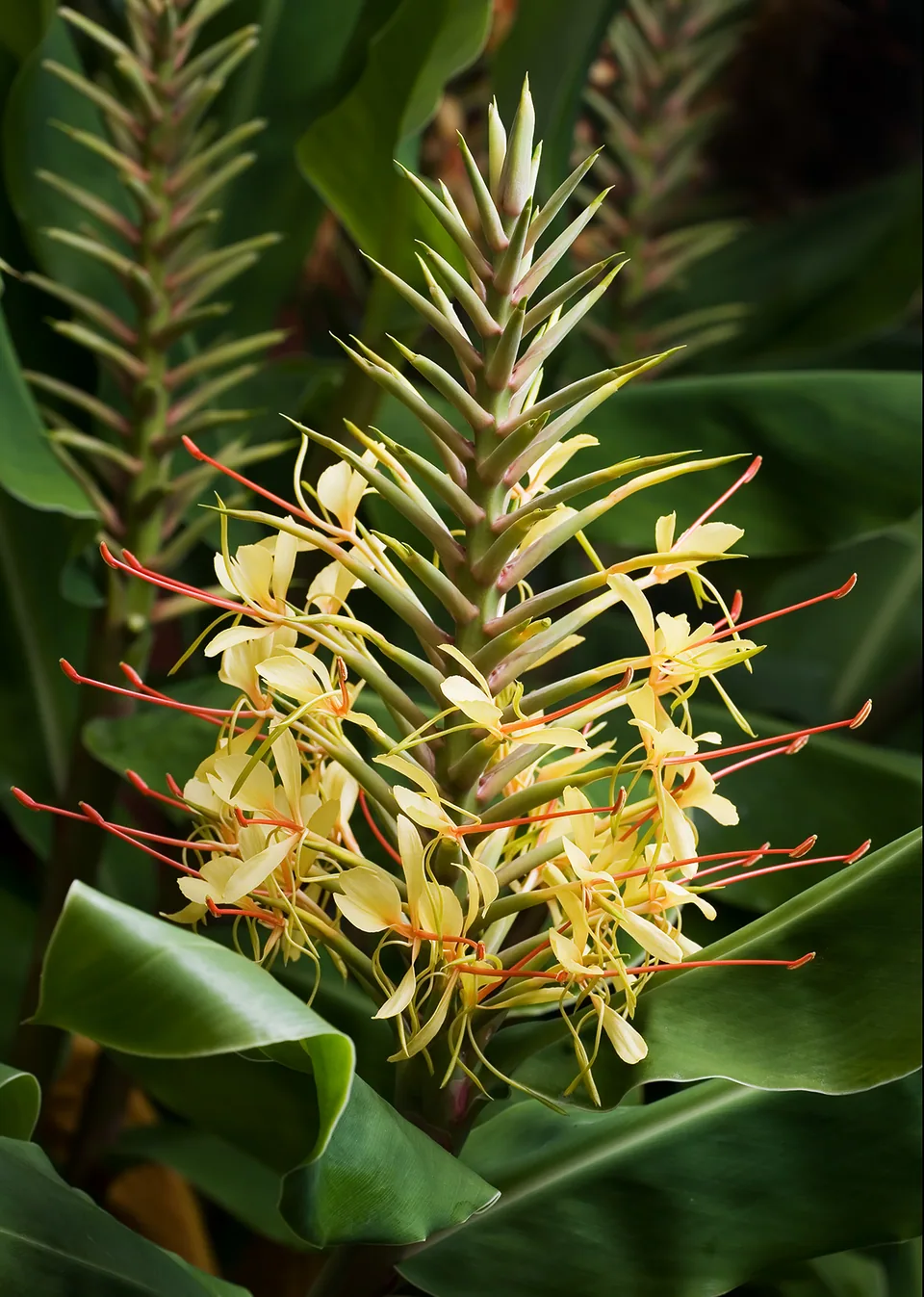
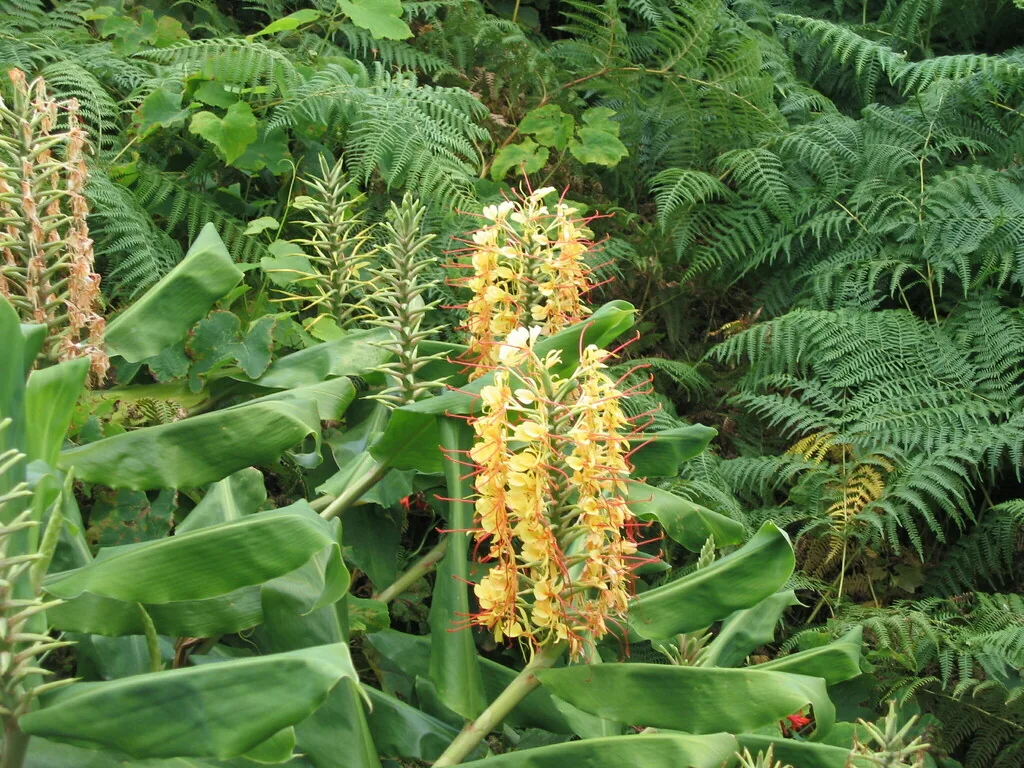
Kahili ginger is an erect, clumping herbaceous perennial that grows from thick rhizomes and can reach 8 feet [2.4 m] tall. [1] It is grown for fragrant flowers and tropical-looking foliage and can be kept in containers or indoors in cold climates. [1][2] It is considered invasive in Hawaii, where it spreads rapidly by rhizomes. [1]
Kahili Ginger care
Measurements in square brackets are our conversion into the other unit system; the quoted text is unchanged.
How to water Kahili Ginger
Watering
Plentiful water throughout the year; water regularly during the growing season and cut back in winter
What the sources say (3)
This ginger requires fertile soil and plentiful water throughout the year to achieve the most luxuriant growth.Water and fertilize regularly during the growing season, but cut back in winter.Plant in full sun to partial shade in consistently moist, humus-rich soil.Watering notes
Tolerates short periods of drought but not standing in water
What the sources say (1)
It tolerates short periods of drought but not standing in water.How much light Kahili Ginger needs
Full sun to partial shade
What the sources say (2)
Plant in full sun to partial shade in consistently moist, humus-rich soil.In the Midwest, it does best in full sun but tolerates partial shade.How much cold Kahili Ginger can take
Hardiness, coldest zone
The sources give different values depending on region, zone or growing conditions.
What each source says
According to NC State Extension: 7a [winter low −17.8 to −15 °C (0 to 5 °F)]
According to Wisconsin Horticulture: 8a [winter low −12.2 to −9.4 °C (10 to 15 °F)]
What the sources say (2)
According to NC State Extension: USDA Plant Hardiness Zone:
7a, 7b, 8a, 8b, 9a, 9b, 10a, 10bAccording to Wisconsin Horticulture: As a tender perennial (zones 8a to 11b)Hardiness, warmest zone
The sources give different values depending on region, zone or growing conditions.
What each source says
According to NC State Extension: 10b [winter low 1.7 to 4.4 °C (35 to 40 °F)]
According to Wisconsin Horticulture: 11b [winter low 7.2 to 10 °C (45 to 50 °F)]
What the sources say (2)
According to NC State Extension: USDA Plant Hardiness Zone:
7a, 7b, 8a, 8b, 9a, 9b, 10a, 10bAccording to Wisconsin Horticulture: As a tender perennial (zones 8a to 11b)Where to grow Kahili Ginger
Indoors
Yes
What the sources say (1)
In the Midwest, kahili ginger is used as a seasonal, indoor, or greenhouse plantIn containers
Yes
What the sources say (2)
You can use them in groups, borders or containers.It cannot survive our harsh winters, so must be grown as a container plant.How to propagate Kahili Ginger
Division (spring), seed
What the sources say (2)
Plants can be propagated by division in spring or from seed .Recommended Propagation Strategy:
DivisionHow to grow Kahili Ginger
The plant
Life cycle
perennial
What the sources say (1)
Kahili ginger is an herbaceous perennial in the ginger family (Zingiberaceae) native to India, the Himalayan region and Southeast Asia.Family
Zingiberaceae
What the sources say (1)
Kahili ginger is an herbaceous perennial in the ginger family (Zingiberaceae) native to India, the Himalayan region and Southeast Asia.Mature height
244 cm (8 ft)
What the sources say (2)
This ginger is an erect, clumping plant that can reach a mature height of 8 feet.In the ground it can grow to 8 feet tall, but plants are generally much shorter in container culture.Sowing and growth
Days to germination
21-28 (3 to 4 weeks)
What the sources say (1)
Seed can be soaked for few hours in warm water before planting, and they should germinate in 3 to 4 weeks.Fertilizing
When
During the growing season; cut back in winter
What the sources say (1)
Water and fertilize regularly during the growing season, but cut back in winter.How often
Regularly during the growing season
What the sources say (1)
Water and fertilize regularly during the growing season, but cut back in winter.Avoid
Regular feeding in winter
What the sources say (1)
Water and fertilize regularly during the growing season, but cut back in winter.Remedies
Each remedy shows what official sources say about it; traditional remedies without an official source are marked as such. Harmful ones are listed so you know to avoid them.
Treating the plant
slugs and snails
diatomaceous earth Not verified
Traditional remedy, not verified by an official source.
How: Sprinkle diatomaceous earth around the plants.
Getting rid of it
invasive spread
digging out the whole plant with rhizomes Not verified
Traditional remedy, not verified by an official source.
Any fragments of rhizomes left on the ground can regrow.
— goonengerrylandcare.org [4] How: Cut back the leaves, dig up the rhizome and hang it up to dry; bag and destroy seeds.
drowning dug-up rhizomes in a water drum Not verified
Traditional remedy, not verified by an official source.
Care must be taken when controlling ginger to remove all rhizomes as new plants can grow from fragments.
— tiakitamakimakaurau.nz [5] How: Dig the plant up by hand and put it into a large drum with water to drown.
Calendar
Sowing
As soon as possible after the seeds ripen
What the sources say (1)
Plant seeds as soon as possible after they ripen.Planting
Early spring (repotting); move outside after the last frost
What the sources say (1)
Repot (dividing if necessary) in early spring and keep in a warm location (room temperature) to get the plants growing again well before they are to be moved outside after the last frost.Pruning
After frost has killed the leaves, cut the stems back to a few inches above the ground
What the sources say (1)
If the leaves are allowed to be killed by frost, cut back the stems to a few inches above the groundMonths as given by the sources, which are mostly from the United States (northern hemisphere). In the southern hemisphere they shift by about six months.
Relative to frost
Less precise estimate: there is no weather station within 300 km.
Find frost dates by ZIP code or city
Transplant: around the last frost
Repot (dividing if necessary) in early spring and keep in a warm location (room temperature) to get the plants growing again well before they are to be moved outside after the last frost.
— Kahili Ginger, Hedychium gardnerianum – Wisconsin Horticulture [2]
Count from the average frost dates where you live.
Edibility
Reported by the source, quoted verbatim. Do not eat a plant on the basis of this page alone: identification mistakes can be dangerous.
Edibility: Roots are edible but not flavorful
[1]
Similar plants
- Butterfly Ginger Hedychium coronarium
- Cardamom Elettaria cardamomum
- Curcuma petiolata Curcuma petiolata
- Japanese ginger Zingiber mioga
- Shampoo Ginger Zingiber zerumbet
- Pink porcelain lily Alpinia zerumbet
- Black cardamom Amomum subulatum
- Ginger Zingiber officinale
Sources
Every value above is quoted from these documents. Links lead to the original publisher.
- Hedychium gardnerianum (Ginger Lily, Kahali Ginger, Kahila Garland-Lily, Kahili Ginger) | North Carolina Extension Gardener Plant Toolbox · plants.ces.ncsu.edu, consulted
- Kahili Ginger, Hedychium gardnerianum – Wisconsin Horticulture · hort.extension.wisc.edu, consulted
- Hedychium (Garland Flower, Ginger Lily, Hardy Ginger, Kahili Ginger) | North Carolina Extension Gardener Plant Toolbox · plants.ces.ncsu.edu, consulted
- goonengerrylandcare.org · goonengerrylandcare.org
- tiakitamakimakaurau.nz · tiakitamakimakaurau.nz
Written by Emilio Marruso · last checked