
Cómo cultivar y cuidar Jengibre hawaiano
Hedychium gardnerianum
Escrito por Emilio Marruso · última revisión
De un vistazo
Esta vivaz alta llega a 2,4 m y crece feliz a pleno sol o en semisombra, en el jardín, en maceta o incluso dentro de casa. Dale agua abundante y abono con regularidad mientras crece, y déjala descansar en invierno. En primavera, divide las matas para tener plantas nuevas y saca las macetas fuera cuando haya pasado la última helada.
- Sol
Sol pleno o semisombra
Qué dicen las fuentes (2)
Luz: Pleno sol a semisombra
Plant in full sun to partial shade in consistently moist, humus-rich soil.
— Hedychium gardnerianum (Ginger Lily, Kahali Ginger, Kahila Garland-Lily, Kahili Ginger) | North Carolina Extension Gardener Plant Toolbox [1] In the Midwest, it does best in full sun but tolerates partial shade.
— Kahili Ginger, Hedychium gardnerianum – Wisconsin Horticulture [2] - Riego
Agua abundante mientras crece y menos en invierno; nunca la dejes encharcada
Qué dicen las fuentes (4)
Riego: Abundante agua durante todo el año; riega regularmente durante la temporada de crecimiento y reduce el riego en invierno.
This ginger requires fertile soil and plentiful water throughout the year to achieve the most luxuriant growth.
— Kahili Ginger, Hedychium gardnerianum – Wisconsin Horticulture [2] Water and fertilize regularly during the growing season, but cut back in winter.
— Kahili Ginger, Hedychium gardnerianum – Wisconsin Horticulture [2] Plant in full sun to partial shade in consistently moist, humus-rich soil.
— Hedychium gardnerianum (Ginger Lily, Kahali Ginger, Kahila Garland-Lily, Kahili Ginger) | North Carolina Extension Gardener Plant Toolbox [1] Notas sobre el riego: Tolera períodos cortos de sequía pero no el agua estancada.
It tolerates short periods of drought but not standing in water.
— Kahili Ginger, Hedychium gardnerianum – Wisconsin Horticulture [2] - Frío
La helada le quema las hojas: sácala fuera solo después de la última helada
Qué dicen las fuentes (2)
Plantación: Principios de primavera (trasplante); trasládalo al exterior después de la última helada.
Repot (dividing if necessary) in early spring and keep in a warm location (room temperature) to get the plants growing again well before they are to be moved outside after the last frost.
— Kahili Ginger, Hedychium gardnerianum – Wisconsin Horticulture [2] Poda: Después de que la helada haya matado las hojas, corta los tallos a unos pocos centímetros por encima del suelo.
If the leaves are allowed to be killed by frost, cut back the stems to a few inches above the ground
— Kahili Ginger, Hedychium gardnerianum – Wisconsin Horticulture [2] - Plantación
Cámbiala de maceta a principios de primavera
Qué dicen las fuentes (1)
Plantación: Principios de primavera (trasplante); trasládalo al exterior después de la última helada.
Repot (dividing if necessary) in early spring and keep in a warm location (room temperature) to get the plants growing again well before they are to be moved outside after the last frost.
— Kahili Ginger, Hedychium gardnerianum – Wisconsin Horticulture [2] - Abonado
Abónala con regularidad mientras crece; no la abones de forma regular en invierno
Qué dicen las fuentes (3)
Cuándo: Durante la temporada de crecimiento; poda en invierno
Water and fertilize regularly during the growing season, but cut back in winter.
— Kahili Ginger, Hedychium gardnerianum – Wisconsin Horticulture [2] Frecuencia: Regularmente durante la temporada de crecimiento
Water and fertilize regularly during the growing season, but cut back in winter.
— Kahili Ginger, Hedychium gardnerianum – Wisconsin Horticulture [2] Evitar: Abonado regular en invierno
Water and fertilize regularly during the growing season, but cut back in winter.
— Kahili Ginger, Hedychium gardnerianum – Wisconsin Horticulture [2] - Poda
Cuando la helada haya matado las hojas, corta los tallos a pocos centímetros del suelo
Qué dicen las fuentes (1)
Poda: Después de que la helada haya matado las hojas, corta los tallos a unos pocos centímetros por encima del suelo.
If the leaves are allowed to be killed by frost, cut back the stems to a few inches above the ground
— Kahili Ginger, Hedychium gardnerianum – Wisconsin Horticulture [2] - Cosecha
Las raíces son comestibles, pero tienen poco sabor
- Tamaño
Alcanza 2,4 m de alto
Qué dicen las fuentes (2)
Altura adulta: 244 cm (8 pies)
This ginger is an erect, clumping plant that can reach a mature height of 8 feet.
— Hedychium gardnerianum (Ginger Lily, Kahali Ginger, Kahila Garland-Lily, Kahili Ginger) | North Carolina Extension Gardener Plant Toolbox [1] In the ground it can grow to 8 feet tall, but plants are generally much shorter in container culture.
— Kahili Ginger, Hedychium gardnerianum – Wisconsin Horticulture [2] - Multiplicación
Divide las matas en primavera o multiplícala por semilla
Qué dicen las fuentes (2)
Propagación: División (primavera), semilla.
Plants can be propagated by division in spring or from seed .
— Kahili Ginger, Hedychium gardnerianum – Wisconsin Horticulture [2] Recommended Propagation Strategy: Division
— Hedychium gardnerianum (Ginger Lily, Kahali Ginger, Kahila Garland-Lily, Kahili Ginger) | North Carolina Extension Gardener Plant Toolbox [1] - Siembra
Siembra las semillas en cuanto maduren; germinan en 3–4 semanas
Qué dicen las fuentes (2)
Siembra: Lo antes posible después de que las semillas maduren.
Plant seeds as soon as possible after they ripen.
— Kahili Ginger, Hedychium gardnerianum – Wisconsin Horticulture [2] Días de germinación: 21-28 (3 a 4 semanas)
Seed can be soaked for few hours in warm water before planting, and they should germinate in 3 to 4 weeks.
— Kahili Ginger, Hedychium gardnerianum – Wisconsin Horticulture [2] - Maceta
Crece también en maceta y dentro de casa
Qué dicen las fuentes (3)
En maceta: Sí
You can use them in groups, borders or containers.
— Hedychium gardnerianum (Ginger Lily, Kahali Ginger, Kahila Garland-Lily, Kahili Ginger) | North Carolina Extension Gardener Plant Toolbox [1] It cannot survive our harsh winters, so must be grown as a container plant.
— Kahili Ginger, Hedychium gardnerianum – Wisconsin Horticulture [2] En interior: Sí
In the Midwest, kahili ginger is used as a seasonal, indoor, or greenhouse plant
— Kahili Ginger, Hedychium gardnerianum – Wisconsin Horticulture [2]
Resumen
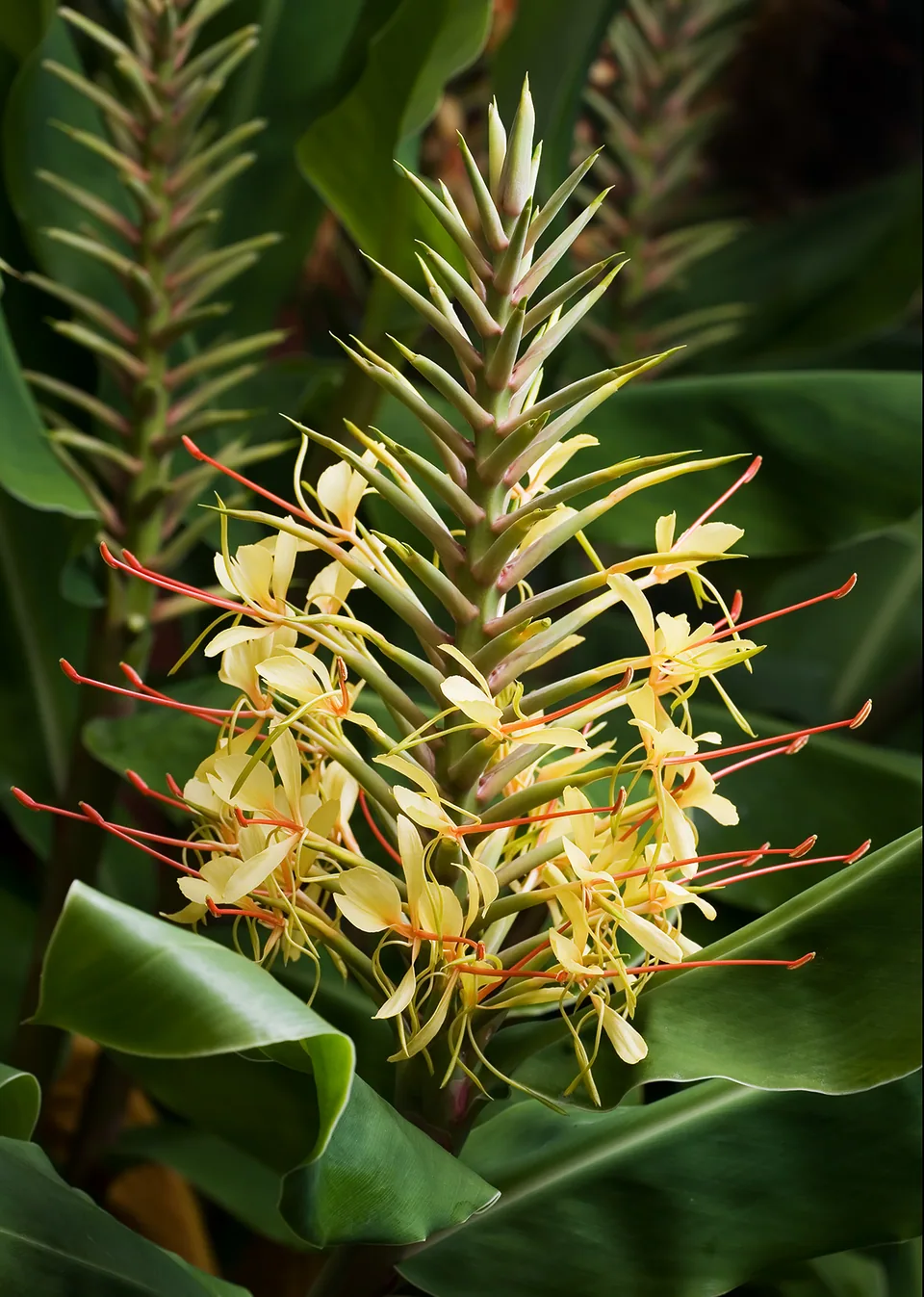
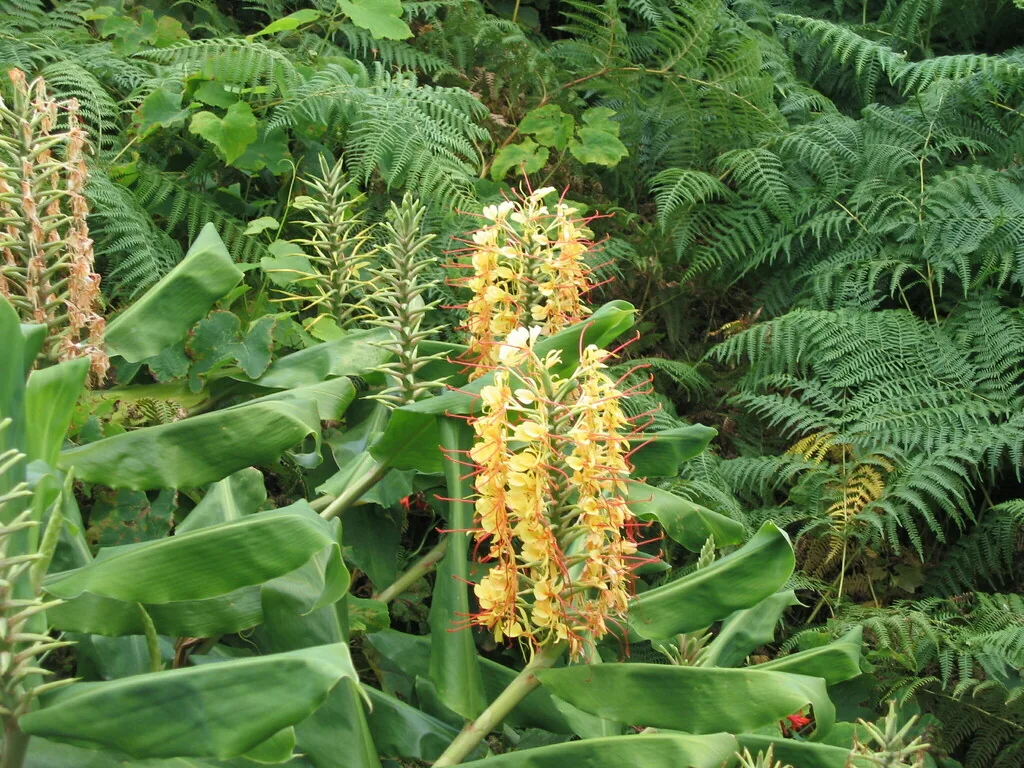
El jengibre kahili es una herbácea perenne erecta y agrupada que crece a partir de rizomas gruesos y puede alcanzar 8 pies [2,4 m] de altura. [1] Se cultiva por sus flores fragantes y su follaje de aspecto tropical y puede mantenerse en contenedores o en interiores en climas fríos. [1][2] Se considera invasiva en Hawái, donde se propaga rápidamente por rizomas. [1]
Citado en inglés, como en la fuente.
Cuidados
Las medidas entre corchetes son nuestra conversión al otro sistema de unidades; el texto citado no cambia.
Riego
Riego
Abundante agua durante todo el año; riega regularmente durante la temporada de crecimiento y reduce el riego en invierno.
Qué dicen las fuentes (3)
This ginger requires fertile soil and plentiful water throughout the year to achieve the most luxuriant growth.Water and fertilize regularly during the growing season, but cut back in winter.Plant in full sun to partial shade in consistently moist, humus-rich soil.Notas sobre el riego
Tolera períodos cortos de sequía pero no el agua estancada.
Qué dicen las fuentes (1)
It tolerates short periods of drought but not standing in water.Luz
Pleno sol a semisombra
Qué dicen las fuentes (2)
Plant in full sun to partial shade in consistently moist, humus-rich soil.In the Midwest, it does best in full sun but tolerates partial shade.Clima y frío
Rusticidad, zona más fría
Las fuentes dan valores distintos según la región, la zona o las condiciones de cultivo.
Lo que dice cada fuente
Según NC State Extension: 7a [mínima invernal de −17,8 a −15 °C (de 0 a 5 °F)]
Según Wisconsin Horticulture: 8a [mínima invernal de −12,2 a −9,4 °C (de 10 a 15 °F)]
Qué dicen las fuentes (2)
Según NC State Extension: USDA Plant Hardiness Zone:
7a, 7b, 8a, 8b, 9a, 9b, 10a, 10bSegún Wisconsin Horticulture: As a tender perennial (zones 8a to 11b)Rusticidad, zona más cálida
Las fuentes dan valores distintos según la región, la zona o las condiciones de cultivo.
Lo que dice cada fuente
Según NC State Extension: 10b [mínima invernal de 1,7 a 4,4 °C (de 35 a 40 °F)]
Según Wisconsin Horticulture: 11b [mínima invernal de 7,2 a 10 °C (de 45 a 50 °F)]
Qué dicen las fuentes (2)
Según NC State Extension: USDA Plant Hardiness Zone:
7a, 7b, 8a, 8b, 9a, 9b, 10a, 10bSegún Wisconsin Horticulture: As a tender perennial (zones 8a to 11b)Dónde cultivarla
En interior
Sí
Qué dicen las fuentes (1)
In the Midwest, kahili ginger is used as a seasonal, indoor, or greenhouse plantEn maceta
Sí
Qué dicen las fuentes (2)
You can use them in groups, borders or containers.It cannot survive our harsh winters, so must be grown as a container plant.Propagación
División (primavera), semilla.
Qué dicen las fuentes (2)
Plants can be propagated by division in spring or from seed .Recommended Propagation Strategy:
DivisionCultivo
La planta
Ciclo de vida
perenne
Qué dicen las fuentes (1)
Kahili ginger is an herbaceous perennial in the ginger family (Zingiberaceae) native to India, the Himalayan region and Southeast Asia.Familia
Zingiberaceae
Qué dicen las fuentes (1)
Kahili ginger is an herbaceous perennial in the ginger family (Zingiberaceae) native to India, the Himalayan region and Southeast Asia.Altura adulta
244 cm (8 pies)
Qué dicen las fuentes (2)
This ginger is an erect, clumping plant that can reach a mature height of 8 feet.In the ground it can grow to 8 feet tall, but plants are generally much shorter in container culture.Siembra y crecimiento
Días de germinación
21-28 (3 a 4 semanas)
Qué dicen las fuentes (1)
Seed can be soaked for few hours in warm water before planting, and they should germinate in 3 to 4 weeks.Abonado
Cuándo
Durante la temporada de crecimiento; poda en invierno
Qué dicen las fuentes (1)
Water and fertilize regularly during the growing season, but cut back in winter.Frecuencia
Regularmente durante la temporada de crecimiento
Qué dicen las fuentes (1)
Water and fertilize regularly during the growing season, but cut back in winter.Evitar
Abonado regular en invierno
Qué dicen las fuentes (1)
Water and fertilize regularly during the growing season, but cut back in winter.Remedios
Cada remedio indica qué dicen las fuentes oficiales; los remedios tradicionales sin fuente oficial aparecen marcados. Los perjudiciales están para que sepas evitarlos.
Cuidar la planta
babosas y caracoles
tierra de diatomeas No verificado
Remedio tradicional, no verificado por una fuente oficial.
Cómo: Espolvorea tierra de diatomeas alrededor de las plantas.
Cómo eliminarla
propagación invasiva
Desentierra toda la planta con los rizomas. No verificado
Remedio tradicional, no verificado por una fuente oficial.
Any fragments of rhizomes left on the ground can regrow.
— goonengerrylandcare.org [4] Cómo: Corta las hojas, desentierra el rizoma y cuélgalo para que se seque; embolsa y destruye las semillas.
ahogando rizomas desenterrados en un tambor de agua No verificado
Remedio tradicional, no verificado por una fuente oficial.
Care must be taken when controlling ginger to remove all rhizomes as new plants can grow from fragments.
— tiakitamakimakaurau.nz [5] Cómo: Desentierra la planta con las manos y ponla en un tambor grande con agua para ahogarla.
Calendario
Siembra
Lo antes posible después de que las semillas maduren.
Qué dicen las fuentes (1)
Plant seeds as soon as possible after they ripen.Plantación
Principios de primavera (trasplante); trasládalo al exterior después de la última helada.
Qué dicen las fuentes (1)
Repot (dividing if necessary) in early spring and keep in a warm location (room temperature) to get the plants growing again well before they are to be moved outside after the last frost.Poda
Después de que la helada haya matado las hojas, corta los tallos a unos pocos centímetros por encima del suelo.
Qué dicen las fuentes (1)
If the leaves are allowed to be killed by frost, cut back the stems to a few inches above the groundMeses tal como los dan las fuentes, en su mayoría de Estados Unidos (hemisferio norte). En el hemisferio sur se desplazan unos seis meses.
Respecto a las heladas
Estimación menos precisa: no hay ninguna estación meteorológica a menos de 300 km.
Busca las fechas de heladas por código postal o ciudad
Trasplante: hacia la última helada
Repot (dividing if necessary) in early spring and keep in a warm location (room temperature) to get the plants growing again well before they are to be moved outside after the last frost.
— Kahili Ginger, Hedychium gardnerianum – Wisconsin Horticulture [2]
Cuenta desde las fechas medias de las heladas de tu zona.
Comestibilidad
Según la fuente, citada textualmente. No comas una planta basándote solo en esta página: los errores de identificación pueden ser peligrosos.
Edibility: Roots are edible but not flavorful
[1]
Plantas similares
- Butterfly Ginger Hedychium coronarium
- Cardamomo Elettaria cardamomum
- Curcuma petiolata Curcuma petiolata
- Myōga Zingiber mioga
- Jengibre amargo Zingiber zerumbet
- Azucena de porcelana Alpinia zerumbet
- Cardamomo negro Amomum subulatum
- Jengibre Zingiber officinale
Fuentes
Cada valor anterior se cita de estos documentos. Los enlaces llevan al editor original.
- Hedychium gardnerianum (Ginger Lily, Kahali Ginger, Kahila Garland-Lily, Kahili Ginger) | North Carolina Extension Gardener Plant Toolbox · plants.ces.ncsu.edu, consultado
- Kahili Ginger, Hedychium gardnerianum – Wisconsin Horticulture · hort.extension.wisc.edu, consultado
- Hedychium (Garland Flower, Ginger Lily, Hardy Ginger, Kahili Ginger) | North Carolina Extension Gardener Plant Toolbox · plants.ces.ncsu.edu, consultado
- goonengerrylandcare.org · goonengerrylandcare.org
- tiakitamakimakaurau.nz · tiakitamakimakaurau.nz
Escrito por Emilio Marruso · última revisión