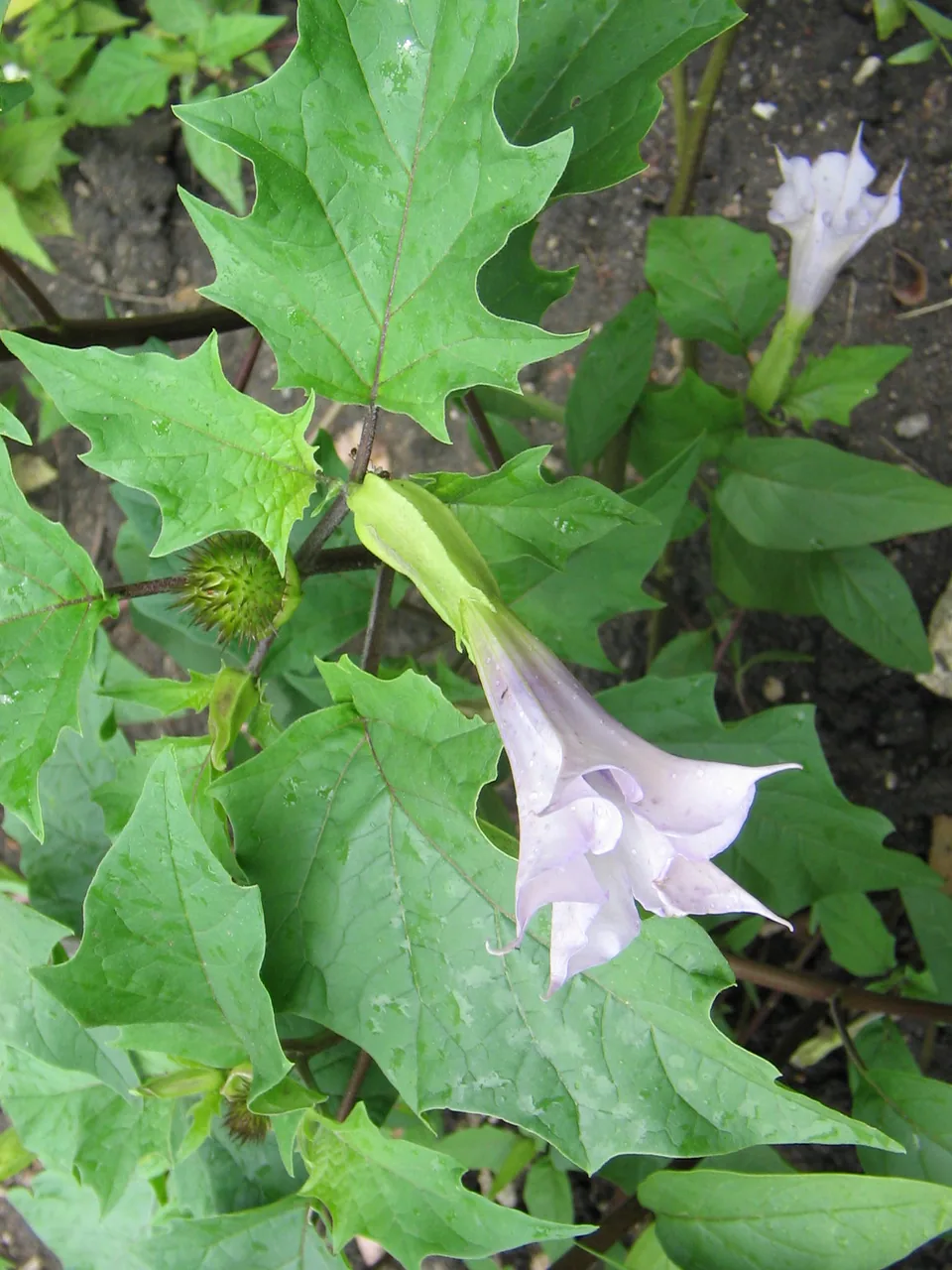


Cómo cultivar y cuidar Estramonio
Datura stramonium
Escrito por Emilio Marruso · última revisión
Tóxica para: Caballos, Ganado vacuno, Ovejas, Personas · Por qué
De un vistazo
El estramonio es una planta anual fácil que crece a partir de semilla: siémbrala fuera después de la última helada, o en interior 6 a 8 semanas antes. Dale sol pleno o semisombra y puede llegar a 1,2 m de ancho, en el suelo o en maceta, con pocas plagas. Eso sí, todas sus partes son tóxicas: mantenla lejos de niños y mascotas.
- Sol
Sol pleno o semisombra; con sombra crece más espigada y con menos flores
Qué dicen las fuentes (4)
Luz: Pleno sol a semisombra
Según NC State Extension: Light: Full sun (6 or more hours of direct sunlight a day) Partial Shade (Direct sunlight only part of the day, 2-6 hours)
— Datura stramonium (Datura, Devil's Snare, Devil's Trumpet, Jamestown Weed, Jimsonweed, Moonflower, Stinkweed, Stinkwort, Thorn-apple, Yugoslavian Stramonium) | North Carolina Extension Gardener Plant Toolbox [1] uso ornamental (Wisconsin Horticulture): Grow datura in full sun and well-drained soil (it will grow in partial shade, but will be leggier and have fewer flowers).
— Datura – Wisconsin Horticulture [5] maleza en el dosel del cultivo (Cornell): Light shade (25%) stimulates growth of jimsonweed, thereby prompting the plant to grow through partial crop canopies
— Jimsonweed | CALS [4] Grow datura in full sun and well-drained soil (it will grow in partial shade, but will be leggier and have fewer flowers).
— Datura – Wisconsin Horticulture [5] - Frío
Aguanta inviernos de hasta −17,8 °C (0 °F)
Rústica en inviernos muy fríos · USDA 7a · RHS H6 · Z7
Qué dicen las fuentes (2)
Rusticidad, zona más fría: 7a [mínima invernal de −17,8 a −15 °C (de 0 a 5 °F)]
USDA Plant Hardiness Zone: 7a, 7b, 8a, 8b, 9a, 9b
— Datura stramonium (Datura, Devil's Snare, Devil's Trumpet, Jamestown Weed, Jimsonweed, Moonflower, Stinkweed, Stinkwort, Thorn-apple, Yugoslavian Stramonium) | North Carolina Extension Gardener Plant Toolbox [1] Rusticidad, zona más cálida: 9b [mínima invernal de −3,9 a −1,1 °C (de 25 a 30 °F)]
USDA Plant Hardiness Zone: 7a, 7b, 8a, 8b, 9a, 9b
— Datura stramonium (Datura, Devil's Snare, Devil's Trumpet, Jamestown Weed, Jimsonweed, Moonflower, Stinkweed, Stinkwort, Thorn-apple, Yugoslavian Stramonium) | North Carolina Extension Gardener Plant Toolbox [1] - Plantación
Planta fuera solo cuando ya no haya riesgo de heladas
Qué dicen las fuentes (1)
Plantación: Al aire libre después de que haya pasado todo riesgo de heladas
and planted outdoors after all threat of frost has passed (and after acclimating the young plants to outdoor conditions).
— Datura – Wisconsin Horticulture [5] - Plagas
Pocas plagas: vigila la mosca blanca, la cochinilla algodonosa, la araña roja y el escarabajo de la patata
Qué dicen las fuentes (2)
Plagas: moscas blancas, cochinillas harinosas, arañitas rojas, escarabajos de la papa de tres líneas
Datura has few pest problems, but may be attacked by whiteflies, mealybugs, or spider mites.
— Datura – Wisconsin Horticulture [5] Three-lined potato beetles ( Lema trivittata and L. trilineata ) destroy seedlings and can cause severe defoliation of larger plants
— Jimsonweed | CALS [4] - Atención
Las semillas duran años en la tierra; arranca las plántulas pronto, las plantas grandes tienen raíz profunda
- Tamaño
De 30 cm a 1,2 m de ancho
Qué dicen las fuentes (1)
Anchura adulta: 30-122 cm (1 pie 0 pulg. - 4 pies 0 pulg.)
Dimensions: Height: 1 ft. 0 in. - 4 ft. 0 in. Width: 1 ft. 0 in. - 4 ft. 0 in.
— Datura stramonium (Datura, Devil's Snare, Devil's Trumpet, Jamestown Weed, Jimsonweed, Moonflower, Stinkweed, Stinkwort, Thorn-apple, Yugoslavian Stramonium) | North Carolina Extension Gardener Plant Toolbox [1] - Siembra
Crece de semilla: siembra fuera tras la última helada, o en interior 6–8 semanas antes
Qué dicen las fuentes (2)
Propagación: Semilla
Datura may be grown from seed sown outdoors after the last frost or started indoors 6 to 8 weeks before the average date of last frost
— Datura – Wisconsin Horticulture [5] Siembra: Al aire libre después de la última helada, o en interiores de 6 a 8 semanas antes de la fecha promedio de la última helada
Datura may be grown from seed sown outdoors after the last frost or started indoors 6 to 8 weeks before the average date of last frost
— Datura – Wisconsin Horticulture [5] - Maceta
Crece también en maceta
Qué dicen las fuentes (1)
En maceta: Sí
Although they can be grown in large containers, Datura is best grown in the ground because of their size.
— Datura – Wisconsin Horticulture [5] - Seguridad
Toda la planta es venenosa: lejos de niños y mascotas, y usa guantes porque la savia irrita la piel
Resumen
El estramonio es una maleza anual tierna de la familia de las solanáceas que es peligrosa y tóxica para humanos, mascotas y ganado si se ingiere. [1] Prospera a pleno sol y en suelos húmedos y bien drenados, y tolera la sequía una vez establecida. [1] Produce muchas semillas que pueden permanecer viables en el suelo durante años. [1]
Citado en inglés, como en la fuente.
Cuidados
Riego
Las fuentes dan valores distintos según la región, la zona o las condiciones de cultivo.
Lo que dice cada fuente
Según Wisconsin Horticulture: Tolerante a la sequía una vez establecida; prefiere condiciones de suelo húmedo
Según NC State Extension: Tolerante a la sequía una vez establecido
Según Cornell: Sobrevive en sitios secos pero prospera mejor en suelo fértil y con altas precipitaciones
Qué dicen las fuentes (4)
Según Wisconsin Horticulture: It is drought tolerant once established and thrives in almost any type of soil , but the plants prefer moist soil conditions.Según NC State Extension: They are drought-tolerant once established and sensitive to frost.Según Cornell: Jimsonweed can survive in sandy pastures and similar dry sites, but thrives best on fertile soil and high rainfallIt is drought tolerant once established and thrives in almost any type of soil , but the plants prefer moist soil conditions.Luz
Pleno sol a semisombra
Lo que dice cada fuente
Según NC State Extension: Pleno sol a semisombra
uso ornamental (Wisconsin Horticulture): Pleno sol; la semisombra produce plantas más espigadas con menos flores.
maleza en el dosel del cultivo (Cornell): La sombra ligera (25%) estimula el crecimiento; la sombra intensa (75%) reduce sustancialmente el crecimiento
Qué dicen las fuentes (4)
Según NC State Extension: Light: Full sun (6 or more hours of direct sunlight a day) Partial Shade (Direct sunlight only part of the day, 2-6 hours)uso ornamental (Wisconsin Horticulture): Grow datura in full sun and well-drained soil (it will grow in partial shade, but will be leggier and have fewer flowers).maleza en el dosel del cultivo (Cornell): Light shade (25%) stimulates growth of jimsonweed, thereby prompting the plant to grow through partial crop canopiesGrow datura in full sun and well-drained soil (it will grow in partial shade, but will be leggier and have fewer flowers).Clima y frío
Rusticidad, zona más fría
7a [mínima invernal de −17,8 a −15 °C (de 0 a 5 °F)]
Qué dicen las fuentes (1)
USDA Plant Hardiness Zone:
7a, 7b, 8a, 8b, 9a, 9bRusticidad, zona más cálida
9b [mínima invernal de −3,9 a −1,1 °C (de 25 a 30 °F)]
Qué dicen las fuentes (1)
USDA Plant Hardiness Zone:
7a, 7b, 8a, 8b, 9a, 9bSuelo
Las fuentes dan valores distintos según la región, la zona o las condiciones de cultivo.
Lo que dice cada fuente
Según Cornell: 4.7 (tolerado); crecimiento reducido por debajo de 5.4
Qué dicen las fuentes (1)
Según Cornell: Jimsonweed tolerates soil pH as low as 4.7, but growth is reduced below pH 5.4Dónde cultivarla
Sí
Qué dicen las fuentes (1)
Although they can be grown in large containers, Datura is best grown in the ground because of their size.Propagación
Semilla
Qué dicen las fuentes (1)
Datura may be grown from seed sown outdoors after the last frost or started indoors 6 to 8 weeks before the average date of last frostCultivo
La planta
Ciclo de vida
anual
Qué dicen las fuentes (2)
Jimsonweed is a tender, annual weed of the nightshade family (Solanaceae).Life Span: AnnualFamilia
Solanáceas
Qué dicen las fuentes (2)
Genus: Datura Species: stramonium Family: SolanaceaeFamily: nightshade family, SolanaceaeAltura adulta
Anchura adulta
30-122 cm (1 pie 0 pulg. - 4 pies 0 pulg.)
Qué dicen las fuentes (1)
Dimensions: Height: 1 ft. 0 in. - 4 ft. 0 in. Width: 1 ft. 0 in. - 4 ft. 0 in.Plagas y enfermedades
Plagas
moscas blancas, cochinillas harinosas, arañitas rojas, escarabajos de la papa de tres líneas
Qué dicen las fuentes (2)
Datura has few pest problems, but may be attacked by whiteflies, mealybugs, or spider mites.Three-lined potato beetles ( Lema trivittata and L. trilineata ) destroy seedlings and can cause severe defoliation of larger plantsProblemas
Moscas blancas, cochinillas harinosas y arañitas rojas
Síntoma: La datura tiene pocos problemas de plagas, pero puede ser atacada por moscas blancas, cochinillas harinosas o arañitas rojas.
Qué dicen las fuentes (1)
Datura has few pest problems, but may be attacked by whiteflies, mealybugs, or spider mites.
— Datura – Wisconsin Horticulture [5] Raíz pivotante y semillas persistentes de maleza
Síntoma: Una raíz pivotante dificulta la eliminación manual de plantas grandes; las semillas permanecen viables en el suelo durante años.
Qué hacer: Las plántulas se pueden quitar a mano.
Qué dicen las fuentes (1)
Jimsonweed produces a branched taproot, which makes hand-removal of larger plants challenging. Seedlings can be hand removed.
— Toxic Weed in the Landscape: Jimsonweed [2]
Remedios
Cada remedio indica qué dicen las fuentes oficiales; los remedios tradicionales sin fuente oficial aparecen marcados. Los perjudiciales están para que sepas evitarlos.
Cómo eliminarla
malezas
Arranca o escardilla los plantones. No verificado
Remedio tradicional, no verificado por una fuente oficial.
Always wear gloves when handling thorn apple, and wash your hands thoroughly afterwards.
— gardenersworld.com [7] Cómo: Arranca las plantas o escardilla los plantones; las plantas arrancadas antes de que produzcan semilla pueden compostarse.
Entierra las plantas que hayan producido semilla. No verificado
Remedio tradicional, no verificado por una fuente oficial.
Always wear gloves when handling thorn apple, and wash your hands thoroughly afterwards.
— gardenersworld.com [7] so you want to be really careful if you burn them not to inhale the smoke
— houzz.com [8] Cómo: las plantas que hayan producido semilla deben quemarse o enterrarse a más de 60 cm de profundidad en el suelo para evitar que las semillas germinen
solarización del suelo No verificado
Remedio tradicional, no verificado por una fuente oficial.
Cómo: Cubre el suelo con plástico transparente en la parte más calurosa del verano o en otoño, invierno o primavera.
Desentierra las raíces. No verificado
Remedio tradicional, no verificado por una fuente oficial.
Always wear gloves when handling thorn apple, and wash your hands thoroughly afterwards.
— gardenersworld.com [7] Cómo: Mata las raíces desenterrándolas; la eliminación mecánica es el mejor medio de control
Corta repetidamente el nuevo crecimiento No verificado
Remedio tradicional, no verificado por una fuente oficial.
Cómo: mantén cortado cualquier nuevo crecimiento verde para que las raíces hambrientas mueran
vinagre Funciona en parte
Note: Although acetic acid can be effective, vinegar with concentrations greater than 11% can cause severe eye injury and burn the skin if applied unsafely.
— extension.illinois.edu [9] Cómo: mata el crecimiento superior pero no las raíces
Vinegar will kill the top growth but not the roots.
— houzz.com [8] Qué dicen las pruebas Vinegar can treat and kill weeds, but it must be herbicidal vinegar or acetic acid, not household vinegar
— extension.illinois.edu [9] agua hirviendo No verificado
Remedio tradicional, no verificado por una fuente oficial.
Cómo: mata el crecimiento superior, generalmente no las raíces
quema con fuego No verificado
Remedio tradicional, no verificado por una fuente oficial.
so you want to be really careful if you burn them not to inhale the smoke
— houzz.com [8] Cómo: mata el crecimiento superior pero no las raíces
Venenosa para los animales
Según la fuente, citada textualmente. No es un consejo médico ni veterinario: si una persona o un animal pudo haber ingerido esta planta, contacta con un centro de toxicología o con un veterinario.
Animales
All parts of jimsonweed are very poisonous. Cattle and sheep have died from eating it.
[3]- Principio tóxico
Most parts of the plant contain atropine, scopolamine, and hyoscyamine.
[3]- Síntomas
Symptoms include dilated pupils, thirst, fever, loss of coordination, confusion, rapid pulse, labored respiration, hallucinations, convulsions, and eventual coma.
[3]- Gravedad
All parts of jimsonweed are very poisonous. Cattle and sheep have died from eating it.
[3]
All parts are extremely toxic, and serious illness or death is possible from ingestion . They are also poisonous to cattle, horses and sheep.
[5]
Personas
Ingestion can cause dilated pupils, fever, excessive thirst, loss of coordination, confusion, flushed skin, hallucinations, delirium, rapid and weak pulse, labored respirations, convulsions, and coma.
[1]- Partes venenosas
Poison Part: Flowers Fruits Leaves Roots Sap/Juice Seeds Stems
[1]- Principio tóxico
Poison Toxic Principle: Tropane alkaloids scopolamine, hyoscyamine, and atropine Causes Contact Dermatitis: Yes
[1]- Gravedad
Poison Severity: High Poison Symptoms: Ingestion can cause dilated pupils, fever, excessive thirst, loss of coordination, confusion
[1]
All parts of this plant are toxic if ingested. Keep out of reach of small children and pets. The sap can cause skin irritation, and protective clothing and gloves are recommended when handling this plant.
[1]Both leaves and seeds are highly toxic to humans and livestock due to alkaloids and sometimes nitrate
[4]
Calendario
Siembra
Al aire libre después de la última helada, o en interiores de 6 a 8 semanas antes de la fecha promedio de la última helada
Qué dicen las fuentes (1)
Datura may be grown from seed sown outdoors after the last frost or started indoors 6 to 8 weeks before the average date of last frostPlantación
Al aire libre después de que haya pasado todo riesgo de heladas
Qué dicen las fuentes (1)
and planted outdoors after all threat of frost has passed (and after acclimating the young plants to outdoor conditions).Meses tal como los dan las fuentes, en su mayoría de Estados Unidos (hemisferio norte). En el hemisferio sur se desplazan unos seis meses.
Respecto a las heladas
Estimación menos precisa: no hay ninguna estación meteorológica a menos de 300 km.
Busca las fechas de heladas por código postal o ciudad
Siembra en interior: de 6 a 8 semanas antes de la última helada
Datura may be grown from seed sown outdoors after the last frost or started indoors 6 to 8 weeks before the average date of last frost and planted outdoors after all threat of frost has passed
— Datura – Wisconsin Horticulture [5] Siembra al aire libre: hacia la última helada
Datura may be grown from seed sown outdoors after the last frost or started indoors 6 to 8 weeks before the average date of last frost and planted outdoors after all threat of frost has passed
— Datura – Wisconsin Horticulture [5] Trasplante: hacia la última helada
Datura may be grown from seed sown outdoors after the last frost or started indoors 6 to 8 weeks before the average date of last frost and planted outdoors after all threat of frost has passed
— Datura – Wisconsin Horticulture [5]
Cuenta desde las fechas medias de las heladas de tu zona.
Plantas similares
- Downy Thorn-Apple Datura innoxia
- Sacred Datura Datura wrightii
- Angel's Trumpet Datura metel
- Trompetero Brugmansia suaveolens
- Bufera Withania somnifera
- Belladona Atropa belladonna
- Dulcamara Solanum dulcamara
- Alquequenje Alkekengi officinarum
Fuentes
Cada valor anterior se cita de estos documentos. Los enlaces llevan al editor original.
- Datura stramonium (Datura, Devil's Snare, Devil's Trumpet, Jamestown Weed, Jimsonweed, Moonflower, Stinkweed, Stinkwort, Thorn-apple, Yugoslavian Stramonium) | North Carolina Extension Gardener Plant Toolbox · plants.ces.ncsu.edu, consultado
- Toxic Weed in the Landscape: Jimsonweed · extension.psu.edu, consultado
- Jimsonweed | USU · extension.usu.edu, consultado
- Jimsonweed | CALS · cals.cornell.edu, consultado
- Datura – Wisconsin Horticulture · hort.extension.wisc.edu, consultado
- Stinkweed - Datura stramonium | North Carolina Extension Gardener Plant Toolbox · plants.ces.ncsu.edu, consultado
- gardenersworld.com · gardenersworld.com
- houzz.com · houzz.com
- extension.illinois.edu · extension.illinois.edu
Escrito por Emilio Marruso · última revisión