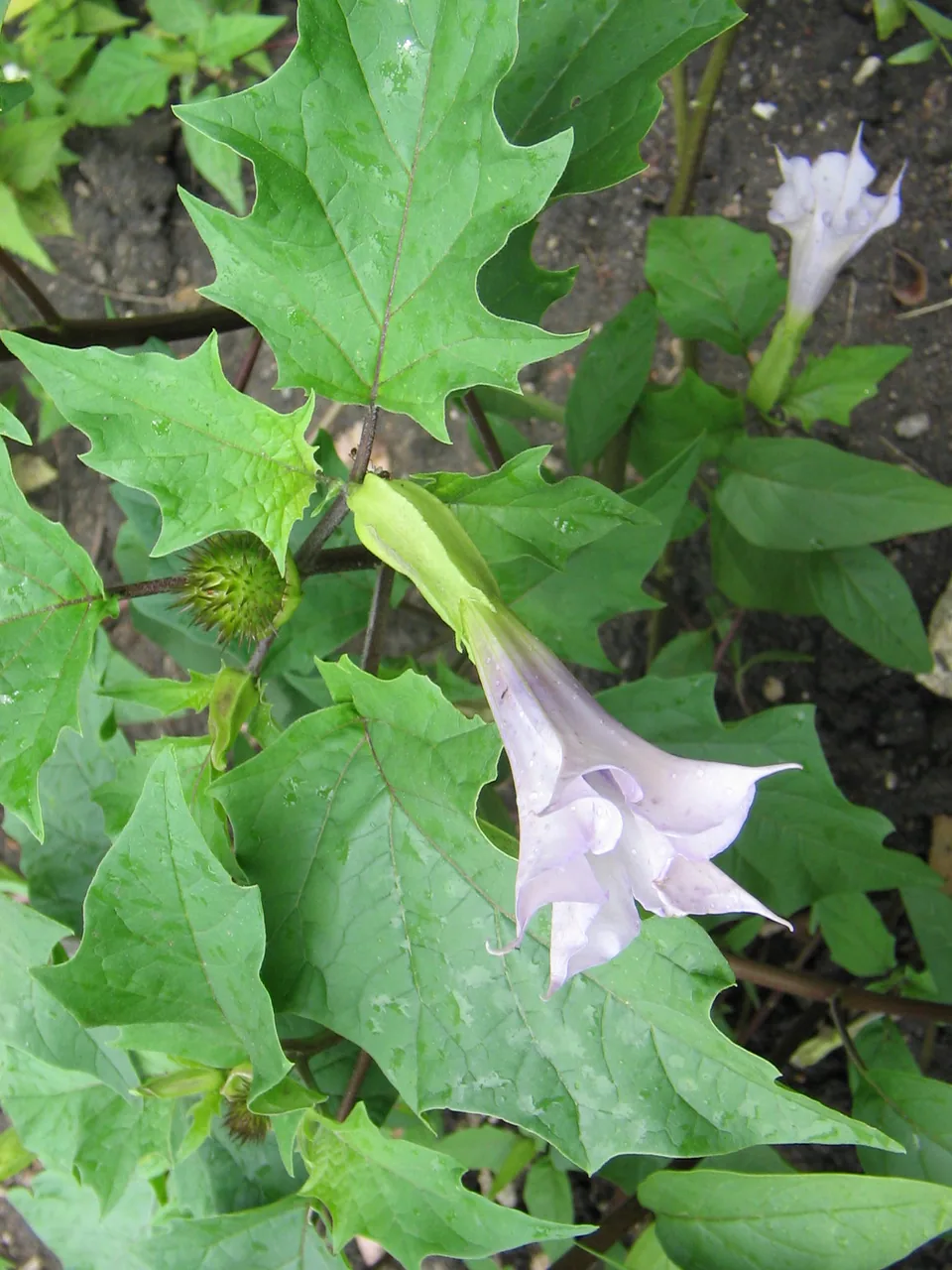


How to Grow and Care for Jimsonweed
Datura stramonium
Written by Emilio Marruso · last checked
Toxic to: Horses, Cattle, Sheep, People · Why
At a glance
Jimsonweed is an easy annual that grows from seed: sow it outdoors after the last frost, or indoors 6 to 8 weeks earlier. Give it full sun to partial shade and it can spread 1 to 4 feet wide, in the ground or in a container, with few pest problems. Just remember that every part is toxic, so keep it away from children and pets.
- Sun
Full sun to partial shade; in shade it gets leggier with fewer flowers
What the sources say (4)
Light: Full sun to partial shade
According to NC State Extension: Light: Full sun (6 or more hours of direct sunlight a day) Partial Shade (Direct sunlight only part of the day, 2-6 hours)
— Datura stramonium (Datura, Devil's Snare, Devil's Trumpet, Jamestown Weed, Jimsonweed, Moonflower, Stinkweed, Stinkwort, Thorn-apple, Yugoslavian Stramonium) | North Carolina Extension Gardener Plant Toolbox [1] ornamental use (Wisconsin Horticulture): Grow datura in full sun and well-drained soil (it will grow in partial shade, but will be leggier and have fewer flowers).
— Datura – Wisconsin Horticulture [5] weed in crop canopy (Cornell): Light shade (25%) stimulates growth of jimsonweed, thereby prompting the plant to grow through partial crop canopies
— Jimsonweed | CALS [4] Grow datura in full sun and well-drained soil (it will grow in partial shade, but will be leggier and have fewer flowers).
— Datura – Wisconsin Horticulture [5] - Cold
Survives winters down to 0 °F (−17.8 °C)
Hardy in very cold winters · USDA 7a · RHS H6 · Z7
What the sources say (2)
Hardiness, coldest zone: 7a [winter low −17.8 to −15 °C (0 to 5 °F)]
USDA Plant Hardiness Zone: 7a, 7b, 8a, 8b, 9a, 9b
— Datura stramonium (Datura, Devil's Snare, Devil's Trumpet, Jamestown Weed, Jimsonweed, Moonflower, Stinkweed, Stinkwort, Thorn-apple, Yugoslavian Stramonium) | North Carolina Extension Gardener Plant Toolbox [1] Hardiness, warmest zone: 9b [winter low −3.9 to −1.1 °C (25 to 30 °F)]
USDA Plant Hardiness Zone: 7a, 7b, 8a, 8b, 9a, 9b
— Datura stramonium (Datura, Devil's Snare, Devil's Trumpet, Jamestown Weed, Jimsonweed, Moonflower, Stinkweed, Stinkwort, Thorn-apple, Yugoslavian Stramonium) | North Carolina Extension Gardener Plant Toolbox [1] - Planting
Plant outdoors only after all danger of frost has passed
What the sources say (1)
Planting: Outdoors after all threat of frost has passed
and planted outdoors after all threat of frost has passed (and after acclimating the young plants to outdoor conditions).
— Datura – Wisconsin Horticulture [5] - Pests
Few pests; watch for whiteflies, mealybugs, spider mites and potato beetles
What the sources say (2)
Pests: whiteflies, mealybugs, spider mites, three-lined potato beetles
Datura has few pest problems, but may be attacked by whiteflies, mealybugs, or spider mites.
— Datura – Wisconsin Horticulture [5] Three-lined potato beetles ( Lema trivittata and L. trilineata ) destroy seedlings and can cause severe defoliation of larger plants
— Jimsonweed | CALS [4] - Watch out
Seeds stay alive in the soil for years; pull seedlings early, big plants have a deep root
- Size
1 to 4 ft wide
What the sources say (1)
Mature width: 30-122 cm (1 ft. 0 in. - 4 ft. 0 in.)
Dimensions: Height: 1 ft. 0 in. - 4 ft. 0 in. Width: 1 ft. 0 in. - 4 ft. 0 in.
— Datura stramonium (Datura, Devil's Snare, Devil's Trumpet, Jamestown Weed, Jimsonweed, Moonflower, Stinkweed, Stinkwort, Thorn-apple, Yugoslavian Stramonium) | North Carolina Extension Gardener Plant Toolbox [1] - Sowing
Grows from seed: sow outdoors after the last frost, or indoors 6–8 weeks before
What the sources say (2)
Propagation: Seed
Datura may be grown from seed sown outdoors after the last frost or started indoors 6 to 8 weeks before the average date of last frost
— Datura – Wisconsin Horticulture [5] Sowing: Outdoors after the last frost, or indoors 6 to 8 weeks before the average date of last frost
Datura may be grown from seed sown outdoors after the last frost or started indoors 6 to 8 weeks before the average date of last frost
— Datura – Wisconsin Horticulture [5] - Containers
Grows in containers too
What the sources say (1)
In containers: Yes
Although they can be grown in large containers, Datura is best grown in the ground because of their size.
— Datura – Wisconsin Horticulture [5] - Safety
Every part is poisonous: keep away from kids and pets, and wear gloves because the sap irritates skin
Overview
Jimsonweed is a tender annual weed of the nightshade family that is dangerous and toxic to humans, pets and livestock if ingested. [1] It thrives in full sun and moist, well-drained soils and is drought-tolerant once established. [1] It produces many seeds that can remain viable in the soil for years. [1]
Jimsonweed care
How to water Jimsonweed
The sources give different values depending on region, zone or growing conditions.
What each source says
According to Wisconsin Horticulture: Drought tolerant once established; prefers moist soil conditions
According to NC State Extension: Drought-tolerant once established
According to Cornell: Survives in dry sites but thrives best on fertile soil and high rainfall
What the sources say (4)
According to Wisconsin Horticulture: It is drought tolerant once established and thrives in almost any type of soil , but the plants prefer moist soil conditions.According to NC State Extension: They are drought-tolerant once established and sensitive to frost.According to Cornell: Jimsonweed can survive in sandy pastures and similar dry sites, but thrives best on fertile soil and high rainfallIt is drought tolerant once established and thrives in almost any type of soil , but the plants prefer moist soil conditions.How much light Jimsonweed needs
Full sun to partial shade
What each source says
According to NC State Extension: Full sun to partial shade
ornamental use (Wisconsin Horticulture): Full sun; partial shade gives leggier plants with fewer flowers
weed in crop canopy (Cornell): Light shade (25%) stimulates growth; heavy shade (75%) substantially reduces growth
What the sources say (4)
According to NC State Extension: Light: Full sun (6 or more hours of direct sunlight a day) Partial Shade (Direct sunlight only part of the day, 2-6 hours)ornamental use (Wisconsin Horticulture): Grow datura in full sun and well-drained soil (it will grow in partial shade, but will be leggier and have fewer flowers).weed in crop canopy (Cornell): Light shade (25%) stimulates growth of jimsonweed, thereby prompting the plant to grow through partial crop canopiesGrow datura in full sun and well-drained soil (it will grow in partial shade, but will be leggier and have fewer flowers).How much cold Jimsonweed can take
Hardiness, coldest zone
7a [winter low −17.8 to −15 °C (0 to 5 °F)]
What the sources say (1)
USDA Plant Hardiness Zone:
7a, 7b, 8a, 8b, 9a, 9bHardiness, warmest zone
9b [winter low −3.9 to −1.1 °C (25 to 30 °F)]
What the sources say (1)
USDA Plant Hardiness Zone:
7a, 7b, 8a, 8b, 9a, 9bBest soil for Jimsonweed
The sources give different values depending on region, zone or growing conditions.
What each source says
According to Cornell: 4.7 (tolerated); growth reduced below 5.4
What the sources say (1)
According to Cornell: Jimsonweed tolerates soil pH as low as 4.7, but growth is reduced below pH 5.4Where to grow Jimsonweed
Yes
What the sources say (1)
Although they can be grown in large containers, Datura is best grown in the ground because of their size.How to propagate Jimsonweed
Seed
What the sources say (1)
Datura may be grown from seed sown outdoors after the last frost or started indoors 6 to 8 weeks before the average date of last frostHow to grow Jimsonweed
The plant
Life cycle
annual
What the sources say (2)
Jimsonweed is a tender, annual weed of the nightshade family (Solanaceae).Life Span: AnnualFamily
Solanaceae
What the sources say (2)
Genus: Datura Species: stramonium Family: SolanaceaeFamily: nightshade family, SolanaceaeMature height
Mature width
30-122 cm (1 ft. 0 in. - 4 ft. 0 in.)
What the sources say (1)
Dimensions: Height: 1 ft. 0 in. - 4 ft. 0 in. Width: 1 ft. 0 in. - 4 ft. 0 in.Pests and diseases
Pests
whiteflies, mealybugs, spider mites, three-lined potato beetles
What the sources say (2)
Datura has few pest problems, but may be attacked by whiteflies, mealybugs, or spider mites.Three-lined potato beetles ( Lema trivittata and L. trilineata ) destroy seedlings and can cause severe defoliation of larger plantsJimsonweed pests and problems
Whiteflies, mealybugs and spider mites
Symptom: Datura has few pest problems but may be attacked by whiteflies, mealybugs, or spider mites.
What the sources say (1)
Datura has few pest problems, but may be attacked by whiteflies, mealybugs, or spider mites.
— Datura – Wisconsin Horticulture [5] Weedy taproot and persistent seeds
Symptom: A taproot makes hand removal of large plants difficult; seeds remain viable in the soil for years.
What to do: Seedlings can be hand removed.
What the sources say (1)
Jimsonweed produces a branched taproot, which makes hand-removal of larger plants challenging. Seedlings can be hand removed.
— Toxic Weed in the Landscape: Jimsonweed [2]
Remedies
Each remedy shows what official sources say about it; traditional remedies without an official source are marked as such. Harmful ones are listed so you know to avoid them.
Getting rid of it
weeds
pulling or hoeing seedlings Not verified
Traditional remedy, not verified by an official source.
Always wear gloves when handling thorn apple, and wash your hands thoroughly afterwards.
— gardenersworld.com [7] How: pull plants out or hoe the seedlings; plants pulled before setting seed can be composted
burying plants that have set seed Not verified
Traditional remedy, not verified by an official source.
Always wear gloves when handling thorn apple, and wash your hands thoroughly afterwards.
— gardenersworld.com [7] so you want to be really careful if you burn them not to inhale the smoke
— houzz.com [8] How: plants that have set seed must be burned or buried deeper than 60cm in the soil to prevent the seeds from germinating
soil solarization Not verified
Traditional remedy, not verified by an official source.
How: cover the soil with clear plastic in the hottest part of summer or in fall, winter or spring
digging up the roots Not verified
Traditional remedy, not verified by an official source.
Always wear gloves when handling thorn apple, and wash your hands thoroughly afterwards.
— gardenersworld.com [7] How: kill the roots by digging them up; mechanical removal is the best means of control
repeated cutting of new growth Not verified
Traditional remedy, not verified by an official source.
How: keep any new green growth cut so the starving roots eventually die
vinegar Partly works
Note: Although acetic acid can be effective, vinegar with concentrations greater than 11% can cause severe eye injury and burn the skin if applied unsafely.
— extension.illinois.edu [9] How: kills the top growth but not the roots
Vinegar will kill the top growth but not the roots.
— houzz.com [8] What the evidence says Vinegar can treat and kill weeds, but it must be herbicidal vinegar or acetic acid, not household vinegar
— extension.illinois.edu [9] boiling water Not verified
Traditional remedy, not verified by an official source.
How: kills the top growth, usually not the roots
flaming Not verified
Traditional remedy, not verified by an official source.
so you want to be really careful if you burn them not to inhale the smoke
— houzz.com [8] How: kills the top growth but not the roots
Is Jimsonweed toxic to pets?
Reported by the source, quoted verbatim. This is not medical or veterinary advice: if a person or an animal may have eaten this plant, contact a poison control centre or a veterinarian.
Animals
All parts of jimsonweed are very poisonous. Cattle and sheep have died from eating it.
[3]- Toxic principle
Most parts of the plant contain atropine, scopolamine, and hyoscyamine.
[3]- Symptoms
Symptoms include dilated pupils, thirst, fever, loss of coordination, confusion, rapid pulse, labored respiration, hallucinations, convulsions, and eventual coma.
[3]- Severity
All parts of jimsonweed are very poisonous. Cattle and sheep have died from eating it.
[3]
All parts are extremely toxic, and serious illness or death is possible from ingestion . They are also poisonous to cattle, horses and sheep.
[5]
People
Ingestion can cause dilated pupils, fever, excessive thirst, loss of coordination, confusion, flushed skin, hallucinations, delirium, rapid and weak pulse, labored respirations, convulsions, and coma.
[1]- Poisonous parts
Poison Part: Flowers Fruits Leaves Roots Sap/Juice Seeds Stems
[1]- Toxic principle
Poison Toxic Principle: Tropane alkaloids scopolamine, hyoscyamine, and atropine Causes Contact Dermatitis: Yes
[1]- Severity
Poison Severity: High Poison Symptoms: Ingestion can cause dilated pupils, fever, excessive thirst, loss of coordination, confusion
[1]
All parts of this plant are toxic if ingested. Keep out of reach of small children and pets. The sap can cause skin irritation, and protective clothing and gloves are recommended when handling this plant.
[1]Both leaves and seeds are highly toxic to humans and livestock due to alkaloids and sometimes nitrate
[4]
Calendar
Sowing
Outdoors after the last frost, or indoors 6 to 8 weeks before the average date of last frost
What the sources say (1)
Datura may be grown from seed sown outdoors after the last frost or started indoors 6 to 8 weeks before the average date of last frostPlanting
Outdoors after all threat of frost has passed
What the sources say (1)
and planted outdoors after all threat of frost has passed (and after acclimating the young plants to outdoor conditions).Months as given by the sources, which are mostly from the United States (northern hemisphere). In the southern hemisphere they shift by about six months.
Relative to frost
Less precise estimate: there is no weather station within 300 km.
Find frost dates by ZIP code or city
Sow indoors: 6 to 8 weeks before the last frost
Datura may be grown from seed sown outdoors after the last frost or started indoors 6 to 8 weeks before the average date of last frost and planted outdoors after all threat of frost has passed
— Datura – Wisconsin Horticulture [5] Sow outdoors: around the last frost
Datura may be grown from seed sown outdoors after the last frost or started indoors 6 to 8 weeks before the average date of last frost and planted outdoors after all threat of frost has passed
— Datura – Wisconsin Horticulture [5] Transplant: around the last frost
Datura may be grown from seed sown outdoors after the last frost or started indoors 6 to 8 weeks before the average date of last frost and planted outdoors after all threat of frost has passed
— Datura – Wisconsin Horticulture [5]
Count from the average frost dates where you live.
Similar plants
- Downy Thorn-Apple Datura innoxia
- Sacred Datura Datura wrightii
- Angel's Trumpet Datura metel
- Angel's-tears Brugmansia suaveolens
- Ashwagandha Withania somnifera
- Belladonna Atropa belladonna
- Bittersweet Solanum dulcamara
- Bladder cherry Alkekengi officinarum
Sources
Every value above is quoted from these documents. Links lead to the original publisher.
- Datura stramonium (Datura, Devil's Snare, Devil's Trumpet, Jamestown Weed, Jimsonweed, Moonflower, Stinkweed, Stinkwort, Thorn-apple, Yugoslavian Stramonium) | North Carolina Extension Gardener Plant Toolbox · plants.ces.ncsu.edu, consulted
- Toxic Weed in the Landscape: Jimsonweed · extension.psu.edu, consulted
- Jimsonweed | USU · extension.usu.edu, consulted
- Jimsonweed | CALS · cals.cornell.edu, consulted
- Datura – Wisconsin Horticulture · hort.extension.wisc.edu, consulted
- Stinkweed - Datura stramonium | North Carolina Extension Gardener Plant Toolbox · plants.ces.ncsu.edu, consulted
- gardenersworld.com · gardenersworld.com
- houzz.com · houzz.com
- extension.illinois.edu · extension.illinois.edu
Written by Emilio Marruso · last checked