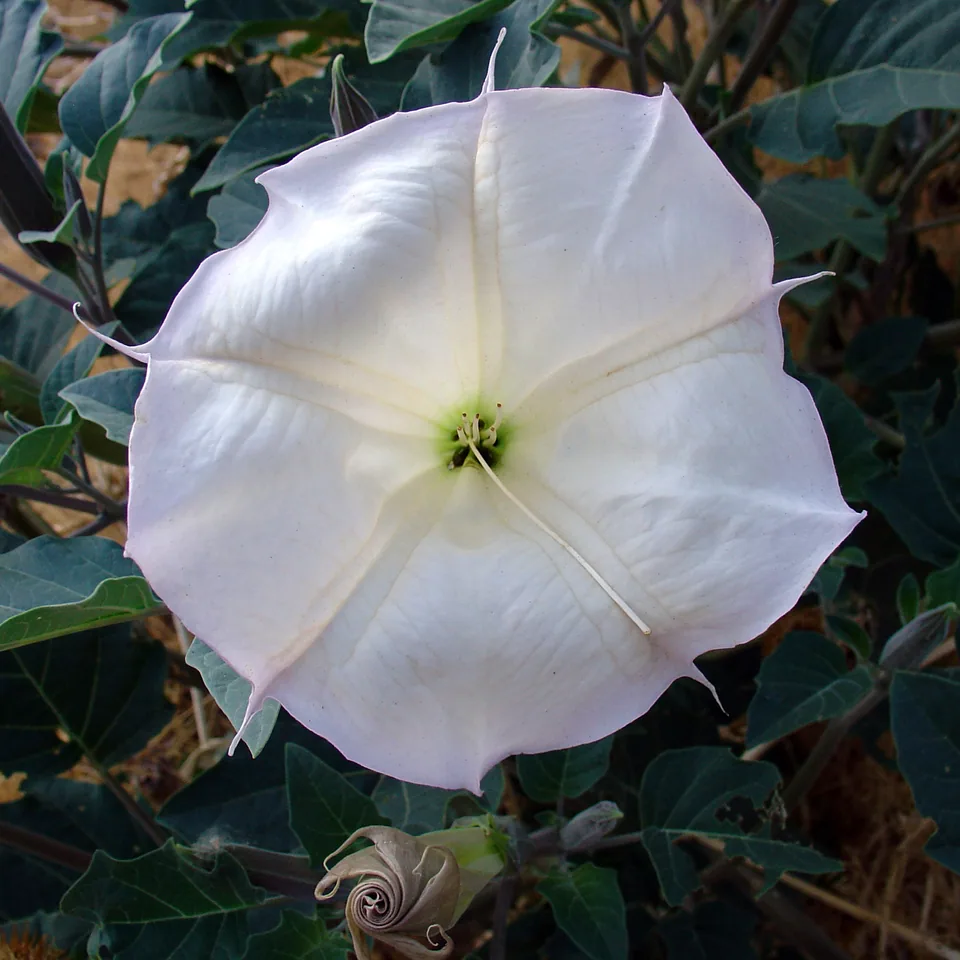
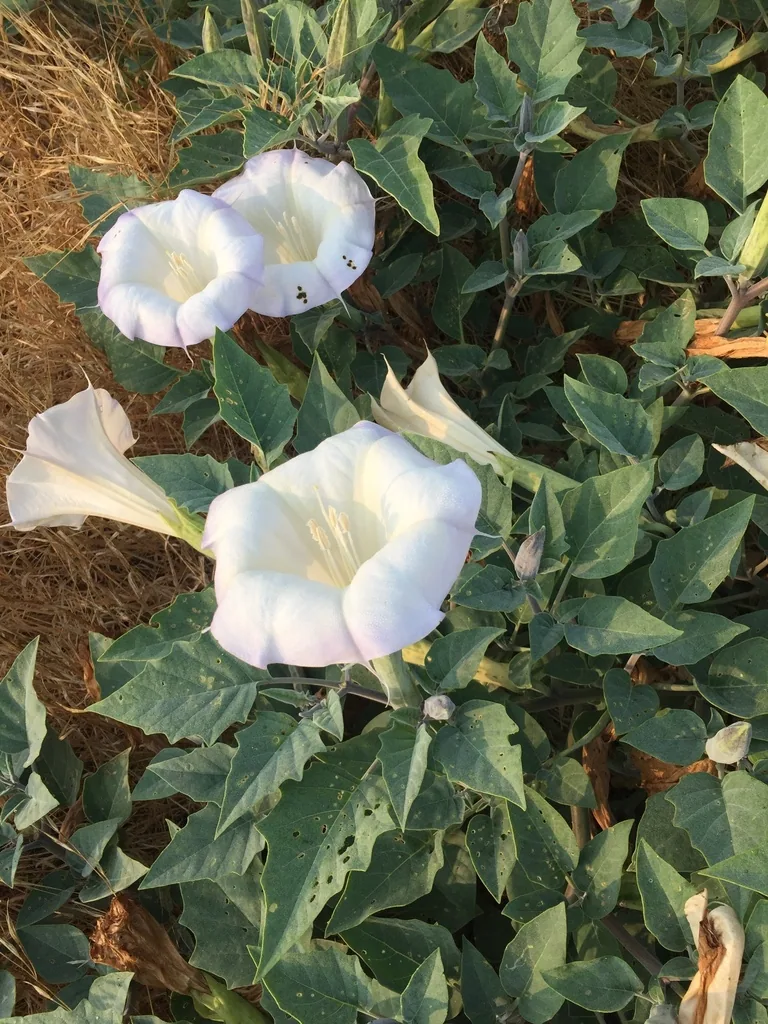

How to Grow and Care for Sacred Datura
Datura wrightii
Written by Emilio Marruso · last checked
Toxic to: Cats, Dogs, Horses, Cattle, People · Why
At a glance
This datura is a bold, spreading plant that grows 2–5 ft tall and up to 6 ft wide, easily filling a spot in full sun or partial shade. You can start it from seed; in warm climates it is a short-lived perennial, while in colder areas it is grown as an annual. Just wear gloves: every part is toxic and the sap irritates skin.
- Sun
Full sun to partial shade
What the sources say (2)
Light: Full sun to partial shade
Light: Full sun (6 or more hours of direct sunlight a day) Partial Shade (Direct sunlight only part of the day, 2-6 hours)
— Datura wrightii (Angel's Trumpet, Indian Apple, Jimsonweed, Moon Lily, Sacred Datura, Sacred Thorn-Apple, Thorn-Apple, Tolguacha, Western Jimson Weed) | North Carolina Extension Gardener Plant Toolbox [1] Thrives in full sun and well-drained, acidic soils of loam, sand, or clay.
— Datura wrightii (Angel's Trumpet, Indian Apple, Jimsonweed, Moon Lily, Sacred Datura, Sacred Thorn-Apple, Thorn-Apple, Tolguacha, Western Jimson Weed) | North Carolina Extension Gardener Plant Toolbox [1] - Cold
Survives winters down to 20 °F (−6.7 °C)
Hardy in average winters · USDA 9a · RHS H4 · Z9
What the sources say (2)
Hardiness, coldest zone: 9a [winter low −6.7 to −3.9 °C (20 to 25 °F)]
USDA Plant Hardiness Zone: 9a, 9b, 10a, 10b, 11a, 11b
— Datura wrightii (Angel's Trumpet, Indian Apple, Jimsonweed, Moon Lily, Sacred Datura, Sacred Thorn-Apple, Thorn-Apple, Tolguacha, Western Jimson Weed) | North Carolina Extension Gardener Plant Toolbox [1] Hardiness, warmest zone: 11b [winter low 7.2 to 10 °C (45 to 50 °F)]
USDA Plant Hardiness Zone: 9a, 9b, 10a, 10b, 11a, 11b
— Datura wrightii (Angel's Trumpet, Indian Apple, Jimsonweed, Moon Lily, Sacred Datura, Sacred Thorn-Apple, Thorn-Apple, Tolguacha, Western Jimson Weed) | North Carolina Extension Gardener Plant Toolbox [1] - Soil
Well-drained soil, pH no higher than 6.0
What the sources say (3)
Watering notes: Thrives in well-drained soils
Thrives in full sun and well-drained, acidic soils of loam, sand, or clay.
— Datura wrightii (Angel's Trumpet, Indian Apple, Jimsonweed, Moon Lily, Sacred Datura, Sacred Thorn-Apple, Thorn-Apple, Tolguacha, Western Jimson Weed) | North Carolina Extension Gardener Plant Toolbox [1] Soil pH, maximum: 6.0
Soil pH: Acid (<6.0) Soil Drainage: Good Drainage
— Datura wrightii (Angel's Trumpet, Indian Apple, Jimsonweed, Moon Lily, Sacred Datura, Sacred Thorn-Apple, Thorn-Apple, Tolguacha, Western Jimson Weed) | North Carolina Extension Gardener Plant Toolbox [1] Thrives in full sun and well-drained, acidic soils of loam, sand, or clay.
— Datura wrightii (Angel's Trumpet, Indian Apple, Jimsonweed, Moon Lily, Sacred Datura, Sacred Thorn-Apple, Thorn-Apple, Tolguacha, Western Jimson Weed) | North Carolina Extension Gardener Plant Toolbox [1] - Pruning
Cut it back in early winter, as the plant dies back
What the sources say (1)
Pruning: Early winter, as the plant dies back
finally pruning back the main stem as the plant dies back in early Winter.
— Datura wrightii | Spill the Beans [2] - Watch out
The sap irritates skin: wear gloves and long sleeves when handling it
- Size
2–5 ft tall and 3–6 ft wide
What the sources say (2)
Mature height: 61-152 cm (2-5 ft)
Dimensions: Height: 2 ft. 0 in. - 5 ft. 0 in. Width: 3 ft. 0 in. - 6 ft. 0 in.
— Datura wrightii (Angel's Trumpet, Indian Apple, Jimsonweed, Moon Lily, Sacred Datura, Sacred Thorn-Apple, Thorn-Apple, Tolguacha, Western Jimson Weed) | North Carolina Extension Gardener Plant Toolbox [1] Mature width: 91-183 cm (3-6 ft)
Dimensions: Height: 2 ft. 0 in. - 5 ft. 0 in. Width: 3 ft. 0 in. - 6 ft. 0 in.
— Datura wrightii (Angel's Trumpet, Indian Apple, Jimsonweed, Moon Lily, Sacred Datura, Sacred Thorn-Apple, Thorn-Apple, Tolguacha, Western Jimson Weed) | North Carolina Extension Gardener Plant Toolbox [1] - Propagation
Grows from seed
What the sources say (1)
Propagation: Seed
Recommended Propagation Strategy: Seed Country Or Region Of Origin:
— Datura wrightii (Angel's Trumpet, Indian Apple, Jimsonweed, Moon Lily, Sacred Datura, Sacred Thorn-Apple, Thorn-Apple, Tolguacha, Western Jimson Weed) | North Carolina Extension Gardener Plant Toolbox [1] - Safety
Every part is poisonous if eaten: keep it away from children, dogs, cats and horses
Overview
Sacred datura is a fast-growing, poisonous ornamental perennial of the nightshade family, native to the southwestern United States and Mexico. [1] All parts of the plant are toxic if ingested, and the sap can cause skin irritation. [1]
This record is incomplete: the sources we read do not cover every field yet.
Not yet covered by our sources: Watering
Sacred Datura care
How to water Sacred Datura
Watering
Not stated in the sources we read.
Watering notes
Thrives in well-drained soils
What the sources say (1)
Thrives in full sun and well-drained, acidic soils of loam, sand, or clay.How much light Sacred Datura needs
Full sun to partial shade
What the sources say (2)
Light:
Full sun (6 or more hours of direct sunlight a day)
Partial Shade (Direct sunlight only part of the day, 2-6 hours)Thrives in full sun and well-drained, acidic soils of loam, sand, or clay.How much cold Sacred Datura can take
Hardiness, coldest zone
9a [winter low −6.7 to −3.9 °C (20 to 25 °F)]
What the sources say (1)
USDA Plant Hardiness Zone:
9a, 9b, 10a, 10b, 11a, 11bHardiness, warmest zone
11b [winter low 7.2 to 10 °C (45 to 50 °F)]
What the sources say (1)
USDA Plant Hardiness Zone:
9a, 9b, 10a, 10b, 11a, 11bBest soil for Sacred Datura
6.0
What the sources say (2)
Soil pH:
Acid (<6.0)
Soil Drainage:
Good DrainageThrives in full sun and well-drained, acidic soils of loam, sand, or clay.How to propagate Sacred Datura
Seed
What the sources say (1)
Recommended Propagation Strategy:
Seed
Country Or Region Of Origin:How to grow Sacred Datura
The plant
Life cycle
perennial (short-lived in the Southern United States, annual in the North)
What the sources say (1)
This plant is a short-lived perennial in the Southern United States and an annual in the North.Family
Solanaceae
What the sources say (1)
Angel's trumpet is a fast-growing, poisonous ornamental perennial and a member of the nightshade family (Solanaceae). It is native to the southwestern United States and Mexico.Mature height
61-152 cm (2-5 ft)
What the sources say (1)
Dimensions:
Height: 2 ft. 0 in. - 5 ft. 0 in.
Width: 3 ft. 0 in. - 6 ft. 0 in.Mature width
91-183 cm (3-6 ft)
What the sources say (1)
Dimensions:
Height: 2 ft. 0 in. - 5 ft. 0 in.
Width: 3 ft. 0 in. - 6 ft. 0 in.Sacred Datura pests and problems
Skin irritation from sap
Symptom: The sap can cause skin irritation
What to do: Use gloves and protective clothing when handling this plant
What the sources say (1)
The sap can cause skin irritation. Use gloves and protective clothing when handling this plant.
— Datura wrightii (Angel's Trumpet, Indian Apple, Jimsonweed, Moon Lily, Sacred Datura, Sacred Thorn-Apple, Thorn-Apple, Tolguacha, Western Jimson Weed) | North Carolina Extension Gardener Plant Toolbox [1]
Remedies
Each remedy shows what official sources say about it; traditional remedies without an official source are marked as such. Harmful ones are listed so you know to avoid them.
Treating the plant
aphids, spider mites, whiteflies
insecticidal soap Works
How: under stressed conditions these pests can be managed with a strong spray of water or insecticidal soap
However, under stressed conditions, it can occasionally encounter common garden pests such as aphids, spider mites, or whiteflies. These can often be managed with a strong spray of water or insecticidal soap.
— biologyinsights.com [5] What the evidence says For example, insecticidal soap is a safe, effective organic insecticide with minimal environmental impact.
— extension.psu.edu [6]
spider mites
strong stream of water Not verified
Traditional remedy, not verified by an official source.
How: use a strong stream of water to remove them; removing all debris once the leaves have fallen helps decrease the population of mites
Is Sacred Datura toxic to pets?
Reported by the source, quoted verbatim. This is not medical or veterinary advice: if a person or an animal may have eaten this plant, contact a poison control centre or a veterinarian.
Animals
#problem for dogs #problem for cats #problem for cattle #problem for children #problem for horses
[1]- Poisonous parts
All parts of this plant are toxic if ingested. Keep out of reach of children and pets.
[1]
People
All parts of this plant are toxic if ingested. Keep out of reach of children and pets. The sap can cause skin irritation. Use gloves and protective clothing when handling this plant.
[1]- Poisonous parts
Poison Part: Bark Flowers Fruits Leaves Roots Sap/Juice Seeds Stems
[1]- Toxic principle
Poison Toxic Principle: Tropane alkaloids, atropine, hyoscyamine
[1]- Symptoms
Poison Symptoms: Hot, dry, and flushed skin, hallucinations, pupil dilation, headache, delirium, rapid and weak pulse, convulsions, and coma. Skin irritation can occur.
[1]- Severity
Poison Severity: High
[1]
Poison Symptoms: Hot, dry, and flushed skin, hallucinations, pupil dilation, headache, delirium, rapid and weak pulse, convulsions, and coma. Skin irritation can occur.
[1]Causes Contact Dermatitis: Yes Poison Part: Bark Flowers Fruits Leaves Roots
[1]
Calendar
Pruning
Early winter, as the plant dies back
What the sources say (1)
finally pruning back the main stem as the plant dies back in early Winter.Months as given by the sources, which are mostly from the United States (northern hemisphere). In the southern hemisphere they shift by about six months.
Similar plants
- Downy Thorn-Apple Datura innoxia
- Jimsonweed Datura stramonium
- Angel's Trumpet Datura metel
- Angel's-tears Brugmansia suaveolens
- Ashwagandha Withania somnifera
- Belladonna Atropa belladonna
- Bittersweet Solanum dulcamara
- Bladder cherry Alkekengi officinarum
Sources
Every value above is quoted from these documents. Links lead to the original publisher.
- Datura wrightii (Angel's Trumpet, Indian Apple, Jimsonweed, Moon Lily, Sacred Datura, Sacred Thorn-Apple, Thorn-Apple, Tolguacha, Western Jimson Weed) | North Carolina Extension Gardener Plant Toolbox · plants.ces.ncsu.edu, consulted
- Datura wrightii | Spill the Beans · ucanr.edu, consulted
- Sacred Datura - Datura wrightii | North Carolina Extension Gardener Plant Toolbox · plants.ces.ncsu.edu, consulted
- Jimsonweed - Datura wrightii | North Carolina Extension Gardener Plant Toolbox · plants.ces.ncsu.edu, consulted
- biologyinsights.com · biologyinsights.com
- extension.psu.edu · extension.psu.edu
Written by Emilio Marruso · last checked