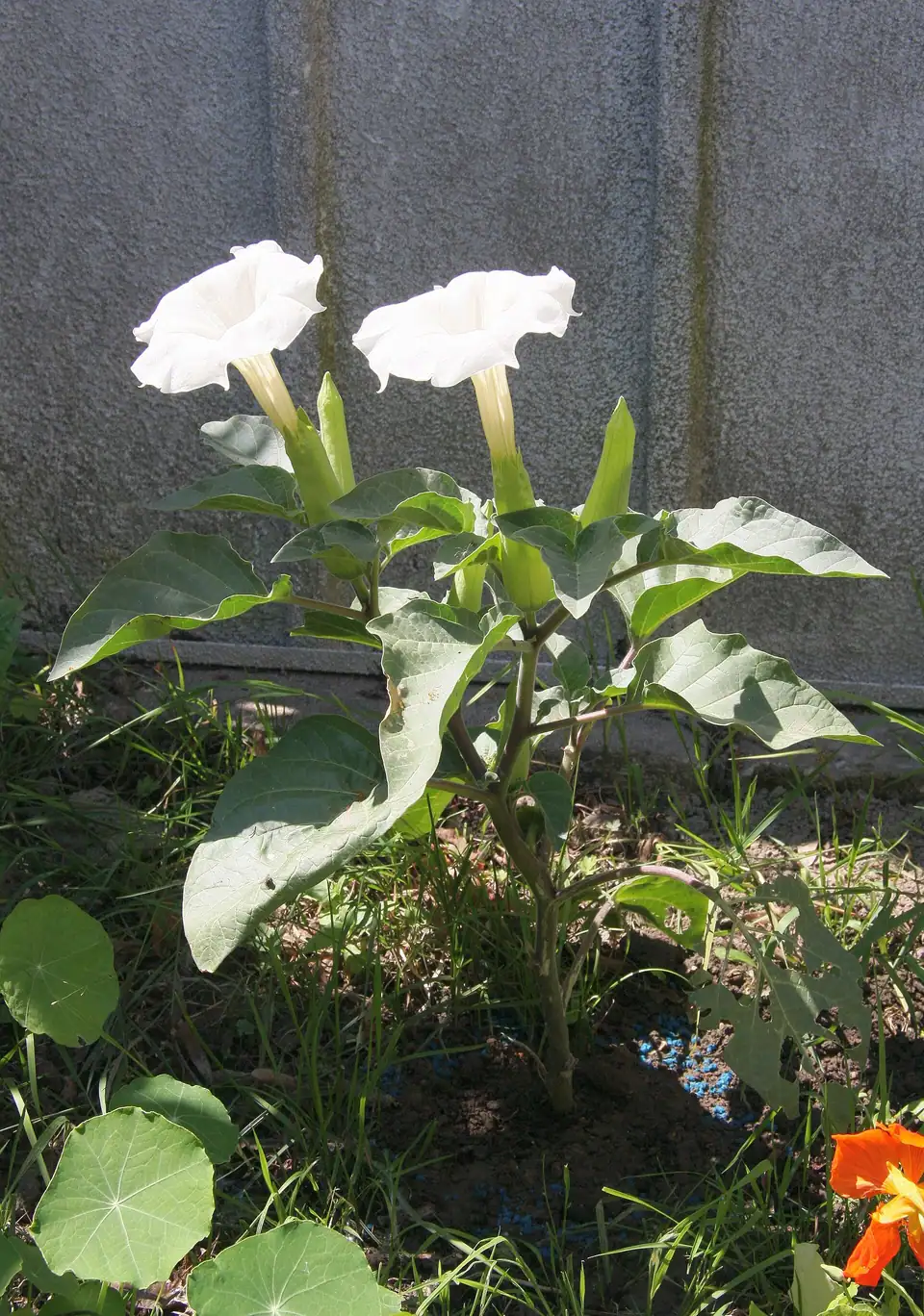


How to Grow and Care for Downy Thorn-Apple
Datura innoxia
Written by Emilio Marruso · last checked
Toxic to: Cats, Dogs, Horses, Cattle, People · Why
At a glance
This datura is a perennial that thrives in full sun or partial shade and fits right into a drought-tolerant garden. Start the seeds indoors 6 to 8 weeks before the last spring frost, set the young plants out once frost has passed, and watch them spread 3 to 6 feet wide. It grows in containers too, and you can save its seeds for next spring.
- Sun
Full sun to partial shade; it does poorly in full shade
What the sources say (1)
Light: Full sun to partial shade; does not do well in full shade
prefers rich, moist, well-drained soil and full sun to partial shade. It does not do well in full shade.
— Datura innoxia (Angel's Trumpet, Downy Thorn-Apple, Prickly Burr) | North Carolina Extension Gardener Plant Toolbox [1] - Water
Likes moist soil but suits a drought-tolerant garden
What the sources say (2)
Watering: Prefers rich, moist, well-drained soil; suited to a drought-tolerant garden
prefers rich, moist, well-drained soil and full sun to partial shade. It does not do well in full shade.
— Datura innoxia (Angel's Trumpet, Downy Thorn-Apple, Prickly Burr) | North Carolina Extension Gardener Plant Toolbox [1] Use in a container or the border of a night or drought-tolerant garden.
— Datura innoxia (Angel's Trumpet, Downy Thorn-Apple, Prickly Burr) | North Carolina Extension Gardener Plant Toolbox [1] - Cold
Survives winters down to 20 °F (−6.7 °C)
Hardy in average winters · USDA 9 · RHS H4 · Z9
What the sources say (3)
Hardiness, coldest zone: 9 [winter low −6.7 to −1.1 °C (20 to 30 °F)]
It is winter hardy to USDA Zone 9 to 10.
— Datura innoxia (Angel's Trumpet, Downy Thorn-Apple, Prickly Burr) | North Carolina Extension Gardener Plant Toolbox [1] Hardiness, warmest zone:
description text: NC State Extension: It is winter hardy to USDA Zone 9 to 10.
— Datura innoxia (Angel's Trumpet, Downy Thorn-Apple, Prickly Burr) | North Carolina Extension Gardener Plant Toolbox [1] hardiness zone list: NC State Extension: USDA Plant Hardiness Zone: 9a, 9b, 10a, 10b, 11a, 11b
— Datura innoxia (Angel's Trumpet, Downy Thorn-Apple, Prickly Burr) | North Carolina Extension Gardener Plant Toolbox [1] - Soil
Rich, moist soil that drains well
What the sources say (2)
Watering: Prefers rich, moist, well-drained soil; suited to a drought-tolerant garden
prefers rich, moist, well-drained soil and full sun to partial shade. It does not do well in full shade.
— Datura innoxia (Angel's Trumpet, Downy Thorn-Apple, Prickly Burr) | North Carolina Extension Gardener Plant Toolbox [1] Use in a container or the border of a night or drought-tolerant garden.
— Datura innoxia (Angel's Trumpet, Downy Thorn-Apple, Prickly Burr) | North Carolina Extension Gardener Plant Toolbox [1] - Spacing
3 ft between plants
What the sources say (1)
Spacing: 91.4 cm (3 ft)
Plants tend to sprawl and should be spaced about 3 feet apart or staked and supported.
— Datura innoxia (Angel's Trumpet, Downy Thorn-Apple, Prickly Burr) | North Carolina Extension Gardener Plant Toolbox [1] - Planting
Set plants out after the last spring frost
What the sources say (1)
Planting: Set plants out after the last spring frost
it can be started indoors from seeds about 6 to 8 weeks before the last spring frost and set plants out after that date.
— Datura innoxia (Angel's Trumpet, Downy Thorn-Apple, Prickly Burr) | North Carolina Extension Gardener Plant Toolbox [1] - Pests
Very prone to tomato-family viruses: keep it away from potatoes and tomatoes
What the sources say (1)
Diseases: viruses of the nightshade family
Extremely susceptible to the viruses that afflict the nightshade family (Solanaceae). Downy thorn-apple should not be grown near potatoes or tomatoes.
— Datura innoxia (Angel's Trumpet, Downy Thorn-Apple, Prickly Burr) | North Carolina Extension Gardener Plant Toolbox [1] - Watch out
Plants sprawl: give them 3 ft of room or stake and support them
What the sources say (1)
Spacing: 91.4 cm (3 ft)
Plants tend to sprawl and should be spaced about 3 feet apart or staked and supported.
— Datura innoxia (Angel's Trumpet, Downy Thorn-Apple, Prickly Burr) | North Carolina Extension Gardener Plant Toolbox [1] - Size
2–3 ft tall and 3–6 ft wide
What the sources say (2)
Mature height: 61-91 cm (2 ft 0 in - 3 ft 0 in)
Dimensions: Height: 2 ft. 0 in. - 3 ft. 0 in. Width: 3 ft. 0 in. - 6 ft. 0 in.
— Datura innoxia (Angel's Trumpet, Downy Thorn-Apple, Prickly Burr) | North Carolina Extension Gardener Plant Toolbox [1] Mature width: 91-183 cm (3 ft 0 in - 6 ft 0 in)
Dimensions: Height: 2 ft. 0 in. - 3 ft. 0 in. Width: 3 ft. 0 in. - 6 ft. 0 in.
— Datura innoxia (Angel's Trumpet, Downy Thorn-Apple, Prickly Burr) | North Carolina Extension Gardener Plant Toolbox [1] - Propagation
By seed; collect and save seeds to plant the following spring
What the sources say (2)
Propagation: Seed
Seeds can be collected and saved for planting in the following spring.
— Datura innoxia (Angel's Trumpet, Downy Thorn-Apple, Prickly Burr) | North Carolina Extension Gardener Plant Toolbox [1] Saving seeds: Seeds can be collected and saved for planting in the following spring.
Self-seeding may occur if the plants are not deadheaded. Seeds can be collected and saved for planting in the following spring.
— Datura innoxia (Angel's Trumpet, Downy Thorn-Apple, Prickly Burr) | North Carolina Extension Gardener Plant Toolbox [1] - Sowing
Sow indoors 6–8 weeks before the last spring frost
What the sources say (1)
Sowing: Start indoors from seed 6 to 8 weeks before the last spring frost
it can be started indoors from seeds about 6 to 8 weeks before the last spring frost and set plants out after that date.
— Datura innoxia (Angel's Trumpet, Downy Thorn-Apple, Prickly Burr) | North Carolina Extension Gardener Plant Toolbox [1] - Containers
Grows in containers too
What the sources say (1)
In containers: Yes
Use in a container or the border of a night or drought-tolerant garden.
— Datura innoxia (Angel's Trumpet, Downy Thorn-Apple, Prickly Burr) | North Carolina Extension Gardener Plant Toolbox [1] - Safety
Every part is extremely toxic if eaten; dangerous for children, dogs, cats, horses and cattle
Overview
Datura innoxia is a tender herbaceous perennial, often grown as an annual, native to the southwestern United States. [1] All parts of the plant are extremely toxic if consumed. [1] It prefers rich, moist, well-drained soil in full sun to partial shade. [1]
This record is incomplete: the sources we read do not cover every field yet.
Not yet covered by our sources: Pruning
Downy Thorn-Apple care
How to water Downy Thorn-Apple
Prefers rich, moist, well-drained soil; suited to a drought-tolerant garden
What the sources say (2)
prefers rich, moist, well-drained soil and full sun to partial shade. It does not do well in full shade.Use in a container or the border of a night or drought-tolerant garden.How much light Downy Thorn-Apple needs
Full sun to partial shade; does not do well in full shade
What the sources say (1)
prefers rich, moist, well-drained soil and full sun to partial shade. It does not do well in full shade.How much cold Downy Thorn-Apple can take
Hardiness, coldest zone
9 [winter low −6.7 to −1.1 °C (20 to 30 °F)]
What the sources say (1)
It is winter hardy to USDA Zone 9 to 10.Hardiness, warmest zone
The sources give different values depending on region, zone or growing conditions.
What each source says
description text: NC State Extension: 10 [winter low −1.1 to 4.4 °C (30 to 40 °F)]
hardiness zone list: NC State Extension: 11b [winter low 7.2 to 10 °C (45 to 50 °F)]
What the sources say (2)
description text: NC State Extension: It is winter hardy to USDA Zone 9 to 10.hardiness zone list: NC State Extension: USDA Plant Hardiness Zone:
9a, 9b, 10a, 10b, 11a, 11bWhere to grow Downy Thorn-Apple
In containers
Yes
What the sources say (1)
Use in a container or the border of a night or drought-tolerant garden.Spacing
91.4 cm (3 ft)
What the sources say (1)
Plants tend to sprawl and should be spaced about 3 feet apart or staked and supported.How to propagate Downy Thorn-Apple
Seed
What the sources say (1)
Seeds can be collected and saved for planting in the following spring.How to grow Downy Thorn-Apple
The plant
Life cycle
perennial
What the sources say (1)
Downy thorn-apple is a tender herbaceous perennial, often grown as an annual, with a 3 foot spread.Family
Solanaceae
What the sources say (1)
In its native environment of the Southwestern United States, It is a member of the nightshade family (Solanaceae).Mature height
61-91 cm (2 ft 0 in - 3 ft 0 in)
What the sources say (1)
Dimensions: Height: 2 ft. 0 in. - 3 ft. 0 in. Width: 3 ft. 0 in. - 6 ft. 0 in.Mature width
91-183 cm (3 ft 0 in - 6 ft 0 in)
What the sources say (1)
Dimensions: Height: 2 ft. 0 in. - 3 ft. 0 in. Width: 3 ft. 0 in. - 6 ft. 0 in.Harvest and storage
Saving seeds
Seeds can be collected and saved for planting in the following spring.
What the sources say (1)
Self-seeding may occur if the plants are not deadheaded. Seeds can be collected and saved for planting in the following spring.Pests and diseases
Diseases
viruses of the nightshade family
What the sources say (1)
Extremely susceptible to the viruses that afflict the nightshade family (Solanaceae). Downy thorn-apple should not be grown near potatoes or tomatoes.Downy Thorn-Apple pests and problems
Nightshade family viruses
Symptom: Extremely susceptible to the viruses that afflict the nightshade family (Solanaceae).
What to do: Should not be grown near potatoes or tomatoes.
What the sources say (1)
Extremely susceptible to the viruses that afflict the nightshade family (Solanaceae). Downy thorn-apple should not be grown near potatoes or tomatoes.
— Datura innoxia (Angel's Trumpet, Downy Thorn-Apple, Prickly Burr) | North Carolina Extension Gardener Plant Toolbox [1] Sprawling habit
Symptom: Plants tend to sprawl.
What to do: Space about 3 feet apart or stake and support.
What the sources say (1)
Plants tend to sprawl and should be spaced about 3 feet apart or staked and supported.
— Datura innoxia (Angel's Trumpet, Downy Thorn-Apple, Prickly Burr) | North Carolina Extension Gardener Plant Toolbox [1]
Remedies
Each remedy shows what official sources say about it; traditional remedies without an official source are marked as such. Harmful ones are listed so you know to avoid them.
Treating the plant
aphids
insecticidal soap spray Works
treat persistent colonies with insecticidal soap in the evening. Wear gloves – the sap is toxic.
— growplants.org [2] How: Dislodge with water, support ladybirds, lacewings and hoverflies, pinch out badly infested tips, and treat persistent colonies with insecticidal soap in the evening.
treat persistent colonies with insecticidal soap in the evening. Wear gloves – the sap is toxic.
— growplants.org [2] What the evidence says insecticidal soap is a safe, effective organic insecticide with minimal environmental impact.
— extension.psu.edu [3]
whiteflies
insecticidal soap spray Works
spraying home remedies that contain dish detergent on plants on a sunny day can injure the plant, essentially burning it.
— extension.psu.edu [4] How: Hang yellow sticky traps, introduce Encarsia parasitic wasps under cover, and spray insecticidal soap or horticultural oil on the undersides every few days.
spray insecticidal soap or horticultural oil on undersides every few days to break the cycle.
— growplants.org [2] What the evidence says insecticidal soap is a safe, effective organic insecticide with minimal environmental impact.
— extension.psu.edu [3]
spider mites
hosing down leaf undersides Not verified
Traditional remedy, not verified by an official source.
How: Raise humidity and hose down leaf undersides; keep the plant watered and unstressed.
hornworms
hand-picking into soapy water Not verified
Traditional remedy, not verified by an official source.
How: Hand-pick (wear gloves) and drop into soapy water; leave caterpillars carrying white cocoons.
leaf miners
picking off mined leaves Not verified
Traditional remedy, not verified by an official source.
How: Pick off and destroy mined leaves, keep the area weeded and use sticky traps for adult flies.
Getting rid of it
self-seeding
removing unwanted seedlings and spent pods Not verified
Traditional remedy, not verified by an official source.
wear gloves when handling cuttings, wash tools and hands afterward, and dispose of prunings – especially any seed pods – rather than composting them
— growplants.org [2] How: Remove unwanted seedlings or spent seed pods where naturalising is not wanted; dispose of pods rather than composting them.
Is Downy Thorn-Apple toxic to pets?
Reported by the source, quoted verbatim. This is not medical or veterinary advice: if a person or an animal may have eaten this plant, contact a poison control centre or a veterinarian.
Animals
#problem for dogs #problem for cats #problem for cattle #problem for children #problem for horses
[1]- Poisonous parts
All parts are extremely toxic if consumed. The
[1]
People
All parts are extremely toxic if consumed.
[1]- Poisonous parts
Poison Part: Flowers Leaves Stems Download Print-Friendly QR
[1]- Toxic principle
Contains several alkaloids, the most active of which is scopolamine.
[1]- Symptoms
All members of this genus contain narcotics and are very poisonous, even in small dose.
[1]- Severity
Poison Severity: High Poison Symptoms: All members of
[1]
Calendar
Sowing
Start indoors from seed 6 to 8 weeks before the last spring frost
What the sources say (1)
it can be started indoors from seeds about 6 to 8 weeks before the last spring frost and set plants out after that date.Planting
Set plants out after the last spring frost
What the sources say (1)
it can be started indoors from seeds about 6 to 8 weeks before the last spring frost and set plants out after that date.Pruning
Not stated in the sources we read.
Months as given by the sources, which are mostly from the United States (northern hemisphere). In the southern hemisphere they shift by about six months.
Relative to frost
Less precise estimate: there is no weather station within 300 km.
Find frost dates by ZIP code or city
Sow indoors: 6 to 8 weeks before the last frost
it can be started indoors from seeds about 6 to 8 weeks before the last spring frost and set plants out after that date.
— Datura innoxia (Angel's Trumpet, Downy Thorn-Apple, Prickly Burr) | North Carolina Extension Gardener Plant Toolbox [1] Transplant: around the last frost
it can be started indoors from seeds about 6 to 8 weeks before the last spring frost and set plants out after that date.
— Datura innoxia (Angel's Trumpet, Downy Thorn-Apple, Prickly Burr) | North Carolina Extension Gardener Plant Toolbox [1]
Count from the average frost dates where you live.
Similar plants
- Jimsonweed Datura stramonium
- Sacred Datura Datura wrightii
- Angel's Trumpet Datura metel
- Angel's-tears Brugmansia suaveolens
- Ashwagandha Withania somnifera
- Belladonna Atropa belladonna
- Bittersweet Solanum dulcamara
- Bladder cherry Alkekengi officinarum
Sources
Every value above is quoted from these documents. Links lead to the original publisher.
- Datura innoxia (Angel's Trumpet, Downy Thorn-Apple, Prickly Burr) | North Carolina Extension Gardener Plant Toolbox · plants.ces.ncsu.edu, consulted
- growplants.org · growplants.org
- extension.psu.edu · extension.psu.edu
- extension.psu.edu · extension.psu.edu
Written by Emilio Marruso · last checked