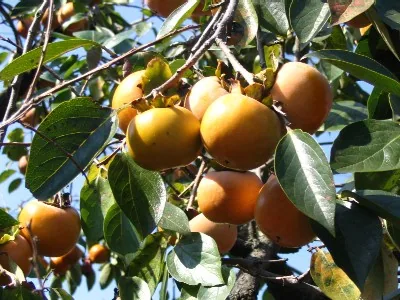


Cómo cultivar y cuidar Kaki
Diospyros kaki
Escrito por Emilio Marruso · última revisión
Tóxica para: Personas · Por qué
De un vistazo
El caqui es un árbol generoso: dale sol pleno, al menos 6 horas al día, y un suelo húmedo pero bien drenado, y dará fruto incluso sin otra variedad cerca. Sus frutos alargan la cosecha hasta bien entrado el otoño y pueden seguir en el árbol en invierno. Ten paciencia: los primeros caquis llegan a los 4–6 años y siguen madurando después de recogerlos.
- Sol
Sol pleno: al menos 6 horas al día
Qué dicen las fuentes (1)
Luz: Pleno sol (6 o más horas de luz solar directa al día)
Full sun (6 or more hours of direct sunlight a day)
— Diospyros kaki (Asian Persimmon, Japanese Persimmon, Kaki, Oriental Persimmon) | North Carolina Extension Gardener Plant Toolbox [1] - Riego
Mantén la tierra húmeda pero bien drenada; aguanta la sequía
Qué dicen las fuentes (2)
Riego: Suelo húmedo pero bien drenado; catalogada como tolerante a la sequía
The trees grow best in loamy, moist but well-drained soils with a pH of 6.0 to 6.5 in full sun but thrive on a wide range of soils.
— Diospyros kaki (Asian Persimmon, Japanese Persimmon, Kaki, Oriental Persimmon) | North Carolina Extension Gardener Plant Toolbox [1] #fruits fall #fruit tree #orange fruits #full sun tolerant #winter fruits #fall interest #drought tolerant
— Diospyros kaki (Asian Persimmon, Japanese Persimmon, Kaki, Oriental Persimmon) | North Carolina Extension Gardener Plant Toolbox [1] - Frío
Aguanta inviernos de hasta −17,8 °C (0 °F)
Rústica en inviernos muy fríos · USDA 7a · RHS H6 · Z7
Qué dicen las fuentes (2)
Rusticidad, zona más fría: 7a [mínima invernal de −17,8 a −15 °C (de 0 a 5 °F)]
7a, 7b, 8a, 8b, 9a, 9b, 10a, 10b
— Diospyros kaki (Asian Persimmon, Japanese Persimmon, Kaki, Oriental Persimmon) | North Carolina Extension Gardener Plant Toolbox [1] Rusticidad, zona más cálida: 10b [mínima invernal de 1,7 a 4,4 °C (de 35 a 40 °F)]
7a, 7b, 8a, 8b, 9a, 9b, 10a, 10b
— Diospyros kaki (Asian Persimmon, Japanese Persimmon, Kaki, Oriental Persimmon) | North Carolina Extension Gardener Plant Toolbox [1] - Suelo
Suelo ligeramente ácido, pH 6,0–6,5
Qué dicen las fuentes (2)
pH del suelo, mínimo: 6.0
The trees grow best in loamy, moist but well-drained soils with a pH of 6.0 to 6.5 in full sun but thrive on a wide range of soils.
— Diospyros kaki (Asian Persimmon, Japanese Persimmon, Kaki, Oriental Persimmon) | North Carolina Extension Gardener Plant Toolbox [1] pH del suelo, máximo: 6.5
The trees grow best in loamy, moist but well-drained soils with a pH of 6.0 to 6.5 in full sun but thrive on a wide range of soils.
— Diospyros kaki (Asian Persimmon, Japanese Persimmon, Kaki, Oriental Persimmon) | North Carolina Extension Gardener Plant Toolbox [1] - Abonado
Necesita poco abono; suele bastar el abonado normal del césped de alrededor
Qué dicen las fuentes (1)
Frecuencia: Se necesita poca fertilización; la fertilización normal del césped suele ser suficiente para un árbol en el paisaje.
Little fertilization is required. Normal lawn fertilization is usually adequate if the tree is growing in the landscape.
— How to Grow Persimmons in South Carolina | Home & Garden Information Center [6] - Poda
Poda los árboles adultos en invierno, no hace falta cada año; florece en las ramas del año
Qué dicen las fuentes (3)
Cuándo podar: Árboles maduros en invierno; no se requiere poda anual.
Prune mature plants during the winter. Remove crossover, shaded, diseased, and broken branches.
— [8] They have no serious insect or disease problems and they do not require annual pruning like some other deciduous fruit trees.
— Diospyros kaki (Asian Persimmon, Japanese Persimmon, Kaki, Oriental Persimmon) | North Carolina Extension Gardener Plant Toolbox [1] Madera que florece: Flores en madera nueva (el crecimiento de este año)
Persimmon fruit develops on branches that have grown in the current season.
— [8] - Cosecha
Primeros frutos a los 4–6 años, hasta bien entrado el otoño; siguen madurando tras recogerlos
Qué dicen las fuentes (5)
Años hasta el primer fruto: 4-6 años
Oriental persimmons need to be 4-6 years old before they start to bear fruit.
— Diospyros kaki (Asian Persimmon, Japanese Persimmon, Kaki, Oriental Persimmon) | North Carolina Extension Gardener Plant Toolbox [1] Cosecha: La fruta extiende la cosecha hasta finales del otoño y puede persistir hasta el invierno
With spectacular autumn foliage and fruit that extends the harvest late into the fall, they are an excellent addition to an edible landscape.
— Diospyros kaki (Asian Persimmon, Japanese Persimmon, Kaki, Oriental Persimmon) | North Carolina Extension Gardener Plant Toolbox [1] 3-4 inch orange fruit is globular/ oval. When cut in the middle, it has 8 lighter colored lines inside. May persist into winter.
— Diospyros kaki (Asian Persimmon, Japanese Persimmon, Kaki, Oriental Persimmon) | North Carolina Extension Gardener Plant Toolbox [1] Cómo cosechar: Los caquis continúan madurando después de ser recolectados; los tipos astringentes deben estar completamente blandos antes de comerlos, los tipos no astringentes son más firmes y se pueden comer antes de que se ablanden.
Persimmons will continue to ripen after they are picked from the tree.
— How to Grow Persimmons in South Carolina | Home & Garden Information Center [6] The astringent type should be completely soft before eating. The non-astringent types are firmer and can be eaten prior to softening.
— How to Grow Persimmons in South Carolina | Home & Garden Information Center [6] - Polinización
Da fruto solo, incluso sin semillas; otra variedad cerca aumenta la cosecha
Qué dicen las fuentes (4)
Qué necesita: No se requiere una segunda variedad para la formación de frutos, pero se recomienda para obtener mayores rendimientos; los árboles pueden producir frutos sin semillas sin polinización.
Regardless, planting more than one variety is recommended especially if large fruit yields is a goal but not required for fruit set.
— Diospyros kaki (Asian Persimmon, Japanese Persimmon, Kaki, Oriental Persimmon) | North Carolina Extension Gardener Plant Toolbox [1] Also, the trees are parthenocarpic which means they may set seedless fruit without pollination.
— Diospyros kaki (Asian Persimmon, Japanese Persimmon, Kaki, Oriental Persimmon) | North Carolina Extension Gardener Plant Toolbox [1] Lo transportan: No se necesita polinización.
cultivar 'Fuyu': “Fuyu” is parthenocarpic and sets fruit without need for pollination.
— Diospyros kaki “Fuyu”; Kaki, Japanese Persimmon, Oriental Persimmon [2] Also, the trees are parthenocarpic which means they may set seedless fruit without pollination.
— Diospyros kaki (Asian Persimmon, Japanese Persimmon, Kaki, Oriental Persimmon) | North Carolina Extension Gardener Plant Toolbox [1] - Plagas
Cochinillas, cochinilla algodonosa, barrenador del caqui y manchas en las hojas; revisa el tronco
Qué dicen las fuentes (4)
Plagas: cochinilla, cochinilla harinosa, psílido del caqui, orugas que enrollan hojas y defolian, barrenador del caqui
Insects, Diseases, and Other Plant Problems: Scale, mealybug and leaf spot can occur. Fruit drop can be messy.
— Diospyros kaki (Asian Persimmon, Japanese Persimmon, Kaki, Oriental Persimmon) | North Carolina Extension Gardener Plant Toolbox [1] Insect pests of persimmons include: - Scale - Persimmon psyllid - Leafrolling and defoliating caterpillars - Persimmon borer
— How to Grow Persimmons in South Carolina | Home & Garden Information Center [6] Enfermedades: mancha foliar, mancha foliar fúngica, muerte regresiva de ramas, mildiu polvoriento
Insects, Diseases, and Other Plant Problems: Scale, mealybug and leaf spot can occur. Fruit drop can be messy.
— Diospyros kaki (Asian Persimmon, Japanese Persimmon, Kaki, Oriental Persimmon) | North Carolina Extension Gardener Plant Toolbox [1] Persimmon diseases include: - Fungal leaf spot - Twig dieback - Powdery mildew
— How to Grow Persimmons in South Carolina | Home & Garden Information Center [6] - Atención
Quita pronto los chupones de raíz; la fruta caída ensucia, plántalo lejos de los paseos
- Tamaño
6–9 m de alto y 4,6–7,6 m de ancho
Qué dicen las fuentes (3)
Altura adulta: 610-914 cm (20 a 30 pies)
cultivar 'Fuyu': “Fuyu” is a Japanese clone and is described as mop-headed (mounded) trees seldom over 20 feet tall.
— Diospyros kaki “Fuyu”; Kaki, Japanese Persimmon, Oriental Persimmon [2] Height: 20 ft. 0 in. - 30 ft. 0 in. Width: 15 ft. 0 in. - 25 ft. 0 in.
— Diospyros kaki (Asian Persimmon, Japanese Persimmon, Kaki, Oriental Persimmon) | North Carolina Extension Gardener Plant Toolbox [1] Anchura adulta: 457-762 cm (15 a 25 pies)
Height: 20 ft. 0 in. - 30 ft. 0 in. Width: 15 ft. 0 in. - 25 ft. 0 in.
— Diospyros kaki (Asian Persimmon, Japanese Persimmon, Kaki, Oriental Persimmon) | North Carolina Extension Gardener Plant Toolbox [1] - Multiplicación
Por injerto o por semilla
Qué dicen las fuentes (1)
Propagación: Injerto, semilla
Recommended Propagation Strategy: Grafting Seed Country Or Region Of Origin:
— Diospyros kaki (Asian Persimmon, Japanese Persimmon, Kaki, Oriental Persimmon) | North Carolina Extension Gardener Plant Toolbox [1] - Maceta
Crece también en maceta
Qué dicen las fuentes (1)
En maceta: Sí
It can be used in mixed borders, as a small specimen in the vegetable garden or even grown in a large container.
— Diospyros kaki “Fuyu”; Kaki, Japanese Persimmon, Oriental Persimmon [2] - Seguridad
Come las variedades astringentes solo muy blandas: antes, sus taninos pueden sentarte mal
Resumen
Diospyros kaki es un árbol frutal de hoja caduca que crece mejor a pleno sol y en suelo húmedo y bien drenado. [1] Los caquis orientales pueden morir o dañarse por debajo de unos 10 grados F [−12 °C], por lo que en zonas más frías se eligen cultivares resistentes al frío. [6] La fruta de las variedades no astringentes se puede comer cruda, mientras que los tipos astringentes deben estar blandos antes de comerlos. [1][6]
Citado en inglés, como en la fuente.
Esta ficha está incompleta: las fuentes consultadas aún no cubren todos los campos.
Aún no cubierto por nuestras fuentes: Plantación, Distancia de plantación
Cuidados
Las medidas entre corchetes son nuestra conversión al otro sistema de unidades; el texto citado no cambia.
Riego
Suelo húmedo pero bien drenado; catalogada como tolerante a la sequía
Qué dicen las fuentes (2)
The trees grow best in loamy, moist but well-drained soils with a pH of 6.0 to 6.5 in full sun but thrive on a wide range of soils.#fruits fall #fruit tree #orange fruits #full sun tolerant #winter fruits #fall interest #drought tolerantLuz
Pleno sol (6 o más horas de luz solar directa al día)
Qué dicen las fuentes (1)
Full sun (6 or more hours of direct sunlight a day)Clima y frío
Rusticidad, zona más fría
7a [mínima invernal de −17,8 a −15 °C (de 0 a 5 °F)]
Qué dicen las fuentes (1)
7a, 7b, 8a, 8b, 9a, 9b, 10a, 10bRusticidad, zona más cálida
10b [mínima invernal de 1,7 a 4,4 °C (de 35 a 40 °F)]
Qué dicen las fuentes (1)
7a, 7b, 8a, 8b, 9a, 9b, 10a, 10bSuelo
pH del suelo, mínimo
6.0
Qué dicen las fuentes (1)
The trees grow best in loamy, moist but well-drained soils with a pH of 6.0 to 6.5 in full sun but thrive on a wide range of soils.pH del suelo, máximo
6.5
Qué dicen las fuentes (1)
The trees grow best in loamy, moist but well-drained soils with a pH of 6.0 to 6.5 in full sun but thrive on a wide range of soils.Dónde cultivarla
En maceta
Sí
Qué dicen las fuentes (1)
It can be used in mixed borders, as a small specimen in the vegetable
garden or even grown in a large container.Distancia de plantación
No figura en las fuentes consultadas.
Propagación
Injerto, semilla
Qué dicen las fuentes (1)
Recommended Propagation Strategy:
Grafting
Seed
Country Or Region Of Origin:Cultivo
La planta
Ciclo de vida
leñoso
Qué dicen las fuentes (1)
Life Cycle:
Woody
Recommended Propagation Strategy:
Grafting
Seed
Country Or Region Of Origin:Familia
Ebenaceae
Qué dicen las fuentes (1)
A deciduous tree from the Ebenaceae or ebony (non-fruit bearing) or persimmon (fruit bearing) family, it is native in Eastern Asia and India.Altura adulta
610-914 cm (20 a 30 pies)
Lo que dice cada fuente
cultivar 'Fuyu': rara vez supera los 610 cm (20 pies)
Qué dicen las fuentes (2)
cultivar 'Fuyu': “Fuyu” is a Japanese clone
and is described as mop-headed (mounded) trees seldom over 20 feet tall.Height: 20 ft. 0 in. - 30 ft. 0 in.
Width: 15 ft. 0 in. - 25 ft. 0 in.Anchura adulta
457-762 cm (15 a 25 pies)
Qué dicen las fuentes (1)
Height: 20 ft. 0 in. - 30 ft. 0 in.
Width: 15 ft. 0 in. - 25 ft. 0 in.Años hasta el primer fruto
4-6 años
Qué dicen las fuentes (1)
Oriental persimmons need to be 4-6 years old before they start to bear fruit.Cosecha y conservación
Cómo cosechar
Los caquis continúan madurando después de ser recolectados; los tipos astringentes deben estar completamente blandos antes de comerlos, los tipos no astringentes son más firmes y se pueden comer antes de que se ablanden.
Qué dicen las fuentes (2)
Persimmons will continue to ripen after they are picked from the tree.The astringent type should be completely soft before eating. The non-astringent types are firmer and can be eaten prior to softening.Plagas y enfermedades
Plagas
cochinilla, cochinilla harinosa, psílido del caqui, orugas que enrollan hojas y defolian, barrenador del caqui
Qué dicen las fuentes (2)
Insects, Diseases, and Other Plant Problems: Scale, mealybug and leaf spot can occur. Fruit drop can be messy.Insect pests of persimmons include:
- Scale
- Persimmon psyllid
- Leafrolling and defoliating caterpillars
- Persimmon borerEnfermedades
mancha foliar, mancha foliar fúngica, muerte regresiva de ramas, mildiu polvoriento
Qué dicen las fuentes (2)
Insects, Diseases, and Other Plant Problems: Scale, mealybug and leaf spot can occur. Fruit drop can be messy.Persimmon diseases include:
- Fungal leaf spot
- Twig dieback
- Powdery mildewAbonado
Frecuencia
Se necesita poca fertilización; la fertilización normal del césped suele ser suficiente para un árbol en el paisaje.
Qué dicen las fuentes (1)
Little fertilization is required. Normal lawn fertilization is usually adequate if the tree is growing in the landscape.Polinización
Cuajado
Qué necesita
No se requiere una segunda variedad para la formación de frutos, pero se recomienda para obtener mayores rendimientos; los árboles pueden producir frutos sin semillas sin polinización.
Qué dicen las fuentes (2)
Regardless, planting more than one variety is recommended especially if large fruit yields is a goal but not required for fruit set.Also, the trees are parthenocarpic which means they may set seedless fruit without pollination.Lo transportan
No se necesita polinización.
Lo que dice cada fuente
cultivar 'Fuyu': No se necesita polinización.
Qué dicen las fuentes (2)
cultivar 'Fuyu': “Fuyu” is parthenocarpic and sets fruit without need for pollination.Also, the trees are parthenocarpic which means they may set seedless fruit without pollination.Poda
Madera que florece
Flores en madera nueva (el crecimiento de este año)
Qué dicen las fuentes (1)
Persimmon fruit develops on branches that have grown in the current season.Cuándo podar
Árboles maduros en invierno; no se requiere poda anual.
Qué dicen las fuentes (2)
Prune mature plants during the winter. Remove crossover, shaded, diseased, and broken branches.They have no serious insect or disease problems and they do not require annual pruning like some other deciduous fruit trees.Frío invernal
Horas de frío
100–400 horas entre 0 y 7,2 °C [32–45 °F]
Lo que dice cada fuente
cultivo «Persimmon»: 100–400 horas
cultivo «Persimmon»: 200–400 horas
Qué dicen las fuentes (6)
cultivo «Persimmon»: Persimmon Chill hours: 100 to 400 Persimmons do well in all zones.cultivo «Persimmon»: Pecan 300–500 Persimmon 200–400 Plum 400–700 Pomegranate 100–200 Strawberry 200–400Persimmon Chill hours: 100 to 400 Persimmons do well in all zones.Pecan 300–500 Persimmon 200–400 Plum 400–700 Pomegranate 100–200 Strawberry 200–400Chill hours are accumulated from November through February when temperatures are between 32° and 45°F.Different models exist to estimate chilling. One model defines a chill hour as each hour below 45°F starting on October 1.Problemas
Cochinilla, cochinilla harinosa y mancha foliar
Síntoma: Pueden presentarse cochinilla, cochinilla harinosa y mancha foliar; la caída de fruta puede ser desordenada.
Qué hacer: Ubica el árbol lejos del tránsito peatonal; la fuente señala que no hay problemas graves de insectos o enfermedades.
Qué dicen las fuentes (2)
Scale, mealybug and leaf spot can occur. Fruit drop can be messy.
— Diospyros kaki (Asian Persimmon, Japanese Persimmon, Kaki, Oriental Persimmon) | North Carolina Extension Gardener Plant Toolbox [1] They have no serious insect or disease problems and they do not require annual pruning like some other deciduous fruit trees.
— Diospyros kaki (Asian Persimmon, Japanese Persimmon, Kaki, Oriental Persimmon) | North Carolina Extension Gardener Plant Toolbox [1] Chupones de raíz
Síntoma: Los árboles producen retoños de raíz.
Qué hacer: Quítalos rápidamente a menos que se desee un efecto naturalizado.
Qué dicen las fuentes (1)
However, they do produce root suckers. Remove promptly unless a naturalized effect is wanted.
— Diospyros kaki (Asian Persimmon, Japanese Persimmon, Kaki, Oriental Persimmon) | North Carolina Extension Gardener Plant Toolbox [1] Taladro del caqui
Síntoma: El daño por taladro puede notarse en el tronco o en las raíces expuestas.
Qué hacer: Vigila el barrenador del persimonio; si se observa daño en el tronco o en las raíces expuestas, puede ser necesario un tratamiento.
Qué dicen las fuentes (1)
It is important to monitor the persimmon borer. If borer damage is noted on the trunk or exposed roots, treatment may be required.
— How to Grow Persimmons in South Carolina | Home & Garden Information Center [6]
Remedios
Cada remedio indica qué dicen las fuentes oficiales; los remedios tradicionales sin fuente oficial aparecen marcados. Los perjudiciales están para que sepas evitarlos.
Cuidar la planta
orugas
Recolección manual de orugas. No verificado
Remedio tradicional, no verificado por una fuente oficial.
Cómo: Recoge las orugas a mano (usa guantes por si eres sensible) o poda las ramas muy infestadas; solo es necesario si un árbol joven pierde las hojas año tras año.
psílido del caqui
aceite hortícola Funciona
Minimize shearing or clipping of terminals during the growing season. Shearing stimulates new growth preferred by psyllids for feeding and egg laying.
— content.ces.ncsu.edu [11] Cómo: Los aceites hortícolas suprimen los psílidos del caqui adultos e inmaduros; la fuente también aconseja minimizar la poda de las puntas, que estimula el crecimiento nuevo que prefieren los psílidos.
Horticultural oils suppress adult and immature persimmon psyllids without leaving a toxic residue that might harm beneficial insects and mites.
— content.ces.ncsu.edu [11] Qué dicen las pruebas Horticultural oils suppress adult and immature persimmon psyllids without leaving a toxic residue that might harm beneficial insects and mites.
— content.ces.ncsu.edu [11]
antracnosis
Corta y quema las ramitas infectadas. No verificado
Remedio tradicional, no verificado por una fuente oficial.
Cómo: Al mismo tiempo que recoges la hojarasca caída en otoño, corta y quema las ramitas infectadas; riega temprano para que el follaje se seque rápido.
agalla de la corona
Protege el árbol de las heridas. No verificado
Remedio tradicional, no verificado por una fuente oficial.
Cómo: La agalla de la corona entra por cortes y heridas: ten cuidado con el desbrozador alrededor del árbol y poda cuando el árbol esté en reposo.
cochinillas harinosas
Introduce crisopas. No verificado
Remedio tradicional, no verificado por una fuente oficial.
Cómo: Los depredadores encontrarán su camino hacia el jardín por sí solos; los insectos benéficos como las crisopas también se pueden comprar e introducir.
cochinillas harinosas y cochinillas
Controla las hormigas. No verificado
Remedio tradicional, no verificado por una fuente oficial.
Cómo: La cochinilla y la escama asociadas con hormigas a veces pueden causar problemas; el control de hormigas generalmente resolverá estos problemas.
pájaros comiendo fruta
red de protección para pájaros No verificado
Remedio tradicional, no verificado por una fuente oficial.
Safe netting is either extremely fine so they can’t get their legs or wings wrapped up in the mesh or somewhat rigid so it doesn’t twist and trap the birds.
— gardenerspath.com [12] Cómo: Usa una red que sea extremadamente fina o algo rígida para que los pájaros no puedan enredarse.
Toxicidad
Según la fuente, citada textualmente. No es un consejo médico ni veterinario: si una persona o un animal pudo haber ingerido esta planta, contacta con un centro de toxicología o con un veterinario.
Astringent varieties can have adverse health effects caused by tannins and must be fully ripe (soft) or artificially treated to remove astringency.
[4]- Principio tóxico
Astringency in persimmon fruit is a sensation caused by tannins present in the flesh that can make the mouth feel dry, cause puckering, numb the tongue, and constrict the throat.
[4]- Síntomas
Astringency in persimmon fruit is a sensation caused by tannins present in the flesh that can make the mouth feel dry, cause puckering, numb the tongue, and constrict the throat.
[4]
Calendario
Plantación
No figura en las fuentes consultadas.
Cosecha
La fruta extiende la cosecha hasta finales del otoño y puede persistir hasta el invierno
Qué dicen las fuentes (2)
With spectacular autumn foliage and fruit that extends the harvest late into the fall, they are an excellent addition to an edible landscape.3-4 inch orange fruit is globular/ oval. When cut in the middle, it has 8 lighter colored lines inside. May persist into winter.Meses tal como los dan las fuentes, en su mayoría de Estados Unidos (hemisferio norte). En el hemisferio sur se desplazan unos seis meses.
Comestibilidad
Según la fuente, citada textualmente. No comas una planta basándote solo en esta página: los errores de identificación pueden ser peligrosos.
Fruits can be eaten raw or made into various dishes. Leaves can be used to make teas.
[1]Fruits can be eaten raw or made into various dishes. Leaves can be used to make teas.
[1]The astringent type should be completely soft before eating. The non-astringent types are firmer and can be eaten prior to softening.
[6]
Valores orientativos
Valores de una fuente secundaria, no comprobados palabra por palabra como el resto de esta página. Úselos como punto de partida.
- Horas de sol
- 8-10 horasValor orientativo, adáptalo a tu clima · Fuente secundaria
- Nivel de cuidado
- MedioValor orientativo, adáptalo a tu clima · Fuente secundaria
- Crecimiento
- AltaValor orientativo, adáptalo a tu clima · Fuente secundaria
- Poda
- Febrero, marzo, abrilValor orientativo, adáptalo a tu clima · Fuente secundaria
Plantas similares
- Date plum Diospyros lotus
- Caqui de Virginia Diospyros virginiana
- Abeto de Vancuver Abies grandis
- Abraham Trachystemon orientalis
- Bananero de Etiopía Ensete ventricosum
- Acacia longifolia Acacia longifolia
- Acanthus hungaricus Acanthus hungaricus
- Palma de aguja Yucca flaccida
Fuentes
Cada valor anterior se cita de estos documentos. Los enlaces llevan al editor original.
- Diospyros kaki (Asian Persimmon, Japanese Persimmon, Kaki, Oriental Persimmon) | North Carolina Extension Gardener Plant Toolbox · plants.ces.ncsu.edu, consultado
- Diospyros kaki “Fuyu”; Kaki, Japanese Persimmon, Oriental Persimmon · uaex.uada.edu, consultado
- Asian Persimmon - Diospyros kaki | North Carolina Extension Gardener Plant Toolbox · plants.ces.ncsu.edu, consultado
- Ask IFAS: Topic - Persimmons · ask.ifas.ufl.edu, consultado
- Native Persimmon in the Garden and the Kitchen · extension.psu.edu, consultado
- How to Grow Persimmons in South Carolina | Home & Garden Information Center · hgic.clemson.edu, consultado
- hgic.clemson.edu · hgic.clemson.edu
- agrilifeextension.tamu.edu · agrilifeextension.tamu.edu
- escholarship.org · escholarship.org
- extension.msstate.edu · extension.msstate.edu
- content.ces.ncsu.edu · content.ces.ncsu.edu
- gardenerspath.com · gardenerspath.com
Escrito por Emilio Marruso · última revisión