

How to Grow and Care for Japanese persimmon
Diospyros kaki
Written by Emilio Marruso · last checked
Toxic to: People · Why
At a glance
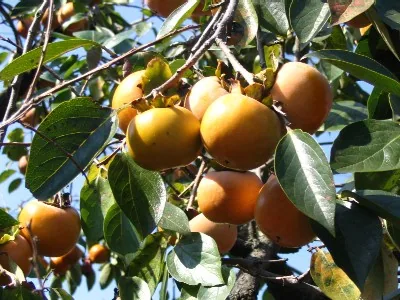
Persimmon is a generous tree: give it full sun, at least 6 hours a day, and moist but well-drained soil, and it sets fruit even without a second variety. The fruit stretches the harvest late into fall and may hang on into winter. Be patient: the first persimmons arrive after 4–6 years, and they keep ripening after you pick them.
- Sun
Full sun: at least 6 hours a day
What the sources say (1)
Light: Full sun (6 or more hours of direct sunlight a day)
Full sun (6 or more hours of direct sunlight a day)
— Diospyros kaki (Asian Persimmon, Japanese Persimmon, Kaki, Oriental Persimmon) | North Carolina Extension Gardener Plant Toolbox [1] - Water
Keep the soil moist but well drained; it handles dry spells
What the sources say (2)
Watering: Moist but well-drained soil; listed as drought tolerant
The trees grow best in loamy, moist but well-drained soils with a pH of 6.0 to 6.5 in full sun but thrive on a wide range of soils.
— Diospyros kaki (Asian Persimmon, Japanese Persimmon, Kaki, Oriental Persimmon) | North Carolina Extension Gardener Plant Toolbox [1] #fruits fall #fruit tree #orange fruits #full sun tolerant #winter fruits #fall interest #drought tolerant
— Diospyros kaki (Asian Persimmon, Japanese Persimmon, Kaki, Oriental Persimmon) | North Carolina Extension Gardener Plant Toolbox [1] - Cold
Survives winters down to 0 °F (−17.8 °C)
Hardy in very cold winters · USDA 7a · RHS H6 · Z7
What the sources say (2)
Hardiness, coldest zone: 7a [winter low −17.8 to −15 °C (0 to 5 °F)]
7a, 7b, 8a, 8b, 9a, 9b, 10a, 10b
— Diospyros kaki (Asian Persimmon, Japanese Persimmon, Kaki, Oriental Persimmon) | North Carolina Extension Gardener Plant Toolbox [1] Hardiness, warmest zone: 10b [winter low 1.7 to 4.4 °C (35 to 40 °F)]
7a, 7b, 8a, 8b, 9a, 9b, 10a, 10b
— Diospyros kaki (Asian Persimmon, Japanese Persimmon, Kaki, Oriental Persimmon) | North Carolina Extension Gardener Plant Toolbox [1] - Soil
Slightly acidic soil, pH 6.0–6.5
What the sources say (2)
Soil pH, minimum: 6.0
The trees grow best in loamy, moist but well-drained soils with a pH of 6.0 to 6.5 in full sun but thrive on a wide range of soils.
— Diospyros kaki (Asian Persimmon, Japanese Persimmon, Kaki, Oriental Persimmon) | North Carolina Extension Gardener Plant Toolbox [1] Soil pH, maximum: 6.5
The trees grow best in loamy, moist but well-drained soils with a pH of 6.0 to 6.5 in full sun but thrive on a wide range of soils.
— Diospyros kaki (Asian Persimmon, Japanese Persimmon, Kaki, Oriental Persimmon) | North Carolina Extension Gardener Plant Toolbox [1] - Feeding
Needs little feeding; regular lawn fertilizer nearby is usually enough
What the sources say (1)
How often: Little fertilization needed; normal lawn fertilization is usually enough for a tree in the landscape
Little fertilization is required. Normal lawn fertilization is usually adequate if the tree is growing in the landscape.
— How to Grow Persimmons in South Carolina | Home & Garden Information Center [6] - Pruning
Prune grown trees in winter, not every year; it flowers on this year's new growth
What the sources say (3)
When to prune: Mature trees in winter; annual pruning is not required.
Prune mature plants during the winter. Remove crossover, shaded, diseased, and broken branches.
— [8] They have no serious insect or disease problems and they do not require annual pruning like some other deciduous fruit trees.
— Diospyros kaki (Asian Persimmon, Japanese Persimmon, Kaki, Oriental Persimmon) | North Carolina Extension Gardener Plant Toolbox [1] Flowering wood: Flowers on new wood (this year's growth)
Persimmon fruit develops on branches that have grown in the current season.
— [8] - Harvest
First fruit in 4–6 years, picked late into fall; it keeps ripening after picking
What the sources say (5)
Years to first fruit: 4-6 years
Oriental persimmons need to be 4-6 years old before they start to bear fruit.
— Diospyros kaki (Asian Persimmon, Japanese Persimmon, Kaki, Oriental Persimmon) | North Carolina Extension Gardener Plant Toolbox [1] Harvest: Fruit extends the harvest late into the fall and may persist into winter
With spectacular autumn foliage and fruit that extends the harvest late into the fall, they are an excellent addition to an edible landscape.
— Diospyros kaki (Asian Persimmon, Japanese Persimmon, Kaki, Oriental Persimmon) | North Carolina Extension Gardener Plant Toolbox [1] 3-4 inch orange fruit is globular/ oval. When cut in the middle, it has 8 lighter colored lines inside. May persist into winter.
— Diospyros kaki (Asian Persimmon, Japanese Persimmon, Kaki, Oriental Persimmon) | North Carolina Extension Gardener Plant Toolbox [1] How to harvest: Persimmons continue to ripen after they are picked; astringent types must be completely soft before eating, non-astringent types are firmer and can be eaten before softening.
Persimmons will continue to ripen after they are picked from the tree.
— How to Grow Persimmons in South Carolina | Home & Garden Information Center [6] The astringent type should be completely soft before eating. The non-astringent types are firmer and can be eaten prior to softening.
— How to Grow Persimmons in South Carolina | Home & Garden Information Center [6] - Pollination
Fruits on its own, even seedless; a second variety gives bigger crops
What the sources say (4)
What it needs: A second variety is not required for fruit set, but it is recommended for larger yields; the trees can set seedless fruit without pollination.
Regardless, planting more than one variety is recommended especially if large fruit yields is a goal but not required for fruit set.
— Diospyros kaki (Asian Persimmon, Japanese Persimmon, Kaki, Oriental Persimmon) | North Carolina Extension Gardener Plant Toolbox [1] Also, the trees are parthenocarpic which means they may set seedless fruit without pollination.
— Diospyros kaki (Asian Persimmon, Japanese Persimmon, Kaki, Oriental Persimmon) | North Carolina Extension Gardener Plant Toolbox [1] Carried by: No pollination needed
cultivar 'Fuyu': “Fuyu” is parthenocarpic and sets fruit without need for pollination.
— Diospyros kaki “Fuyu”; Kaki, Japanese Persimmon, Oriental Persimmon [2] Also, the trees are parthenocarpic which means they may set seedless fruit without pollination.
— Diospyros kaki (Asian Persimmon, Japanese Persimmon, Kaki, Oriental Persimmon) | North Carolina Extension Gardener Plant Toolbox [1] - Pests
Scale, mealybugs, persimmon borer and leaf spot; check the trunk for borer damage
What the sources say (4)
Pests: scale, mealybug, persimmon psyllid, leafrolling and defoliating caterpillars, persimmon borer
Insects, Diseases, and Other Plant Problems: Scale, mealybug and leaf spot can occur. Fruit drop can be messy.
— Diospyros kaki (Asian Persimmon, Japanese Persimmon, Kaki, Oriental Persimmon) | North Carolina Extension Gardener Plant Toolbox [1] Insect pests of persimmons include: - Scale - Persimmon psyllid - Leafrolling and defoliating caterpillars - Persimmon borer
— How to Grow Persimmons in South Carolina | Home & Garden Information Center [6] Diseases: leaf spot, fungal leaf spot, twig dieback, powdery mildew
Insects, Diseases, and Other Plant Problems: Scale, mealybug and leaf spot can occur. Fruit drop can be messy.
— Diospyros kaki (Asian Persimmon, Japanese Persimmon, Kaki, Oriental Persimmon) | North Carolina Extension Gardener Plant Toolbox [1] Persimmon diseases include: - Fungal leaf spot - Twig dieback - Powdery mildew
— How to Grow Persimmons in South Carolina | Home & Garden Information Center [6] - Watch out
Pull root suckers promptly; fallen fruit is messy, so plant it away from paths
- Size
20–30 ft tall and 15–25 ft wide
What the sources say (3)
Mature height: 610-914 cm (20 to 30 ft)
cultivar 'Fuyu': “Fuyu” is a Japanese clone and is described as mop-headed (mounded) trees seldom over 20 feet tall.
— Diospyros kaki “Fuyu”; Kaki, Japanese Persimmon, Oriental Persimmon [2] Height: 20 ft. 0 in. - 30 ft. 0 in. Width: 15 ft. 0 in. - 25 ft. 0 in.
— Diospyros kaki (Asian Persimmon, Japanese Persimmon, Kaki, Oriental Persimmon) | North Carolina Extension Gardener Plant Toolbox [1] Mature width: 457-762 cm (15 to 25 ft)
Height: 20 ft. 0 in. - 30 ft. 0 in. Width: 15 ft. 0 in. - 25 ft. 0 in.
— Diospyros kaki (Asian Persimmon, Japanese Persimmon, Kaki, Oriental Persimmon) | North Carolina Extension Gardener Plant Toolbox [1] - Propagation
By grafting or from seed
What the sources say (1)
Propagation: Grafting, seed
Recommended Propagation Strategy: Grafting Seed Country Or Region Of Origin:
— Diospyros kaki (Asian Persimmon, Japanese Persimmon, Kaki, Oriental Persimmon) | North Carolina Extension Gardener Plant Toolbox [1] - Containers
Grows in containers too
What the sources say (1)
In containers: Yes
It can be used in mixed borders, as a small specimen in the vegetable garden or even grown in a large container.
— Diospyros kaki “Fuyu”; Kaki, Japanese Persimmon, Oriental Persimmon [2] - Safety
Eat astringent kinds only when fully soft: before that, their tannins can make you ill
Overview
Diospyros kaki is a deciduous fruit tree that grows best in full sun and moist, well-drained soil. [1] Oriental persimmons may be killed or injured below about 10 degrees F [−12 °C], so cold-hardy cultivars are chosen in cooler areas. [6] Fruit from non-astringent varieties can be eaten raw, while astringent types must be soft before eating. [1][6]
This record is incomplete: the sources we read do not cover every field yet.
Not yet covered by our sources: Planting, Spacing
Japanese persimmon care
Measurements in square brackets are our conversion into the other unit system; the quoted text is unchanged.
How to water Japanese persimmon
Moist but well-drained soil; listed as drought tolerant
What the sources say (2)
The trees grow best in loamy, moist but well-drained soils with a pH of 6.0 to 6.5 in full sun but thrive on a wide range of soils.#fruits fall #fruit tree #orange fruits #full sun tolerant #winter fruits #fall interest #drought tolerantHow much light Japanese persimmon needs
Full sun (6 or more hours of direct sunlight a day)
What the sources say (1)
Full sun (6 or more hours of direct sunlight a day)How much cold Japanese persimmon can take
Hardiness, coldest zone
7a [winter low −17.8 to −15 °C (0 to 5 °F)]
What the sources say (1)
7a, 7b, 8a, 8b, 9a, 9b, 10a, 10bHardiness, warmest zone
10b [winter low 1.7 to 4.4 °C (35 to 40 °F)]
What the sources say (1)
7a, 7b, 8a, 8b, 9a, 9b, 10a, 10bBest soil for Japanese persimmon
Soil pH, minimum
6.0
What the sources say (1)
The trees grow best in loamy, moist but well-drained soils with a pH of 6.0 to 6.5 in full sun but thrive on a wide range of soils.Soil pH, maximum
6.5
What the sources say (1)
The trees grow best in loamy, moist but well-drained soils with a pH of 6.0 to 6.5 in full sun but thrive on a wide range of soils.Where to grow Japanese persimmon
In containers
Yes
What the sources say (1)
It can be used in mixed borders, as a small specimen in the vegetable
garden or even grown in a large container.Spacing
Not stated in the sources we read.
How to propagate Japanese persimmon
Grafting, seed
What the sources say (1)
Recommended Propagation Strategy:
Grafting
Seed
Country Or Region Of Origin:How to grow Japanese persimmon
The plant
Life cycle
woody
What the sources say (1)
Life Cycle:
Woody
Recommended Propagation Strategy:
Grafting
Seed
Country Or Region Of Origin:Family
Ebenaceae
What the sources say (1)
A deciduous tree from the Ebenaceae or ebony (non-fruit bearing) or persimmon (fruit bearing) family, it is native in Eastern Asia and India.Mature height
610-914 cm (20 to 30 ft)
What each source says
cultivar 'Fuyu': seldom over 610 cm (20 ft)
What the sources say (2)
cultivar 'Fuyu': “Fuyu” is a Japanese clone
and is described as mop-headed (mounded) trees seldom over 20 feet tall.Height: 20 ft. 0 in. - 30 ft. 0 in.
Width: 15 ft. 0 in. - 25 ft. 0 in.Mature width
457-762 cm (15 to 25 ft)
What the sources say (1)
Height: 20 ft. 0 in. - 30 ft. 0 in.
Width: 15 ft. 0 in. - 25 ft. 0 in.Years to first fruit
4-6 years
What the sources say (1)
Oriental persimmons need to be 4-6 years old before they start to bear fruit.Harvest and storage
How to harvest
Persimmons continue to ripen after they are picked; astringent types must be completely soft before eating, non-astringent types are firmer and can be eaten before softening.
What the sources say (2)
Persimmons will continue to ripen after they are picked from the tree.The astringent type should be completely soft before eating. The non-astringent types are firmer and can be eaten prior to softening.Pests and diseases
Pests
scale, mealybug, persimmon psyllid, leafrolling and defoliating caterpillars, persimmon borer
What the sources say (2)
Insects, Diseases, and Other Plant Problems: Scale, mealybug and leaf spot can occur. Fruit drop can be messy.Insect pests of persimmons include:
- Scale
- Persimmon psyllid
- Leafrolling and defoliating caterpillars
- Persimmon borerDiseases
leaf spot, fungal leaf spot, twig dieback, powdery mildew
What the sources say (2)
Insects, Diseases, and Other Plant Problems: Scale, mealybug and leaf spot can occur. Fruit drop can be messy.Persimmon diseases include:
- Fungal leaf spot
- Twig dieback
- Powdery mildewFertilizing
How often
Little fertilization needed; normal lawn fertilization is usually enough for a tree in the landscape
What the sources say (1)
Little fertilization is required. Normal lawn fertilization is usually adequate if the tree is growing in the landscape.Pollination
Fruit set
What it needs
A second variety is not required for fruit set, but it is recommended for larger yields; the trees can set seedless fruit without pollination.
What the sources say (2)
Regardless, planting more than one variety is recommended especially if large fruit yields is a goal but not required for fruit set.Also, the trees are parthenocarpic which means they may set seedless fruit without pollination.Carried by
No pollination needed
What each source says
cultivar 'Fuyu': No pollination needed
What the sources say (2)
cultivar 'Fuyu': “Fuyu” is parthenocarpic and sets fruit without need for pollination.Also, the trees are parthenocarpic which means they may set seedless fruit without pollination.Pruning
Flowering wood
Flowers on new wood (this year's growth)
What the sources say (1)
Persimmon fruit develops on branches that have grown in the current season.When to prune
Mature trees in winter; annual pruning is not required.
What the sources say (2)
Prune mature plants during the winter. Remove crossover, shaded, diseased, and broken branches.They have no serious insect or disease problems and they do not require annual pruning like some other deciduous fruit trees.Winter chill
Chill hours
100–400 hours between 0 and 7.2 °C [32–45 °F]
What each source says
coltura «Persimmon»: 100–400 hours
coltura «Persimmon»: 200–400 hours
What the sources say (6)
coltura «Persimmon»: Persimmon Chill hours: 100 to 400 Persimmons do well in all zones.coltura «Persimmon»: Pecan 300–500 Persimmon 200–400 Plum 400–700 Pomegranate 100–200 Strawberry 200–400Persimmon Chill hours: 100 to 400 Persimmons do well in all zones.Pecan 300–500 Persimmon 200–400 Plum 400–700 Pomegranate 100–200 Strawberry 200–400Chill hours are accumulated from November through February when temperatures are between 32° and 45°F.Different models exist to estimate chilling. One model defines a chill hour as each hour below 45°F starting on October 1.Japanese persimmon pests and problems
Scale, mealybug and leaf spot
Symptom: Scale, mealybug and leaf spot can occur; fruit drop can be messy.
What to do: Site the tree away from foot traffic; the source notes no serious insect or disease problems.
What the sources say (2)
Scale, mealybug and leaf spot can occur. Fruit drop can be messy.
— Diospyros kaki (Asian Persimmon, Japanese Persimmon, Kaki, Oriental Persimmon) | North Carolina Extension Gardener Plant Toolbox [1] They have no serious insect or disease problems and they do not require annual pruning like some other deciduous fruit trees.
— Diospyros kaki (Asian Persimmon, Japanese Persimmon, Kaki, Oriental Persimmon) | North Carolina Extension Gardener Plant Toolbox [1] Root suckers
Symptom: The trees produce root suckers.
What to do: Remove promptly unless a naturalized effect is wanted.
What the sources say (1)
However, they do produce root suckers. Remove promptly unless a naturalized effect is wanted.
— Diospyros kaki (Asian Persimmon, Japanese Persimmon, Kaki, Oriental Persimmon) | North Carolina Extension Gardener Plant Toolbox [1] Persimmon borer
Symptom: Borer damage may be noted on the trunk or exposed roots.
What to do: Monitor the persimmon borer; if damage is noted on the trunk or exposed roots, treatment may be required.
What the sources say (1)
It is important to monitor the persimmon borer. If borer damage is noted on the trunk or exposed roots, treatment may be required.
— How to Grow Persimmons in South Carolina | Home & Garden Information Center [6]
Remedies
Each remedy shows what official sources say about it; traditional remedies without an official source are marked as such. Harmful ones are listed so you know to avoid them.
Treating the plant
caterpillars
hand-picking caterpillars Not verified
Traditional remedy, not verified by an official source.
How: Hand-pick the caterpillars (wear gloves in case you are sensitive) or prune off heavily infested branches; only needed if a young tree is defoliated year after year.
persimmon psyllid
horticultural oil Works
Minimize shearing or clipping of terminals during the growing season. Shearing stimulates new growth preferred by psyllids for feeding and egg laying.
— content.ces.ncsu.edu [11] How: Horticultural oils suppress adult and immature persimmon psyllids; the source also advises minimizing shearing of terminals, which stimulates the new growth psyllids prefer.
Horticultural oils suppress adult and immature persimmon psyllids without leaving a toxic residue that might harm beneficial insects and mites.
— content.ces.ncsu.edu [11] What the evidence says Horticultural oils suppress adult and immature persimmon psyllids without leaving a toxic residue that might harm beneficial insects and mites.
— content.ces.ncsu.edu [11]
anthracnose
cutting out and burning infected twigs Not verified
Traditional remedy, not verified by an official source.
How: At the same time as picking up fallen leaf litter in autumn, cut out and burn infected twigs; water early so the foliage dries quickly.
crown gall
protecting the tree from wounds Not verified
Traditional remedy, not verified by an official source.
How: Crown gall enters through cuts and wounds: be careful with the weed whacker around the tree and prune when the tree is dormant.
mealybugs
introducing lacewings Not verified
Traditional remedy, not verified by an official source.
How: Predators will find their way into the garden on their own; beneficial insects such as lacewings can also be purchased and introduced.
mealybugs and scale
controlling ants Not verified
Traditional remedy, not verified by an official source.
How: Mealybug and scale in association with ants can sometimes cause problems; ant control will usually take care of these pests.
birds eating fruit
bird-safe netting Not verified
Traditional remedy, not verified by an official source.
Safe netting is either extremely fine so they can’t get their legs or wings wrapped up in the mesh or somewhat rigid so it doesn’t twist and trap the birds.
— gardenerspath.com [12] How: Use netting that is either extremely fine or somewhat rigid so birds cannot get tangled.
Is Japanese persimmon poisonous?
Reported by the source, quoted verbatim. This is not medical or veterinary advice: if a person or an animal may have eaten this plant, contact a poison control centre or a veterinarian.
Astringent varieties can have adverse health effects caused by tannins and must be fully ripe (soft) or artificially treated to remove astringency.
[4]- Toxic principle
Astringency in persimmon fruit is a sensation caused by tannins present in the flesh that can make the mouth feel dry, cause puckering, numb the tongue, and constrict the throat.
[4]- Symptoms
Astringency in persimmon fruit is a sensation caused by tannins present in the flesh that can make the mouth feel dry, cause puckering, numb the tongue, and constrict the throat.
[4]
Calendar
Planting
Not stated in the sources we read.
Harvest
Fruit extends the harvest late into the fall and may persist into winter
What the sources say (2)
With spectacular autumn foliage and fruit that extends the harvest late into the fall, they are an excellent addition to an edible landscape.3-4 inch orange fruit is globular/ oval. When cut in the middle, it has 8 lighter colored lines inside. May persist into winter.Months as given by the sources, which are mostly from the United States (northern hemisphere). In the southern hemisphere they shift by about six months.
Edibility
Reported by the source, quoted verbatim. Do not eat a plant on the basis of this page alone: identification mistakes can be dangerous.
Fruits can be eaten raw or made into various dishes. Leaves can be used to make teas.
[1]Fruits can be eaten raw or made into various dishes. Leaves can be used to make teas.
[1]The astringent type should be completely soft before eating. The non-astringent types are firmer and can be eaten prior to softening.
[6]
Indicative values
Values from a secondary source, not checked word for word like the rest of this page. Use them as a starting point.
- Hours of sun
- 8-10 hoursIndicative value, adapt it to your climate · Secondary source
- Care level
- MediumIndicative value, adapt it to your climate · Secondary source
- Growth rate
- HighIndicative value, adapt it to your climate · Secondary source
- Pruning
- February, March, AprilIndicative value, adapt it to your climate · Secondary source
Similar plants
- Date plum Diospyros lotus
- Persimmon Diospyros virginiana
- Abies grandis Abies grandis
- Abraham Trachystemon orientalis
- Abyssinian banana Ensete ventricosum
- Acacia longifolia Acacia longifolia
- Acanthus hungaricus Acanthus hungaricus
- Adam's Needle Yucca flaccida
Sources
Every value above is quoted from these documents. Links lead to the original publisher.
- Diospyros kaki (Asian Persimmon, Japanese Persimmon, Kaki, Oriental Persimmon) | North Carolina Extension Gardener Plant Toolbox · plants.ces.ncsu.edu, consulted
- Diospyros kaki “Fuyu”; Kaki, Japanese Persimmon, Oriental Persimmon · uaex.uada.edu, consulted
- Asian Persimmon - Diospyros kaki | North Carolina Extension Gardener Plant Toolbox · plants.ces.ncsu.edu, consulted
- Ask IFAS: Topic - Persimmons · ask.ifas.ufl.edu, consulted
- Native Persimmon in the Garden and the Kitchen · extension.psu.edu, consulted
- How to Grow Persimmons in South Carolina | Home & Garden Information Center · hgic.clemson.edu, consulted
- hgic.clemson.edu · hgic.clemson.edu
- agrilifeextension.tamu.edu · agrilifeextension.tamu.edu
- escholarship.org · escholarship.org
- extension.msstate.edu · extension.msstate.edu
- content.ces.ncsu.edu · content.ces.ncsu.edu
- gardenerspath.com · gardenerspath.com
Written by Emilio Marruso · last checked