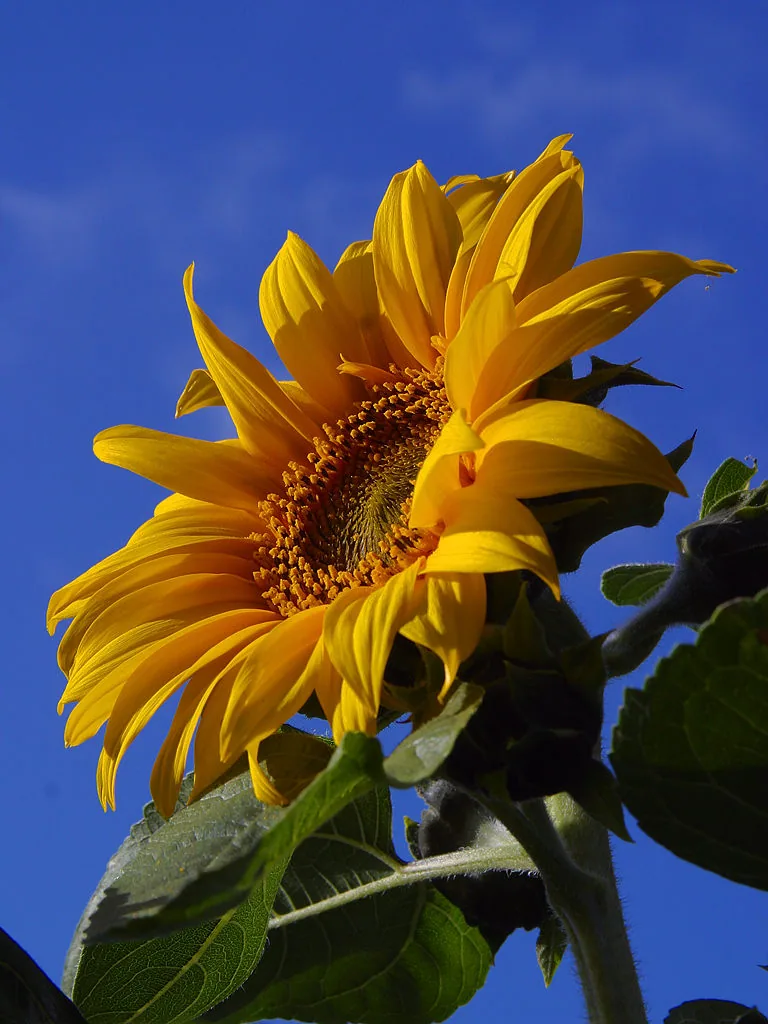


Cómo cultivar y cuidar Girasol
Helianthus annuus
Escrito por Emilio Marruso · última revisión
De un vistazo
El girasol es una de las flores más fáciles de cultivar a partir de semilla: siémbralo directamente en tierra templada tras la última helada y en solo 4–5 días verás brotar las plántulas. Dale sol pleno y riego regular, y podrá alcanzar de 46 cm a 3 m de alto. Después llega el premio: semillas y pétalos comestibles, y botones tiernos que se cocinan al vapor como alcachofas.
- Sol
Sol pleno: 6 horas o más al día
Qué dicen las fuentes (1)
Luz: Pleno sol (6 o más horas de luz solar directa al día)
Full sun (6 or more hours of direct sunlight a day)
— Helianthus annuus (Comb Flower, Common Sunflower, Golden Flower of Peru, Kansas Sunflower, Sunflower, Wild Sunflower) | North Carolina Extension Gardener Plant Toolbox [1] - Riego
El riego regular da más flores y semillas; mantén la tierra húmeda hasta que germinen
Qué dicen las fuentes (4)
Riego: Tolerante a la sequía una vez establecida; el riego regular da la mejor floración y producción de semillas.
Sunflowers are drought-tolerant once the plants have an established root system. Flowering and seed production will be best when the plant receives regular watering.
— Grow your own sunflowers | OSU Extension Service [4] Notas sobre el riego: Mantén la tierra húmeda hasta que las semillas hayan germinado; las plantaciones en contenedores necesitan riego más a menudo que las plantaciones en tierra; asegura agua adecuada durante las olas de calor para reducir la quemadura del sol en las hojas.
Plant seeds about 1 inch deep and keep the soil moist until the seeds have germinated.
— Grow your own sunflowers | OSU Extension Service [4] You will need to irrigate containers more frequently than in-ground plantings.
— Grow your own sunflowers | OSU Extension Service [4] To reduce the risk, make sure plants receive adequate water during heatwaves.
— Grow your own sunflowers | OSU Extension Service [4] - Frío
Siembra solo tras la última helada de primavera; cosecha las semillas antes de la primera helada de otoño
Qué dicen las fuentes (11)
Siembra: Siembra directamente después de la última helada cuando la temperatura del suelo haya alcanzado al menos 50°F [10 °C]; de abril a junio en el Valle de Willamette y la Costa de Oregón, en junio en el Centro y Este de Oregón; en Misuri desde que el suelo se calienta hasta 50°F [10 °C] (abril) hasta mediados de julio.
Valle de Willamette y la Costa (Oregón): The best time to direct seed sunflowers is usually from April to June for the Willamette Valley and the Coast, and June for Central and Eastern Oregon.
— Grow your own sunflowers | OSU Extension Service [4] Oregón Central y Oriental: The best time to direct seed sunflowers is usually from April to June for the Willamette Valley and the Coast, and June for Central and Eastern Oregon.
— Grow your own sunflowers | OSU Extension Service [4] Misuri: Planting sunflower can begin anytime after soils have warmed to 50 degrees F. (April) through mid-July.
— Sunflower | Iowa State University Extension and Outreach Alternative Agriculture [7] Según NC State Extension: This annual is best planted by seed after the last frost in the spring, and harvested before the first frost in the fall.
— Helianthus annuus (Comb Flower, Common Sunflower, Golden Flower of Peru, Kansas Sunflower, Sunflower, Wild Sunflower) | North Carolina Extension Gardener Plant Toolbox [1] If direct sowing, wait until after the last frost when soil temperatures have reached at least 50°F.
— Grow your own sunflowers | OSU Extension Service [4] The best time to direct seed sunflowers is usually from April to June for the Willamette Valley and the Coast, and June for Central and Eastern Oregon.
— Grow your own sunflowers | OSU Extension Service [4] Planting sunflower can begin anytime after soils have warmed to 50 degrees F. (April) through mid-July.
— Sunflower | Iowa State University Extension and Outreach Alternative Agriculture [7] Cosecha: Las semillas suelen estar listas para cosechar cuando la cabeza se vuelve marrón por detrás; cosecha antes de la primera helada en el otoño.
Según NC State Extension: This annual is best planted by seed after the last frost in the spring, and harvested before the first frost in the fall.
— Helianthus annuus (Comb Flower, Common Sunflower, Golden Flower of Peru, Kansas Sunflower, Sunflower, Wild Sunflower) | North Carolina Extension Gardener Plant Toolbox [1] Missouri (cultivo de semillas): When the head turns brown on the back, seeds are usually ready for harvest.
— Sunflower | Iowa State University Extension and Outreach Alternative Agriculture [7] When the head turns brown on the back, seeds are usually ready for harvest.
— Sunflower | Iowa State University Extension and Outreach Alternative Agriculture [7] This annual is best planted by seed after the last frost in the spring, and harvested before the first frost in the fall.
— Helianthus annuus (Comb Flower, Common Sunflower, Golden Flower of Peru, Kansas Sunflower, Sunflower, Wild Sunflower) | North Carolina Extension Gardener Plant Toolbox [1] - Suelo
Tolera suelos pobres y secos; su raíz profunda afloja la tierra compactada
Qué dicen las fuentes (4)
Sequía: Tolerante a la sequía una vez que el sistema radicular está establecido; tolera suelos pobres y secos.
Sunflowers are drought-tolerant once the plants have an established root system.
— Grow your own sunflowers | OSU Extension Service [4] It is tolerant of poor soils and dry soils and is drought-tolerant once established.
— Helianthus annuus (Comb Flower, Common Sunflower, Golden Flower of Peru, Kansas Sunflower, Sunflower, Wild Sunflower) | North Carolina Extension Gardener Plant Toolbox [1] Sistema radicular: Raíz pivotante profunda, que ayuda a aflojar el suelo compactado y mejora la aireación y la infiltración de agua.
This plant has a taproot and rough, coarse, hairy stems that grow 2 to10 feet tall.
— Helianthus annuus (Comb Flower, Common Sunflower, Golden Flower of Peru, Kansas Sunflower, Sunflower, Wild Sunflower) | North Carolina Extension Gardener Plant Toolbox [1] Their deep taproot also helps loosen compacted soils, enhancing aeration and water infiltration.
— Grow your own sunflowers | OSU Extension Service [4] - Distancia
45–60 cm entre plantas en variedades grandes ramificadas; las de un solo tallo, a 10–15 cm
Qué dicen las fuentes (3)
Distancia de plantación: Variedades más grandes y ramificadas a 45,7-61,0 cm (18-24 pulgadas) de distancia; variedades de tallo único tan juntas como 10,2-15,2 cm (4-6 pulgadas) de distancia
variedades más grandes y ramificadas (Oregón): Larger, branching varieties should be spaced 18 to 24 inches apart, while single stem varieties can be spaced as close as 4 to 6 inches apart.
— Grow your own sunflowers | OSU Extension Service [4] variedades de tallo único (Oregón): Larger, branching varieties should be spaced 18 to 24 inches apart, while single stem varieties can be spaced as close as 4 to 6 inches apart.
— Grow your own sunflowers | OSU Extension Service [4] Larger, branching varieties should be spaced 18 to 24 inches apart, while single stem varieties can be spaced as close as 4 to 6 inches apart.
— Grow your own sunflowers | OSU Extension Service [4] - Plantación
Las plántulas criadas en interior van al jardín en mayo o junio, según tu clima
Qué dicen las fuentes (2)
Plantación: Los trasplantes iniciados en interiores van al jardín a partir de mayo o junio según la ubicación (Oregón)
Oregón (trasplantes iniciados en interiores): Sunflowers can also be started indoors and then transplanted into the garden starting in May or June depending on location.
— Grow your own sunflowers | OSU Extension Service [4] Sunflowers can also be started indoors and then transplanted into the garden starting in May or June depending on location.
— Grow your own sunflowers | OSU Extension Service [4] - Abonado
Abona al plantar y otra vez con dos pares de hojas; demasiado nitrógeno da hojas y no flores
Qué dicen las fuentes (3)
Cuándo: Al plantar y cuando las plantas tengan dos pares de hojas; fertilizantes orgánicos unas semanas antes
You can use a conventional slow-release fertilizer or split a quick-release fertilizer application by applying half at planting and then another application when the plants have two sets of leaves.
— Grow your own sunflowers | OSU Extension Service [4] Remember to apply organic fertilizers a few weeks ahead. These fertilizers need time to interact with soil bacteria for the nutrients to become available.
— Grow your own sunflowers | OSU Extension Service [4] Evitar: Fertilizantes con alto contenido de nitrógeno, que favorecen las hojas en lugar de las flores
Sunflowers do best with a balanced fertilizer (for example, NPK = 10-10-10). Avoid high nitrogen fertilizers as these promote leaf growth rather than flower formation.
— Grow your own sunflowers | OSU Extension Service [4] - Cosecha
Recoge las semillas cuando el dorso de la flor se vuelva marrón; semillas, pétalos y botones tiernos se comen
Qué dicen las fuentes (2)
Cómo cosechar: Las semillas están fisiológicamente maduras cuando la parte posterior de la cabeza de la flor es amarilla y listas para cosechar cuando la parte posterior de la cabeza se vuelve marrón; cubre las cabezas con malla fina antes de que las semillas maduren para protegerlas de los pájaros.
Sunflower seeds are generally physiologically mature when the back of the flower head is yellow. When the head turns brown on the back, seeds are usually ready for harvest.
— Sunflower | Iowa State University Extension and Outreach Alternative Agriculture [7] Protect the heads by covering with a fine mesh netting before the seeds mature.
— Grow your own sunflowers | OSU Extension Service [4] - Polinización
Variedades distintas cultivadas juntas pueden cruzarse; guarda semilla de variedades no híbridas
Qué dicen las fuentes (2)
Guardar semillas: Guarda semillas de variedades de polinización abierta para que se mantengan fieles al tipo; las semillas de híbridos no son ideales porque muchas semillas pueden no ser viables; diferentes variedades cultivadas cerca unas de otras pueden polinizarse entre sí.
If you’d like to save seed to grow next year, you’ll want to save seed from open-pollinated varieties so that they stay true to type.
— Grow your own sunflowers | OSU Extension Service [4] Saving seed from hybrid sunflower cultivars is not ideal because many of the seeds may not be viable.
— Grow your own sunflowers | OSU Extension Service [4] - Plagas
Babosas, caracoles, orugas y escarabajos; también oídio, roya y manchas en las hojas
Qué dicen las fuentes (11)
Plagas: orugas, babosas, caracoles, escarabajos (incluidos los escarabajos del pepino), gusanos cortadores, chinches hediondas, polilla del girasol (polilla del girasol de bandas), insectos cortadores de cabezas, pájaros, ardillas, ciervos
Insects, Diseases, and Other Plant Problems: Caterpillars, slugs, snails, and beetles will munch on the foliage.
— Helianthus annuus (Comb Flower, Common Sunflower, Golden Flower of Peru, Kansas Sunflower, Sunflower, Wild Sunflower) | North Carolina Extension Gardener Plant Toolbox [1] Cutworm feeding can damage seedlings. Remove weeds in and around the garden bed to remove their hiding places.
— Grow your own sunflowers | OSU Extension Service [4] Birds and squirrels can dig up newly planted seeds and feed on the seedlings.
— Grow your own sunflowers | OSU Extension Service [4] Stink bug or beetle feeding can cause some distortion as the flowers develop.
— Grow your own sunflowers | OSU Extension Service [4] Cucumber beetles can damage sunflower leaves and flowers.
— Grow your own sunflowers | OSU Extension Service [4] Deer and squirrels may gnaw off and carry away entire flowers to feed on.
— Grow your own sunflowers | OSU Extension Service [4] The main threat to sunflower in Missouri is sunflower moth or banded sunflower moth.
— Sunflower | Iowa State University Extension and Outreach Alternative Agriculture [7] Head clipper insects which attack the stem right below the head can cause the whole head to fall off, but are not too common.
— Sunflower | Iowa State University Extension and Outreach Alternative Agriculture [7] Enfermedades: mildiú polvoriento, manchas foliares, roya, pudrición por Sclerotinia (moho blanco)
This plant may be susceptible to powdery mildew, leaf spots, and rust.
— Helianthus annuus (Comb Flower, Common Sunflower, Golden Flower of Peru, Kansas Sunflower, Sunflower, Wild Sunflower) | North Carolina Extension Gardener Plant Toolbox [1] A fungal disease called Sclerotinia rot can cause brown rot that starts at the base of the flower, stem rot and wilting plants.
— Grow your own sunflowers | OSU Extension Service [4] Probably the greatest disease threat to sunflower is sclerotinia (white mold)
— Sunflower | Iowa State University Extension and Outreach Alternative Agriculture [7] - Atención
Las plantas altas pueden caerse: ponles tutor; cubre las flores con malla contra pájaros y ardillas
Qué dicen las fuentes (2)
Cómo cosechar: Las semillas están fisiológicamente maduras cuando la parte posterior de la cabeza de la flor es amarilla y listas para cosechar cuando la parte posterior de la cabeza se vuelve marrón; cubre las cabezas con malla fina antes de que las semillas maduren para protegerlas de los pájaros.
Sunflower seeds are generally physiologically mature when the back of the flower head is yellow. When the head turns brown on the back, seeds are usually ready for harvest.
— Sunflower | Iowa State University Extension and Outreach Alternative Agriculture [7] Protect the heads by covering with a fine mesh netting before the seeds mature.
— Grow your own sunflowers | OSU Extension Service [4] - Tamaño
De 46 cm a 3 m de alto y de 46 a 91 cm de ancho
Qué dicen las fuentes (2)
Altura adulta: 46-305 cm (1.5-10 pies)
Height: 1 ft. 6 in. - 10 ft. 0 in. Width: 1 ft. 6 in. - 3 ft. 0 in.
— Helianthus annuus (Comb Flower, Common Sunflower, Golden Flower of Peru, Kansas Sunflower, Sunflower, Wild Sunflower) | North Carolina Extension Gardener Plant Toolbox [1] Anchura adulta: 46-91 cm (1,5-3 pies)
Height: 1 ft. 6 in. - 10 ft. 0 in. Width: 1 ft. 6 in. - 3 ft. 0 in.
— Helianthus annuus (Comb Flower, Common Sunflower, Golden Flower of Peru, Kansas Sunflower, Sunflower, Wild Sunflower) | North Carolina Extension Gardener Plant Toolbox [1] - Multiplicación
Por semilla, sembrada directamente en el jardín o en interior
Qué dicen las fuentes (1)
Propagación: Semilla, por siembra directa o como trasplantes iniciados en interiores
Sunflowers can be grown either by direct sowing or as transplants.
— Grow your own sunflowers | OSU Extension Service [4] - Siembra
Siembra a 2,5–4 cm de profundidad con la tierra a 10 °C; brota en 4–5 días
Qué dicen las fuentes (12)
Siembra: Siembra directamente después de la última helada cuando la temperatura del suelo haya alcanzado al menos 50°F [10 °C]; de abril a junio en el Valle de Willamette y la Costa de Oregón, en junio en el Centro y Este de Oregón; en Misuri desde que el suelo se calienta hasta 50°F [10 °C] (abril) hasta mediados de julio.
Valle de Willamette y la Costa (Oregón): The best time to direct seed sunflowers is usually from April to June for the Willamette Valley and the Coast, and June for Central and Eastern Oregon.
— Grow your own sunflowers | OSU Extension Service [4] Oregón Central y Oriental: The best time to direct seed sunflowers is usually from April to June for the Willamette Valley and the Coast, and June for Central and Eastern Oregon.
— Grow your own sunflowers | OSU Extension Service [4] Misuri: Planting sunflower can begin anytime after soils have warmed to 50 degrees F. (April) through mid-July.
— Sunflower | Iowa State University Extension and Outreach Alternative Agriculture [7] Según NC State Extension: This annual is best planted by seed after the last frost in the spring, and harvested before the first frost in the fall.
— Helianthus annuus (Comb Flower, Common Sunflower, Golden Flower of Peru, Kansas Sunflower, Sunflower, Wild Sunflower) | North Carolina Extension Gardener Plant Toolbox [1] If direct sowing, wait until after the last frost when soil temperatures have reached at least 50°F.
— Grow your own sunflowers | OSU Extension Service [4] The best time to direct seed sunflowers is usually from April to June for the Willamette Valley and the Coast, and June for Central and Eastern Oregon.
— Grow your own sunflowers | OSU Extension Service [4] Planting sunflower can begin anytime after soils have warmed to 50 degrees F. (April) through mid-July.
— Sunflower | Iowa State University Extension and Outreach Alternative Agriculture [7] Profundidad de siembra: 2.5-3.8 cm (1-1.5 pulgadas)
Plant seeds about 1 inch deep and keep the soil moist until the seeds have germinated.
— Grow your own sunflowers | OSU Extension Service [4] Sunflowers should be planted 1 to 1 1/2 inches deep.
— Sunflower | Iowa State University Extension and Outreach Alternative Agriculture [7] Germinación: Siembra después de la última helada una vez que el suelo haya alcanzado al menos 10 °C [50 °F], a 2,5 cm [1 in] de profundidad, manteniendo el suelo húmedo; las plántulas emergen en cuatro a cinco días en suelo cálido, unos días más tarde en suelo más fresco o cuando se siembra más profundo.
If direct sowing, wait until after the last frost when soil temperatures have reached at least 50°F.
— Grow your own sunflowers | OSU Extension Service [4] Plant seeds about 1 inch deep and keep the soil moist until the seeds have germinated.
— Grow your own sunflowers | OSU Extension Service [4] Emergence will take four to five days when planted an inch deep in warm soil, but will take a few days longer in cooler soils or when planted deeper.
— Sunflower | Iowa State University Extension and Outreach Alternative Agriculture [7] - Maceta
Elige variedades enanas de menos de 91 cm, maceta de 19 litros con agujeros y riega más a menudo
Qué dicen las fuentes (7)
En maceta: Sí
Choose shorter or dwarf cultivars that have a maximum height of 3 feet for container plantings.
— Grow your own sunflowers | OSU Extension Service [4] Entre plantas: 46-61 cm [18–24 in] para variedades grandes ramificadas; variedades de tallo único tan juntas como 10-15 cm [3,9–5,9 in].
en contenedores: Choose shorter or dwarf cultivars that have a maximum height of 3 feet for container plantings.
— Grow your own sunflowers | OSU Extension Service [4] en contenedores: A 5-gallon bucket with holes drilled in the bottom or a similar-sized pot will provide enough space for the roots to grow.
— Grow your own sunflowers | OSU Extension Service [4] Larger, branching varieties should be spaced 18 to 24 inches apart, while single stem varieties can be spaced as close as 4 to 6 inches apart.
— Grow your own sunflowers | OSU Extension Service [4] Notas sobre el riego: Mantén la tierra húmeda hasta que las semillas hayan germinado; las plantaciones en contenedores necesitan riego más a menudo que las plantaciones en tierra; asegura agua adecuada durante las olas de calor para reducir la quemadura del sol en las hojas.
Plant seeds about 1 inch deep and keep the soil moist until the seeds have germinated.
— Grow your own sunflowers | OSU Extension Service [4] You will need to irrigate containers more frequently than in-ground plantings.
— Grow your own sunflowers | OSU Extension Service [4] To reduce the risk, make sure plants receive adequate water during heatwaves.
— Grow your own sunflowers | OSU Extension Service [4]
Resumen
El girasol común es una anual de crecimiento rápido y temporada cálida que prefiere pleno sol y es tolerante a la sequía una vez establecido. [1][4] Se siembra directamente después de la última helada, una vez que el suelo se haya calentado a al menos 50°F [10 °C], o se inicia en interiores y se trasplanta. [4] Las semillas son comestibles y se utilizan para aceite de cocina, alimento para ganado y como aperitivo. [1]
Citado en inglés, como en la fuente.
Esta ficha está incompleta: las fuentes consultadas aún no cubren todos los campos.
Aún no cubierto por nuestras fuentes: Rusticidad, zona más fría, Rusticidad, zona más cálida, Poda
Cuidados
Las medidas entre corchetes son nuestra conversión al otro sistema de unidades; el texto citado no cambia.
Riego
Riego
Tolerante a la sequía una vez establecida; el riego regular da la mejor floración y producción de semillas.
Qué dicen las fuentes (1)
Sunflowers are drought-tolerant once the plants have an established root system. Flowering and seed production will be best when the plant receives regular watering.Notas sobre el riego
Mantén la tierra húmeda hasta que las semillas hayan germinado; las plantaciones en contenedores necesitan riego más a menudo que las plantaciones en tierra; asegura agua adecuada durante las olas de calor para reducir la quemadura del sol en las hojas.
Qué dicen las fuentes (3)
Plant seeds about 1 inch deep and keep the soil moist until the seeds have germinated.You will need to irrigate containers more frequently than in-ground plantings.To reduce the risk, make sure plants receive adequate water during heatwaves.Luz
Pleno sol (6 o más horas de luz solar directa al día)
Qué dicen las fuentes (1)
Full sun (6 or more hours of direct sunlight a day)Clima y frío
Rusticidad, zona más fría
No figura en las fuentes consultadas.
Rusticidad, zona más cálida
No figura en las fuentes consultadas.
Suelo
pH del suelo, mínimo
Las fuentes dan valores distintos según la región, la zona o las condiciones de cultivo.
Lo que dice cada fuente
Oregón (Extensión de OSU): 6.0
Misuri: 5.5
Qué dicen las fuentes (3)
Oregón (Extensión de OSU): sunflowers thrive in full sun and well-drained soil with a slightly acidic to near neutral pH (6.0 to 7.5)Misuri: Sunflower appears tolerant of soils with a pH down to 5.5, but consider liming if the pH is below 6.0, to improve nutrient availability in the soil.sunflowers thrive in full sun and well-drained soil with a slightly acidic to near neutral pH (6.0 to 7.5)pH del suelo, máximo
Las fuentes dan valores distintos según la región, la zona o las condiciones de cultivo.
Lo que dice cada fuente
Oregón (Extensión de OSU): 7.5
Según NC State Extension: pH neutro o alcalino
Qué dicen las fuentes (3)
Oregón (Extensión de OSU): sunflowers thrive in full sun and well-drained soil with a slightly acidic to near neutral pH (6.0 to 7.5)Según NC State Extension: It prefers full sun and moist, well-drained, loamy, sandy, or clay soils, with a neutral or alkaline pH.sunflowers thrive in full sun and well-drained soil with a slightly acidic to near neutral pH (6.0 to 7.5)Dónde cultivarla
En maceta
Sí
Qué dicen las fuentes (1)
Choose shorter or dwarf cultivars that have a maximum height of 3 feet for container plantings.Distancia de plantación
Variedades más grandes y ramificadas a 45,7-61,0 cm (18-24 pulgadas) de distancia; variedades de tallo único tan juntas como 10,2-15,2 cm (4-6 pulgadas) de distancia
Lo que dice cada fuente
variedades más grandes y ramificadas (Oregón): 45.7-61.0 cm (18-24 pulgadas)
variedades de tallo único (Oregón): Tan juntas como 10,2-15,2 cm (4-6 pulgadas)
Qué dicen las fuentes (3)
variedades más grandes y ramificadas (Oregón): Larger, branching varieties should be spaced 18 to 24 inches apart, while single stem varieties can be spaced as close as 4 to 6 inches apart.variedades de tallo único (Oregón): Larger, branching varieties should be spaced 18 to 24 inches apart, while single stem varieties can be spaced as close as 4 to 6 inches apart.Larger, branching varieties should be spaced 18 to 24 inches apart, while single stem varieties can be spaced as close as 4 to 6 inches apart.Propagación
Semilla, por siembra directa o como trasplantes iniciados en interiores
Qué dicen las fuentes (1)
Sunflowers can be grown either by direct sowing or as transplants.Cultivo
La planta
Ciclo de vida
anual
Qué dicen las fuentes (1)
Common sunflower is a warm-season, fast-growing annual with tall, upright stalks and 3- to 6-inch-wide flowers with orangish-yellow petal rays and blackish-brown to purplish center disks.Familia
Asteraceae
Qué dicen las fuentes (1)
It is a member of the daisy family (Asteraceae), native to the western United States and parts of Mexico, and has been introduced almost worldwide.Altura adulta
46-305 cm (1.5-10 pies)
Qué dicen las fuentes (1)
Height: 1 ft. 6 in. - 10 ft. 0 in. Width: 1 ft. 6 in. - 3 ft. 0 in.Anchura adulta
46-91 cm (1,5-3 pies)
Qué dicen las fuentes (1)
Height: 1 ft. 6 in. - 10 ft. 0 in. Width: 1 ft. 6 in. - 3 ft. 0 in.Siembra y crecimiento
Días de germinación
4-5 días para la emergencia (semilla a 1 pulgada / 2.5 cm de profundidad en suelo cálido; más tiempo en suelo frío)
Qué dicen las fuentes (1)
Emergence will take four to five days when planted an inch deep in warm soil, but will take a few days longer in cooler soils or when planted deeper.Profundidad de siembra
2.5-3.8 cm (1-1.5 pulgadas)
Qué dicen las fuentes (2)
Plant seeds about 1 inch deep and keep the soil moist until the seeds have germinated.Sunflowers should be planted 1 to 1 1/2 inches deep.Cosecha y conservación
Cómo cosechar
Las semillas están fisiológicamente maduras cuando la parte posterior de la cabeza de la flor es amarilla y listas para cosechar cuando la parte posterior de la cabeza se vuelve marrón; cubre las cabezas con malla fina antes de que las semillas maduren para protegerlas de los pájaros.
Qué dicen las fuentes (2)
Sunflower seeds are generally physiologically mature when the back of the flower head is yellow. When the head turns brown on the back, seeds are usually ready for harvest.Protect the heads by covering with a fine mesh netting before the seeds mature.Conservación
Almacena las semillas con un 10% de humedad o menos en períodos más fríos y con un 8% o menos en meses más cálidos.
Qué dicen las fuentes (1)
During colder periods, sunflower can be safely stored at 10% moisture or less, but during warmer months the storage moisture should be at 8% or less.Guardar semillas
Guarda semillas de variedades de polinización abierta para que se mantengan fieles al tipo; las semillas de híbridos no son ideales porque muchas semillas pueden no ser viables; diferentes variedades cultivadas cerca unas de otras pueden polinizarse entre sí.
Qué dicen las fuentes (2)
If you’d like to save seed to grow next year, you’ll want to save seed from open-pollinated varieties so that they stay true to type.Saving seed from hybrid sunflower cultivars is not ideal because many of the seeds may not be viable.Plagas y enfermedades
Plagas
orugas, babosas, caracoles, escarabajos (incluidos los escarabajos del pepino), gusanos cortadores, chinches hediondas, polilla del girasol (polilla del girasol de bandas), insectos cortadores de cabezas, pájaros, ardillas, ciervos
Qué dicen las fuentes (8)
Insects, Diseases, and Other Plant Problems: Caterpillars, slugs, snails, and beetles will munch on the foliage.Cutworm feeding can damage seedlings. Remove weeds in and around the garden bed to remove their hiding places.Birds and squirrels can dig up newly planted seeds and feed on the seedlings.Stink bug or beetle feeding can cause some distortion as the flowers develop.Cucumber beetles can damage sunflower leaves and flowers.Deer and squirrels may gnaw off and carry away entire flowers to feed on.The main threat to sunflower in Missouri is sunflower moth or banded sunflower moth.Head clipper insects which attack the stem right below the head can cause the whole head to fall off, but are not too common.Enfermedades
mildiú polvoriento, manchas foliares, roya, pudrición por Sclerotinia (moho blanco)
Qué dicen las fuentes (3)
This plant may be susceptible to powdery mildew, leaf spots, and rust.A fungal disease called Sclerotinia rot can cause brown rot that starts at the base of the flower, stem rot and wilting plants.Probably the greatest disease threat to sunflower is sclerotinia (white mold)Abonado
Cuándo
Al plantar y cuando las plantas tengan dos pares de hojas; fertilizantes orgánicos unas semanas antes
Qué dicen las fuentes (2)
You can use a conventional slow-release fertilizer or split a quick-release fertilizer application by applying half at planting and then another application when the plants have two sets of leaves.Remember to apply organic fertilizers a few weeks ahead. These fertilizers need time to interact with soil bacteria for the nutrients to become available.Frecuencia
Dos aplicaciones con fertilizante de liberación rápida, o una aplicación de liberación lenta
Qué dicen las fuentes (1)
You can use a conventional slow-release fertilizer or split a quick-release fertilizer application by applying half at planting and then another application when the plants have two sets of leaves.Abonos naturales
Compost: 2.54 a 5.08 cm [1–2 in] mezclado a una profundidad de 30.48 cm [12 in] antes de plantar; fertilizantes orgánicos aplicados unas semanas antes
Lo que dice cada fuente
cultivo de campo: El estiércol animal o un cultivo de cobertura de leguminosas puede reducir o eliminar la necesidad de fertilizante nitrogenado
Qué dicen las fuentes (3)
cultivo de campo: Animal manure or a legume cover crop can reduce or eliminate need for N fertilizer. One option is to spring plant a legume cover, such as Austrian winter peas in early AprilHeavy clay soil can reduce sunflower growth. Before planting, amend the soil with 1-2 inches of compost and mix to a depth of 12 inches using a digging fork or broadfork.Remember to apply organic fertilizers a few weeks ahead. These fertilizers need time to interact with soil bacteria for the nutrients to become available.Abonos minerales
Fertilizante equilibrado como 10-10-10, de liberación lenta, o de liberación rápida dividido en dos aplicaciones
Lo que dice cada fuente
en contenedores: Fertilizante equilibrado
producción en campo: Nitrógeno: 56 a 78.5 kg [123,5–173 lb]/ha después de soja, 89.7 a 112 kg [197,8–246,9 lb]/ha después de un cultivo no leguminoso
Producción en campo, doble cultivo después del trigo: Nitrógeno: 67.3 kg [148,4 lb]/ha si se incorpora el rastrojo de trigo, 89.7 kg [197,8 lb]/ha si se cultiva sin labranza en el residuo
Qué dicen las fuentes (5)
en contenedores: You will need to irrigate containers more frequently than in-ground plantings. Fertilize with a balanced fertilizer as described above.producción en campo: When following soybeans in the rotation, roughly 50 to 70 lbs. N/acre is appropriate. Following a non-legume, about 80 to 100 lbs. N/acre is suitable.Producción en campo, doble cultivo después del trigo: For sunflower planted double crop after wheat, apply about 60 lbs. N/acre if the wheat stubble is tillage incorporated, or about 80 lbs. N/acre if the sunflower is grown no-till in the residue.Sunflowers do best with a balanced fertilizer (for example, NPK = 10-10-10). Avoid high nitrogen fertilizers as these promote leaf growth rather than flower formation.You can use a conventional slow-release fertilizer or split a quick-release fertilizer application by applying half at planting and then another application when the plants have two sets of leaves.Evitar
Fertilizantes con alto contenido de nitrógeno, que favorecen las hojas en lugar de las flores
Qué dicen las fuentes (1)
Sunflowers do best with a balanced fertilizer (for example, NPK = 10-10-10). Avoid high nitrogen fertilizers as these promote leaf growth rather than flower formation.Signos de exceso
Crecimiento de las hojas a costa de la formación de flores (exceso de nitrógeno)
Qué dicen las fuentes (1)
Sunflowers do best with a balanced fertilizer (for example, NPK = 10-10-10). Avoid high nitrogen fertilizers as these promote leaf growth rather than flower formation.Distancias
Entre plantas
46-61 cm [18–24 in] para variedades grandes ramificadas; variedades de tallo único tan juntas como 10-15 cm [3,9–5,9 in].
Lo que dice cada fuente
en contenedores: Cultivares enanos de no más de 91 cm [36 in] de altura
en contenedores: Una maceta de 19 L [5 gal] con agujeros de drenaje da a las raíces suficiente espacio
Qué dicen las fuentes (3)
en contenedores: Choose shorter or dwarf cultivars that have a maximum height of 3 feet for container plantings.en contenedores: A 5-gallon bucket with holes drilled in the bottom or a similar-sized pot will provide enough space for the roots to grow.Larger, branching varieties should be spaced 18 to 24 inches apart, while single stem varieties can be spaced as close as 4 to 6 inches apart.Raíces
Sistema radicular
Raíz pivotante profunda, que ayuda a aflojar el suelo compactado y mejora la aireación y la infiltración de agua.
Qué dicen las fuentes (2)
This plant has a taproot and rough, coarse, hairy stems that grow 2 to10 feet tall.Their deep taproot also helps loosen compacted soils, enhancing aeration and water infiltration.Propagación
Germinación
Siembra después de la última helada una vez que el suelo haya alcanzado al menos 10 °C [50 °F], a 2,5 cm [1 in] de profundidad, manteniendo el suelo húmedo; las plántulas emergen en cuatro a cinco días en suelo cálido, unos días más tarde en suelo más fresco o cuando se siembra más profundo.
Qué dicen las fuentes (3)
If direct sowing, wait until after the last frost when soil temperatures have reached at least 50°F.Plant seeds about 1 inch deep and keep the soil moist until the seeds have germinated.Emergence will take four to five days when planted an inch deep in warm soil, but will take a few days longer in cooler soils or when planted deeper.Tras la cosecha
Conservación
Semilla cosechada almacenada en contenedores: 10% de humedad o menos en períodos fríos, 8% o menos en meses cálidos; airea o rota entre contenedores para evitar puntos calientes.
Qué dicen las fuentes (2)
During colder periods, sunflower can be safely stored at 10% moisture or less, but during warmer months the storage moisture should be at 8% or less.If aeration is not available, sunflower should be rotated between bins to avoid hot spots developing in the stored grain.Calor y sequía
Sequía
Tolerante a la sequía una vez que el sistema radicular está establecido; tolera suelos pobres y secos.
Qué dicen las fuentes (2)
Sunflowers are drought-tolerant once the plants have an established root system.It is tolerant of poor soils and dry soils and is drought-tolerant once established.Problemas
Babosas y caracoles
Qué hacer: Usa un molusquicida con el ingrediente activo fosfato de hierro o usa una trampa.
Qué dicen las fuentes (1)
Slugs and snails are a common pest of tender young plants. Use a molluscicide with the active ingredient iron phosphate or use a trap
— Grow your own sunflowers | OSU Extension Service [4] Mildiu polvoriento
Qué hacer: Al final de la temporada de crecimiento, retira todas las plantas afectadas para limitar la cantidad de enfermedad que pasa el invierno en el jardín.
Qué dicen las fuentes (1)
Powdery mildew is a common disease that may develop by the end of season in areas with high humidity and will cause white powdery growth on leaves.
— Grow your own sunflowers | OSU Extension Service [4] Pudrición por esclerotinia
Qué hacer: Enfermedad transmitida por el suelo difícil de manejar; consulta con el Programa Master Gardener del condado o la Extensión para el diagnóstico
Qué dicen las fuentes (1)
A fungal disease called Sclerotinia rot can cause brown rot that starts at the base of the flower, stem rot and wilting plants.
— Grow your own sunflowers | OSU Extension Service [4] Vuelco
Qué hacer: El entutorado puede ser útil; planta en un lugar suficientemente grande con suelo sin compactar.
Qué dicen las fuentes (1)
High winds can blow over sunflowers, especially very tall cultivars. Staking can be helpful.
— Grow your own sunflowers | OSU Extension Service [4] Pájaros y ardillas
Qué hacer: Cubre las cabezas con malla fina antes de que las semillas maduren; los dispositivos de distracción como tipos reflectantes o giratorios pueden ayudar.
Qué dicen las fuentes (1)
Protect the heads by covering with a fine mesh netting before the seeds mature.
— Grow your own sunflowers | OSU Extension Service [4]
Remedios
Cada remedio indica qué dicen las fuentes oficiales; los remedios tradicionales sin fuente oficial aparecen marcados. Los perjudiciales están para que sepas evitarlos.
Cuidar la planta
mapaches
pasta de aceite de oliva, ajo y pimiento de cayena No verificado
Remedio tradicional, no verificado por una fuente oficial.
The pepper spray can be very potent if it gets on your skin or in your eyes.
— extension.psu.edu [8] Cómo: Mezcla aceite de oliva con ajo y pimienta de cayena, y usa un pincel para untar esto en los tallos.
spray de jabón de castilla diluido No verificado
Remedio tradicional, no verificado por una fuente oficial.
Cómo: jabón de castilla de lavanda diluido en spray y rociado alrededor de los tallos
ardillas
cardos espinosos plantados alrededor de los girasoles No verificado
Remedio tradicional, no verificado por una fuente oficial.
Cómo: planta cardos realmente espinosos alrededor de los girasoles para que las ardillas no puedan acercarse
escarabajos de los girasoles
cinta adhesiva de doble cara en los tallos No verificado
Remedio tradicional, no verificado por una fuente oficial.
Cómo: envuelve las bases de los tallos con un poco de gasa médica y luego envuelve eso con cinta adhesiva de doble cara
pulgones
spray de aceite de neem Funciona
Despite these being biological pesticides, it is important to read the directions on the label and wear safety equipment.
— extension.illinois.edu [10] Cómo: rocía las plantas con aceite de neem
Spray the plants with neem oil, and scatter some diatomaceous earth around for good measure.
— morningchores.com [9] Qué dicen las pruebas Neem oil is found in the seeds of the neem tree. The active component found in this biological pesticide reduces insect feeding, interferes with hormones -- making it hard to grow or lay eggs -- and acts as a repellent.
— extension.illinois.edu [10] tierra de diatomeas No verificado
Remedio tradicional, no verificado por una fuente oficial.
Cómo: esparce un poco de tierra de diatomeas alrededor de las plantas
cebollino chino, salvia y capuchinas plantados alrededor No verificado
Remedio tradicional, no verificado por una fuente oficial.
Cómo: planta abundante cebollino chino, salvia y capuchinas alrededor de las flores, porque a los pulgones no les gustan los olores fuertes
rociado con agua No verificado
Remedio tradicional, no verificado por una fuente oficial.
Cómo: rocía agua para desprender los pulgones
Roya del girasol
aspirina en spray No verificado
Remedio tradicional, no verificado por una fuente oficial.
Cómo: Disuelve 10 tabletas de aspirina común en un galón de agua, y rocía las plantas con esto cada pocos días.
mildiu polvoriento
Rociado de vinagre de sidra de manzana No verificado
Remedio tradicional, no verificado por una fuente oficial.
Cómo: Trata el mildiu con vinagre de sidra de manzana (diluido).
Cancro del tallo
rociado de ajo No verificado
Remedio tradicional, no verificado por una fuente oficial.
Cómo: Rociado fuerte de ajo, que a veces funciona según la fuente
Calendario
Siembra
Siembra directamente después de la última helada cuando la temperatura del suelo haya alcanzado al menos 50°F [10 °C]; de abril a junio en el Valle de Willamette y la Costa de Oregón, en junio en el Centro y Este de Oregón; en Misuri desde que el suelo se calienta hasta 50°F [10 °C] (abril) hasta mediados de julio.
Lo que dice cada fuente
Valle de Willamette y la Costa (Oregón): De abril a junio
Oregón Central y Oriental: junio
Misuri: Después de que los suelos se hayan calentado a 50 grados F [10 °C] (abril) y hasta mediados de julio
Según NC State Extension: Después de la última helada en primavera
Qué dicen las fuentes (7)
Valle de Willamette y la Costa (Oregón): The best time to direct seed sunflowers is usually from April to June for the Willamette Valley and the Coast, and June for Central and Eastern Oregon.Oregón Central y Oriental: The best time to direct seed sunflowers is usually from April to June for the Willamette Valley and the Coast, and June for Central and Eastern Oregon.Misuri: Planting sunflower can begin anytime after soils have warmed to 50 degrees F. (April) through mid-July.Según NC State Extension: This annual is best planted by seed after the last frost in the spring, and harvested before the first frost in the fall.If direct sowing, wait until after the last frost when soil temperatures have reached at least 50°F.The best time to direct seed sunflowers is usually from April to June for the Willamette Valley and the Coast, and June for Central and Eastern Oregon.Planting sunflower can begin anytime after soils have warmed to 50 degrees F. (April) through mid-July.Plantación
Los trasplantes iniciados en interiores van al jardín a partir de mayo o junio según la ubicación (Oregón)
Lo que dice cada fuente
Oregón (trasplantes iniciados en interiores): A partir de mayo o junio según la ubicación
Qué dicen las fuentes (2)
Oregón (trasplantes iniciados en interiores): Sunflowers can also be started indoors and then transplanted into the garden starting in May or June depending on location.Sunflowers can also be started indoors and then transplanted into the garden starting in May or June depending on location.Cosecha
Las semillas suelen estar listas para cosechar cuando la cabeza se vuelve marrón por detrás; cosecha antes de la primera helada en el otoño.
Lo que dice cada fuente
Según NC State Extension: Antes de la primera helada en otoño
Missouri (cultivo de semillas): Cuando la cabeza se vuelve marrón por la parte trasera
Qué dicen las fuentes (4)
Según NC State Extension: This annual is best planted by seed after the last frost in the spring, and harvested before the first frost in the fall.Missouri (cultivo de semillas): When the head turns brown on the back, seeds are usually ready for harvest.When the head turns brown on the back, seeds are usually ready for harvest.This annual is best planted by seed after the last frost in the spring, and harvested before the first frost in the fall.Poda
No figura en las fuentes consultadas.
Meses tal como los dan las fuentes, en su mayoría de Estados Unidos (hemisferio norte). En el hemisferio sur se desplazan unos seis meses.
Respecto a las heladas
Estimación menos precisa: no hay ninguna estación meteorológica a menos de 300 km.
Busca las fechas de heladas por código postal o ciudad
Siembra al aire libre: hacia la última helada
This annual is best planted by seed after the last frost in the spring, and harvested before the first frost in the fall.
— Helianthus annuus (Comb Flower, Common Sunflower, Golden Flower of Peru, Kansas Sunflower, Sunflower, Wild Sunflower) | North Carolina Extension Gardener Plant Toolbox [1]
Cuenta desde las fechas medias de las heladas de tu zona.
Comestibilidad
Según la fuente, citada textualmente. No comas una planta basándote solo en esta página: los errores de identificación pueden ser peligrosos.
Valores orientativos
Valores de una fuente secundaria, no comprobados palabra por palabra como el resto de esta página. Úselos como punto de partida.
- Resiste la sequía
- SíValor orientativo, adáptalo a tu clima · Fuente secundaria
- Zonas de rusticidad USDA
- 2-11 [mínima invernal de −45,6 a 10 °C (de −50 a 50 °F)]Valor orientativo, adáptalo a tu clima · Fuente secundaria
- Nivel de cuidado
- MedioValor orientativo, adáptalo a tu clima · Fuente secundaria
- Crecimiento
- AltaValor orientativo, adáptalo a tu clima · Fuente secundaria
- Poda
- agosto, marzo, abril, mayo, junio, julio, agosto, septiembreValor orientativo, adáptalo a tu clima · Fuente secundaria
Plantas similares
- Appalachian Sunflower Helianthus atrorubens
- Tupinambo Helianthus tuberosus
- Maximilian Sunflower Helianthus maximiliani
- Muck Sunflower Helianthus simulans
- Naked-stem Sunflower Helianthus occidentalis
- Resinous Sunflower Helianthus resinosus
- Schweinitz's Sunflower Helianthus schweinitzii
- Sunflower Helianthus angustifolius
Fuentes
Cada valor anterior se cita de estos documentos. Los enlaces llevan al editor original.
- Helianthus annuus (Comb Flower, Common Sunflower, Golden Flower of Peru, Kansas Sunflower, Sunflower, Wild Sunflower) | North Carolina Extension Gardener Plant Toolbox · plants.ces.ncsu.edu, consultado
- Kansas Sunflower - Helianthus annuus | North Carolina Extension Gardener Plant Toolbox · plants.ces.ncsu.edu, consultado
- Helianthus (Sunflower) | North Carolina Extension Gardener Plant Toolbox · plants.ces.ncsu.edu, consultado
- Grow your own sunflowers | OSU Extension Service · extension.oregonstate.edu, consultado
- Perennial Sunflowers for the Home Landscape | Yard and Garden · yardandgarden.extension.iastate.edu, consultado
- Helianthus / Sunflower Cultivar Production Trials - Cut Flowers | NC State Extension · cutflowers.ces.ncsu.edu, consultado
- Sunflower | Iowa State University Extension and Outreach Alternative Agriculture · extension.iastate.edu, consultado
- extension.psu.edu · extension.psu.edu
- morningchores.com · morningchores.com
- extension.illinois.edu · extension.illinois.edu
Escrito por Emilio Marruso · última revisión