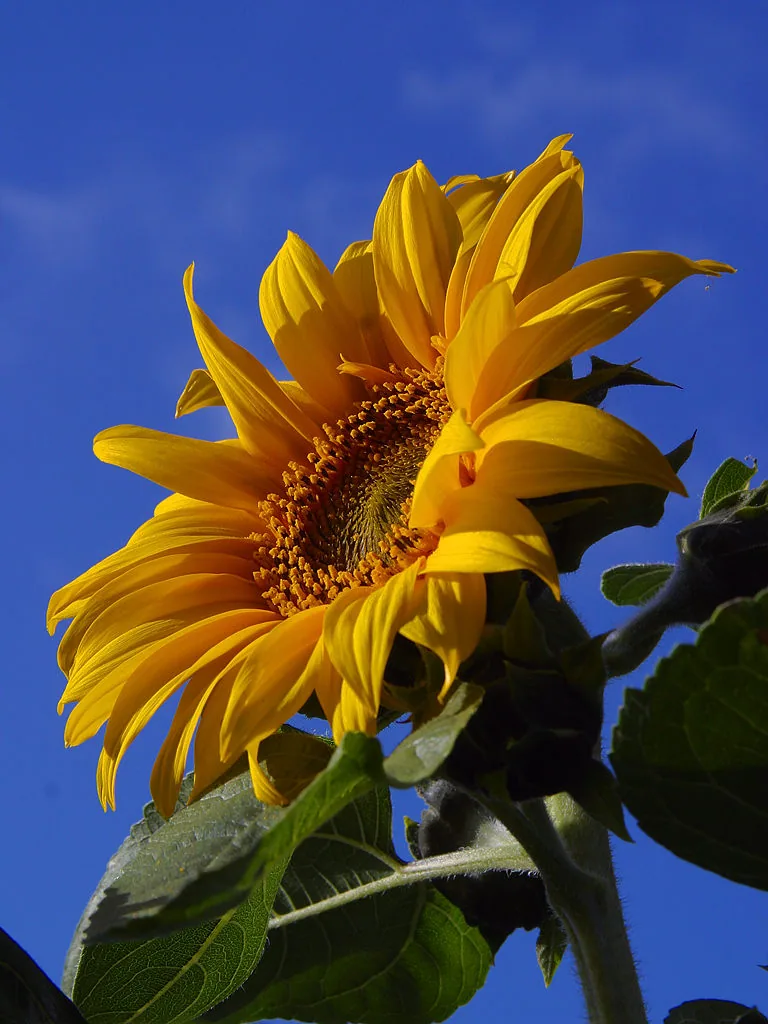


How to Grow and Care for Sunflower
Helianthus annuus
Written by Emilio Marruso · last checked
At a glance
Sunflowers are one of the easiest flowers to grow from seed: sow them straight into warm soil after the last frost, and seedlings pop up in just 4–5 days. Give them full sun and regular water, and they can reach 1.5 to 10 feet tall. Then enjoy the reward: edible seeds, petals and young buds you can steam like artichokes.
- Sun
Full sun: 6 or more hours a day
What the sources say (1)
Light: Full sun (6 or more hours of direct sunlight a day)
Full sun (6 or more hours of direct sunlight a day)
— Helianthus annuus (Comb Flower, Common Sunflower, Golden Flower of Peru, Kansas Sunflower, Sunflower, Wild Sunflower) | North Carolina Extension Gardener Plant Toolbox [1] - Water
Regular water gives the best flowers and seeds; keep the soil moist until the seeds sprout
What the sources say (4)
Watering: Drought-tolerant once established; regular watering gives the best flowering and seed production
Sunflowers are drought-tolerant once the plants have an established root system. Flowering and seed production will be best when the plant receives regular watering.
— Grow your own sunflowers | OSU Extension Service [4] Watering notes: Keep the soil moist until the seeds have germinated; container plantings need irrigation more often than in-ground plantings; ensure adequate water during heatwaves to reduce leaf sunburn
Plant seeds about 1 inch deep and keep the soil moist until the seeds have germinated.
— Grow your own sunflowers | OSU Extension Service [4] You will need to irrigate containers more frequently than in-ground plantings.
— Grow your own sunflowers | OSU Extension Service [4] To reduce the risk, make sure plants receive adequate water during heatwaves.
— Grow your own sunflowers | OSU Extension Service [4] - Cold
Sow only after the last spring frost; harvest the seeds before the first fall frost
What the sources say (11)
Sowing: Direct sow after the last frost when soil temperature has reached at least 50°F [10 °C]; April to June in the Willamette Valley and the Coast of Oregon, June in Central and Eastern Oregon; in Missouri from soil warming to 50°F [10 °C] (April) through mid-July
Willamette Valley and the Coast (Oregon): The best time to direct seed sunflowers is usually from April to June for the Willamette Valley and the Coast, and June for Central and Eastern Oregon.
— Grow your own sunflowers | OSU Extension Service [4] Central and Eastern Oregon: The best time to direct seed sunflowers is usually from April to June for the Willamette Valley and the Coast, and June for Central and Eastern Oregon.
— Grow your own sunflowers | OSU Extension Service [4] Missouri: Planting sunflower can begin anytime after soils have warmed to 50 degrees F. (April) through mid-July.
— Sunflower | Iowa State University Extension and Outreach Alternative Agriculture [7] According to NC State Extension: This annual is best planted by seed after the last frost in the spring, and harvested before the first frost in the fall.
— Helianthus annuus (Comb Flower, Common Sunflower, Golden Flower of Peru, Kansas Sunflower, Sunflower, Wild Sunflower) | North Carolina Extension Gardener Plant Toolbox [1] If direct sowing, wait until after the last frost when soil temperatures have reached at least 50°F.
— Grow your own sunflowers | OSU Extension Service [4] The best time to direct seed sunflowers is usually from April to June for the Willamette Valley and the Coast, and June for Central and Eastern Oregon.
— Grow your own sunflowers | OSU Extension Service [4] Planting sunflower can begin anytime after soils have warmed to 50 degrees F. (April) through mid-July.
— Sunflower | Iowa State University Extension and Outreach Alternative Agriculture [7] Harvest: Seeds are usually ready for harvest when the head turns brown on the back; harvest before the first frost in the fall
According to NC State Extension: This annual is best planted by seed after the last frost in the spring, and harvested before the first frost in the fall.
— Helianthus annuus (Comb Flower, Common Sunflower, Golden Flower of Peru, Kansas Sunflower, Sunflower, Wild Sunflower) | North Carolina Extension Gardener Plant Toolbox [1] Missouri (seed crop): When the head turns brown on the back, seeds are usually ready for harvest.
— Sunflower | Iowa State University Extension and Outreach Alternative Agriculture [7] When the head turns brown on the back, seeds are usually ready for harvest.
— Sunflower | Iowa State University Extension and Outreach Alternative Agriculture [7] This annual is best planted by seed after the last frost in the spring, and harvested before the first frost in the fall.
— Helianthus annuus (Comb Flower, Common Sunflower, Golden Flower of Peru, Kansas Sunflower, Sunflower, Wild Sunflower) | North Carolina Extension Gardener Plant Toolbox [1] - Soil
Puts up with poor, dry soil; its deep root loosens hard, packed ground
What the sources say (4)
Drought: Drought tolerant once the root system is established; tolerates poor and dry soils.
Sunflowers are drought-tolerant once the plants have an established root system.
— Grow your own sunflowers | OSU Extension Service [4] It is tolerant of poor soils and dry soils and is drought-tolerant once established.
— Helianthus annuus (Comb Flower, Common Sunflower, Golden Flower of Peru, Kansas Sunflower, Sunflower, Wild Sunflower) | North Carolina Extension Gardener Plant Toolbox [1] Root system: Deep taproot, which helps loosen compacted soil and improves aeration and water infiltration.
This plant has a taproot and rough, coarse, hairy stems that grow 2 to10 feet tall.
— Helianthus annuus (Comb Flower, Common Sunflower, Golden Flower of Peru, Kansas Sunflower, Sunflower, Wild Sunflower) | North Carolina Extension Gardener Plant Toolbox [1] Their deep taproot also helps loosen compacted soils, enhancing aeration and water infiltration.
— Grow your own sunflowers | OSU Extension Service [4] - Spacing
18–24 in apart for big branching kinds; single-stem kinds as close as 4–6 in
What the sources say (3)
Spacing: Larger, branching varieties 45.7-61.0 cm (18-24 in) apart; single stem varieties as close as 10.2-15.2 cm (4-6 in) apart
larger, branching varieties (Oregon): Larger, branching varieties should be spaced 18 to 24 inches apart, while single stem varieties can be spaced as close as 4 to 6 inches apart.
— Grow your own sunflowers | OSU Extension Service [4] single stem varieties (Oregon): Larger, branching varieties should be spaced 18 to 24 inches apart, while single stem varieties can be spaced as close as 4 to 6 inches apart.
— Grow your own sunflowers | OSU Extension Service [4] Larger, branching varieties should be spaced 18 to 24 inches apart, while single stem varieties can be spaced as close as 4 to 6 inches apart.
— Grow your own sunflowers | OSU Extension Service [4] - Planting
Seedlings started indoors go into the garden in May or June, depending on your climate
What the sources say (2)
Planting: Transplants started indoors go into the garden starting in May or June depending on location (Oregon)
Oregon (transplants started indoors): Sunflowers can also be started indoors and then transplanted into the garden starting in May or June depending on location.
— Grow your own sunflowers | OSU Extension Service [4] Sunflowers can also be started indoors and then transplanted into the garden starting in May or June depending on location.
— Grow your own sunflowers | OSU Extension Service [4] - Feeding
Feed at planting and again at two sets of leaves; too much nitrogen means leaves, not flowers
What the sources say (3)
When: At planting and when plants have two sets of leaves; organic fertilizers a few weeks ahead
You can use a conventional slow-release fertilizer or split a quick-release fertilizer application by applying half at planting and then another application when the plants have two sets of leaves.
— Grow your own sunflowers | OSU Extension Service [4] Remember to apply organic fertilizers a few weeks ahead. These fertilizers need time to interact with soil bacteria for the nutrients to become available.
— Grow your own sunflowers | OSU Extension Service [4] Avoid: High-nitrogen fertilizers, which promote leaves rather than flowers
Sunflowers do best with a balanced fertilizer (for example, NPK = 10-10-10). Avoid high nitrogen fertilizers as these promote leaf growth rather than flower formation.
— Grow your own sunflowers | OSU Extension Service [4] - Harvest
Pick seeds when the back of the head turns brown; seeds, petals and young buds are edible
What the sources say (2)
How to harvest: Seeds are physiologically mature when the back of the flower head is yellow and ready for harvest when the back of the head turns brown; cover the heads with fine mesh netting before the seeds mature to protect them from birds
Sunflower seeds are generally physiologically mature when the back of the flower head is yellow. When the head turns brown on the back, seeds are usually ready for harvest.
— Sunflower | Iowa State University Extension and Outreach Alternative Agriculture [7] Protect the heads by covering with a fine mesh netting before the seeds mature.
— Grow your own sunflowers | OSU Extension Service [4] - Pollination
Different varieties grown close together can cross; save seed from non-hybrid kinds
What the sources say (2)
Saving seeds: Save seed from open-pollinated varieties so they stay true to type; seed from hybrids is not ideal because many seeds may not be viable; different varieties grown close together can cross-pollinate
If you’d like to save seed to grow next year, you’ll want to save seed from open-pollinated varieties so that they stay true to type.
— Grow your own sunflowers | OSU Extension Service [4] Saving seed from hybrid sunflower cultivars is not ideal because many of the seeds may not be viable.
— Grow your own sunflowers | OSU Extension Service [4] - Pests
Slugs, snails, caterpillars and beetles; also powdery mildew, rust and leaf spots
What the sources say (11)
Pests: caterpillars, slugs, snails, beetles (including cucumber beetles), cutworms, stink bugs, sunflower moth (banded sunflower moth), head clipper insects, birds, squirrels, deer
Insects, Diseases, and Other Plant Problems: Caterpillars, slugs, snails, and beetles will munch on the foliage.
— Helianthus annuus (Comb Flower, Common Sunflower, Golden Flower of Peru, Kansas Sunflower, Sunflower, Wild Sunflower) | North Carolina Extension Gardener Plant Toolbox [1] Cutworm feeding can damage seedlings. Remove weeds in and around the garden bed to remove their hiding places.
— Grow your own sunflowers | OSU Extension Service [4] Birds and squirrels can dig up newly planted seeds and feed on the seedlings.
— Grow your own sunflowers | OSU Extension Service [4] Stink bug or beetle feeding can cause some distortion as the flowers develop.
— Grow your own sunflowers | OSU Extension Service [4] Cucumber beetles can damage sunflower leaves and flowers.
— Grow your own sunflowers | OSU Extension Service [4] Deer and squirrels may gnaw off and carry away entire flowers to feed on.
— Grow your own sunflowers | OSU Extension Service [4] The main threat to sunflower in Missouri is sunflower moth or banded sunflower moth.
— Sunflower | Iowa State University Extension and Outreach Alternative Agriculture [7] Head clipper insects which attack the stem right below the head can cause the whole head to fall off, but are not too common.
— Sunflower | Iowa State University Extension and Outreach Alternative Agriculture [7] Diseases: powdery mildew, leaf spots, rust, Sclerotinia rot (white mold)
This plant may be susceptible to powdery mildew, leaf spots, and rust.
— Helianthus annuus (Comb Flower, Common Sunflower, Golden Flower of Peru, Kansas Sunflower, Sunflower, Wild Sunflower) | North Carolina Extension Gardener Plant Toolbox [1] A fungal disease called Sclerotinia rot can cause brown rot that starts at the base of the flower, stem rot and wilting plants.
— Grow your own sunflowers | OSU Extension Service [4] Probably the greatest disease threat to sunflower is sclerotinia (white mold)
— Sunflower | Iowa State University Extension and Outreach Alternative Agriculture [7] - Watch out
Tall plants can topple, so stake them; net the heads to keep birds and squirrels off the seeds
What the sources say (2)
How to harvest: Seeds are physiologically mature when the back of the flower head is yellow and ready for harvest when the back of the head turns brown; cover the heads with fine mesh netting before the seeds mature to protect them from birds
Sunflower seeds are generally physiologically mature when the back of the flower head is yellow. When the head turns brown on the back, seeds are usually ready for harvest.
— Sunflower | Iowa State University Extension and Outreach Alternative Agriculture [7] Protect the heads by covering with a fine mesh netting before the seeds mature.
— Grow your own sunflowers | OSU Extension Service [4] - Size
1.5 to 10 ft tall and 1.5 to 3 ft wide
What the sources say (2)
Mature height: 46-305 cm (1.5-10 ft)
Height: 1 ft. 6 in. - 10 ft. 0 in. Width: 1 ft. 6 in. - 3 ft. 0 in.
— Helianthus annuus (Comb Flower, Common Sunflower, Golden Flower of Peru, Kansas Sunflower, Sunflower, Wild Sunflower) | North Carolina Extension Gardener Plant Toolbox [1] Mature width: 46-91 cm (1.5-3 ft)
Height: 1 ft. 6 in. - 10 ft. 0 in. Width: 1 ft. 6 in. - 3 ft. 0 in.
— Helianthus annuus (Comb Flower, Common Sunflower, Golden Flower of Peru, Kansas Sunflower, Sunflower, Wild Sunflower) | North Carolina Extension Gardener Plant Toolbox [1] - Propagation
From seed, sown straight in the garden or started indoors
What the sources say (1)
Propagation: Seed, by direct sowing or as transplants started indoors
Sunflowers can be grown either by direct sowing or as transplants.
— Grow your own sunflowers | OSU Extension Service [4] - Sowing
Sow 1–1.5 in deep once the soil reaches 50 °F (10 °C); sprouts appear in 4–5 days
What the sources say (12)
Sowing: Direct sow after the last frost when soil temperature has reached at least 50°F [10 °C]; April to June in the Willamette Valley and the Coast of Oregon, June in Central and Eastern Oregon; in Missouri from soil warming to 50°F [10 °C] (April) through mid-July
Willamette Valley and the Coast (Oregon): The best time to direct seed sunflowers is usually from April to June for the Willamette Valley and the Coast, and June for Central and Eastern Oregon.
— Grow your own sunflowers | OSU Extension Service [4] Central and Eastern Oregon: The best time to direct seed sunflowers is usually from April to June for the Willamette Valley and the Coast, and June for Central and Eastern Oregon.
— Grow your own sunflowers | OSU Extension Service [4] Missouri: Planting sunflower can begin anytime after soils have warmed to 50 degrees F. (April) through mid-July.
— Sunflower | Iowa State University Extension and Outreach Alternative Agriculture [7] According to NC State Extension: This annual is best planted by seed after the last frost in the spring, and harvested before the first frost in the fall.
— Helianthus annuus (Comb Flower, Common Sunflower, Golden Flower of Peru, Kansas Sunflower, Sunflower, Wild Sunflower) | North Carolina Extension Gardener Plant Toolbox [1] If direct sowing, wait until after the last frost when soil temperatures have reached at least 50°F.
— Grow your own sunflowers | OSU Extension Service [4] The best time to direct seed sunflowers is usually from April to June for the Willamette Valley and the Coast, and June for Central and Eastern Oregon.
— Grow your own sunflowers | OSU Extension Service [4] Planting sunflower can begin anytime after soils have warmed to 50 degrees F. (April) through mid-July.
— Sunflower | Iowa State University Extension and Outreach Alternative Agriculture [7] Sowing depth: 2.5-3.8 cm (1-1.5 in)
Plant seeds about 1 inch deep and keep the soil moist until the seeds have germinated.
— Grow your own sunflowers | OSU Extension Service [4] Sunflowers should be planted 1 to 1 1/2 inches deep.
— Sunflower | Iowa State University Extension and Outreach Alternative Agriculture [7] Germination: Sow after the last frost once soil has reached at least 10 °C [50 °F], 2.5 cm [1 in] deep, keeping the soil moist; seedlings emerge in four to five days in warm soil, a few days later in cooler soil or when sown deeper.
If direct sowing, wait until after the last frost when soil temperatures have reached at least 50°F.
— Grow your own sunflowers | OSU Extension Service [4] Plant seeds about 1 inch deep and keep the soil moist until the seeds have germinated.
— Grow your own sunflowers | OSU Extension Service [4] Emergence will take four to five days when planted an inch deep in warm soil, but will take a few days longer in cooler soils or when planted deeper.
— Sunflower | Iowa State University Extension and Outreach Alternative Agriculture [7] - Containers
Choose dwarf kinds under 3 ft, a 5-gallon pot with drainage holes, and water more often
What the sources say (7)
In containers: Yes
Choose shorter or dwarf cultivars that have a maximum height of 3 feet for container plantings.
— Grow your own sunflowers | OSU Extension Service [4] Between plants: 46-61 cm [18–24 in] for large branching varieties; single-stem varieties as close as 10-15 cm [3.9–5.9 in].
in containers: Choose shorter or dwarf cultivars that have a maximum height of 3 feet for container plantings.
— Grow your own sunflowers | OSU Extension Service [4] in containers: A 5-gallon bucket with holes drilled in the bottom or a similar-sized pot will provide enough space for the roots to grow.
— Grow your own sunflowers | OSU Extension Service [4] Larger, branching varieties should be spaced 18 to 24 inches apart, while single stem varieties can be spaced as close as 4 to 6 inches apart.
— Grow your own sunflowers | OSU Extension Service [4] Watering notes: Keep the soil moist until the seeds have germinated; container plantings need irrigation more often than in-ground plantings; ensure adequate water during heatwaves to reduce leaf sunburn
Plant seeds about 1 inch deep and keep the soil moist until the seeds have germinated.
— Grow your own sunflowers | OSU Extension Service [4] You will need to irrigate containers more frequently than in-ground plantings.
— Grow your own sunflowers | OSU Extension Service [4] To reduce the risk, make sure plants receive adequate water during heatwaves.
— Grow your own sunflowers | OSU Extension Service [4]
Overview
Common sunflower is a fast-growing, warm-season annual that prefers full sun and is drought-tolerant once established. [1][4] It is direct-sown after the last frost once the soil has warmed to at least 50°F [10 °C], or started indoors and transplanted. [4] The seeds are edible and used for cooking oil, livestock feed and as a snack. [1]
This record is incomplete: the sources we read do not cover every field yet.
Not yet covered by our sources: Hardiness, coldest zone, Hardiness, warmest zone, Pruning
Sunflower care
Measurements in square brackets are our conversion into the other unit system; the quoted text is unchanged.
How to water Sunflower
Watering
Drought-tolerant once established; regular watering gives the best flowering and seed production
What the sources say (1)
Sunflowers are drought-tolerant once the plants have an established root system. Flowering and seed production will be best when the plant receives regular watering.Watering notes
Keep the soil moist until the seeds have germinated; container plantings need irrigation more often than in-ground plantings; ensure adequate water during heatwaves to reduce leaf sunburn
What the sources say (3)
Plant seeds about 1 inch deep and keep the soil moist until the seeds have germinated.You will need to irrigate containers more frequently than in-ground plantings.To reduce the risk, make sure plants receive adequate water during heatwaves.How much light Sunflower needs
Full sun (6 or more hours of direct sunlight a day)
What the sources say (1)
Full sun (6 or more hours of direct sunlight a day)How much cold Sunflower can take
Hardiness, coldest zone
Not stated in the sources we read.
Hardiness, warmest zone
Not stated in the sources we read.
Best soil for Sunflower
Soil pH, minimum
The sources give different values depending on region, zone or growing conditions.
What each source says
Oregon (OSU Extension): 6.0
Missouri: 5.5
What the sources say (3)
Oregon (OSU Extension): sunflowers thrive in full sun and well-drained soil with a slightly acidic to near neutral pH (6.0 to 7.5)Missouri: Sunflower appears tolerant of soils with a pH down to 5.5, but consider liming if the pH is below 6.0, to improve nutrient availability in the soil.sunflowers thrive in full sun and well-drained soil with a slightly acidic to near neutral pH (6.0 to 7.5)Soil pH, maximum
The sources give different values depending on region, zone or growing conditions.
What each source says
Oregon (OSU Extension): 7.5
According to NC State Extension: Neutral or alkaline pH
What the sources say (3)
Oregon (OSU Extension): sunflowers thrive in full sun and well-drained soil with a slightly acidic to near neutral pH (6.0 to 7.5)According to NC State Extension: It prefers full sun and moist, well-drained, loamy, sandy, or clay soils, with a neutral or alkaline pH.sunflowers thrive in full sun and well-drained soil with a slightly acidic to near neutral pH (6.0 to 7.5)Where to grow Sunflower
In containers
Yes
What the sources say (1)
Choose shorter or dwarf cultivars that have a maximum height of 3 feet for container plantings.Spacing
Larger, branching varieties 45.7-61.0 cm (18-24 in) apart; single stem varieties as close as 10.2-15.2 cm (4-6 in) apart
What each source says
larger, branching varieties (Oregon): 45.7-61.0 cm (18-24 in)
single stem varieties (Oregon): As close as 10.2-15.2 cm (4-6 in)
What the sources say (3)
larger, branching varieties (Oregon): Larger, branching varieties should be spaced 18 to 24 inches apart, while single stem varieties can be spaced as close as 4 to 6 inches apart.single stem varieties (Oregon): Larger, branching varieties should be spaced 18 to 24 inches apart, while single stem varieties can be spaced as close as 4 to 6 inches apart.Larger, branching varieties should be spaced 18 to 24 inches apart, while single stem varieties can be spaced as close as 4 to 6 inches apart.How to propagate Sunflower
Seed, by direct sowing or as transplants started indoors
What the sources say (1)
Sunflowers can be grown either by direct sowing or as transplants.How to grow Sunflower
The plant
Life cycle
annual
What the sources say (1)
Common sunflower is a warm-season, fast-growing annual with tall, upright stalks and 3- to 6-inch-wide flowers with orangish-yellow petal rays and blackish-brown to purplish center disks.Family
Asteraceae
What the sources say (1)
It is a member of the daisy family (Asteraceae), native to the western United States and parts of Mexico, and has been introduced almost worldwide.Mature height
46-305 cm (1.5-10 ft)
What the sources say (1)
Height: 1 ft. 6 in. - 10 ft. 0 in. Width: 1 ft. 6 in. - 3 ft. 0 in.Mature width
46-91 cm (1.5-3 ft)
What the sources say (1)
Height: 1 ft. 6 in. - 10 ft. 0 in. Width: 1 ft. 6 in. - 3 ft. 0 in.Sowing and growth
Days to germination
4-5 days to emergence (seed 1 in / 2.5 cm deep in warm soil; longer in cool soil)
What the sources say (1)
Emergence will take four to five days when planted an inch deep in warm soil, but will take a few days longer in cooler soils or when planted deeper.Sowing depth
2.5-3.8 cm (1-1.5 in)
What the sources say (2)
Plant seeds about 1 inch deep and keep the soil moist until the seeds have germinated.Sunflowers should be planted 1 to 1 1/2 inches deep.Harvest and storage
How to harvest
Seeds are physiologically mature when the back of the flower head is yellow and ready for harvest when the back of the head turns brown; cover the heads with fine mesh netting before the seeds mature to protect them from birds
What the sources say (2)
Sunflower seeds are generally physiologically mature when the back of the flower head is yellow. When the head turns brown on the back, seeds are usually ready for harvest.Protect the heads by covering with a fine mesh netting before the seeds mature.Storage
Store seed at 10% moisture or less in colder periods and at 8% or less in warmer months
What the sources say (1)
During colder periods, sunflower can be safely stored at 10% moisture or less, but during warmer months the storage moisture should be at 8% or less.Saving seeds
Save seed from open-pollinated varieties so they stay true to type; seed from hybrids is not ideal because many seeds may not be viable; different varieties grown close together can cross-pollinate
What the sources say (2)
If you’d like to save seed to grow next year, you’ll want to save seed from open-pollinated varieties so that they stay true to type.Saving seed from hybrid sunflower cultivars is not ideal because many of the seeds may not be viable.Pests and diseases
Pests
caterpillars, slugs, snails, beetles (including cucumber beetles), cutworms, stink bugs, sunflower moth (banded sunflower moth), head clipper insects, birds, squirrels, deer
What the sources say (8)
Insects, Diseases, and Other Plant Problems: Caterpillars, slugs, snails, and beetles will munch on the foliage.Cutworm feeding can damage seedlings. Remove weeds in and around the garden bed to remove their hiding places.Birds and squirrels can dig up newly planted seeds and feed on the seedlings.Stink bug or beetle feeding can cause some distortion as the flowers develop.Cucumber beetles can damage sunflower leaves and flowers.Deer and squirrels may gnaw off and carry away entire flowers to feed on.The main threat to sunflower in Missouri is sunflower moth or banded sunflower moth.Head clipper insects which attack the stem right below the head can cause the whole head to fall off, but are not too common.Diseases
powdery mildew, leaf spots, rust, Sclerotinia rot (white mold)
What the sources say (3)
This plant may be susceptible to powdery mildew, leaf spots, and rust.A fungal disease called Sclerotinia rot can cause brown rot that starts at the base of the flower, stem rot and wilting plants.Probably the greatest disease threat to sunflower is sclerotinia (white mold)Fertilizing
When
At planting and when plants have two sets of leaves; organic fertilizers a few weeks ahead
What the sources say (2)
You can use a conventional slow-release fertilizer or split a quick-release fertilizer application by applying half at planting and then another application when the plants have two sets of leaves.Remember to apply organic fertilizers a few weeks ahead. These fertilizers need time to interact with soil bacteria for the nutrients to become available.How often
Two applications with quick-release fertilizer, or one slow-release application
What the sources say (1)
You can use a conventional slow-release fertilizer or split a quick-release fertilizer application by applying half at planting and then another application when the plants have two sets of leaves.Natural fertilizers
Compost: 2.54 to 5.08 cm [1–2 in] mixed to a depth of 30.48 cm [12 in] before planting; organic fertilizers applied a few weeks ahead
What each source says
field crop: Animal manure or a legume cover crop can reduce or eliminate the need for nitrogen fertilizer
What the sources say (3)
field crop: Animal manure or a legume cover crop can reduce or eliminate need for N fertilizer. One option is to spring plant a legume cover, such as Austrian winter peas in early AprilHeavy clay soil can reduce sunflower growth. Before planting, amend the soil with 1-2 inches of compost and mix to a depth of 12 inches using a digging fork or broadfork.Remember to apply organic fertilizers a few weeks ahead. These fertilizers need time to interact with soil bacteria for the nutrients to become available.Mineral fertilizers
Balanced fertilizer such as 10-10-10, slow-release, or quick-release split in two applications
What each source says
in containers: Balanced fertilizer
field production: Nitrogen: 56 to 78.5 kg [123.5–173 lb]/ha after soybeans, 89.7 to 112 kg [197.8–246.9 lb]/ha after a non-legume crop
field production, double crop after wheat: Nitrogen: 67.3 kg [148.4 lb]/ha if the wheat stubble is tilled in, 89.7 kg [197.8 lb]/ha if grown no-till in the residue
What the sources say (5)
in containers: You will need to irrigate containers more frequently than in-ground plantings. Fertilize with a balanced fertilizer as described above.field production: When following soybeans in the rotation, roughly 50 to 70 lbs. N/acre is appropriate. Following a non-legume, about 80 to 100 lbs. N/acre is suitable.field production, double crop after wheat: For sunflower planted double crop after wheat, apply about 60 lbs. N/acre if the wheat stubble is tillage incorporated, or about 80 lbs. N/acre if the sunflower is grown no-till in the residue.Sunflowers do best with a balanced fertilizer (for example, NPK = 10-10-10). Avoid high nitrogen fertilizers as these promote leaf growth rather than flower formation.You can use a conventional slow-release fertilizer or split a quick-release fertilizer application by applying half at planting and then another application when the plants have two sets of leaves.Avoid
High-nitrogen fertilizers, which promote leaves rather than flowers
What the sources say (1)
Sunflowers do best with a balanced fertilizer (for example, NPK = 10-10-10). Avoid high nitrogen fertilizers as these promote leaf growth rather than flower formation.Signs of excess
Leaf growth at the expense of flower formation (too much nitrogen)
What the sources say (1)
Sunflowers do best with a balanced fertilizer (for example, NPK = 10-10-10). Avoid high nitrogen fertilizers as these promote leaf growth rather than flower formation.Spacing
Between plants
46-61 cm [18–24 in] for large branching varieties; single-stem varieties as close as 10-15 cm [3.9–5.9 in].
What each source says
in containers: Dwarf cultivars no taller than 91 cm [36 in]
in containers: A 19 L [5 gal] pot with drainage holes gives the roots enough space
What the sources say (3)
in containers: Choose shorter or dwarf cultivars that have a maximum height of 3 feet for container plantings.in containers: A 5-gallon bucket with holes drilled in the bottom or a similar-sized pot will provide enough space for the roots to grow.Larger, branching varieties should be spaced 18 to 24 inches apart, while single stem varieties can be spaced as close as 4 to 6 inches apart.Roots
Root system
Deep taproot, which helps loosen compacted soil and improves aeration and water infiltration.
What the sources say (2)
This plant has a taproot and rough, coarse, hairy stems that grow 2 to10 feet tall.Their deep taproot also helps loosen compacted soils, enhancing aeration and water infiltration.Propagation
Germination
Sow after the last frost once soil has reached at least 10 °C [50 °F], 2.5 cm [1 in] deep, keeping the soil moist; seedlings emerge in four to five days in warm soil, a few days later in cooler soil or when sown deeper.
What the sources say (3)
If direct sowing, wait until after the last frost when soil temperatures have reached at least 50°F.Plant seeds about 1 inch deep and keep the soil moist until the seeds have germinated.Emergence will take four to five days when planted an inch deep in warm soil, but will take a few days longer in cooler soils or when planted deeper.After harvest
Storage
Harvested seed stored in bins: 10% moisture or less in cold periods, 8% or less in warmer months; aerate or rotate between bins to avoid hot spots.
What the sources say (2)
During colder periods, sunflower can be safely stored at 10% moisture or less, but during warmer months the storage moisture should be at 8% or less.If aeration is not available, sunflower should be rotated between bins to avoid hot spots developing in the stored grain.Heat and drought
Drought
Drought tolerant once the root system is established; tolerates poor and dry soils.
What the sources say (2)
Sunflowers are drought-tolerant once the plants have an established root system.It is tolerant of poor soils and dry soils and is drought-tolerant once established.Sunflower pests and problems
Slugs and snails
What to do: Use a molluscicide with the active ingredient iron phosphate or use a trap
What the sources say (1)
Slugs and snails are a common pest of tender young plants. Use a molluscicide with the active ingredient iron phosphate or use a trap
— Grow your own sunflowers | OSU Extension Service [4] Powdery mildew
What to do: At the end of the growing season, remove all affected plants to limit the amount of disease that overwinters in the garden
What the sources say (1)
Powdery mildew is a common disease that may develop by the end of season in areas with high humidity and will cause white powdery growth on leaves.
— Grow your own sunflowers | OSU Extension Service [4] Sclerotinia rot
What to do: Hard-to-manage soilborne disease; check with the county Master Gardener Program or Extension for diagnosis
What the sources say (1)
A fungal disease called Sclerotinia rot can cause brown rot that starts at the base of the flower, stem rot and wilting plants.
— Grow your own sunflowers | OSU Extension Service [4] Lodging
What to do: Staking can be helpful; plant in a large enough spot with uncompacted soil
What the sources say (1)
High winds can blow over sunflowers, especially very tall cultivars. Staking can be helpful.
— Grow your own sunflowers | OSU Extension Service [4] Birds and squirrels
What to do: Cover heads with fine mesh netting before the seeds mature; distraction devices such as reflective types or spinners can help
What the sources say (1)
Protect the heads by covering with a fine mesh netting before the seeds mature.
— Grow your own sunflowers | OSU Extension Service [4]
Remedies
Each remedy shows what official sources say about it; traditional remedies without an official source are marked as such. Harmful ones are listed so you know to avoid them.
Treating the plant
raccoons
olive oil, garlic and cayenne pepper paste Not verified
Traditional remedy, not verified by an official source.
The pepper spray can be very potent if it gets on your skin or in your eyes.
— extension.psu.edu [8] How: mix olive oil with garlic and cayenne pepper, and use a paintbrush to spread this on the stalks
diluted castile soap spray Not verified
Traditional remedy, not verified by an official source.
How: lavender Castile soap diluted into spray and spritzed around the stems
squirrels
thorny thistles planted around the sunflowers Not verified
Traditional remedy, not verified by an official source.
How: plant really thorny thistles around the sunflowers so squirrels can’t get close
sunflower beetles
double-sided sticky tape on the stalks Not verified
Traditional remedy, not verified by an official source.
How: wrap the bases of the stalks with a bit of medical gauze, then wrap that in double-sided sticky tape
aphids
neem oil spray Works
Despite these being biological pesticides, it is important to read the directions on the label and wear safety equipment.
— extension.illinois.edu [10] How: spray the plants with neem oil
Spray the plants with neem oil, and scatter some diatomaceous earth around for good measure.
— morningchores.com [9] What the evidence says Neem oil is found in the seeds of the neem tree. The active component found in this biological pesticide reduces insect feeding, interferes with hormones -- making it hard to grow or lay eggs -- and acts as a repellent.
— extension.illinois.edu [10] diatomaceous earth Not verified
Traditional remedy, not verified by an official source.
How: scatter some diatomaceous earth around the plants
garlic chives, sage and nasturtiums planted around Not verified
Traditional remedy, not verified by an official source.
How: plant plenty of garlic chives, sage and nasturtiums around the flowers, because aphids don’t like strong scents
water spray Not verified
Traditional remedy, not verified by an official source.
How: spray water to dislodge the aphids
sunflower rust
aspirin spray Not verified
Traditional remedy, not verified by an official source.
How: dissolve 10 plain aspirin tablets in a gallon of water, and spray the plants with this every few days
powdery mildew
apple cider vinegar spray Not verified
Traditional remedy, not verified by an official source.
How: treat the mildew with apple cider vinegar (diluted)
stem canker
garlic spray Not verified
Traditional remedy, not verified by an official source.
How: strong garlic spray, which sometimes works according to the source
Calendar
Sowing
Direct sow after the last frost when soil temperature has reached at least 50°F [10 °C]; April to June in the Willamette Valley and the Coast of Oregon, June in Central and Eastern Oregon; in Missouri from soil warming to 50°F [10 °C] (April) through mid-July
What each source says
Willamette Valley and the Coast (Oregon): April to June
Central and Eastern Oregon: June
Missouri: After soils have warmed to 50 degrees F [10 °C] (April) through mid-July
According to NC State Extension: After the last frost in the spring
What the sources say (7)
Willamette Valley and the Coast (Oregon): The best time to direct seed sunflowers is usually from April to June for the Willamette Valley and the Coast, and June for Central and Eastern Oregon.Central and Eastern Oregon: The best time to direct seed sunflowers is usually from April to June for the Willamette Valley and the Coast, and June for Central and Eastern Oregon.Missouri: Planting sunflower can begin anytime after soils have warmed to 50 degrees F. (April) through mid-July.According to NC State Extension: This annual is best planted by seed after the last frost in the spring, and harvested before the first frost in the fall.If direct sowing, wait until after the last frost when soil temperatures have reached at least 50°F.The best time to direct seed sunflowers is usually from April to June for the Willamette Valley and the Coast, and June for Central and Eastern Oregon.Planting sunflower can begin anytime after soils have warmed to 50 degrees F. (April) through mid-July.Planting
Transplants started indoors go into the garden starting in May or June depending on location (Oregon)
What each source says
Oregon (transplants started indoors): Starting in May or June depending on location
What the sources say (2)
Oregon (transplants started indoors): Sunflowers can also be started indoors and then transplanted into the garden starting in May or June depending on location.Sunflowers can also be started indoors and then transplanted into the garden starting in May or June depending on location.Harvest
Seeds are usually ready for harvest when the head turns brown on the back; harvest before the first frost in the fall
What each source says
According to NC State Extension: Before the first frost in the fall
Missouri (seed crop): When the head turns brown on the back
What the sources say (4)
According to NC State Extension: This annual is best planted by seed after the last frost in the spring, and harvested before the first frost in the fall.Missouri (seed crop): When the head turns brown on the back, seeds are usually ready for harvest.When the head turns brown on the back, seeds are usually ready for harvest.This annual is best planted by seed after the last frost in the spring, and harvested before the first frost in the fall.Pruning
Not stated in the sources we read.
Months as given by the sources, which are mostly from the United States (northern hemisphere). In the southern hemisphere they shift by about six months.
Relative to frost
Less precise estimate: there is no weather station within 300 km.
Find frost dates by ZIP code or city
Sow outdoors: around the last frost
This annual is best planted by seed after the last frost in the spring, and harvested before the first frost in the fall.
— Helianthus annuus (Comb Flower, Common Sunflower, Golden Flower of Peru, Kansas Sunflower, Sunflower, Wild Sunflower) | North Carolina Extension Gardener Plant Toolbox [1]
Count from the average frost dates where you live.
Edibility
Reported by the source, quoted verbatim. Do not eat a plant on the basis of this page alone: identification mistakes can be dangerous.
Indicative values
Values from a secondary source, not checked word for word like the rest of this page. Use them as a starting point.
- Drought tolerant
- yesIndicative value, adapt it to your climate · Secondary source
- USDA hardiness zones
- 2-11 [winter low −45.6 to 10 °C (−50 to 50 °F)]Indicative value, adapt it to your climate · Secondary source
- Care level
- MediumIndicative value, adapt it to your climate · Secondary source
- Growth rate
- HighIndicative value, adapt it to your climate · Secondary source
- Pruning
- August, March, April, May, June, July, August, SeptemberIndicative value, adapt it to your climate · Secondary source
Similar plants
- Appalachian Sunflower Helianthus atrorubens
- Jerusalem Artichoke Helianthus tuberosus
- Maximilian Sunflower Helianthus maximiliani
- Muck Sunflower Helianthus simulans
- Naked-stem Sunflower Helianthus occidentalis
- Resinous Sunflower Helianthus resinosus
- Schweinitz's Sunflower Helianthus schweinitzii
- Sunflower Helianthus angustifolius
Sources
Every value above is quoted from these documents. Links lead to the original publisher.
- Helianthus annuus (Comb Flower, Common Sunflower, Golden Flower of Peru, Kansas Sunflower, Sunflower, Wild Sunflower) | North Carolina Extension Gardener Plant Toolbox · plants.ces.ncsu.edu, consulted
- Kansas Sunflower - Helianthus annuus | North Carolina Extension Gardener Plant Toolbox · plants.ces.ncsu.edu, consulted
- Helianthus (Sunflower) | North Carolina Extension Gardener Plant Toolbox · plants.ces.ncsu.edu, consulted
- Grow your own sunflowers | OSU Extension Service · extension.oregonstate.edu, consulted
- Perennial Sunflowers for the Home Landscape | Yard and Garden · yardandgarden.extension.iastate.edu, consulted
- Helianthus / Sunflower Cultivar Production Trials - Cut Flowers | NC State Extension · cutflowers.ces.ncsu.edu, consulted
- Sunflower | Iowa State University Extension and Outreach Alternative Agriculture · extension.iastate.edu, consulted
- extension.psu.edu · extension.psu.edu
- morningchores.com · morningchores.com
- extension.illinois.edu · extension.illinois.edu
Written by Emilio Marruso · last checked