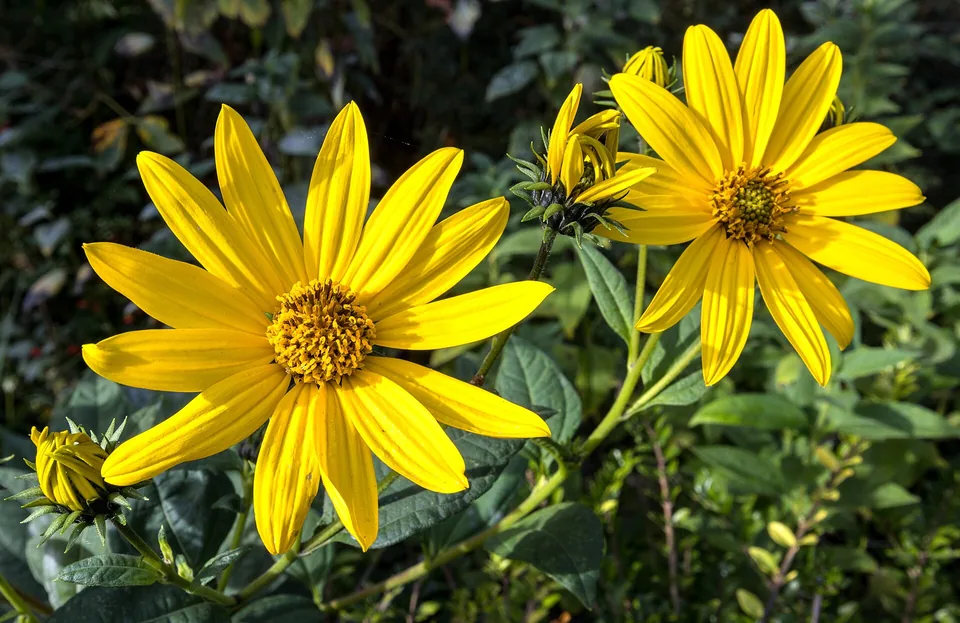


How to Grow and Care for Jerusalem Artichoke
Helianthus tuberosus
Written by Emilio Marruso · last checked
At a glance
Jerusalem artichoke is a carefree perennial that gives you knobby tubers with a nutty flavor, crunchy like water chestnuts. Plant pieces in early spring in a sunny spot, and after 120 days you can dig them in fall, once the flowers fade, and keep digging as needed until spring. Enjoy them raw, mashed or roasted like potatoes.
- Sun
Full sun to part sun; it does not like deep shade
What the sources say (3)
Light: Full to part sun; does not tolerate deep shade
Grow in full to part sun. This is a tall bushy (6-10' x 5'wide) plant that may require some staking or protection from strong wind.
— Helianthus tuberosus (Earth Apple, Jerusalem Artichoke, Sunchoke, Sunroot) | North Carolina Extension Gardener Plant Toolbox [1] Heavy clay soils prone to waterlogging will reduce yields. It does not tolerate deep shade or maritime exposure.
— Helianthus tuberosus (Earth Apple, Jerusalem Artichoke, Sunchoke, Sunroot) | North Carolina Extension Gardener Plant Toolbox [1] Pick a spot that has full sun. It will be 120 days to maturity.
— Jerusalem Artichokes - Chatham County Center | N.C. Cooperative Extension [2] - Water
Best with steady moisture; mulch to keep it in, and avoid heavy clay that stays soggy
What the sources say (3)
Watering: Average, dry to medium moisture; best with consistent moisture
Average, dry to medium moisture is required; however, this plant is best with consistent moisture. Mulch to conserve moisture.
— Helianthus tuberosus (Earth Apple, Jerusalem Artichoke, Sunchoke, Sunroot) | North Carolina Extension Gardener Plant Toolbox [1] Watering notes: Mulch to conserve moisture; heavy clay soils prone to waterlogging reduce yields
Average, dry to medium moisture is required; however, this plant is best with consistent moisture. Mulch to conserve moisture.
— Helianthus tuberosus (Earth Apple, Jerusalem Artichoke, Sunchoke, Sunroot) | North Carolina Extension Gardener Plant Toolbox [1] Heavy clay soils prone to waterlogging will reduce yields. It does not tolerate deep shade or maritime exposure.
— Helianthus tuberosus (Earth Apple, Jerusalem Artichoke, Sunchoke, Sunroot) | North Carolina Extension Gardener Plant Toolbox [1] - Cold
Survives winters down to −40 °F (−40 °C)
Very hardy · USDA 3a · RHS H7 · Z3
What the sources say (2)
Hardiness, coldest zone: 3a [winter low −40 to −37.2 °C (−40 to −35 °F)]
3a, 3b, 4a, 4b, 5a, 5b, 6a, 6b, 7a, 7b, 8a, 8b, 9a, 9b
— Helianthus tuberosus (Earth Apple, Jerusalem Artichoke, Sunchoke, Sunroot) | North Carolina Extension Gardener Plant Toolbox [1] Hardiness, warmest zone: 9b [winter low −3.9 to −1.1 °C (25 to 30 °F)]
3a, 3b, 4a, 4b, 5a, 5b, 6a, 6b, 7a, 7b, 8a, 8b, 9a, 9b
— Helianthus tuberosus (Earth Apple, Jerusalem Artichoke, Sunchoke, Sunroot) | North Carolina Extension Gardener Plant Toolbox [1] - Soil
Neutral to slightly alkaline soil, pH 7.0–7.5
What the sources say (2)
Soil pH, minimum: 7.0
Jerusalem artichoke will tolerate most soil types as long as they are well drained, but is happiest in slightly alkaline soils (7-7.5).
— Helianthus tuberosus (Earth Apple, Jerusalem Artichoke, Sunchoke, Sunroot) | North Carolina Extension Gardener Plant Toolbox [1] Soil pH, maximum: 7.5
Jerusalem artichoke will tolerate most soil types as long as they are well drained, but is happiest in slightly alkaline soils (7-7.5).
— Helianthus tuberosus (Earth Apple, Jerusalem Artichoke, Sunchoke, Sunroot) | North Carolina Extension Gardener Plant Toolbox [1] - Spacing
12–18 in between plants
What the sources say (1)
Spacing: 30.5-45.7 cm (12-18 in) apart
The tubers are planted 4 to 6 inches deep and 12 to 18 inches apart the first two weeks in March.
— Jerusalem Artichokes - Chatham County Center | N.C. Cooperative Extension [2] - Planting
Plant tubers in early spring, 4–6 in deep
What the sources say (5)
Planting: Early spring; first two weeks in March (North Carolina)
According to NC State Plant Toolbox: Tubers may be planted in early spring. Similar to potatoes
— Helianthus tuberosus (Earth Apple, Jerusalem Artichoke, Sunchoke, Sunroot) | North Carolina Extension Gardener Plant Toolbox [1] Chatham County (fonte: NC State Extension): The tubers are planted 4 to 6 inches deep and 12 to 18 inches apart the first two weeks in March.
— Jerusalem Artichokes - Chatham County Center | N.C. Cooperative Extension [2] Tubers may be planted in early spring. Similar to potatoes, whole tubers or pieces of tuber with at least two to three strong buds should be planted.
— Helianthus tuberosus (Earth Apple, Jerusalem Artichoke, Sunchoke, Sunroot) | North Carolina Extension Gardener Plant Toolbox [1] The tubers are planted 4 to 6 inches deep and 12 to 18 inches apart the first two weeks in March.
— Jerusalem Artichokes - Chatham County Center | N.C. Cooperative Extension [2] Sowing depth: 10-15 cm (4 to 6 inches) for tubers
The tubers are planted 4 to 6 inches deep and 12 to 18 inches apart the first two weeks in March.
— Jerusalem Artichokes - Chatham County Center | N.C. Cooperative Extension [2] - Feeding
Work compost into the soil; a balanced fertilizer every two weeks or monthly gives bigger harvests
What the sources say (7)
Natural fertilizers: Compost worked into the soil
in containers: For containers, a 50/50 mix of native soil and compost is preferred.
— [6] Sunchokes will grow in relatively infertile soil, but it's best to amend with compost.
— [6] Mineral fertilizers: Balanced NPK fertilizer such as 20-20-20
trial raised beds: Plants were fertilized every two weeks with water-soluble fertilizer [28-8-16; nitrogen, phosphorus, and potassium (NPK)].
— [4] field production: Nitrogen: 150-200 lb N/acre. Apply no more than half the total before planting. Phosphorus: 80-150 (P205) lb/acre Potash: 80-100 lb K2O/acre Sulfur: 15-20 lb S/acre
— [3] Sunchoke plants show higher yields with regular applications (biweekly or monthly) of fertilizer with a balanced nitrogen, phosphorus, and potassium (NPK) ratio (e.g., 20-20-20).
— [5] How often: Every two weeks or monthly, for higher yields
trial raised beds: Plants were fertilized every two weeks with water-soluble fertilizer [28-8-16; nitrogen, phosphorus, and potassium (NPK)].
— [4] Sunchoke plants show higher yields with regular applications (biweekly or monthly) of fertilizer with a balanced nitrogen, phosphorus, and potassium (NPK) ratio (e.g., 20-20-20).
— [5] - Pruning
Prune after it blooms, August to October
What the sources say (1)
Pruning: After bloom time, August-October
Trim back after bloom time, August-October, or leave seeds as a treat for the birds.
— Helianthus tuberosus (Earth Apple, Jerusalem Artichoke, Sunchoke, Sunroot) | North Carolina Extension Gardener Plant Toolbox [1] - Harvest
Dig tubers in fall, two weeks after the flowers fade, and on into spring; eat them in moderation
What the sources say (6)
Harvest: Fall, approximately two weeks after the flowers fade (October-December); harvesting starts after the first frost in fall/winter and ends in the spring
According to NC State Plant Toolbox: The knobby tubers are harvested in the fall approximately two weeks after the flowers fade (October-December).
— Helianthus tuberosus (Earth Apple, Jerusalem Artichoke, Sunchoke, Sunroot) | North Carolina Extension Gardener Plant Toolbox [1] Chatham County (fonte: NC State Extension): Harvesting should start after the first frost in fall/winter and ends in the spring.
— Jerusalem Artichokes - Chatham County Center | N.C. Cooperative Extension [2] The knobby tubers are harvested in the fall approximately two weeks after the flowers fade (October-December).
— Helianthus tuberosus (Earth Apple, Jerusalem Artichoke, Sunchoke, Sunroot) | North Carolina Extension Gardener Plant Toolbox [1] Harvesting should start after the first frost in fall/winter and ends in the spring.
— Jerusalem Artichokes - Chatham County Center | N.C. Cooperative Extension [2] How to harvest: Dig the knobby tubers in fall, about two weeks after the flowers fade; harvest can start after the first frost and continue into spring, digging them as needed.
The knobby tubers are harvested in the fall approximately two weeks after the flowers fade (October-December).
— Helianthus tuberosus (Earth Apple, Jerusalem Artichoke, Sunchoke, Sunroot) | North Carolina Extension Gardener Plant Toolbox [1] Harvesting should start after the first frost in fall/winter and ends in the spring. Also, it is best to dig when you need them.
— Jerusalem Artichokes - Chatham County Center | N.C. Cooperative Extension [2] - Pests
Slugs and swift moths chew holes in tubers; rust, leaf spots and powdery mildew are common
What the sources say (2)
Pests: slugs, swift moths
Slugs and swift moths may eat holes in the tubers. Consistent weeding and moisture control may help prevent damage.
— Helianthus tuberosus (Earth Apple, Jerusalem Artichoke, Sunchoke, Sunroot) | North Carolina Extension Gardener Plant Toolbox [1] Diseases: rust, leaf fungal spots, powdery mildew
This plant has few pesticides labeled for it. Rust, leaf fungal spots and powdery mildew occur frequently.
— Helianthus tuberosus (Earth Apple, Jerusalem Artichoke, Sunchoke, Sunroot) | North Carolina Extension Gardener Plant Toolbox [1] - Watch out
It spreads fast: any tiny piece left in the soil sprouts a new plant
- Size
3 to 5 ft wide
What the sources say (1)
Mature width: 91-152 cm (3 to 5 ft)
Height: 6 ft. 0 in. - 10 ft. 0 in. Width: 3 ft. 0 in. - 5 ft. 0 in.
— Helianthus tuberosus (Earth Apple, Jerusalem Artichoke, Sunchoke, Sunroot) | North Carolina Extension Gardener Plant Toolbox [1] - Propagation
Plant whole tubers or pieces with 2–3 strong buds; also from seed or cuttings
What the sources say (2)
Propagation: Tubers (whole, or pieces with at least two to three strong buds); root cutting; seed; stem cutting
Life Cycle: Perennial Recommended Propagation Strategy: Root Cutting Seed Stem Cutting
— Helianthus tuberosus (Earth Apple, Jerusalem Artichoke, Sunchoke, Sunroot) | North Carolina Extension Gardener Plant Toolbox [1] Planting is similar to planting Irish potatoes because you can cut larger ones in pieces but making sure there are 2 to 3 buds on each section.
— Jerusalem Artichokes - Chatham County Center | N.C. Cooperative Extension [2]
Overview
Jerusalem artichoke is an herbaceous perennial root vegetable in the sunflower family, grown for its late yellow flowers or for its edible tubers. [1] It grows in full to part sun, tolerates most well-drained soils, and may need staking or protection from strong wind. [1] It spreads by rhizome and self-seeds to form colonies, and can become a weed problem. [1]
Jerusalem Artichoke care
How to water Jerusalem Artichoke
Watering
Average, dry to medium moisture; best with consistent moisture
What the sources say (1)
Average, dry to medium moisture is required; however, this plant is best with consistent moisture. Mulch to conserve moisture.Watering notes
Mulch to conserve moisture; heavy clay soils prone to waterlogging reduce yields
What the sources say (2)
Average, dry to medium moisture is required; however, this plant is best with consistent moisture. Mulch to conserve moisture.Heavy clay soils prone to waterlogging will reduce yields. It does not tolerate deep shade or maritime exposure.How much light Jerusalem Artichoke needs
Full to part sun; does not tolerate deep shade
What the sources say (3)
Grow in full to part sun. This is a tall bushy (6-10' x 5'wide) plant that may require some staking or protection from strong wind.Heavy clay soils prone to waterlogging will reduce yields. It does not tolerate deep shade or maritime exposure.Pick a spot that has full sun. It will be 120 days to maturity.How much cold Jerusalem Artichoke can take
Hardiness, coldest zone
3a [winter low −40 to −37.2 °C (−40 to −35 °F)]
What the sources say (1)
3a, 3b, 4a, 4b, 5a, 5b, 6a, 6b, 7a, 7b, 8a, 8b, 9a, 9bHardiness, warmest zone
9b [winter low −3.9 to −1.1 °C (25 to 30 °F)]
What the sources say (1)
3a, 3b, 4a, 4b, 5a, 5b, 6a, 6b, 7a, 7b, 8a, 8b, 9a, 9bBest soil for Jerusalem Artichoke
Soil pH, minimum
7.0
What the sources say (1)
Jerusalem artichoke will tolerate most soil types as long as they are well drained, but is happiest in slightly alkaline soils (7-7.5).Soil pH, maximum
7.5
What the sources say (1)
Jerusalem artichoke will tolerate most soil types as long as they are well drained, but is happiest in slightly alkaline soils (7-7.5).Where to grow Jerusalem Artichoke
30.5-45.7 cm (12-18 in) apart
What the sources say (1)
The tubers are planted 4 to 6 inches deep and 12 to 18 inches apart the first two weeks in March.How to propagate Jerusalem Artichoke
Tubers (whole, or pieces with at least two to three strong buds); root cutting; seed; stem cutting
What the sources say (2)
Life Cycle:
Perennial
Recommended Propagation Strategy:
Root Cutting
Seed
Stem CuttingPlanting is similar to planting Irish potatoes because you can cut larger ones in pieces but making sure there are 2 to 3 buds on each section.How to grow Jerusalem Artichoke
The plant
Life cycle
perennial
What the sources say (1)
Jerusalem artichoke, (also called Sunchoke, or Sunroot) is an herbaceous perennial root vegetable in the sunflower family.Family
Asteraceae
What the sources say (1)
Genus: Helianthus Species: tuberosus Family: Asteraceae Uses (Ethnobotany): First cultivation of this important food crop was by Native Americans.Mature height
Mature width
91-152 cm (3 to 5 ft)
What the sources say (1)
Height: 6 ft. 0 in. - 10 ft. 0 in. Width: 3 ft. 0 in. - 5 ft. 0 in.Sowing and growth
Sowing depth
10-15 cm (4 to 6 inches) for tubers
What the sources say (1)
The tubers are planted 4 to 6 inches deep and 12 to 18 inches apart the first two weeks in March.Days to maturity
120 days
What the sources say (1)
Pick a spot that has full sun. It will be 120 days to maturity.Harvest and storage
How to harvest
Dig the knobby tubers in fall, about two weeks after the flowers fade; harvest can start after the first frost and continue into spring, digging them as needed.
What the sources say (2)
The knobby tubers are harvested in the fall approximately two weeks after the flowers fade (October-December).Harvesting should start after the first frost in fall/winter and ends in the spring. Also, it is best to dig when you need them.Storage
In the refrigerator, in a plastic bag with a few slightly damp paper towels; they last up to two months, changing color over time.
What the sources say (1)
They will store in the refrigerator if placed in a plastic bag with a few slightly damp paper towels. Over time, they will change in color but will last up to two months.Pests and diseases
Pests
slugs, swift moths
What the sources say (1)
Slugs and swift moths may eat holes in the tubers. Consistent weeding and moisture control may help prevent damage.Diseases
rust, leaf fungal spots, powdery mildew
What the sources say (1)
This plant has few pesticides labeled for it. Rust, leaf fungal spots and powdery mildew occur frequently.Fertilizing
When
The sources give different values depending on region, zone or growing conditions.
What each source says
field production: No more than half of the total nitrogen before planting
What the sources say (1)
field production: Nitrogen: 150-200 lb N/acre. Apply no more than half the total before planting.How often
Every two weeks or monthly, for higher yields
What each source says
trial raised beds: Every two weeks with a water-soluble fertilizer
What the sources say (2)
trial raised beds: Plants were fertilized every two weeks with water-soluble fertilizer [28-8-16; nitrogen, phosphorus, and potassium (NPK)].Sunchoke plants show higher yields with regular applications (biweekly or monthly) of fertilizer with a balanced nitrogen, phosphorus, and potassium (NPK) ratio (e.g., 20-20-20).Natural fertilizers
Compost worked into the soil
What each source says
in containers: A 50/50 mix of native soil and compost
Mineral fertilizers
Balanced NPK fertilizer such as 20-20-20
What each source says
trial raised beds: Water-soluble 28-8-16 every two weeks
field production: Nitrogen 168 to 224 kg [370.4–493.8 lb]/ha (no more than half before planting), P2O5 89.7 to 168 kg [197.8–370.4 lb]/ha, K2O 89.7 to 112 kg [197.8–246.9 lb]/ha, sulfur 16.8 to 22.4 kg [37–49.4 lb]/ha
What the sources say (3)
trial raised beds: Plants were fertilized every two weeks with water-soluble fertilizer [28-8-16; nitrogen, phosphorus, and potassium (NPK)].field production: Nitrogen: 150-200 lb N/acre. Apply no more than half the total before planting. Phosphorus: 80-150 (P205) lb/acre Potash: 80-100 lb K2O/acre Sulfur: 15-20 lb S/acreSunchoke plants show higher yields with regular applications (biweekly or monthly) of fertilizer with a balanced nitrogen, phosphorus, and potassium (NPK) ratio (e.g., 20-20-20).Signs of deficiency
Yellowing leaves or stunted growth
What the sources say (1)
It is best to monitor the plants during the growing season for signs of nutrient deficiencies, such as yellowing leaves or stunted growth.Jerusalem Artichoke pests and problems
Slugs and swift moths
Symptom: Slugs and swift moths may eat holes in the tubers.
What to do: Consistent weeding and moisture control may help prevent damage.
What the sources say (1)
Slugs and swift moths may eat holes in the tubers. Consistent weeding and moisture control may help prevent damage.
— Helianthus tuberosus (Earth Apple, Jerusalem Artichoke, Sunchoke, Sunroot) | North Carolina Extension Gardener Plant Toolbox [1] Rust, leaf fungal spots and powdery mildew
Symptom: Rust, leaf fungal spots and powdery mildew occur frequently.
What the sources say (1)
This plant has few pesticides labeled for it. Rust, leaf fungal spots and powdery mildew occur frequently.
— Helianthus tuberosus (Earth Apple, Jerusalem Artichoke, Sunchoke, Sunroot) | North Carolina Extension Gardener Plant Toolbox [1] Weedy spread
Symptom: Spreads by rhizome and self-seeds to form colonies; any tiny piece left in the soil will sprout new plants and it may be difficult to remove once established.
What the sources say (1)
Once established in the garden it may be difficult to remove. Any tiny piece of the plant left in the soil will sprout new plants.
— Helianthus tuberosus (Earth Apple, Jerusalem Artichoke, Sunchoke, Sunroot) | North Carolina Extension Gardener Plant Toolbox [1]
Remedies
Each remedy shows what official sources say about it; traditional remedies without an official source are marked as such. Harmful ones are listed so you know to avoid them.
Treating the plant
slugs
slug traps Not verified
Traditional remedy, not verified by an official source.
How: Protect new growth with organic slug traps or barriers.
Getting rid of it
weedy spread
pulling young shoots Works
How: Pull the young plants as soon as they emerge in spring, preferably when they are about 4 to 8 inches (10-20 cm.) tall. New tubers are unable to develop without the above-ground shoots, but total control requires removing every single sprout.
A more effective way of managing Jerusalem artichoke weeds is to pull the young plants as soon as they emerge in spring-- preferably when they are about 4 to 8 inches (10-20 cm.) tall.
— gardeningknowhow.com [7] What the evidence says Regularly pulling, hoeing or mowing weeds and encouraging grass to grow and out-compete the weeds is an excellent solution.
— extension.usu.edu [8] mowing young shoots Works
How: If you have a large patch or the plants are sprouting in your lawn, mow them down; new tubers cannot develop without the above-ground shoots. Total control requires removing every single sprout.
If you have a large patch of Jerusalem artichoke or if the plants are sprouting in your lawn, you can mow them down.
— gardeningknowhow.com [7] What the evidence says Regularly pulling, hoeing or mowing weeds and encouraging grass to grow and out-compete the weeds is an excellent solution.
— extension.usu.edu [8] digging out all tubers Not verified
Traditional remedy, not verified by an official source.
locating all of the tubers, which grow on long stolons, is nearly impossible.
— gardeningknowhow.com [7] How: Dig up the tubers carefully, making sure to get all of the roots, and dispose of them properly because they can easily resprout. When harvesting in fall, dig up as many tubers as possible to keep growth in check.
snipping blooms Not verified
Traditional remedy, not verified by an official source.
How: If you grow a small patch for the tubers, snip the blooms from the plants before they go to seed; the flowers work well in bouquets.
mulch Partly works
How: Mulching around plants can help to suppress the growth of weeds, including Jerusalem artichoke plants.
Mulching: Mulching around plants can help to suppress the growth of weeds, including Jerusalem artichoke plants.
— susanhomecare.com [9] What the evidence says Lay the material down to prevent sunlight from reaching the unwanted plants, and cover with mulch or other plant-resistant material.
— extension.usu.edu [8] solarization Not verified
Traditional remedy, not verified by an official source.
How: Cover the soil with a clear plastic tarp during the summer months to heat the soil and kill the tubers.
Calendar
Early spring; first two weeks in March (North Carolina)
What each source says
According to NC State Plant Toolbox: Early spring
Chatham County (fonte: NC State Extension): First two weeks in March
What the sources say (4)
According to NC State Plant Toolbox: Tubers may be planted in early spring. Similar to potatoesChatham County (fonte: NC State Extension): The tubers are planted 4 to 6 inches deep and 12 to 18 inches apart the first two weeks in March.Tubers may be planted in early spring. Similar to potatoes, whole tubers or pieces of tuber with at least two to three strong buds should be planted.The tubers are planted 4 to 6 inches deep and 12 to 18 inches apart the first two weeks in March.Fall, approximately two weeks after the flowers fade (October-December); harvesting starts after the first frost in fall/winter and ends in the spring
What each source says
According to NC State Plant Toolbox: Fall, approximately two weeks after the flowers fade (October-December)
Chatham County (fonte: NC State Extension): Starts after the first frost in fall/winter and ends in the spring
What the sources say (4)
According to NC State Plant Toolbox: The knobby tubers are harvested in the fall approximately two weeks after the flowers fade (October-December).Chatham County (fonte: NC State Extension): Harvesting should start after the first frost in fall/winter and ends in the spring.The knobby tubers are harvested in the fall approximately two weeks after the flowers fade (October-December).Harvesting should start after the first frost in fall/winter and ends in the spring.After bloom time, August-October
What the sources say (1)
Trim back after bloom time, August-October, or leave seeds as a treat for the birds.Months as given by the sources, which are mostly from the United States (northern hemisphere). In the southern hemisphere they shift by about six months.
Relative to frost
Less precise estimate: there is no weather station within 300 km.
Find frost dates by ZIP code or city
Harvest: around the first frost
Harvesting should start after the first frost in fall/winter and ends in the spring.
— Jerusalem Artichokes - Chatham County Center | N.C. Cooperative Extension [2]
Count from the average frost dates where you live.
Edibility
Reported by the source, quoted verbatim. Do not eat a plant on the basis of this page alone: identification mistakes can be dangerous.
Fresh Jerusalem artichoke tubers are edible, and are similar in texture to water chestnuts with a nutty flavor. They may be boiled, mashed, roasted like potatoes, or eaten raw.
[1]eat in moderation, as they contain inulin, which can cause flatulence, especially if it is more than half of your meal.
[2]
Indicative values
Values from a secondary source, not checked word for word like the rest of this page. Use them as a starting point.
- Hours of sun
- 4-6 hoursIndicative value, adapt it to your climate · Secondary source
- Care level
- MediumIndicative value, adapt it to your climate · Secondary source
- Growth rate
- HighIndicative value, adapt it to your climate · Secondary source
Similar plants
- Appalachian Sunflower Helianthus atrorubens
- Maximilian Sunflower Helianthus maximiliani
- Muck Sunflower Helianthus simulans
- Naked-stem Sunflower Helianthus occidentalis
- Resinous Sunflower Helianthus resinosus
- Schweinitz's Sunflower Helianthus schweinitzii
- Sunflower Helianthus angustifolius
- Sunflower Helianthus annuus
Sources
Every value above is quoted from these documents. Links lead to the original publisher.
- Helianthus tuberosus (Earth Apple, Jerusalem Artichoke, Sunchoke, Sunroot) | North Carolina Extension Gardener Plant Toolbox · plants.ces.ncsu.edu, consulted
- Jerusalem Artichokes - Chatham County Center | N.C. Cooperative Extension · chatham.ces.ncsu.edu, consulted
- horticulture.oregonstate.edu · horticulture.oregonstate.edu
- ohioline.osu.edu · ohioline.osu.edu
- ohioline.osu.edu · ohioline.osu.edu
- ucanr.edu · ucanr.edu
- gardeningknowhow.com · gardeningknowhow.com
- extension.usu.edu · extension.usu.edu
- susanhomecare.com · susanhomecare.com
Written by Emilio Marruso · last checked