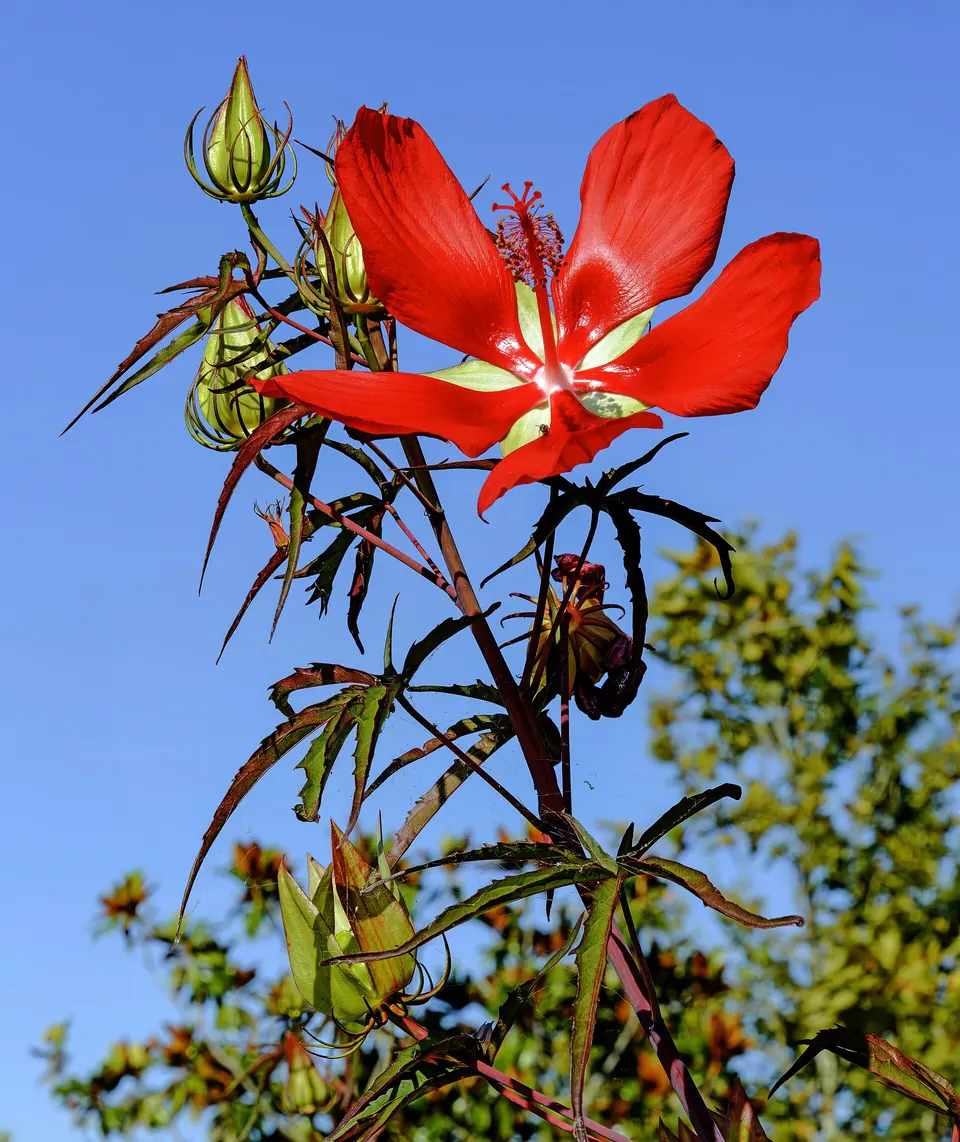
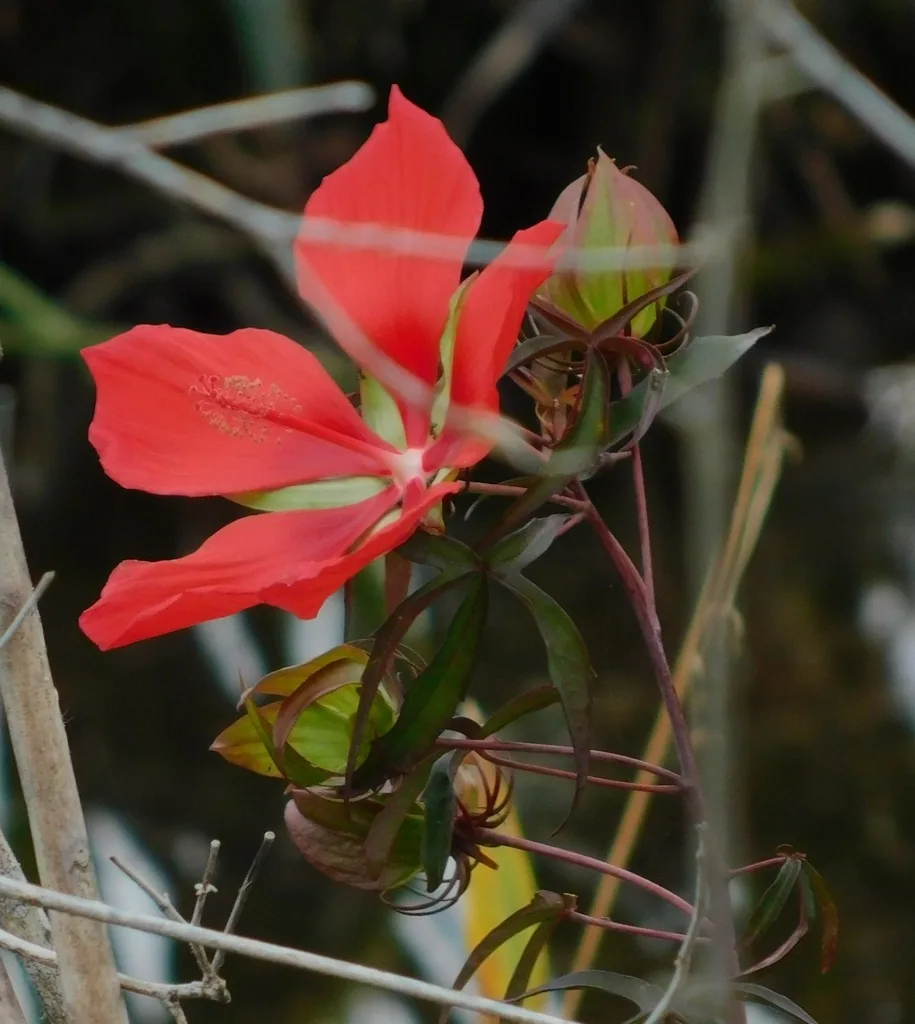

Cómo cultivar y cuidar Scarlet Rose Mallow
Hibiscus coccineus
Escrito por Emilio Marruso · última revisión
De un vistazo
Este hibisco perenne encaja fácilmente en tu jardín: crece a pleno sol o en semisombra, e incluso en maceta. Una vez asentado, solo necesita un riego profundo cuando la tierra esté seca a 5 cm de profundidad. Puedes multiplicarlo por semilla, esquejes de tallo o división, así que una sola planta pronto se convierte en muchas para compartir con amigos.
- Sol
Pleno sol o semisombra
Qué dicen las fuentes (2)
Luz: Pleno sol a semisombra
Plant in locations with full sun to partial shade and with moist, occasionally wet soils.
— Muenchhusia coccinea (Red Hibiscus, Scarlet Rose Mallow, Texas Hibiscus) | North Carolina Extension Gardener Plant Toolbox [1] This plant requires a full sun or partial shade location in the landscape.
— FPS-253 [2] - Riego
Riega a fondo cuando la tierra esté seca a 5 cm; no mojes las hojas
Qué dicen las fuentes (3)
Riego: Una vez establecida, riega profundamente pero con poca frecuencia siempre que la superficie del suelo esté seca o casi seca 2 pulgadas [5,1 cm] por debajo de la superficie.
Once plant is established water deeply but infrequently whenever the soil surface is dry or almost dry 2” below the soil surface.
— Hibiscus coccineus – Sustainable Landscape Demonstration Garden [7] Notas sobre el riego: Mantén el suelo húmedo pero no empapado hasta que se establezca; evita regar las hojas para prevenir la mancha foliar.
Keep soil moist but not soggy until plant is established.
— Hibiscus coccineus – Sustainable Landscape Demonstration Garden [7] Avoid watering leaves to avoid leaf spot.
— Hibiscus coccineus - Native Plant Society of Texas [6] - Distancia
60–90 cm entre plantas
Qué dicen las fuentes (1)
Distancia de plantación: 61.0-91.4 cm (24 a 36 pulgadas)
Plant spacing: 24 to 36 inches
— FPS-253 [2] - Plantación
En climas cálidos puedes plantarlo en cualquier época del año
Qué dicen las fuentes (2)
Plantación: Todo el año en las zonas USDA 8-11.
Zonas USDA 8-11: Planting month for zone 8: year-round Planting month for zone 9: year-round Planting month for zone 10 and 11: year-round
— FPS-253 [2] Planting month for zone 8: year-round Planting month for zone 9: year-round Planting month for zone 10 and 11: year-round
— FPS-253 [2] - Poda
Pódalo a finales de invierno o principios de primavera
Qué dicen las fuentes (2)
Poda: A fines del invierno o principios de la primavera
May be pruned in late winter or early spring for bushier shape or it may need stakes for support.
— Hibiscus coccineus - Native Plant Society of Texas [6] Wait until the fear of frost has passed in the spring to prune back the plant.
— Scarlet Swamp Hibiscus | Home & Garden Information Center [3] - Plagas
Pulgón, cochinilla, mosca blanca, escarabajo japonés y saltamontes; también roya y manchas foliares
Qué dicen las fuentes (3)
Plagas: pulgones, cochinillas, moscas blancas, escarabajo japonés, barrenador del tallo, saltamontes
It has some susceptibility to blight, canker, rust, leaf spots, aphids, scale, whiteflies, and Japanese beetle.
— Muenchhusia coccinea (Red Hibiscus, Scarlet Rose Mallow, Texas Hibiscus) | North Carolina Extension Gardener Plant Toolbox [1] The scarlet rosemallow may be occasionally bothered by a stalk borer. Grasshoppers also enjoy chewing the foliage and flower buds.
— FPS-253 [2] Enfermedades: tizón, cancro, roya, manchas foliares
It has some susceptibility to blight, canker, rust, leaf spots, aphids, scale, whiteflies, and Japanese beetle.
— Muenchhusia coccinea (Red Hibiscus, Scarlet Rose Mallow, Texas Hibiscus) | North Carolina Extension Gardener Plant Toolbox [1] - Multiplicación
Por semilla, esquejes de tallo o división
Qué dicen las fuentes (2)
- Siembra
Siembra en interior 6–8 semanas antes de la última helada, o fuera tras las heladas en climas cálidos
Qué dicen las fuentes (1)
Siembra: Comienza las semillas en interiores 6-8 semanas antes de la última helada esperada; siembra al aire libre después de que haya pasado el riesgo de heladas en climas más cálidos.
Start seeds indoors 6-8 weeks before the last expected frost. In warmer climates seeds can be sown directly outdoors after the risk of frost has passed.
— Hibiscus coccineus - Native Plant Society of Texas [6]
Resumen
El Hibiscus coccineus es una herbácea perenne originaria del sureste de los Estados Unidos que crece de 6 a 8 pies [1,8–2,4 m] de altura. [1] Crece a pleno sol o semisombra en suelos húmedos y ocasionalmente mojados. [1] Se propaga por semilla, esquejes de tallo o división. [1][2]
Citado en inglés, como en la fuente.
Cuidados
Las medidas entre corchetes son nuestra conversión al otro sistema de unidades; el texto citado no cambia.
Riego
Riego
Una vez establecida, riega profundamente pero con poca frecuencia siempre que la superficie del suelo esté seca o casi seca 2 pulgadas [5,1 cm] por debajo de la superficie.
Qué dicen las fuentes (1)
Once plant is established water deeply but infrequently whenever the soil surface is dry or almost dry 2” below the soil surface.Notas sobre el riego
Mantén el suelo húmedo pero no empapado hasta que se establezca; evita regar las hojas para prevenir la mancha foliar.
Luz
Pleno sol a semisombra
Qué dicen las fuentes (2)
Plant in locations with full sun to partial shade and with moist, occasionally wet soils.This plant requires a full sun or partial shade location in the landscape.Clima y frío
Rusticidad, zona más fría
Las fuentes dan valores distintos según la región, la zona o las condiciones de cultivo.
Lo que dice cada fuente
Según NC State Extension: 5b-9b [mínima invernal de −26,1 a −1,1 °C (de −15 a 30 °F)]
Según UF/IFAS Extension: 8-10 [mínima invernal de −12,2 a 4,4 °C (de 10 a 40 °F)]
Según Clemson HGIC: 6-10 [mínima invernal de −23,3 a 4,4 °C (de −10 a 40 °F)]
Según Clemson Sustainable Landscape Demonstration Garden: 6-9 [mínima invernal de −23,3 a −1,1 °C (de −10 a 30 °F)]
Qué dicen las fuentes (4)
Según NC State Extension: USDA Plant Hardiness Zone: 5b, 6b, 7a, 7b, 8a, 8b, 9a, 9bSegún UF/IFAS Extension: USDA hardiness zones: 8 through 10Según Clemson HGIC: is hardy in USDA Zones 6 to 10Según Clemson Sustainable Landscape Demonstration Garden: Moisture: Medium to wet 4 Soil: Wet soil, tolerates poor drainage 13 Zones: 6-9 12Rusticidad, zona más cálida
Las fuentes dan valores distintos según la región, la zona o las condiciones de cultivo.
Lo que dice cada fuente
Según NC State Extension: 5b-9b [mínima invernal de −26,1 a −1,1 °C (de −15 a 30 °F)]
Según UF/IFAS Extension: 8-10 [mínima invernal de −12,2 a 4,4 °C (de 10 a 40 °F)]
Según Clemson HGIC: 6-10 [mínima invernal de −23,3 a 4,4 °C (de −10 a 40 °F)]
Según Clemson Sustainable Landscape Demonstration Garden: 6-9 [mínima invernal de −23,3 a −1,1 °C (de −10 a 30 °F)]
Qué dicen las fuentes (4)
Según NC State Extension: USDA Plant Hardiness Zone: 5b, 6b, 7a, 7b, 8a, 8b, 9a, 9bSegún UF/IFAS Extension: USDA hardiness zones: 8 through 10Según Clemson HGIC: is hardy in USDA Zones 6 to 10Según Clemson Sustainable Landscape Demonstration Garden: Moisture: Medium to wet 4 Soil: Wet soil, tolerates poor drainage 13 Zones: 6-9 12Dónde cultivarla
En maceta
Sí
Distancia de plantación
61.0-91.4 cm (24 a 36 pulgadas)
Qué dicen las fuentes (1)
Plant spacing: 24 to 36 inchesPropagación
Semilla, esquejes de tallo, división
Cultivo
La planta
Ciclo de vida
perenne
Qué dicen las fuentes (1)
Scarlet rose mallow is an herbaceous perennial in the Malvaceae (mallow) family.Familia
Malvaceae
Qué dicen las fuentes (1)
Scarlet rose mallow is an herbaceous perennial in the Malvaceae (mallow) family.Plagas y enfermedades
Plagas
pulgones, cochinillas, moscas blancas, escarabajo japonés, barrenador del tallo, saltamontes
Qué dicen las fuentes (2)
It has some susceptibility to blight, canker, rust, leaf spots, aphids, scale, whiteflies, and Japanese beetle.The scarlet rosemallow may be occasionally bothered by a stalk borer. Grasshoppers also enjoy chewing the foliage and flower buds.Enfermedades
tizón, cancro, roya, manchas foliares
Qué dicen las fuentes (1)
It has some susceptibility to blight, canker, rust, leaf spots, aphids, scale, whiteflies, and Japanese beetle.Problemas
Plagas de insectos y enfermedades fúngicas
Síntoma: Alguna susceptibilidad al tizón, cancro, roya, manchas foliares, pulgones, cochinillas, moscas blancas y escarabajo japonés.
Qué hacer: Evita regar las hojas para evitar la mancha foliar.
Qué dicen las fuentes (2)
It has some susceptibility to blight, canker, rust, leaf spots, aphids, scale, whiteflies, and Japanese beetle.
— Muenchhusia coccinea (Red Hibiscus, Scarlet Rose Mallow, Texas Hibiscus) | North Carolina Extension Gardener Plant Toolbox [1] Avoid watering leaves to avoid leaf spot.
— Hibiscus coccineus - Native Plant Society of Texas [6] Barrenador del tallo y saltamontes.
Síntoma: Las plantas pueden verse ocasionalmente afectadas por un barrenador del tallo; los saltamontes mastican el follaje y los botones florales y pueden arruinar la exhibición de flores.
Qué dicen las fuentes (1)
The scarlet rosemallow may be occasionally bothered by a stalk borer. Grasshoppers also enjoy chewing the foliage and flower buds.
— FPS-253 [2]
Remedios
Cada remedio indica qué dicen las fuentes oficiales; los remedios tradicionales sin fuente oficial aparecen marcados. Los perjudiciales están para que sepas evitarlos.
Cuidar la planta
escarabajo japonés
recogiendo a mano en agua jabonosa Funciona
Cómo: Inspecciona los escarabajos a diario, recógelos a mano y sumérgelos en una solución de agua jabonosa.
If only one or two plants in your landscape are affected, handpick beetles and dropping them into a can of soapy water.
— lancaster.unl.edu [8] Qué dicen las pruebas scouting for beetles daily, handpicking them and dropping them into a solution of soapy water can be an effective control.
— lancaster.unl.edu [8]
pulgones
jabón insecticida Funciona
Use only insecticidal soap if treating the plant (or horticultural oil), not any household soaps or detergents, as the latter may damage the plant’s tissues or won’t treat a pest very effectively.
— ask.extension.org [10] Cómo: Si se detectan a tiempo, se controlan fácilmente con jabones insecticidas.
Scout your hibiscus regularly for pests such as aphids, whiteflies and mealybugs. These piercing sucking insects are usually found in clusters on leaves and flower buds. Scout by flipping leaves and looking for the pests or by noticing sooty mold growing on the honey dew produced. If caught early they are easily controlled with insecticidal soaps or horticulture oils.
— gardeningsolutions.ifas.ufl.edu [9] Qué dicen las pruebas Scout your hibiscus regularly for pests such as aphids, whiteflies and mealybugs. These piercing sucking insects are usually found in clusters on leaves and flower buds. Scout by flipping leaves and looking for the pests or by noticing sooty mold growing on the honey dew produced. If caught early they are easily controlled with insecticidal soaps or horticulture oils.
— gardeningsolutions.ifas.ufl.edu [9]
moscas blancas
aceite hortícola Funciona
Use only insecticidal soap if treating the plant (or horticultural oil), not any household soaps or detergents, as the latter may damage the plant’s tissues or won’t treat a pest very effectively.
— ask.extension.org [10] Cómo: Si se detectan a tiempo, se controlan fácilmente con aceites hortícolas.
Scout your hibiscus regularly for pests such as aphids, whiteflies and mealybugs. These piercing sucking insects are usually found in clusters on leaves and flower buds. Scout by flipping leaves and looking for the pests or by noticing sooty mold growing on the honey dew produced. If caught early they are easily controlled with insecticidal soaps or horticulture oils.
— gardeningsolutions.ifas.ufl.edu [9] Qué dicen las pruebas Scout your hibiscus regularly for pests such as aphids, whiteflies and mealybugs. These piercing sucking insects are usually found in clusters on leaves and flower buds. Scout by flipping leaves and looking for the pests or by noticing sooty mold growing on the honey dew produced. If caught early they are easily controlled with insecticidal soaps or horticulture oils.
— gardeningsolutions.ifas.ufl.edu [9]
saltamontes
Aplasta a mano. Fuente oficial, sin prueba independiente
Cómo: Aplástalos entre las manos por la tarde como método de control mecánico.
I usually squash them between my hands in the evening as a means of mechanical control.
— FPS-253 [2]
Calendario
Siembra
Comienza las semillas en interiores 6-8 semanas antes de la última helada esperada; siembra al aire libre después de que haya pasado el riesgo de heladas en climas más cálidos.
Qué dicen las fuentes (1)
Start seeds indoors 6-8 weeks before the last expected frost. In warmer climates seeds can be sown directly outdoors after the risk of frost has passed.Plantación
Todo el año en las zonas USDA 8-11.
Lo que dice cada fuente
Zonas USDA 8-11: Todo el año
Qué dicen las fuentes (2)
Zonas USDA 8-11: Planting month for zone 8: year-round Planting month for zone 9: year-round Planting month for zone 10 and 11: year-roundPlanting month for zone 8: year-round Planting month for zone 9: year-round Planting month for zone 10 and 11: year-roundPoda
A fines del invierno o principios de la primavera
Qué dicen las fuentes (2)
May be pruned in late winter or early spring for bushier shape or it may need stakes for support.Wait until the fear of frost has passed in the spring to prune back the plant.Meses tal como los dan las fuentes, en su mayoría de Estados Unidos (hemisferio norte). En el hemisferio sur se desplazan unos seis meses.
Valores orientativos
Valores de una fuente secundaria, no comprobados palabra por palabra como el resto de esta página. Úselos como punto de partida.
- Horas de sol
- 6-8 horasValor orientativo, adáptalo a tu clima · Fuente secundaria
- Resiste la sequía
- SíValor orientativo, adáptalo a tu clima · Fuente secundaria
- pH del suelo
- 6-7Valor orientativo, adáptalo a tu clima · Fuente secundaria
- Nivel de cuidado
- MedioValor orientativo, adáptalo a tu clima · Fuente secundaria
- Crecimiento
- AltaValor orientativo, adáptalo a tu clima · Fuente secundaria
Plantas similares
- Rosa de China Hibiscus × rosa-sinensis
- Cranberry Hibiscus Hibiscus acetosella
- Flower of an hour Hibiscus trionum
- Hibisco militar Hibiscus laevis
- Hamabo Hibiscus Hibiscus hamabo
- Tulipán del Monte Hibiscus martianus
- Altea Hibiscus syriacus
- Sea hibiscus Hibiscus tiliaceus
Fuentes
Cada valor anterior se cita de estos documentos. Los enlaces llevan al editor original.
- Muenchhusia coccinea (Red Hibiscus, Scarlet Rose Mallow, Texas Hibiscus) | North Carolina Extension Gardener Plant Toolbox · plants.ces.ncsu.edu, consultado
- FPS-253 · edis.ifas.ufl.edu, consultado
- Scarlet Swamp Hibiscus | Home & Garden Information Center · hgic.clemson.edu, consultado
- Lady Bird Johnson Wildflower Center - The University of Texas at Austin · wildflower.org, consultado
-  · flawildflowers.org, consultado
- Hibiscus coccineus - Native Plant Society of Texas · npsot.org, consultado
- Hibiscus coccineus – Sustainable Landscape Demonstration Garden · blogs.clemson.edu, consultado
- lancaster.unl.edu · lancaster.unl.edu
- gardeningsolutions.ifas.ufl.edu · gardeningsolutions.ifas.ufl.edu
- ask.extension.org · ask.extension.org
Escrito por Emilio Marruso · última revisión