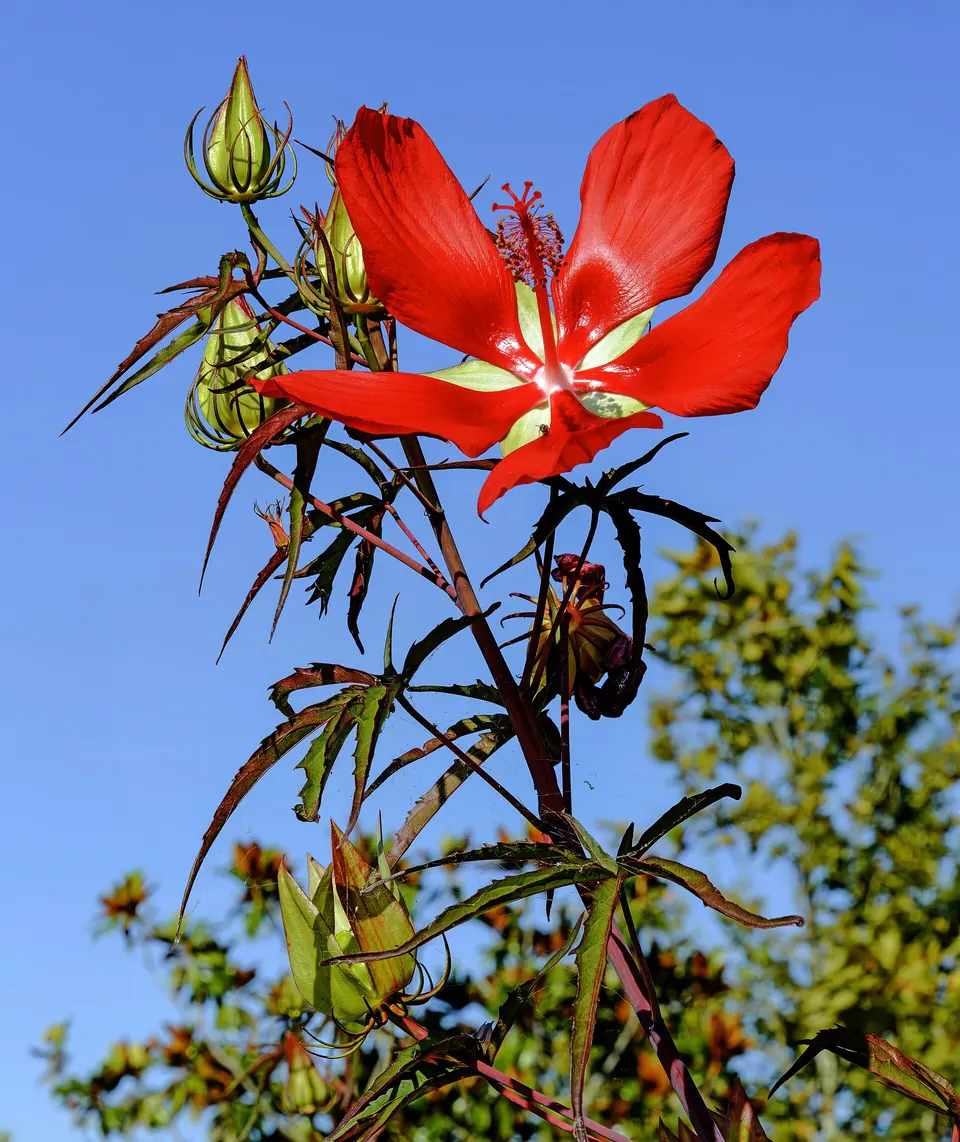
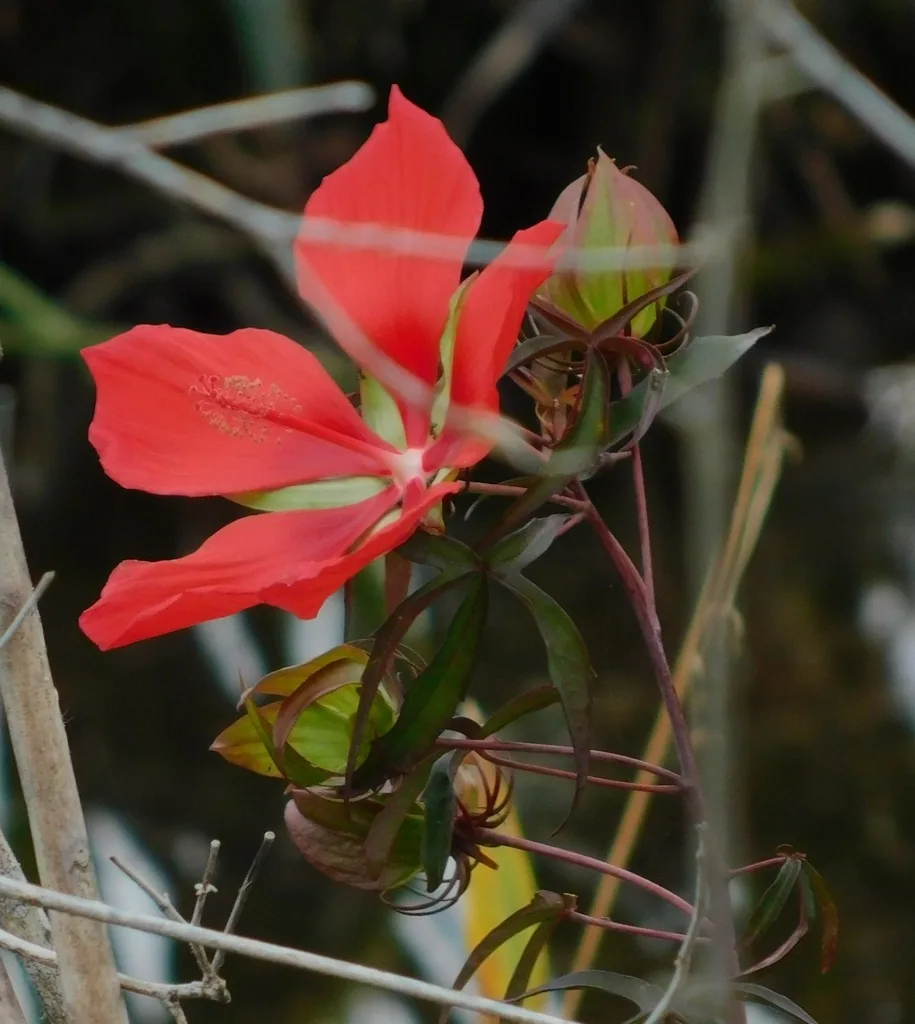

How to Grow and Care for Scarlet Rose Mallow
Hibiscus coccineus
Written by Emilio Marruso · last checked
At a glance
This perennial hibiscus fits easily into your garden: it grows in full sun or partial shade, and even in a container. Once established, it only needs a deep watering when the soil is dry 2 inches down. You can start it from seed, stem cuttings or division, so one plant can soon become many to share with friends.
- Sun
Full sun to partial shade
What the sources say (2)
Light: Full sun to partial shade
Plant in locations with full sun to partial shade and with moist, occasionally wet soils.
— Muenchhusia coccinea (Red Hibiscus, Scarlet Rose Mallow, Texas Hibiscus) | North Carolina Extension Gardener Plant Toolbox [1] This plant requires a full sun or partial shade location in the landscape.
— FPS-253 [2] - Water
Water deeply when the soil is dry 2 inches down; keep water off the leaves
What the sources say (3)
Watering: Once established, water deeply but infrequently whenever the soil surface is dry or almost dry 2 in [5.1 cm] below the surface
Once plant is established water deeply but infrequently whenever the soil surface is dry or almost dry 2” below the soil surface.
— Hibiscus coccineus – Sustainable Landscape Demonstration Garden [7] Watering notes: Keep soil moist but not soggy until established; avoid watering the leaves to prevent leaf spot
Keep soil moist but not soggy until plant is established.
— Hibiscus coccineus – Sustainable Landscape Demonstration Garden [7] Avoid watering leaves to avoid leaf spot.
— Hibiscus coccineus - Native Plant Society of Texas [6] - Spacing
2–3 ft between plants
What the sources say (1)
Spacing: 61.0-91.4 cm (24 to 36 inches)
Plant spacing: 24 to 36 inches
— FPS-253 [2] - Planting
In warm climates you can plant it any time of year
What the sources say (2)
Planting: Year-round in USDA zones 8-11
USDA zones 8-11: Planting month for zone 8: year-round Planting month for zone 9: year-round Planting month for zone 10 and 11: year-round
— FPS-253 [2] Planting month for zone 8: year-round Planting month for zone 9: year-round Planting month for zone 10 and 11: year-round
— FPS-253 [2] - Pruning
Prune in late winter or early spring
What the sources say (2)
Pruning: Late winter or early spring
May be pruned in late winter or early spring for bushier shape or it may need stakes for support.
— Hibiscus coccineus - Native Plant Society of Texas [6] Wait until the fear of frost has passed in the spring to prune back the plant.
— Scarlet Swamp Hibiscus | Home & Garden Information Center [3] - Pests
Aphids, scale, whiteflies, Japanese beetles and grasshoppers; also rust and leaf spots
What the sources say (3)
Pests: aphids, scale, whiteflies, Japanese beetle, stalk borer, grasshoppers
It has some susceptibility to blight, canker, rust, leaf spots, aphids, scale, whiteflies, and Japanese beetle.
— Muenchhusia coccinea (Red Hibiscus, Scarlet Rose Mallow, Texas Hibiscus) | North Carolina Extension Gardener Plant Toolbox [1] The scarlet rosemallow may be occasionally bothered by a stalk borer. Grasshoppers also enjoy chewing the foliage and flower buds.
— FPS-253 [2] Diseases: blight, canker, rust, leaf spots
It has some susceptibility to blight, canker, rust, leaf spots, aphids, scale, whiteflies, and Japanese beetle.
— Muenchhusia coccinea (Red Hibiscus, Scarlet Rose Mallow, Texas Hibiscus) | North Carolina Extension Gardener Plant Toolbox [1] - Propagation
From seed, stem cuttings or division
What the sources say (2)
- Sowing
Sow indoors 6–8 weeks before the last frost, or outdoors after frost in warm climates
What the sources say (1)
Sowing: Start seeds indoors 6-8 weeks before the last expected frost; sow outdoors after the risk of frost has passed in warmer climates
Start seeds indoors 6-8 weeks before the last expected frost. In warmer climates seeds can be sown directly outdoors after the risk of frost has passed.
— Hibiscus coccineus - Native Plant Society of Texas [6]
Overview
Hibiscus coccineus is an herbaceous perennial native to the southeastern United States that grows 6 to 8 feet [1.8–2.4 m] tall. [1] It grows in full sun to partial shade on moist, occasionally wet soils. [1] It is propagated by seed, stem cuttings or division. [1][2]
Scarlet Rose Mallow care
Measurements in square brackets are our conversion into the other unit system; the quoted text is unchanged.
How to water Scarlet Rose Mallow
Watering
Once established, water deeply but infrequently whenever the soil surface is dry or almost dry 2 in [5.1 cm] below the surface
What the sources say (1)
Once plant is established water deeply but infrequently whenever the soil surface is dry or almost dry 2” below the soil surface.Watering notes
Keep soil moist but not soggy until established; avoid watering the leaves to prevent leaf spot
How much light Scarlet Rose Mallow needs
Full sun to partial shade
What the sources say (2)
Plant in locations with full sun to partial shade and with moist, occasionally wet soils.This plant requires a full sun or partial shade location in the landscape.How much cold Scarlet Rose Mallow can take
Hardiness, coldest zone
The sources give different values depending on region, zone or growing conditions.
What each source says
According to NC State Extension: 5b-9b [winter low −26.1 to −1.1 °C (−15 to 30 °F)]
According to UF/IFAS Extension: 8-10 [winter low −12.2 to 4.4 °C (10 to 40 °F)]
According to Clemson HGIC: 6-10 [winter low −23.3 to 4.4 °C (−10 to 40 °F)]
According to Clemson Sustainable Landscape Demonstration Garden: 6-9 [winter low −23.3 to −1.1 °C (−10 to 30 °F)]
What the sources say (4)
According to NC State Extension: USDA Plant Hardiness Zone: 5b, 6b, 7a, 7b, 8a, 8b, 9a, 9bAccording to UF/IFAS Extension: USDA hardiness zones: 8 through 10According to Clemson HGIC: is hardy in USDA Zones 6 to 10According to Clemson Sustainable Landscape Demonstration Garden: Moisture: Medium to wet 4 Soil: Wet soil, tolerates poor drainage 13 Zones: 6-9 12Hardiness, warmest zone
The sources give different values depending on region, zone or growing conditions.
What each source says
According to NC State Extension: 5b-9b [winter low −26.1 to −1.1 °C (−15 to 30 °F)]
According to UF/IFAS Extension: 8-10 [winter low −12.2 to 4.4 °C (10 to 40 °F)]
According to Clemson HGIC: 6-10 [winter low −23.3 to 4.4 °C (−10 to 40 °F)]
According to Clemson Sustainable Landscape Demonstration Garden: 6-9 [winter low −23.3 to −1.1 °C (−10 to 30 °F)]
What the sources say (4)
According to NC State Extension: USDA Plant Hardiness Zone: 5b, 6b, 7a, 7b, 8a, 8b, 9a, 9bAccording to UF/IFAS Extension: USDA hardiness zones: 8 through 10According to Clemson HGIC: is hardy in USDA Zones 6 to 10According to Clemson Sustainable Landscape Demonstration Garden: Moisture: Medium to wet 4 Soil: Wet soil, tolerates poor drainage 13 Zones: 6-9 12Where to grow Scarlet Rose Mallow
In containers
Yes
Spacing
61.0-91.4 cm (24 to 36 inches)
What the sources say (1)
Plant spacing: 24 to 36 inchesHow to propagate Scarlet Rose Mallow
How to grow Scarlet Rose Mallow
The plant
Life cycle
perennial
What the sources say (1)
Scarlet rose mallow is an herbaceous perennial in the Malvaceae (mallow) family.Family
Malvaceae
What the sources say (1)
Scarlet rose mallow is an herbaceous perennial in the Malvaceae (mallow) family.Pests and diseases
Pests
aphids, scale, whiteflies, Japanese beetle, stalk borer, grasshoppers
What the sources say (2)
It has some susceptibility to blight, canker, rust, leaf spots, aphids, scale, whiteflies, and Japanese beetle.The scarlet rosemallow may be occasionally bothered by a stalk borer. Grasshoppers also enjoy chewing the foliage and flower buds.Diseases
blight, canker, rust, leaf spots
What the sources say (1)
It has some susceptibility to blight, canker, rust, leaf spots, aphids, scale, whiteflies, and Japanese beetle.Scarlet Rose Mallow pests and problems
Insect pests and fungal diseases
Symptom: Some susceptibility to blight, canker, rust, leaf spots, aphids, scale, whiteflies, and Japanese beetle
What to do: Avoid watering the leaves to avoid leaf spot
What the sources say (2)
It has some susceptibility to blight, canker, rust, leaf spots, aphids, scale, whiteflies, and Japanese beetle.
— Muenchhusia coccinea (Red Hibiscus, Scarlet Rose Mallow, Texas Hibiscus) | North Carolina Extension Gardener Plant Toolbox [1] Avoid watering leaves to avoid leaf spot.
— Hibiscus coccineus - Native Plant Society of Texas [6] Stalk borer and grasshoppers
Symptom: Plants may be occasionally bothered by a stalk borer; grasshoppers chew the foliage and flower buds and can spoil the flower display
What the sources say (1)
The scarlet rosemallow may be occasionally bothered by a stalk borer. Grasshoppers also enjoy chewing the foliage and flower buds.
— FPS-253 [2]
Remedies
Each remedy shows what official sources say about it; traditional remedies without an official source are marked as such. Harmful ones are listed so you know to avoid them.
Treating the plant
japanese beetle
handpicking into soapy water Works
How: Scout for beetles daily, handpick them and drop them into a solution of soapy water.
If only one or two plants in your landscape are affected, handpick beetles and dropping them into a can of soapy water.
— lancaster.unl.edu [8] What the evidence says scouting for beetles daily, handpicking them and dropping them into a solution of soapy water can be an effective control.
— lancaster.unl.edu [8]
aphids
insecticidal soap Works
Use only insecticidal soap if treating the plant (or horticultural oil), not any household soaps or detergents, as the latter may damage the plant’s tissues or won’t treat a pest very effectively.
— ask.extension.org [10] How: If caught early they are easily controlled with insecticidal soaps.
Scout your hibiscus regularly for pests such as aphids, whiteflies and mealybugs. These piercing sucking insects are usually found in clusters on leaves and flower buds. Scout by flipping leaves and looking for the pests or by noticing sooty mold growing on the honey dew produced. If caught early they are easily controlled with insecticidal soaps or horticulture oils.
— gardeningsolutions.ifas.ufl.edu [9] What the evidence says Scout your hibiscus regularly for pests such as aphids, whiteflies and mealybugs. These piercing sucking insects are usually found in clusters on leaves and flower buds. Scout by flipping leaves and looking for the pests or by noticing sooty mold growing on the honey dew produced. If caught early they are easily controlled with insecticidal soaps or horticulture oils.
— gardeningsolutions.ifas.ufl.edu [9]
whiteflies
horticulture oil Works
Use only insecticidal soap if treating the plant (or horticultural oil), not any household soaps or detergents, as the latter may damage the plant’s tissues or won’t treat a pest very effectively.
— ask.extension.org [10] How: If caught early they are easily controlled with horticulture oils.
Scout your hibiscus regularly for pests such as aphids, whiteflies and mealybugs. These piercing sucking insects are usually found in clusters on leaves and flower buds. Scout by flipping leaves and looking for the pests or by noticing sooty mold growing on the honey dew produced. If caught early they are easily controlled with insecticidal soaps or horticulture oils.
— gardeningsolutions.ifas.ufl.edu [9] What the evidence says Scout your hibiscus regularly for pests such as aphids, whiteflies and mealybugs. These piercing sucking insects are usually found in clusters on leaves and flower buds. Scout by flipping leaves and looking for the pests or by noticing sooty mold growing on the honey dew produced. If caught early they are easily controlled with insecticidal soaps or horticulture oils.
— gardeningsolutions.ifas.ufl.edu [9]
grasshoppers
squashing by hand Official source, not independently tested
How: Squash them between the hands in the evening as a means of mechanical control.
I usually squash them between my hands in the evening as a means of mechanical control.
— FPS-253 [2]
Calendar
Sowing
Start seeds indoors 6-8 weeks before the last expected frost; sow outdoors after the risk of frost has passed in warmer climates
What the sources say (1)
Start seeds indoors 6-8 weeks before the last expected frost. In warmer climates seeds can be sown directly outdoors after the risk of frost has passed.Planting
Year-round in USDA zones 8-11
What each source says
USDA zones 8-11: Year-round
What the sources say (2)
USDA zones 8-11: Planting month for zone 8: year-round Planting month for zone 9: year-round Planting month for zone 10 and 11: year-roundPlanting month for zone 8: year-round Planting month for zone 9: year-round Planting month for zone 10 and 11: year-roundPruning
Late winter or early spring
What the sources say (2)
May be pruned in late winter or early spring for bushier shape or it may need stakes for support.Wait until the fear of frost has passed in the spring to prune back the plant.Months as given by the sources, which are mostly from the United States (northern hemisphere). In the southern hemisphere they shift by about six months.
Indicative values
Values from a secondary source, not checked word for word like the rest of this page. Use them as a starting point.
- Hours of sun
- 6-8 hoursIndicative value, adapt it to your climate · Secondary source
- Drought tolerant
- yesIndicative value, adapt it to your climate · Secondary source
- Soil pH
- 6-7Indicative value, adapt it to your climate · Secondary source
- Care level
- MediumIndicative value, adapt it to your climate · Secondary source
- Growth rate
- HighIndicative value, adapt it to your climate · Secondary source
Similar plants
- Chinese Hibiscus Hibiscus × rosa-sinensis
- Cranberry Hibiscus Hibiscus acetosella
- Flower of an hour Hibiscus trionum
- Halberdleaf Rosemallow Hibiscus laevis
- Hamabo Hibiscus Hibiscus hamabo
- Heart-leaf Hibiscus Hibiscus martianus
- Rose of Sharon Hibiscus syriacus
- Sea hibiscus Hibiscus tiliaceus
Sources
Every value above is quoted from these documents. Links lead to the original publisher.
- Muenchhusia coccinea (Red Hibiscus, Scarlet Rose Mallow, Texas Hibiscus) | North Carolina Extension Gardener Plant Toolbox · plants.ces.ncsu.edu, consulted
- FPS-253 · edis.ifas.ufl.edu, consulted
- Scarlet Swamp Hibiscus | Home & Garden Information Center · hgic.clemson.edu, consulted
- Lady Bird Johnson Wildflower Center - The University of Texas at Austin · wildflower.org, consulted
-  · flawildflowers.org, consulted
- Hibiscus coccineus - Native Plant Society of Texas · npsot.org, consulted
- Hibiscus coccineus – Sustainable Landscape Demonstration Garden · blogs.clemson.edu, consulted
- lancaster.unl.edu · lancaster.unl.edu
- gardeningsolutions.ifas.ufl.edu · gardeningsolutions.ifas.ufl.edu
- ask.extension.org · ask.extension.org
Written by Emilio Marruso · last checked