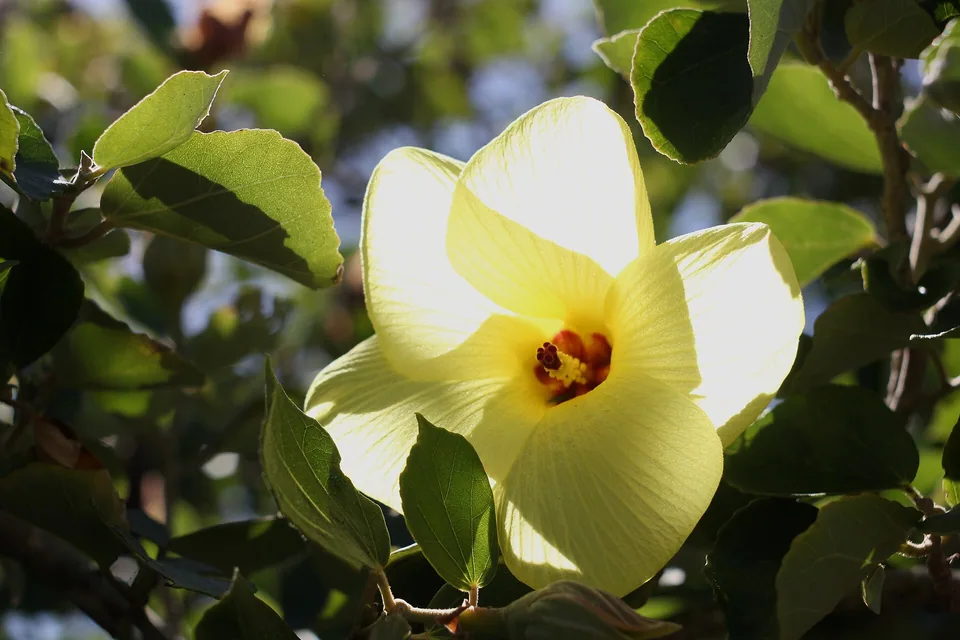


How to Grow and Care for Hamabo Hibiscus
Hibiscus hamabo
Written by Emilio Marruso · last checked
At a glance
This hibiscus is a generous perennial that can grow 6 to 15 feet tall and spread up to 15 feet wide. It is happy in full sun or partial shade, and once settled in it handles dry spells well, as long as the ground drains freely. You can grow it in a container too, and start new plants from seed or cuttings.
- Sun
Full sun to partial shade
What the sources say (1)
Light: Full sun to partial shade
Plant in full sun to partial shade and in an area with good drainage.
— Hibiscus hamabo (Hamabo Hibiscus, Hardy Yellow Hibiscus) | North Carolina Extension Gardener Plant Toolbox [1] - Water
Handles dry spells once it is settled in
What the sources say (1)
Watering: Drought tolerant once established
resistant to salt, and drought tolerant once established.
— Hibiscus hamabo (Hamabo Hibiscus, Hardy Yellow Hibiscus) | North Carolina Extension Gardener Plant Toolbox [1] - Cold
Survives winters down to 10 °F (−12.2 °C)
Hardy in cold winters · USDA 8a · RHS H5 · Z8
What the sources say (2)
Hardiness, coldest zone: 8a [winter low −12.2 to −9.4 °C (10 to 15 °F)]
USDA Plant Hardiness Zone: 8a, 8b, 9a, 9b, 10a, 10b, 11a, 11b, 12a, 12b
— Hibiscus hamabo (Hamabo Hibiscus, Hardy Yellow Hibiscus) | North Carolina Extension Gardener Plant Toolbox [1] Hardiness, warmest zone: 12b [winter low 12.8 to 15.6 °C (55 to 60 °F)]
USDA Plant Hardiness Zone: 8a, 8b, 9a, 9b, 10a, 10b, 11a, 11b, 12a, 12b
— Hibiscus hamabo (Hamabo Hibiscus, Hardy Yellow Hibiscus) | North Carolina Extension Gardener Plant Toolbox [1] - Soil
Plant it where the soil drains well
What the sources say (1)
Watering notes: Plant in an area with good drainage
Plant in full sun to partial shade and in an area with good drainage.
— Hibiscus hamabo (Hamabo Hibiscus, Hardy Yellow Hibiscus) | North Carolina Extension Gardener Plant Toolbox [1] - Pests
Aphids, scale, whiteflies and Japanese beetles; also rust, leaf spots, blight and canker
What the sources say (2)
Pests: aphids, scale, whiteflies, Japanese beetle, moth larvae
It has some susceptibility to blight, canker, rust, leaf spots, aphids, scale, whiteflies, and Japanese beetle. Taller plants may need staking. Moth larvae can bore into the fruit.
— Hibiscus hamabo (Hamabo Hibiscus, Hardy Yellow Hibiscus) | North Carolina Extension Gardener Plant Toolbox [1] Diseases: blight, canker, rust, leaf spots
It has some susceptibility to blight, canker, rust, leaf spots, aphids, scale, whiteflies, and Japanese beetle. Taller plants may need staking. Moth larvae can bore into the fruit.
— Hibiscus hamabo (Hamabo Hibiscus, Hardy Yellow Hibiscus) | North Carolina Extension Gardener Plant Toolbox [1] - Watch out
Taller plants may need a stake for support
- Size
6 to 15 ft tall and 10 to 15 ft wide
What the sources say (2)
Mature height: 182.88-457.2 cm (6-15 ft)
It grows 6 to 15 feet in height and 10 to 15 feet wide and has flowers that last from mid-spring through the first frost.
— Hibiscus hamabo (Hamabo Hibiscus, Hardy Yellow Hibiscus) | North Carolina Extension Gardener Plant Toolbox [1] Mature width: 304.8-457.2 cm (10-15 ft)
It grows 6 to 15 feet in height and 10 to 15 feet wide and has flowers that last from mid-spring through the first frost.
— Hibiscus hamabo (Hamabo Hibiscus, Hardy Yellow Hibiscus) | North Carolina Extension Gardener Plant Toolbox [1] - Propagation
Start new plants from seed or stem cuttings
What the sources say (1)
Propagation: Seed, stem cutting
Life Cycle: Perennial Woody Recommended Propagation Strategy: Seed Stem Cutting
— Hibiscus hamabo (Hamabo Hibiscus, Hardy Yellow Hibiscus) | North Carolina Extension Gardener Plant Toolbox [1] - Containers
Grows in containers too
What the sources say (1)
In containers: Yes
In cooler climates, they do well planted in large containers where they can be brought inside over the winter.
— Hibiscus hamabo (Hamabo Hibiscus, Hardy Yellow Hibiscus) | North Carolina Extension Gardener Plant Toolbox [1]
Overview
Hamabo hibiscus is a small broadleaf evergreen tree or large shrub native to China, Korea, and Japan. [1] It grows in full sun to partial shade with good drainage and is drought tolerant once established. [1] It does well in large containers in cooler climates and is susceptible to deer damage. [1]
This record is incomplete: the sources we read do not cover every field yet.
Not yet covered by our sources: Pruning
Hamabo Hibiscus care
How to water Hamabo Hibiscus
Watering
Drought tolerant once established
What the sources say (1)
resistant to salt, and drought tolerant once established.Watering notes
Plant in an area with good drainage
What the sources say (1)
Plant in full sun to partial shade and in an area with good drainage.How much light Hamabo Hibiscus needs
Full sun to partial shade
What the sources say (1)
Plant in full sun to partial shade and in an area with good drainage.How much cold Hamabo Hibiscus can take
Hardiness, coldest zone
8a [winter low −12.2 to −9.4 °C (10 to 15 °F)]
What the sources say (1)
USDA Plant Hardiness Zone:
8a, 8b, 9a, 9b, 10a, 10b, 11a, 11b, 12a, 12bHardiness, warmest zone
12b [winter low 12.8 to 15.6 °C (55 to 60 °F)]
What the sources say (1)
USDA Plant Hardiness Zone:
8a, 8b, 9a, 9b, 10a, 10b, 11a, 11b, 12a, 12bWhere to grow Hamabo Hibiscus
Yes
What the sources say (1)
In cooler climates, they do well planted in large containers where they can be brought inside over the winter.How to propagate Hamabo Hibiscus
Seed, stem cutting
What the sources say (1)
Life Cycle:
Perennial
Woody
Recommended Propagation Strategy:
Seed
Stem CuttingHow to grow Hamabo Hibiscus
The plant
Life cycle
perennial
What the sources say (1)
Life Cycle: Perennial Woody Recommended Propagation Strategy: Seed Stem CuttingFamily
Malvaceae
What the sources say (1)
Hamabo hibiscus is a small, broadleaf evergreen tree or large shrub native to China, Korea, and Japan and in the Malvaceae (mallow) family.Mature height
182.88-457.2 cm (6-15 ft)
What the sources say (1)
It grows 6 to 15 feet in height and 10 to 15 feet wide and has flowers that last from mid-spring through the first frost.Mature width
304.8-457.2 cm (10-15 ft)
What the sources say (1)
It grows 6 to 15 feet in height and 10 to 15 feet wide and has flowers that last from mid-spring through the first frost.Pests and diseases
Pests
aphids, scale, whiteflies, Japanese beetle, moth larvae
What the sources say (1)
It has some susceptibility to blight, canker, rust, leaf spots, aphids, scale, whiteflies, and Japanese beetle. Taller plants may need staking. Moth larvae can bore into the fruit.Diseases
blight, canker, rust, leaf spots
What the sources say (1)
It has some susceptibility to blight, canker, rust, leaf spots, aphids, scale, whiteflies, and Japanese beetle. Taller plants may need staking. Moth larvae can bore into the fruit.Hamabo Hibiscus pests and problems
Diseases and pests
Symptom: Susceptibility to blight, canker, rust, leaf spots, aphids, scale, whiteflies, Japanese beetle; moth larvae can bore into the fruit
What to do: Taller plants may need staking.
What the sources say (1)
It has some susceptibility to blight, canker, rust, leaf spots, aphids, scale, whiteflies, and Japanese beetle. Taller plants may need staking. Moth larvae can bore into the fruit.
— Hibiscus hamabo (Hamabo Hibiscus, Hardy Yellow Hibiscus) | North Carolina Extension Gardener Plant Toolbox [1]
Remedies
Each remedy shows what official sources say about it; traditional remedies without an official source are marked as such. Harmful ones are listed so you know to avoid them.
Treating the plant
japanese beetles
hand picking into soapy water Partly works
How: Hand pick the beetles and discard them in a pail of soapy water.
Hand pick the beetles and discard them in a pail of soapy water.
— ask.extension.org [4] What the evidence says Reall recommends tapping beetles off plants by hand and putting them in a bucket of soapy water to kill them.
— extension.missouri.edu [5]
aphids
water stream from shower Partly works
How: Put the plant in the shower or tub and use a stream of water to dislodge and wash away the aphids.
One option is to put the plant in the shower or tub and use a stream of water to dislodge and wash away the aphids.
— ask.extension.org [6] What the evidence says One option is to put the plant in the shower or tub and use a stream of water to dislodge and wash away the aphids.
— ask.extension.org [6] insecticidal soap spray Partly works
How: Apply repeated sprays of insecticidal soap, diluted and applied according to label directions.
You can also apply repeated sprays of insecticidal soap, diluted and applied according to label directions.
— ask.extension.org [6] What the evidence says You can also apply repeated sprays of insecticidal soap, diluted and applied according to label directions.
— ask.extension.org [6]
leaf spot
removing affected leaves and debris Works
How: Remove the worst-affected leaves and thoroughly clean up plant debris after frosts kill foliage.
As you have been doing, removing the worst-affected leaves is usually sufficient to help suppress re-infection during the growing season, as is a thorough cleaning-up of plant debris after frosts kill foliage.
— ask.extension.org [7] What the evidence says As you have been doing, removing the worst-affected leaves is usually sufficient to help suppress re-infection during the growing season, as is a thorough cleaning-up of plant debris after frosts kill foliage.
— ask.extension.org [7] watering the soil only Official source, not independently tested
How: Avoid wetting leaves and water only the soil.
If you irrigate during drought, avoid wetting leaves and instead only water the soil, since prolonged leaf wetness encourages infection
— ask.extension.org [7]
Calendar
Pruning
Not stated in the sources we read.
Months as given by the sources, which are mostly from the United States (northern hemisphere). In the southern hemisphere they shift by about six months.
Similar plants
- Chinese Hibiscus Hibiscus × rosa-sinensis
- Cranberry Hibiscus Hibiscus acetosella
- Flower of an hour Hibiscus trionum
- Halberdleaf Rosemallow Hibiscus laevis
- Heart-leaf Hibiscus Hibiscus martianus
- Rose of Sharon Hibiscus syriacus
- Scarlet Rose Mallow Hibiscus coccineus
- Sea hibiscus Hibiscus tiliaceus
Sources
Every value above is quoted from these documents. Links lead to the original publisher.
- Hibiscus hamabo (Hamabo Hibiscus, Hardy Yellow Hibiscus) | North Carolina Extension Gardener Plant Toolbox · plants.ces.ncsu.edu, consulted
- Hardy Yellow Hibiscus - Hibiscus hamabo | North Carolina Extension Gardener Plant Toolbox · plants.ces.ncsu.edu, consulted
- Find a Plant | North Carolina Extension Gardener Plant Toolbox · plants.ces.ncsu.edu, consulted
- ask.extension.org · ask.extension.org
- extension.missouri.edu · extension.missouri.edu
- ask.extension.org · ask.extension.org
- ask.extension.org · ask.extension.org
Written by Emilio Marruso · last checked