
How to Grow and Care for Flower of an hour
Hibiscus trionum
Written by Emilio Marruso · last checked
Toxic to: People · Why
At a glance
This little hibiscus loves full sun and warm, dry conditions, and it stays under 1.5 ft tall. Plant it in early summer, water it slowly and deeply when it doesn't rain, and it will grow happily in a container too. In some parts of the world, its young leaves, flowers and shoots are even eaten raw or cooked.
- Sun
Full sun
- Water
Water slowly and deeply when it doesn't rain; 2–3 in of mulch helps the soil stay moist
What the sources say (4)
Watering: Water slowly and deeply in the absence of rain; medium moisture
Water the plants slowly and deeply in the absence of rain, stopping when the water begins to run off.
— Flower Of An Hour Plant - Information On Hibiscus Flower Of An Hour | Gardening Know How [8] Light : Full Sun - Moisture : Medium Moisture - Maintenance : Moderate
— Flower-of-an-hour - Fine Gardening [7] Watering notes: Use 5-8 cm (2-3 in) of mulch to help the soil hold moisture; drought intolerant; needs well-drained soil
Use 2 to 3 inches (5-8 cm.) of mulch to help the soil hold moisture.
— Flower Of An Hour Plant - Information On Hibiscus Flower Of An Hour | Gardening Know How [8] Drainage well drained Tolerates Nutritionally Poor Soil No Drought intolerant
— Flower Of An Hour (Hibiscus trionum) — Practical Plants [4] - Cold
Survives winters down to 30 °F (−1.1 °C)
Half hardy: mild winters or an unheated greenhouse · USDA 10 · RHS H3 · Z10
What the sources say (4)
Hardiness, coldest zone: 10 [winter low −1.1 to 4.4 °C (30 to 40 °F)]
According to Fine Gardening: Plant Width : 1 to 3 feet - Zones : 10, 11 - Plant Type : Annuals
— Flower-of-an-hour - Fine Gardening [7] According to Practical Plants: Water moderate Hardiness Zone 10+ Soil textures sandy, loamy, clay
— Flower Of An Hour (Hibiscus trionum) — Practical Plants [4] Plant Width : 1 to 3 feet - Zones : 10, 11 - Plant Type : Annuals
— Flower-of-an-hour - Fine Gardening [7] Hardiness, warmest zone: 11 [winter low 4.4 to 10 °C (40 to 50 °F)]
Plant Width : 1 to 3 feet - Zones : 10, 11 - Plant Type : Annuals
— Flower-of-an-hour - Fine Gardening [7] - Soil
Well-drained soil
What the sources say (2)
Watering notes: Use 5-8 cm (2-3 in) of mulch to help the soil hold moisture; drought intolerant; needs well-drained soil
Use 2 to 3 inches (5-8 cm.) of mulch to help the soil hold moisture.
— Flower Of An Hour Plant - Information On Hibiscus Flower Of An Hour | Gardening Know How [8] Drainage well drained Tolerates Nutritionally Poor Soil No Drought intolerant
— Flower Of An Hour (Hibiscus trionum) — Practical Plants [4] - Planting
Plant in early summer
What the sources say (4)
Planting: Early summer (as an annual); early summer of the following year (as a perennial)
grown as an annual: If growing them as annuals, plant them out into their permanent positions in early summer and protect them with a frame or cloche until they are growing away well.
— Hibiscus trionum - Useful Temperate Plants [3] grown as a perennial: If hoping to grow them as perennials, then it is better to grow them on in the greenhouse for their first year and to plant them out in early summer of the following year.
— Hibiscus trionum - Useful Temperate Plants [3] If growing them as annuals, plant them out into their permanent positions in early summer and protect them with a frame or cloche until they are growing away well.
— Hibiscus trionum - Useful Temperate Plants [3] If hoping to grow them as perennials, then it is better to grow them on in the greenhouse for their first year and to plant them out in early summer of the following year.
— Hibiscus trionum - Useful Temperate Plants [3] - Harvest
Young leaves, flowers and shoots can be eaten raw or cooked
- Pests
Whiteflies, aphids, mealybugs and mites; it can also get rust and leaf spots
- Watch out
It spreads its seeds and can become weedy: pick off faded flowers
- Size
Up to 1.5 ft tall
What the sources say (1)
Mature height: up to 46 cm (1.5 ft)
General description: Spreading to erect plant reaching heights of 1.5 ft. The first two leaves are round with a toothed margin;
— Venice mallow | Integrated Crop Management [1] - Propagation
From seed or from cuttings of half-ripe stems
What the sources say (2)
Propagation: Seed; cuttings of half-ripe wood
Seed - sow early spring in a warm greenhouse. Germination is usually fairly rapid and no special pretreatment is needed
— Hibiscus trionum - Useful Temperate Plants [3] Cuttings of half-ripe wood, July/August in a frame. Overwinter them in a warm greenhouse and plant out after the last expected frosts.
— Flower Of An Hour (Hibiscus trionum) — Practical Plants [4] - Containers
Grows in containers too
What the sources say (1)
In containers: Yes
A seldom-seen annual or short-lived perennial, this easy-to-grow plant performs as the perfect filler in beds and containers.
— Flower-of-an-hour - Fine Gardening [7] - Safety
The oil in the seeds is thought to cause infertility in men if eaten
Overview
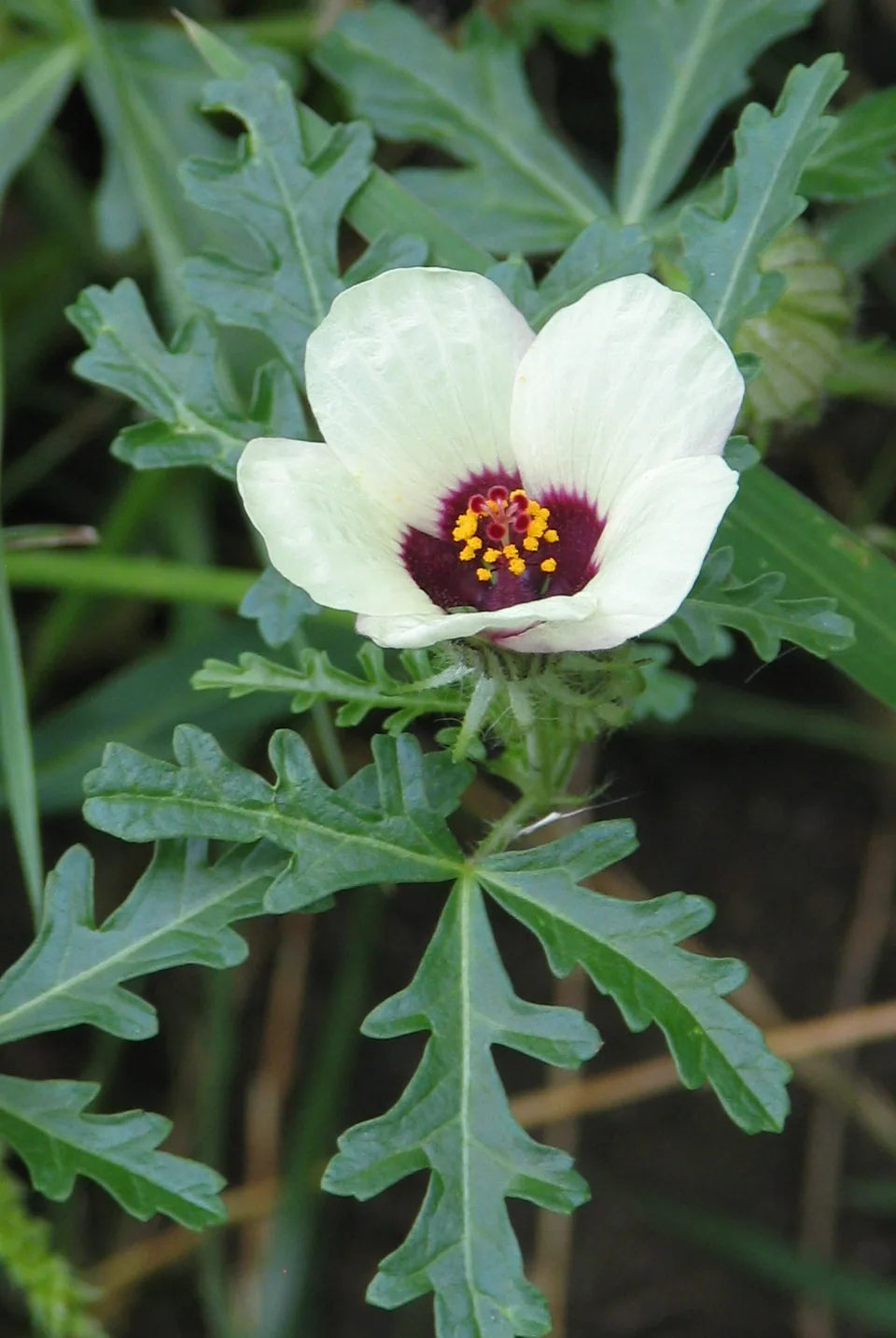
Flower-of-an-hour is an annual or short-lived perennial mallow whose cream flowers with a dark purple base last only part of a day. [7][1] It wants full sun and a well-drained, humus-rich, fertile soil, and is damaged or killed by a few degrees of frost. [3][4] It self-seeds vigorously and is recorded as a weed of crop fields. [8][6]
This record is incomplete: the sources we read do not cover every field yet.
Not yet covered by our sources: Pruning
Flower of an hour care
How to water Flower of an hour
Watering
Water slowly and deeply in the absence of rain; medium moisture
What the sources say (2)
Water the plants slowly and deeply in the absence of rain, stopping when the water begins to run off.Light :
Full Sun
-
Moisture :
Medium Moisture
-
Maintenance :
ModerateWatering notes
Use 5-8 cm (2-3 in) of mulch to help the soil hold moisture; drought intolerant; needs well-drained soil
What the sources say (2)
Use 2 to 3 inches (5-8 cm.) of mulch to help the soil hold moisture.Drainage
well drained
Tolerates Nutritionally Poor Soil
No
Drought
intolerantHow much light Flower of an hour needs
How much cold Flower of an hour can take
Hardiness, coldest zone
10 [winter low −1.1 to 4.4 °C (30 to 40 °F)]
What each source says
According to Fine Gardening: 10-11 [winter low −1.1 to 10 °C (30 to 50 °F)]
According to Practical Plants: 10 [winter low −1.1 to 4.4 °C (30 to 40 °F)]+
What the sources say (3)
According to Fine Gardening: Plant Width :
1 to 3 feet
-
Zones :
10, 11
-
Plant Type :
AnnualsAccording to Practical Plants: Water
moderate
Hardiness
Zone 10+
Soil textures
sandy, loamy, clayPlant Width :
1 to 3 feet
-
Zones :
10, 11
-
Plant Type :
AnnualsHardiness, warmest zone
11 [winter low 4.4 to 10 °C (40 to 50 °F)]
What the sources say (1)
Plant Width :
1 to 3 feet
-
Zones :
10, 11
-
Plant Type :
AnnualsWhere to grow Flower of an hour
Yes
What the sources say (1)
A seldom-seen annual or short-lived perennial, this easy-to-grow plant performs as the perfect filler in beds and containers.How to propagate Flower of an hour
Seed; cuttings of half-ripe wood
What the sources say (2)
Seed - sow early spring in a warm greenhouse. Germination is usually fairly rapid and no special pretreatment is neededCuttings of half-ripe wood, July/August in a frame. Overwinter them in a warm greenhouse and plant out after the last expected frosts.How to grow Flower of an hour
The plant
Life cycle
annual
Family
Malvaceae
What the sources say (1)
Venice mallow - Hibiscus trionum L.
Family: Malvaceae (mallow family)
Life cycle: AnnualMature height
up to 46 cm (1.5 ft)
What the sources say (1)
General description: Spreading to erect plant reaching heights of 1.5 ft. The first two leaves are round with a toothed margin;Heat and drought
Drought
Thrives in warm, dry conditions; originated in the arid zones of the Old World Tropics
What the sources say (1)
It is believed to have originated in the arid zones of the Old World Tropics, and thrives in warm, dry conditions as a fast-growing, hardy annual which self-seeds readily.Flower of an hour pests and problems
Diseases
Symptom: Rust, fungal leaf spots, bacterial blight, Verticillium wilt, viruses, stem and root rots
What the sources say (1)
Problems Rust, fungal leaf spots, bacterial blight, Verticillium wilt, viruses, stem rots, root rots.
— Flower-of-an-hour - Fine Gardening [7] Pests
Symptom: Whiteflies, aphids, mealybugs, scale insects, mites, Japanese beetles and caterpillars
What the sources say (1)
Whiteflies, aphids, mealybugs, scale insects, mites, Japanese beetles, and caterpillars can also cause problems.
— Flower-of-an-hour - Fine Gardening [7] Self-seeding
Symptom: Seed pods scatter seed throughout the garden and the plant can become weedy
What to do: Picking off faded blossoms prevents self-sowing
What the sources say (1)
Picking off faded blossoms may help prolong the bloom season and prevents self- sowing , but it may be more trouble than it's worth
— Flower Of An Hour Plant - Information On Hibiscus Flower Of An Hour | Gardening Know How [8]
Remedies
Each remedy shows what official sources say about it; traditional remedies without an official source are marked as such. Harmful ones are listed so you know to avoid them.
Treating the plant
self-seeding
picking off faded blossoms Not verified
Traditional remedy, not verified by an official source.
How: Pick off faded blossoms: it prolongs the bloom season and prevents self-sowing, though it can be a lot of work given the number of blossoms.
Getting rid of it
weedy venice mallow
hand pulling or hoe-cutting in first bloom Works
How: Prevent seed production by hand pulling or hoe-cutting the plants while in first bloom.
Prevent seed production by hand pulling or hoe-cutting while in first bloom.
— chestofbooks.com [9] What the evidence says Regularly pulling, hoeing or mowing weeds and encouraging grass to grow and out-compete the weeds is an excellent solution.
— extension.usu.edu [10] cutting the plant off the taproot Works
How: Cultivation or cutting that separates the main plant from the taproot kills the plant.
Cultivation or cutting that cuts off the main plant from the taproot will kill the plant.
— nwcb.wa.gov [11] What the evidence says How Do I Control It? Cultivation or cutting that cuts off the main plant from the taproot will kill the plant.
— nwcb.wa.gov [11]
weed seed bank
well-tilled hoed crop on infested ground Not verified
Traditional remedy, not verified by an official source.
How: Ground where seeds have matured should be put to a well-tilled hoed crop.
Is Flower of an hour poisonous?
Reported by the source, quoted verbatim. This is not medical or veterinary advice: if a person or an animal may have eaten this plant, contact a poison control centre or a veterinarian.
The oil from the seed contains gossypol. It is believed that this substance, when ingested, causes reduced sperm levels and infertility in men
[3]- Poisonous parts
The oil from the seed contains gossypol. It is believed that this substance, when ingested, causes reduced sperm levels and infertility in men
[3]- Toxic principle
The seeds contain 22–24% of oil and a small quantity of gossypol.
[6]- Symptoms
The oil from the seed contains gossypol. It is believed that this substance, when ingested, causes reduced sperm levels and infertility in men
[3]
Calendar
Sowing
The sources give different values depending on region, zone or growing conditions.
What each source says
According to Fine Gardening: Indoors 4-6 weeks before the last frost, or outdoors after danger of frost has passed
According to Gardening Know How: Outdoors in fall; indoors 4-6 weeks before the last expected frost
According to Useful Temperate Plants (warm greenhouse): Early spring
What the sources say (6)
According to Fine Gardening: Propagation Sow seeds indoors 4 to 6 weeks before the last frost or outdoors after danger of frost has passed.According to Gardening Know How: You can get a head start by starting the seeds indoors four to six weeks before the last expected frost date .According to Useful Temperate Plants (warm greenhouse): Seed - sow early spring in a warm greenhouse. Germination is usually fairly rapid and no special pretreatment is neededPropagation Sow seeds indoors 4 to 6 weeks before the last frost or outdoors after danger of frost has passed.Sow seeds outdoors in fall and they will germinate in spring when the soil stays warm both day and night.Seed - sow early spring in a warm greenhouse. Germination is usually fairly rapid and no special pretreatment is neededPlanting
Early summer (as an annual); early summer of the following year (as a perennial)
What each source says
grown as an annual: Early summer
grown as a perennial: Early summer of the following year
What the sources say (4)
grown as an annual: If growing them as annuals, plant them out into their permanent positions in early summer and protect them with a frame or cloche until they are growing away well.grown as a perennial: If hoping to grow them as perennials, then it is better to grow them on in the greenhouse for their first year and to plant them out in early summer of the following year.If growing them as annuals, plant them out into their permanent positions in early summer and protect them with a frame or cloche until they are growing away well.If hoping to grow them as perennials, then it is better to grow them on in the greenhouse for their first year and to plant them out in early summer of the following year.Pruning
Not stated in the sources we read.
Months as given by the sources, which are mostly from the United States (northern hemisphere). In the southern hemisphere they shift by about six months.
Edibility
Reported by the source, quoted verbatim. Do not eat a plant on the basis of this page alone: identification mistakes can be dangerous.
Similar plants
- Chinese Hibiscus Hibiscus × rosa-sinensis
- Cranberry Hibiscus Hibiscus acetosella
- Halberdleaf Rosemallow Hibiscus laevis
- Hamabo Hibiscus Hibiscus hamabo
- Heart-leaf Hibiscus Hibiscus martianus
- Rose of Sharon Hibiscus syriacus
- Scarlet Rose Mallow Hibiscus coccineus
- Sea hibiscus Hibiscus tiliaceus
Sources
Every value above is quoted from these documents. Links lead to the original publisher.
- Venice mallow | Integrated Crop Management · crops.extension.iastate.edu, consulted
- Hibiscus trionum (HIBTR)[Overview]| EPPO Global Database · gd.eppo.int, consulted
- Hibiscus trionum - Useful Temperate Plants · temperate.theferns.info, consulted
- Flower Of An Hour (Hibiscus trionum) — Practical Plants · practicalplants.org, consulted
- Hibiscus trionum - Cambridge University Botanic Garden · botanic.cam.ac.uk, consulted
- Hibiscus trionum (PROTA) - Pl@ntUse · uses.plantnet-project.org, consulted
- Flower-of-an-hour - Fine Gardening · finegardening.com, consulted
- Flower Of An Hour Plant - Information On Hibiscus Flower Of An Hour | Gardening Know How · gardeningknowhow.com, consulted
- chestofbooks.com · chestofbooks.com
- extension.usu.edu · extension.usu.edu
- nwcb.wa.gov · nwcb.wa.gov
Written by Emilio Marruso · last checked