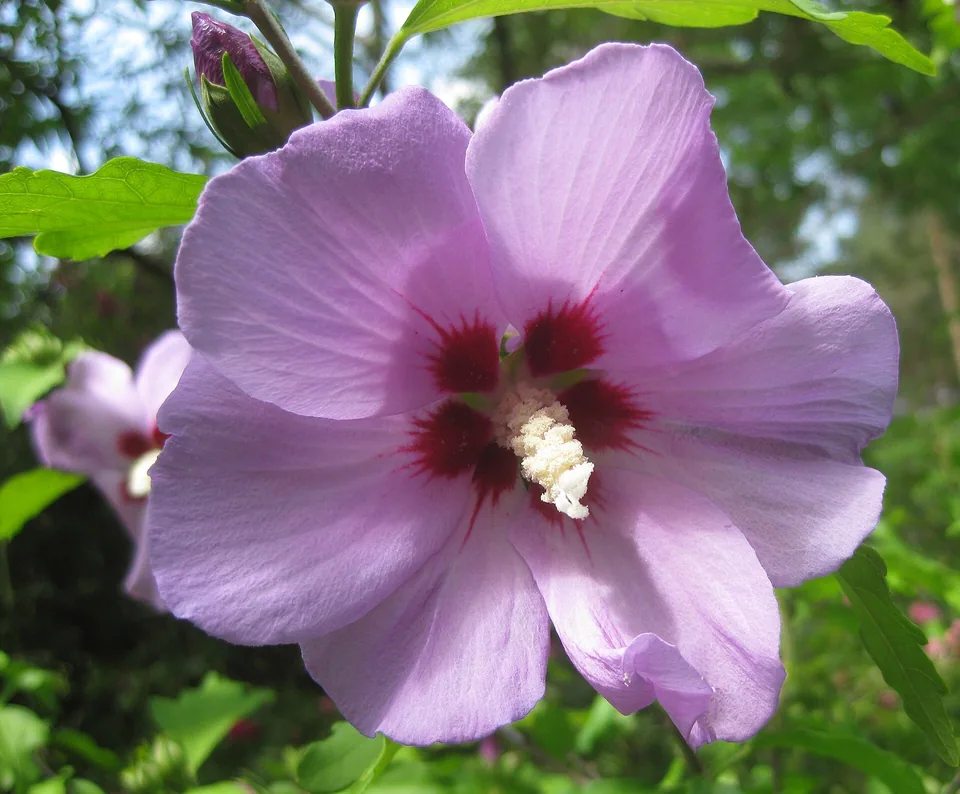


How to Grow and Care for Rose of Sharon
Hibiscus syriacus
Written by Emilio Marruso · last checked
At a glance
Rose of Sharon is an easygoing shrub that grows 8 to 12 feet tall and thrives in full sun or partial shade. It handles almost any soil except very wet or very dry, and it blooms on this year's growth, so a spring pruning keeps it tidy. Plant several 6 to 12 feet apart for a flowering hedge, and enjoy its edible flowers.
- Sun
Full sun to partial shade
What the sources say (1)
Light: Full sun to partial shade
Plant in locations with full sun to partial shade.
— Hibiscus syriacus (Hibiscus, Rose of China, Rose of Sharon, Rose-of-Sharon, Shrub Althea) | North Carolina Extension Gardener Plant Toolbox [1] - Water
Likes moist soil; handles everything except very wet or very dry conditions
What the sources say (1)
Watering: Moist, well-drained soils; tolerant of all except extremely wet or dry soils
It grows best in moist, well-drained soils but is tolerant of all except extremely wet or dry soils.
— Hibiscus syriacus (Hibiscus, Rose of China, Rose of Sharon, Rose-of-Sharon, Shrub Althea) | North Carolina Extension Gardener Plant Toolbox [1] - Cold
Survives winters down to −20 °F (−28.9 °C)
Very hardy · USDA 5a · RHS H7 · Z5
What the sources say (6)
Hardiness, coldest zone: 5a [winter low −28.9 to −26.1 °C (−20 to −15 °F)]
According to NC State Extension: 5a, 5b, 6a, 6b, 7a, 7b, 8a, 8b, 9a, 9b
— Hibiscus syriacus (Hibiscus, Rose of China, Rose of Sharon, Rose-of-Sharon, Shrub Althea) | North Carolina Extension Gardener Plant Toolbox [1] South Carolina (Clemson HGIC): It is hardy in USDA Zones 5-9.
— Hibiscus | Home & Garden Information Center [4] USDA Plant Hardiness Zone: 5a, 5b, 6a, 6b, 7a, 7b, 8a, 8b, 9a, 9b
— Hibiscus syriacus (Hibiscus, Rose of China, Rose of Sharon, Rose-of-Sharon, Shrub Althea) | North Carolina Extension Gardener Plant Toolbox [1] Hardiness, warmest zone: 9b [winter low −3.9 to −1.1 °C (25 to 30 °F)]
According to NC State Extension: 5a, 5b, 6a, 6b, 7a, 7b, 8a, 8b, 9a, 9b
— Hibiscus syriacus (Hibiscus, Rose of China, Rose of Sharon, Rose-of-Sharon, Shrub Althea) | North Carolina Extension Gardener Plant Toolbox [1] South Carolina (Clemson HGIC): It is hardy in USDA Zones 5-9.
— Hibiscus | Home & Garden Information Center [4] USDA Plant Hardiness Zone: 5a, 5b, 6a, 6b, 7a, 7b, 8a, 8b, 9a, 9b
— Hibiscus syriacus (Hibiscus, Rose of China, Rose of Sharon, Rose-of-Sharon, Shrub Althea) | North Carolina Extension Gardener Plant Toolbox [1] - Soil
Moist, well-drained soil
What the sources say (1)
Watering: Moist, well-drained soils; tolerant of all except extremely wet or dry soils
It grows best in moist, well-drained soils but is tolerant of all except extremely wet or dry soils.
— Hibiscus syriacus (Hibiscus, Rose of China, Rose of Sharon, Rose-of-Sharon, Shrub Althea) | North Carolina Extension Gardener Plant Toolbox [1] - Spacing
6–12 ft apart; plant several in a row for a hedge
What the sources say (1)
Spacing: 182.9-365.8 cm (6 to 12 feet apart, in multiples to create a hedge)
Plant in multiples 6 to 12 feet apart to create a hedge.
— Hibiscus syriacus (Hibiscus, Rose of China, Rose of Sharon, Rose-of-Sharon, Shrub Althea) | North Carolina Extension Gardener Plant Toolbox [1] - Feeding
Go easy: too much fertilizer and water make the buds drop
What the sources say (1)
Signs of excess: Bud drop (too much fertilizer and water)
Too much fertilizer and too much water can be a cause the buds to drop off.
— [5] - Pruning
Prune in winter or spring before new growth; it flowers on this year's shoots
What the sources say (5)
Pruning: Spring
Spring pruning will encourage flowers on new growth and will increase flower size.
— Hibiscus syriacus (Hibiscus, Rose of China, Rose of Sharon, Rose-of-Sharon, Shrub Althea) | North Carolina Extension Gardener Plant Toolbox [1] When to prune: Winter or spring, before new growth begins.
Prune them in the winter or spring before new growth begins; these plants develop flowers on growth produced during the spring. Examples are shrub roses, beautyberry, abelia, and rose of Sharon.
— [6] Spring pruning will encourage flowers on new growth and will increase flower size.
— Hibiscus syriacus (Hibiscus, Rose of China, Rose of Sharon, Rose-of-Sharon, Shrub Althea) | North Carolina Extension Gardener Plant Toolbox [1] Flowering wood: Flowers on new wood (this year's growth)
Prune them in the winter or spring before new growth begins; these plants develop flowers on growth produced during the spring. Examples are shrub roses, beautyberry, abelia, and rose of Sharon.
— [6] Spring pruning will encourage flowers on new growth and will increase flower size.
— Hibiscus syriacus (Hibiscus, Rose of China, Rose of Sharon, Rose-of-Sharon, Shrub Althea) | North Carolina Extension Gardener Plant Toolbox [1] - Harvest
The flowers are edible
- Pests
Aphids, whiteflies and Japanese beetles; also leaf spots and stem blight
What the sources say (3)
Pests: aphids, whiteflies, Japanese beetles
Insect pests of hibiscus include aphids, whiteflies, and Japanese beetles.
— Hibiscus | Home & Garden Information Center [4] - Watch out
Some varieties seed themselves readily, and it is invasive in some areas
- Size
8–12 ft tall and 6–10 ft wide
What the sources say (2)
Mature width: 183-305 cm (6 to 10 ft)
Width: 6 ft. 0 in. - 10 ft. 0 in.
— Hibiscus syriacus (Hibiscus, Rose of China, Rose of Sharon, Rose-of-Sharon, Shrub Althea) | North Carolina Extension Gardener Plant Toolbox [1] grows 8 to 10 feet tall and 6 to 10 feet wide. It is hardy in USDA Zones 5-9.
— Hibiscus | Home & Garden Information Center [4] - Sowing
Collect seed when the papery pods turn brown and split, then sow it in fall
What the sources say (1)
Saving seeds: Collect seed for fall sowing once the papery seed capsules brown and start to split.
Collect seed for fall sowing once the papery seed capsules brown and start to split.
— Hibiscus | Home & Garden Information Center [4]
Overview
Rose of Sharon is a rapidly growing deciduous shrub or tree that grows 8 to 12 feet [2.4–3.7 m] tall. [1] It is planted in full sun to partial shade and grows best in moist, well-drained soils. [1] Spring pruning encourages flowers on new growth, and the plant has been reported to be invasive in some states. [1]
This record is incomplete: the sources we read do not cover every field yet.
Not yet covered by our sources: Propagation
Rose of Sharon care
Measurements in square brackets are our conversion into the other unit system; the quoted text is unchanged.
How to water Rose of Sharon
Moist, well-drained soils; tolerant of all except extremely wet or dry soils
What the sources say (1)
It grows best in moist, well-drained soils but is tolerant of all except extremely wet or dry soils.How much light Rose of Sharon needs
Full sun to partial shade
What the sources say (1)
Plant in locations with full sun to partial shade.How much cold Rose of Sharon can take
Hardiness, coldest zone
5a [winter low −28.9 to −26.1 °C (−20 to −15 °F)]
What each source says
According to NC State Extension: 5a [winter low −28.9 to −26.1 °C (−20 to −15 °F)]
South Carolina (Clemson HGIC): 5 [winter low −28.9 to −23.3 °C (−20 to −10 °F)]
What the sources say (3)
According to NC State Extension: 5a, 5b, 6a, 6b, 7a, 7b, 8a, 8b, 9a, 9bSouth Carolina (Clemson HGIC): It is hardy in USDA Zones 5-9.USDA Plant Hardiness Zone:
5a, 5b, 6a, 6b, 7a, 7b, 8a, 8b, 9a, 9bHardiness, warmest zone
9b [winter low −3.9 to −1.1 °C (25 to 30 °F)]
What each source says
According to NC State Extension: 9b [winter low −3.9 to −1.1 °C (25 to 30 °F)]
South Carolina (Clemson HGIC): 9 [winter low −6.7 to −1.1 °C (20 to 30 °F)]
What the sources say (3)
According to NC State Extension: 5a, 5b, 6a, 6b, 7a, 7b, 8a, 8b, 9a, 9bSouth Carolina (Clemson HGIC): It is hardy in USDA Zones 5-9.USDA Plant Hardiness Zone:
5a, 5b, 6a, 6b, 7a, 7b, 8a, 8b, 9a, 9bWhere to grow Rose of Sharon
182.9-365.8 cm (6 to 12 feet apart, in multiples to create a hedge)
What the sources say (1)
Plant in multiples 6 to 12 feet apart to create a hedge.How to propagate Rose of Sharon
Not stated in the sources we read.
How to grow Rose of Sharon
The plant
Life cycle
perennial (woody, deciduous shrub or small tree)
What the sources say (2)
Plant Type: Perennial Shrub TreeRose of Sharon is a rapidly growing, large, deciduous shrub or tree in the Malvaceae (mallow) familyFamily
Malvaceae
What the sources say (1)
Rose of Sharon is a rapidly growing, large, deciduous shrub or tree in the Malvaceae (mallow) familyMature height
Mature width
183-305 cm (6 to 10 ft)
What the sources say (2)
Width: 6 ft. 0 in. - 10 ft. 0 in.grows 8 to 10 feet tall and 6 to 10 feet wide. It is hardy in USDA Zones 5-9.Harvest and storage
Saving seeds
Collect seed for fall sowing once the papery seed capsules brown and start to split.
What the sources say (1)
Collect seed for fall sowing once the papery seed capsules brown and start to split.Pests and diseases
Pests
aphids, whiteflies, Japanese beetles
What the sources say (1)
Insect pests of hibiscus include aphids, whiteflies, and Japanese beetles.Fertilizing
Signs of excess
Bud drop (too much fertilizer and water)
What the sources say (1)
Too much fertilizer and too much water can be a cause the buds to drop off.Pruning
Flowering wood
Flowers on new wood (this year's growth)
What the sources say (2)
Prune them in the winter or spring before new growth begins; these plants develop flowers on growth produced during the spring. Examples are shrub roses, beautyberry, abelia, and rose of Sharon.Spring pruning will encourage flowers on new growth and will increase flower size.When to prune
Winter or spring, before new growth begins.
What the sources say (2)
Prune them in the winter or spring before new growth begins; these plants develop flowers on growth produced during the spring. Examples are shrub roses, beautyberry, abelia, and rose of Sharon.Spring pruning will encourage flowers on new growth and will increase flower size.Rose of Sharon pests and problems
Invasiveness
Symptom: Reported to be invasive in some states, including Virginia and Kentucky.
What to do: No management given.
What the sources say (1)
Rose of Sharon has been reported to be invasive in some states, including Virginia and Kentucky.
— Hibiscus syriacus (Hibiscus, Rose of China, Rose of Sharon, Rose-of-Sharon, Shrub Althea) | North Carolina Extension Gardener Plant Toolbox [1] Self-seeding cultivars
Symptom: Some cultivars readily produce offspring from seed.
What to do: No management given.
What the sources say (1)
Be aware that some cultivars will readily produce offspring from seed.
— Hibiscus | Home & Garden Information Center [4]
Remedies
Each remedy shows what official sources say about it; traditional remedies without an official source are marked as such. Harmful ones are listed so you know to avoid them.
Treating the plant
aphids
hand-picking aphids Works
How: Squash aphids by hand if you see them in small numbers.
Manual Removal : Squash aphids by hand if you see them in small numbers.
— gardeningsolved.com [7] What the evidence says Many insect and disease issues can be solved in the home garden by hand-picking insects or clipping and disposing of diseased plant parts.
— extension.unh.edu [8] strong water spray Not verified
Traditional remedy, not verified by an official source.
How: Use a strong jet of water to dislodge aphids from the leaves.
attract ladybugs and green lacewings Not verified
Traditional remedy, not verified by an official source.
How: Encourage ladybugs and green lacewings by planting flowers nearby.
soap and water spray Harmful
Home remedies often lack specific mix or use rates or identify how often to use them.
— extension.psu.edu [9] Most dish soaps are not naturally occurring substances nor are they biodegradable.
— ucanr.edu [10] How: Soap and water sprays, as reported on the page.
Yes, you can use homemade remedies like soap and water sprays. These can effectively control pests without harming beneficial insects.
— gardeningsolved.com [7] What the evidence says For example, spraying home remedies that contain dish detergent on plants on a sunny day can injure the plant, essentially burning it.
— extension.psu.edu [9]
whiteflies
yellow sticky traps Not verified
Traditional remedy, not verified by an official source.
How: Place yellow sticky traps near the plants to catch adult whiteflies.
fungal diseases
neem oil spray Partly works
Neem Oil : Use this oil to suffocate the mites, but avoid applying it during blooming to protect pollinators.
— gardeningsolved.com [7] Many organic pesticides are less toxic than their synthetic counterparts, but that doesn’t mean they are safe or won’t cause environmental harm.
— extension.unh.edu [8] How: Horticultural oils, such as neem oil, applied at the first sign of disease and covering all plant surfaces, including the undersides of leaves.
Options include horticultural oils, such as neem oil, or copper-based sprays, which are effective against many common fungal pathogens.
— scienceinsights.org [11] What the evidence says However, neem oil is not effective against every insect and disease, and often must be frequently reapplied to reach the desired outcome.
— extension.unh.edu [8] water at the base of the plant Not verified
Traditional remedy, not verified by an official source.
How: Water deeply at the base of the plant, allowing the top layer of soil to dry between waterings.
leaf spot
clean up plant debris and remove diseased leaves Works
How: Clean up plant debris and remove infected leaves.
Leaf spots may be caused by several fungi. In most cases, cleaning up plant debris and removing infected leaves will provide adequate control.
— Hibiscus | Home & Garden Information Center [4] What the evidence says Many insect and disease issues can be solved in the home garden by hand-picking insects or clipping and disposing of diseased plant parts.
— extension.unh.edu [8]
leaf rust
cut back and destroy infected tissue Not verified
Traditional remedy, not verified by an official source.
How: Cut back all infected plant tissues and destroy them.
southern blight
keep mulch off the stems Official source, not independently tested
How: Keep mulch from touching the stems.
To help prevent southern blight, keep mulch from touching the stems.
— Hibiscus | Home & Garden Information Center [4]
Calendar
Pruning
Spring
What the sources say (1)
Spring pruning will encourage flowers on new growth and will increase flower size.Months as given by the sources, which are mostly from the United States (northern hemisphere). In the southern hemisphere they shift by about six months.
Relative to frost
Less precise estimate: there is no weather station within 300 km.
Find frost dates by ZIP code or city
Sow indoors: 12 weeks before the last frost
Seed can be sown indoors 12 weeks before the last spring frost.
— Hibiscus | Home & Garden Information Center [4] Sow outdoors: around the last frost
Seed can also be sown in place outdoors after the last expected frost date
— Hibiscus | Home & Garden Information Center [4]
Count from the average frost dates where you live.
Edibility
Reported by the source, quoted verbatim. Do not eat a plant on the basis of this page alone: identification mistakes can be dangerous.
Flowers are edible. Dimensions: Height: 8 ft. 0 in. - 12 ft. 0 in.
[1]
Indicative values
Values from a secondary source, not checked word for word like the rest of this page. Use them as a starting point.
- Hours of sun
- 6-8 hoursIndicative value, adapt it to your climate · Secondary source
- Drought tolerant
- yesIndicative value, adapt it to your climate · Secondary source
- Soil
- Humus rich, Well-drainedIndicative value, adapt it to your climate · Secondary source
- Soil pH
- 6-7.5Indicative value, adapt it to your climate · Secondary source
- Growth rate
- ModerateIndicative value, adapt it to your climate · Secondary source
- Propagation
- Greenwood Cuttings, Layering PropagationIndicative value, adapt it to your climate · Secondary source
Similar plants
- Chinese Hibiscus Hibiscus × rosa-sinensis
- Cranberry Hibiscus Hibiscus acetosella
- Flower of an hour Hibiscus trionum
- Halberdleaf Rosemallow Hibiscus laevis
- Hamabo Hibiscus Hibiscus hamabo
- Heart-leaf Hibiscus Hibiscus martianus
- Scarlet Rose Mallow Hibiscus coccineus
- Sea hibiscus Hibiscus tiliaceus
Sources
Every value above is quoted from these documents. Links lead to the original publisher.
- Hibiscus syriacus (Hibiscus, Rose of China, Rose of Sharon, Rose-of-Sharon, Shrub Althea) | North Carolina Extension Gardener Plant Toolbox · plants.ces.ncsu.edu, consulted
- Hibiscus - Hibiscus syriacus | North Carolina Extension Gardener Plant Toolbox · plants.ces.ncsu.edu, consulted
- Find a Plant | North Carolina Extension Gardener Plant Toolbox · plants.ces.ncsu.edu, consulted
- Hibiscus | Home & Garden Information Center · hgic.clemson.edu, consulted
- ask.extension.org · ask.extension.org
- extension.umd.edu · extension.umd.edu
- gardeningsolved.com · gardeningsolved.com
- extension.unh.edu · extension.unh.edu
- extension.psu.edu · extension.psu.edu
- ucanr.edu · ucanr.edu
- scienceinsights.org · scienceinsights.org
Written by Emilio Marruso · last checked