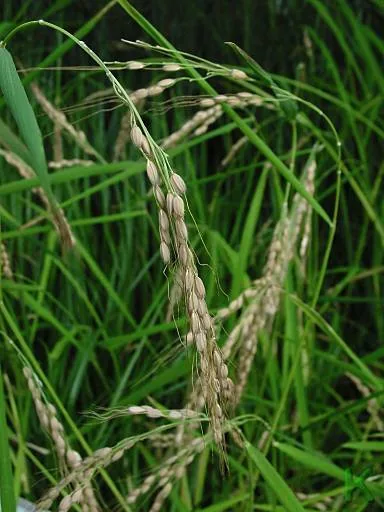
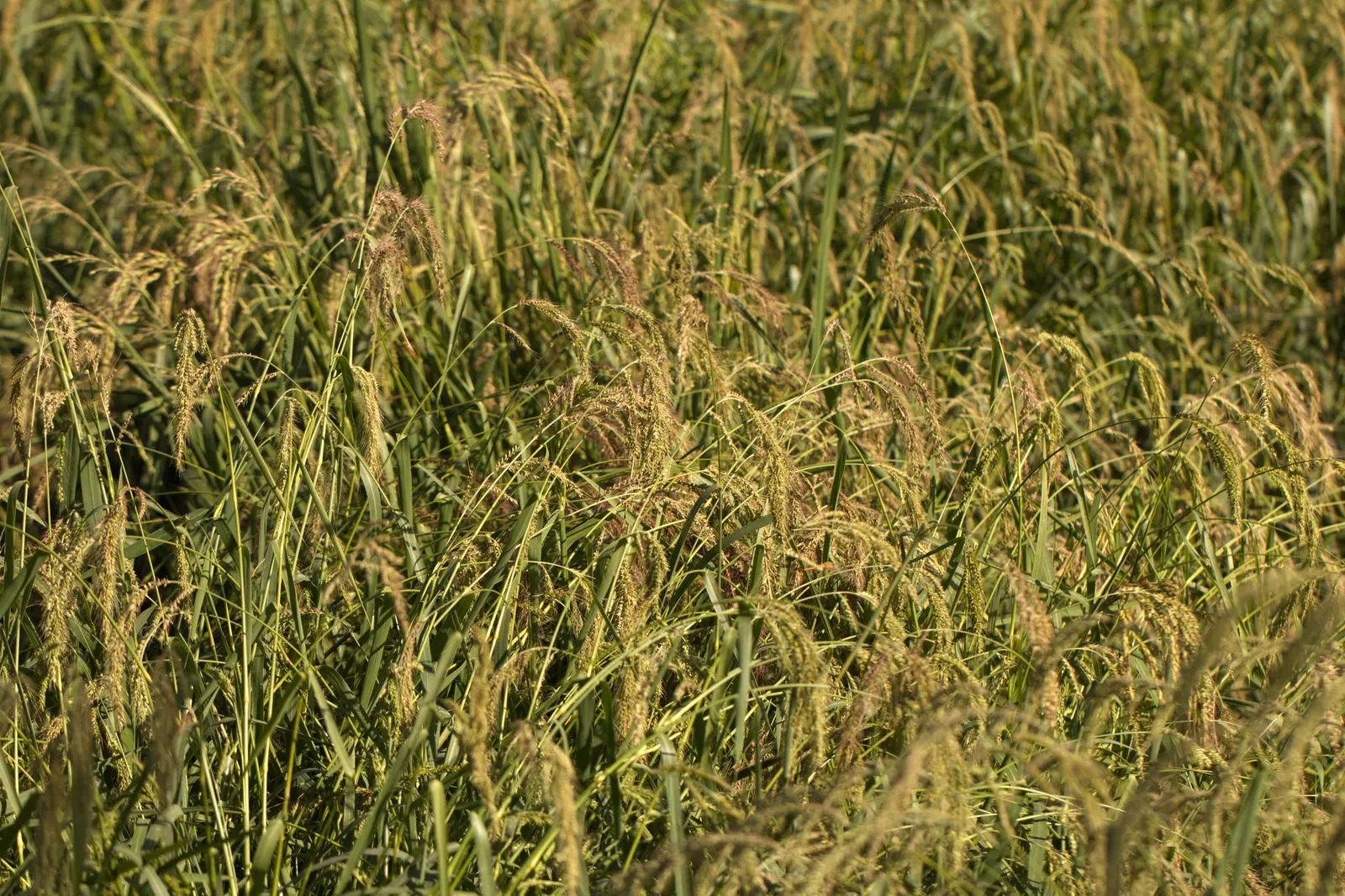

Cómo cultivar y cuidar Arroz
Oryza sativa
Escrito por Emilio Marruso · última revisión
De un vistazo
El arroz alimenta a más de la mitad de la población mundial, y cultivar el tuyo es una aventura preciosa. Mantén las plantas jóvenes con 2–5 cm de agua y dales un suelo con pH de 5 a 7. Cuando el 80–90 % de los granos se vuelvan amarillo dorado, llega el momento de cortar, trillar y secar una cosecha que has cultivado tú.
- Riego
Mantén 2–5 cm de agua, sobre todo al principio; deja que drene bien mientras se llena el grano
Qué dicen las fuentes (2)
Riego: Mantén el agua estancada a 2-5 cm [0,8–2 in], especialmente durante el crecimiento inicial.
Maintain adequate water levels, typically 2-5 cm, especially during the early stages of growth, to control weeds and support seedling establishment.
— Rice | Diseases and Pests, Description, Uses, Propagation [2] Notas sobre el riego: Asegura un drenaje adecuado durante la etapa de llenado del grano para evitar el encharcamiento
Ensure proper drainage during the grain-filling stage to avoid waterlogging and promote healthy grain development.
— Rice | Diseases and Pests, Description, Uses, Propagation [2] - Suelo
Suelo de ácido a neutro, pH 5–7
Qué dicen las fuentes (2)
pH del suelo, mínimo: 5
The optimal pH is between 5 and 7, though rice has been grown in fields with a PH between 3 and 10.
— Rice | Diseases and Pests, Description, Uses, Propagation [2] pH del suelo, máximo: 7
The optimal pH is between 5 and 7, though rice has been grown in fields with a PH between 3 and 10.
— Rice | Diseases and Pests, Description, Uses, Propagation [2] - Plantación
En climas cálidos, planta de noviembre a enero
Qué dicen las fuentes (2)
Plantación: Noviembre-enero
Sudeste asiático: are transplanted by hand into fl ooded paddies, usually between November and January in South-east Asia
— Tropical Horticulture © 2002 Jules Janick, Purdue University [1] are transplanted by hand into fl ooded paddies, usually between November and January in South-east Asia
— Tropical Horticulture © 2002 Jules Janick, Purdue University [1] - Abonado
Abona al plantar, al salir nuevos tallos y al formarse la espiga; el exceso de nitrógeno trae enfermedades
Qué dicen las fuentes (4)
Cuándo: Al plantar, al macollar y al inicio de la panícula
arroz trasplantado en Japón: A complete fertilizer is generally plowed down prior to fl ooding and hand planting of the seedling rice plants. Another topdressing is applied just before heading to increase yields.
— Tropical Horticulture © 2002 Jules Janick, Purdue University [1] Apply balanced fertilizers, including nitrogen, phosphorus, and potassium, at recommended stages typically at planting, tillering, and panicle initiation.
— Rice | Diseases and Pests, Description, Uses, Propagation [2] Evitar: Exceso de nitrógeno, que aumenta la susceptibilidad a la piriculariosis, la añublo bacteriano y otras enfermedades
If disease is not endemic to the region, blast can be controlled by planting resistant rice varieties; avoid over-fertilizing crop with nitrogen as this increases the plant's susceptibility to the disease
— Rice | Diseases and Pests, Description, Uses, Propagation [2] Bacterial blight can be effectively controlled by planting resistant rice varieties; avoid excessive nitrogen fertilization; plow stubble and straw into soil after harvest
— Rice | Diseases and Pests, Description, Uses, Propagation [2] - Cosecha
Cosecha cuando el 80–90 % de los granos estén dorados; corta, trilla y seca
Qué dicen las fuentes (2)
Cosecha: Cuando el 80-90% de los granos se han vuelto amarillo dorado
Harvesting rice involves timing the harvest when about 80-90% of the grains have turned golden yellow, indicating full maturity.
— Rice | Diseases and Pests, Description, Uses, Propagation [2] Cómo cosechar: Cosecha cuando alrededor del 80-90% de los granos hayan adquirido un color amarillo dorado, indicando plena madurez; corta manualmente con hoces o con cosechadoras combinadas, luego trilla y seca.
Harvesting rice involves timing the harvest when about 80-90% of the grains have turned golden yellow, indicating full maturity.
— Rice | Diseases and Pests, Description, Uses, Propagation [2] - Tamaño
De 1 a 1,8 m de alto
Qué dicen las fuentes (1)
Altura adulta: 100-180 cm (1-1.8 m)
can reach a height of between 1 and 1.8 m
— Rice | Diseases and Pests, Description, Uses, Propagation [2] - Multiplicación
Por semilla, sembrada directamente en el campo o en semillero y luego trasplantada
Qué dicen las fuentes (1)
Propagación: Semilla, siembra a voleo o en surcos directamente en el campo, o se cría en almácigos y se trasplanta
Rice is always propagated by seed, which may be either broadcast or drilled directly in the field, or the seedlings may be grown in nurseries and transplanted.
— Rice | Diseases and Pests, Description, Uses, Propagation [2]
Resumen
El arroz es una hierba anual cultivada por su grano, que prospera en terrenos saturados de agua o sumergidos durante el crecimiento. [2] Se propaga por semilla, sembrada directamente o criada en almácigos y trasplantada. [2]
Citado en inglés, como en la fuente.
Esta ficha está incompleta: las fuentes consultadas aún no cubren todos los campos.
Aún no cubierto por nuestras fuentes: Luz, Distancia de plantación
Cuidados
Las medidas entre corchetes son nuestra conversión al otro sistema de unidades; el texto citado no cambia.
Riego
Riego
Mantén el agua estancada a 2-5 cm [0,8–2 in], especialmente durante el crecimiento inicial.
Qué dicen las fuentes (1)
Maintain adequate water levels, typically 2-5 cm, especially during the early stages of growth, to control weeds and support seedling establishment.Notas sobre el riego
Asegura un drenaje adecuado durante la etapa de llenado del grano para evitar el encharcamiento
Qué dicen las fuentes (1)
Ensure proper drainage during the grain-filling stage to avoid waterlogging and promote healthy grain development.Luz
No figura en las fuentes consultadas.
Suelo
pH del suelo, mínimo
5
Qué dicen las fuentes (1)
The optimal pH is between 5 and 7, though rice has been grown in fields with a PH between 3 and 10.pH del suelo, máximo
7
Qué dicen las fuentes (1)
The optimal pH is between 5 and 7, though rice has been grown in fields with a PH between 3 and 10.Dónde cultivarla
No figura en las fuentes consultadas.
Propagación
Semilla, siembra a voleo o en surcos directamente en el campo, o se cría en almácigos y se trasplanta
Qué dicen las fuentes (1)
Rice is always propagated by seed, which may be either broadcast or drilled directly in the field, or the seedlings may be grown in nurseries and transplanted.Cultivo
La planta
Ciclo de vida
anual (puede ser perenne en condiciones tropicales)
Qué dicen las fuentes (2)
All rices are customarily grown as annuals, although under tropical conditions they may be perennial, perpetuated by new tillers or even rhizomes.Rice is an annual plant, harvested after one growing seasonAltura adulta
100-180 cm (1-1.8 m)
Qué dicen las fuentes (1)
can reach a height of between 1 and 1.8 mCosecha y conservación
Cómo cosechar
Cosecha cuando alrededor del 80-90% de los granos hayan adquirido un color amarillo dorado, indicando plena madurez; corta manualmente con hoces o con cosechadoras combinadas, luego trilla y seca.
Qué dicen las fuentes (1)
Harvesting rice involves timing the harvest when about 80-90% of the grains have turned golden yellow, indicating full maturity.Abonado
Cuándo
Al plantar, al macollar y al inicio de la panícula
Lo que dice cada fuente
arroz trasplantado en Japón: Fertilizante completo incorporado antes del riego y el trasplante; una aplicación de cobertera justo antes de la espigación
Qué dicen las fuentes (2)
arroz trasplantado en Japón: A complete fertilizer is generally plowed down prior to fl ooding and hand planting of the seedling rice plants. Another topdressing is applied just before heading to increase yields.Apply balanced fertilizers, including nitrogen, phosphorus, and potassium, at recommended stages typically at planting, tillering, and panicle initiation.Abonos naturales
Compost; abono verde (vicia) incorporado; en los arrozales asiáticos, el helecho acuático Azolla con algas verdeazules fijadoras de nitrógeno
Qué dicen las fuentes (2)
A green manure (vetch) is sometimes planted and plowed down. The paddy fi elds may also be used for a winter cropcompost and sewage have been used since ancient times to fertilize paddy fi elds. Symbiotic nitrogen fi xation by blue-green algae grow-ing in association with the water fern Azolla commonly maintains fertility in Asiatic paddy fi elds.Abonos minerales
Fertilizante equilibrado con nitrógeno, fósforo y potasio; nitrógeno a la dosis recomendada en aplicaciones divididas
Qué dicen las fuentes (2)
Apply balanced fertilizers, including nitrogen, phosphorus, and potassium, at recommended stages typically at planting, tillering, and panicle initiation.Grow resistant varieties. Treat the seeds with suitable fungicide. Apply only recommended quantity of nitrogen fertilizer in split dose.Evitar
Exceso de nitrógeno, que aumenta la susceptibilidad a la piriculariosis, la añublo bacteriano y otras enfermedades
Qué dicen las fuentes (2)
If disease is not endemic to the region, blast can be controlled by planting resistant rice varieties; avoid over-fertilizing crop with nitrogen as this increases the plant's susceptibility to the diseaseBacterial blight can be effectively controlled by planting resistant rice varieties; avoid excessive nitrogen fertilization; plow stubble and straw into soil after harvestRemedios
Cada remedio indica qué dicen las fuentes oficiales; los remedios tradicionales sin fuente oficial aparecen marcados. Los perjudiciales están para que sepas evitarlos.
Cuidar la planta
chinche del arroz
pulverización con extracto de semillas de neem No verificado
Remedio tradicional, no verificado por una fuente oficial.
Cómo: Pulveriza extracto de semillas de neem a 50 gramos por litro de agua.
enrollador de hojas del arroz
rociado con bacillus thuringiensis No verificado
Remedio tradicional, no verificado por una fuente oficial.
Cómo: Pulveriza Bacillus thuringiensis a 4 gramos por 10 litros de agua.
espaciamiento adecuado y nitrógeno controlado No verificado
Remedio tradicional, no verificado por una fuente oficial.
Cómo: Sigue el espaciado adecuado para evitar condiciones de sombra y controla la aplicación de nitrógeno.
gorgojo acuático del arroz
eliminación de malezas en los diques Funciona en parte
Cómo: Elimina la vegetación maleza en los diques en primavera, cerca de la época de siembra.
Eliminating weedy vegetation on levees in spring, near the time of seeding, can reduce rice water weevil infestations in fields and subsequent larvae.
— ipm.ucanr.edu [4] Qué dicen las pruebas Eliminating weedy vegetation on levees in spring, near the time of seeding, can reduce rice water weevil infestations in fields and subsequent larvae.
— ipm.ucanr.edu [4] inundación invernal Funciona en parte
Cómo: Inunda el campo en invierno para mejorar la descomposición de la paja y proporcionar hábitat para aves acuáticas.
Winter flooding of the field, to improve straw decomposition and provide waterfowl habitat, can help with weevil control and reduce numbers by about 50%.
— ipm.ucanr.edu [4] Qué dicen las pruebas Winter flooding of the field, to improve straw decomposition and provide waterfowl habitat, can help with weevil control and reduce numbers by about 50%.
— ipm.ucanr.edu [4]
Calendario
Noviembre-enero
Lo que dice cada fuente
Sudeste asiático: Noviembre-enero
Qué dicen las fuentes (2)
Sudeste asiático: are transplanted by hand into fl ooded paddies, usually between November and January in South-east Asiaare transplanted by hand into fl ooded paddies, usually between November and January in South-east AsiaCuando el 80-90% de los granos se han vuelto amarillo dorado
Qué dicen las fuentes (1)
Harvesting rice involves timing the harvest when about 80-90% of the grains have turned golden yellow, indicating full maturity.Meses tal como los dan las fuentes, en su mayoría de Estados Unidos (hemisferio norte). En el hemisferio sur se desplazan unos seis meses.
Comestibilidad
Según la fuente, citada textualmente. No comas una planta basándote solo en esta página: los errores de identificación pueden ser peligrosos.
Rice is a vital staple food for over half of the world's population
[2]
Plantas similares
- Bananero de Etiopía Ensete ventricosum
- Agretti Soda inermis
- Ají Capsicum chinense
- Apio caballar Smyrnium olusatrum
- Allium senescens Allium senescens
- Allium triquetrum Allium triquetrum
- Alpine dock Rumex alpinus
- Alpine mountain-sorrel Oxyria digyna
Fuentes
Cada valor anterior se cita de estos documentos. Los enlaces llevan al editor original.
- Tropical Horticulture © 2002 Jules Janick, Purdue University · hort.purdue.edu, consultado
- Rice | Diseases and Pests, Description, Uses, Propagation · plantvillage.psu.edu, consultado
- FESTIVAL CEREALIA XI EDIZIONE 2021 · unora.unior.it, consultado
- ipm.ucanr.edu · ipm.ucanr.edu
Escrito por Emilio Marruso · última revisión