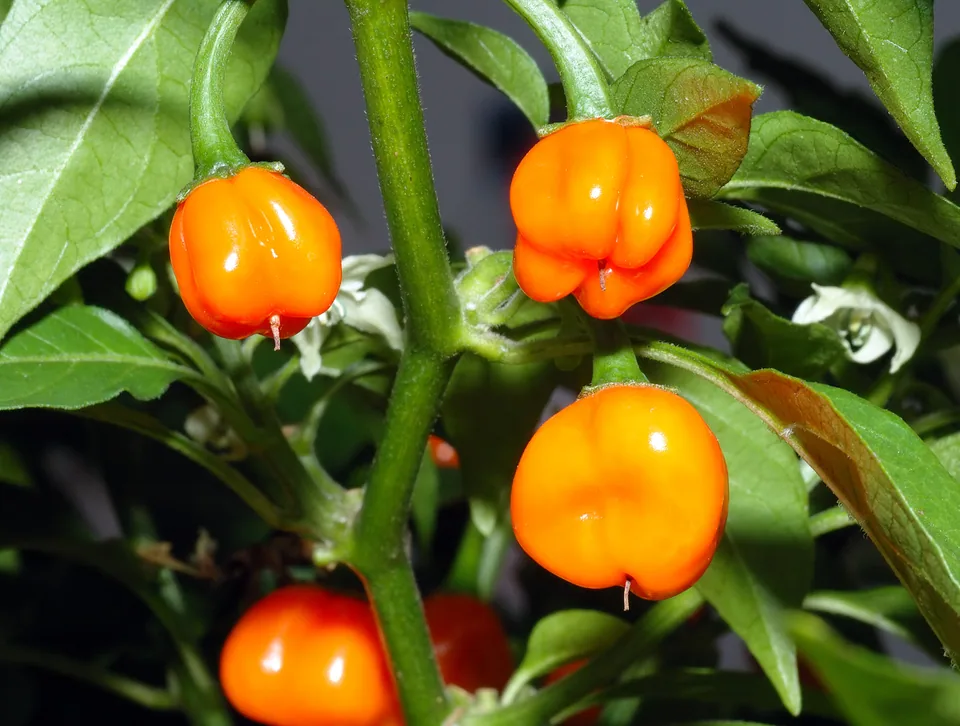


Cómo cultivar y cuidar Ají
Capsicum chinense
Escrito por Emilio Marruso · última revisión
Tóxica para: Aves, Personas · Por qué
De un vistazo
El pimiento datil se cultiva desde el siglo XVIII y sus frutos picantes acaban en salsas, guisos, mermeladas, jaleas y hasta polos. Trasplántalo cuando hayan pasado las heladas y las noches sean templadas, mantén la tierra húmeda de forma constante y los primeros pimientos llegarán de 8 a 10 semanas después del trasplante. También crece feliz en maceta.
- Riego
Mantén la tierra siempre húmeda; riega la tierra, no las hojas
Qué dicen las fuentes (8)
Riego: Tolera la sequía, aunque la sequía prolongada puede afectar la calidad de la fruta; mantén el suelo constantemente húmedo en lugar de dejar que se seque entre riegos
Según NC State Extension: These plants enjoy heat and tolerate drought, though prolonged drought may affect fruit quality.
— Capsicum chinense (Carolina Reaper, Habanero, Habanero Pepper, Habanero Type Pepper) | North Carolina Extension Gardener Plant Toolbox [1] Según Oregon State University Extension: Try to keep the soil consistently moist rather than allowing it to dry out between waterings.
— Grow your own peppers | OSU Extension Service [2] Según UF/IFAS (datil peppers, Florida): Hot peppers are relatively drought-tolerant, but you should water them regularly to keep them productive.
— Datil Peppers – Gardening Solutions [4] These plants enjoy heat and tolerate drought, though prolonged drought may affect fruit quality.
— Capsicum chinense (Carolina Reaper, Habanero, Habanero Pepper, Habanero Type Pepper) | North Carolina Extension Gardener Plant Toolbox [1] Try to keep the soil consistently moist rather than allowing it to dry out between waterings.
— Grow your own peppers | OSU Extension Service [2] Hot peppers are relatively drought-tolerant, but you should water them regularly to keep them productive.
— Datil Peppers – Gardening Solutions [4] Notas sobre el riego: Evita mojar las hojas con aspersores de arriba (usa riego por goteo o riega a mano en la superficie del suelo); las plantas en maceta pueden necesitar riego diario en clima cálido
Avoid wetting the leaves with overhead sprinklers. Instead, use drip irrigation (micro emitters, drip lines or soaker hoses) or hand water at the soil surface.
— Grow your own peppers | OSU Extension Service [2] Container plants may need daily irrigation in warm weather.
— Grow your own peppers | OSU Extension Service [2] - Frío
Aguanta inviernos de hasta −1,1 °C (30 °F)
Semirrústica: inviernos suaves o invernadero sin calefacción · USDA 10a · RHS H3 · Z10
Qué dicen las fuentes (2)
Rusticidad, zona más fría: 10a [mínima invernal de −1,1 a 1,7 °C (de 30 a 35 °F)]
USDA Plant Hardiness Zone: 10a, 10b, 11a, 11b
— Capsicum chinense (Carolina Reaper, Habanero, Habanero Pepper, Habanero Type Pepper) | North Carolina Extension Gardener Plant Toolbox [1] Rusticidad, zona más cálida: 11b [mínima invernal de 7,2 a 10 °C (de 45 a 50 °F)]
USDA Plant Hardiness Zone: 10a, 10b, 11a, 11b
— Capsicum chinense (Carolina Reaper, Habanero, Habanero Pepper, Habanero Type Pepper) | North Carolina Extension Gardener Plant Toolbox [1] - Suelo
Suelo de ligeramente ácido a neutro, pH 6,0–7,0
- Distancia
36–46 cm entre plantas, 61–91 cm entre hileras
Qué dicen las fuentes (2)
Distancia de plantación: 35.6-45.7 cm (14-18 pulgadas) de separación en la hilera; hileras a 61.0-91.4 cm (24-36 pulgadas) de separación
Make the transplant holes 3 to 4 inches deep and about 14 to 18 inches apart in the row. Space the rows 24 to 36 inches apart.
— Grow your own peppers | OSU Extension Service [2] Distancia entre hileras: 61-91 cm (24 a 36 pulgadas)
Make the transplant holes 3 to 4 inches deep and about 14 to 18 inches apart in the row. Space the rows 24 to 36 inches apart.
— Grow your own peppers | OSU Extension Service [2] - Plantación
Tras la última helada, con noches de al menos 13 °C y la tierra a 16 °C
Qué dicen las fuentes (6)
Plantación: Después de la última helada, cuando las temperaturas nocturnas sean al menos 55F y el suelo se haya calentado a al menos 60F; en Florida, después de la última helada en febrero o marzo
Según NC State Extension: Plant only when nighttime temperatures are at least 55F; seedlings may be started indoors earlier and transplanted at this time.
— Capsicum chinense (Carolina Reaper, Habanero, Habanero Pepper, Habanero Type Pepper) | North Carolina Extension Gardener Plant Toolbox [1] Según Oregon State University Extension: Delay transplant until the danger of frost is past and until the soil has warmed to at least 60°F.
— Grow your own peppers | OSU Extension Service [2] Florida: Be sure to plant after the last frost in the spring in either February or March.
— Datil Peppers – Gardening Solutions [4] Plant only when nighttime temperatures are at least 55F; seedlings may be started indoors earlier and transplanted at this time.
— Capsicum chinense (Carolina Reaper, Habanero, Habanero Pepper, Habanero Type Pepper) | North Carolina Extension Gardener Plant Toolbox [1] Delay transplant until the danger of frost is past and until the soil has warmed to at least 60°F.
— Grow your own peppers | OSU Extension Service [2] Be sure to plant after the last frost in the spring in either February or March.
— Datil Peppers – Gardening Solutions [4] - Abonado
La mitad antes del trasplante y la otra al florecer; con demasiado nitrógeno da hojas, no pimientos
Qué dicen las fuentes (7)
Cuándo: La mitad se incorpora al suelo al menos dos semanas antes del trasplante, y la otra mitad cuando las plantas comienzan a florecer.
fertilizantes orgánicos: Most organic fertilizers should be applied as a single application early in spring. Organic fertilizers can be purchased as a complete formulation (containing NPK) or as individual components (nitrogen, phosphorous or potassium-only).
— Grow your own peppers | OSU Extension Service [2] en contenedores: If fertilizer is not listed, then mix in a nitrogen fertilizer labeled for use with vegetables prior to transplanting. Apply fertilizer again when the plants begin to flower.
— Grow your own peppers | OSU Extension Service [2] Split your fertilizer into two applications. Work half of the recommended fertilizer amount into the top 4–6 inches of soil at least two weeks before transplanting.
— Grow your own peppers | OSU Extension Service [2] As soon as peppers begin to flower, fertilize again with the other half by sidedressing.
— Grow your own peppers | OSU Extension Service [2] Evitar: Exceso de fertilización con nitrógeno (crecimiento de las hojas a costa del fruto, pudrición del extremo del fruto); fertilizante que toca la planta.
Avoid overfertilizing with nitrogen, as this encourages leaf growth and can divert nutrients from the fruit.
— Grow your own peppers | OSU Extension Service [2] Use caution because too much nitrogen may encourage blossom end rot.
— Grow your own peppers | OSU Extension Service [2] This means to apply the fertilizer to the soil in a circle around the plant. Don’t let the fertilizer contact the plant.
— Grow your own peppers | OSU Extension Service [2] - Cosecha
Primeros pimientos 8–10 semanas tras el trasplante; cógelos con el rabito y usa guantes
Qué dicen las fuentes (7)
Cosecha: Los primeros pimientos 8 a 10 semanas después del trasplante; para los pimientos datil en Florida, la temporada de cosecha normalmente va de julio a noviembre
Según Oregon State University Extension: The first peppers should be ready eight to 10 weeks after transplanting.
— Grow your own peppers | OSU Extension Service [2] Florida: In three to five months, plants will begin producing peppers ready for harvest season, which normally runs from July through November.
— Datil Peppers – Gardening Solutions [4] The first peppers should be ready eight to 10 weeks after transplanting.
— Grow your own peppers | OSU Extension Service [2] In three to five months, plants will begin producing peppers ready for harvest season, which normally runs from July through November.
— Datil Peppers – Gardening Solutions [4] Cómo cosechar: Corta los pimientos de la planta, dejando el tallo unido al fruto; los pimientos picantes generalmente se cosechan en la etapa de madurez roja (el jalapeño y el ancho generalmente se cosechan verdes); usa guantes al cosechar y manipular.
Harvest peppers by breaking them from the plant, leaving the stem attached to the fruits.
— Grow your own peppers | OSU Extension Service [2] Hot peppers are usually harvested at the red ripe stage, with the exception of Jalapeño and Ancho, which are usually harvested green.
— Grow your own peppers | OSU Extension Service [2] It’s strongly recommended that you wear gloves when harvesting and handling your datil peppers.
— Datil Peppers – Gardening Solutions [4] - Plagas
Pulgones, moscas blancas y gusanos grises; vigila el virus del mosaico y la marchitez
Qué dicen las fuentes (8)
Plagas: pulgones, moscas blancas, gusanos cortadores, larvas de la mosca del pimiento, escarabajos de la patata de Colorado, picudos del pimiento, escarabajos pulga, chinches apestosas marmoradas
It is important to look out for aphids, whiteflies, cutworms, pepper maggots, and Colorado potato beetles.
— Capsicum chinense (Carolina Reaper, Habanero, Habanero Pepper, Habanero Type Pepper) | North Carolina Extension Gardener Plant Toolbox [1] Common pests include aphids and pepper weevils, which insert an egg at the base of the fruit and the larvae then cause the peppers to drop.
— Datil Peppers – Gardening Solutions [4] Flea beetle feeding can cause holes or other damage to pepper leaves.
— Grow your own peppers | OSU Extension Service [2] Brown marmorated stink bug can be an occasional pest of peppers.
— Grow your own peppers | OSU Extension Service [2] Enfermedades: marchitez por Verticillium, virus del mosaico, pudrición de raíz por Phytophthora, moho blanco, virus del marchitamiento manchado del tomate, virus del mosaico del tomate, virus del mosaico del tabaco
This plant is also sensitive to Verticillium wilt (a fungal pathogen) and mosaic virus
— Capsicum chinense (Carolina Reaper, Habanero, Habanero Pepper, Habanero Type Pepper) | North Carolina Extension Gardener Plant Toolbox [1] If your pepper patch is affected by Phytophthora root rot, verticillium wilt, white mold or others, you need careful management.
— Grow your own peppers | OSU Extension Service [2] Tomato spotted wilt virus is one of the most common viruses in peppers.
— Grow your own peppers | OSU Extension Service [2] Tomato mosaic virus and tobacco mosaic virus are related viruses that cause symptoms similar to herbicide damage.
— Grow your own peppers | OSU Extension Service [2] - Atención
Protege los frutos del sol de última hora de la tarde para evitar quemaduras
- Tamaño
De 30 a 61 cm de ancho
Qué dicen las fuentes (1)
Anchura adulta: 30-61 cm (1 a 2 pies)
Width: 1 ft. 0 in. - 2 ft. 0 in.
— Capsicum chinense (Carolina Reaper, Habanero, Habanero Pepper, Habanero Type Pepper) | North Carolina Extension Gardener Plant Toolbox [1] - Multiplicación
Por semilla o con plantel de vivero
Qué dicen las fuentes (2)
- Maceta
Crece en maceta; con calor puede necesitar riego a diario
Qué dicen las fuentes (4)
En maceta: Sí
Landscape Location: Container Landscape Theme: Drought Tolerant Garden
— Capsicum chinense (Carolina Reaper, Habanero, Habanero Pepper, Habanero Type Pepper) | North Carolina Extension Gardener Plant Toolbox [1] Peppers grow well in containers. You’ll get the best plant growth and fruit set when the container is big enough to support a large root system.
— Grow your own peppers | OSU Extension Service [2] Notas sobre el riego: Evita mojar las hojas con aspersores de arriba (usa riego por goteo o riega a mano en la superficie del suelo); las plantas en maceta pueden necesitar riego diario en clima cálido
Avoid wetting the leaves with overhead sprinklers. Instead, use drip irrigation (micro emitters, drip lines or soaker hoses) or hand water at the soil surface.
— Grow your own peppers | OSU Extension Service [2] Container plants may need daily irrigation in warm weather.
— Grow your own peppers | OSU Extension Service [2] - Seguridad
Irrita mucho la piel y los ojos; comido entero puede sentar mal al estómago
Resumen
Capsicum chinense es una especie de pimientos tipo habanero, cultivada por sus frutos picantes y de colores brillantes utilizados como alimento y especia. [1] Se cultiva en suelo rico, húmedo y bien drenado, tolera la sequía y se puede cultivar en contenedores. [1][2] Las plantas deben salir al exterior solo después de que haya pasado el peligro de las heladas y las noches sean cálidas. [1][2]
Citado en inglés, como en la fuente.
Cuidados
Riego
Riego
Tolera la sequía, aunque la sequía prolongada puede afectar la calidad de la fruta; mantén el suelo constantemente húmedo en lugar de dejar que se seque entre riegos
Lo que dice cada fuente
Según NC State Extension: Tolera la sequía; la sequía prolongada puede afectar la calidad de la fruta
Según Oregon State University Extension: Mantén el suelo constantemente húmedo en lugar de dejar que se seque entre riegos
Según UF/IFAS (datil peppers, Florida): Relativamente tolerante a la sequía; riega regularmente para mantener la productividad
Qué dicen las fuentes (6)
Según NC State Extension: These plants enjoy heat and tolerate drought, though prolonged drought may affect fruit quality.Según Oregon State University Extension: Try to keep the soil consistently moist rather than allowing it to dry out between waterings.Según UF/IFAS (datil peppers, Florida): Hot peppers are relatively drought-tolerant, but you should water them regularly to keep them productive.These plants enjoy heat and tolerate drought, though prolonged drought may affect fruit quality.Try to keep the soil consistently moist rather than allowing it to dry out between waterings.Hot peppers are relatively drought-tolerant, but you should water them regularly to keep them productive.Notas sobre el riego
Evita mojar las hojas con aspersores de arriba (usa riego por goteo o riega a mano en la superficie del suelo); las plantas en maceta pueden necesitar riego diario en clima cálido
Qué dicen las fuentes (2)
Avoid wetting the leaves with overhead sprinklers. Instead, use drip irrigation (micro emitters, drip lines or soaker hoses) or hand water at the soil surface.Container plants may need daily irrigation in warm weather.Luz
Las fuentes dan valores distintos según la región, la zona o las condiciones de cultivo.
Lo que dice cada fuente
Según NC State Extension: Pleno sol
Según Oregon State University Extension: Pleno sol durante al menos seis a ocho horas
Según UF/IFAS (datil peppers, Florida): 60% a 70% de sombra
Qué dicen las fuentes (3)
Según NC State Extension: Grow in rich, moist, well-drained soil in full sun.Según Oregon State University Extension: Chose a site that provides full sun for at least six to eight hours.Según UF/IFAS (datil peppers, Florida): Datil peppers prefer 60% to 70% shade and well-drained soil.Clima y frío
Rusticidad, zona más fría
10a [mínima invernal de −1,1 a 1,7 °C (de 30 a 35 °F)]
Qué dicen las fuentes (1)
USDA Plant Hardiness Zone:
10a, 10b, 11a, 11bRusticidad, zona más cálida
11b [mínima invernal de 7,2 a 10 °C (de 45 a 50 °F)]
Qué dicen las fuentes (1)
USDA Plant Hardiness Zone:
10a, 10b, 11a, 11bSuelo
pH del suelo, mínimo
6.0
Qué dicen las fuentes (1)
Peppers grow best at soil pH between 6.0 and 7.0.pH del suelo, máximo
7.0
Qué dicen las fuentes (1)
Peppers grow best at soil pH between 6.0 and 7.0.Dónde cultivarla
En maceta
Sí
Qué dicen las fuentes (2)
Landscape Location:
Container
Landscape Theme:
Drought Tolerant GardenPeppers grow well in containers. You’ll get the best plant growth and fruit set when the container is big enough to support a large root system.Distancia de plantación
35.6-45.7 cm (14-18 pulgadas) de separación en la hilera; hileras a 61.0-91.4 cm (24-36 pulgadas) de separación
Qué dicen las fuentes (1)
Make the transplant holes 3 to 4 inches deep and about 14 to 18 inches apart in the row. Space the rows 24 to 36 inches apart.Propagación
Semilla; trasplantes
Cultivo
La planta
Ciclo de vida
anual (se puede mantener como perenne en un invernadero cálido)
Qué dicen las fuentes (2)
In Oregon, peppers are usually grown as summer annuals, although they can be overwintered in greenhouses.Peppers can be grown as perennials in greenhouses if optimal temperatures are maintained.Familia
Solanáceas
Qué dicen las fuentes (1)
The genus of peppers, composed of species native across Central and South America, is in the Solanaceae (nightshade) familyAltura adulta
Anchura adulta
30-61 cm (1 a 2 pies)
Qué dicen las fuentes (1)
Width: 1 ft. 0 in. - 2 ft. 0 in.Siembra y crecimiento
Distancia entre hileras
61-91 cm (24 a 36 pulgadas)
Qué dicen las fuentes (1)
Make the transplant holes 3 to 4 inches deep and about 14 to 18 inches apart in the row. Space the rows 24 to 36 inches apart.Cosecha y conservación
Cómo cosechar
Corta los pimientos de la planta, dejando el tallo unido al fruto; los pimientos picantes generalmente se cosechan en la etapa de madurez roja (el jalapeño y el ancho generalmente se cosechan verdes); usa guantes al cosechar y manipular.
Qué dicen las fuentes (3)
Harvest peppers by breaking them from the plant, leaving the stem attached to the fruits.Hot peppers are usually harvested at the red ripe stage, with the exception of Jalapeño and Ancho, which are usually harvested green.It’s strongly recommended that you wear gloves when harvesting and handling your datil peppers.Conservación
Guarda los pimientos frescos de una a dos semanas; el almacenamiento ideal es en condiciones frescas y húmedas a 7-10 °C (45-50 °F) y 85-90% de humedad relativa; también puedes enlatarlos, secarlos, congelarlos o encurtirlos.
Qué dicen las fuentes (2)
In general, fresh peppers have a short storage life (one to two weeks). Cool, moist conditions (45°F–50°F) and 85%–90% relative humidity make for ideal storage.You can preserve peppers by canning, drying, freezing or pickling.Plagas y enfermedades
Plagas
pulgones, moscas blancas, gusanos cortadores, larvas de la mosca del pimiento, escarabajos de la patata de Colorado, picudos del pimiento, escarabajos pulga, chinches apestosas marmoradas
Qué dicen las fuentes (4)
It is important to look out for aphids, whiteflies, cutworms, pepper maggots, and Colorado potato beetles.Common pests include aphids and pepper weevils, which insert an egg at the base of the fruit and the larvae then cause the peppers to drop.Flea beetle feeding can cause holes or other damage to pepper leaves.Brown marmorated stink bug can be an occasional pest of peppers.Enfermedades
marchitez por Verticillium, virus del mosaico, pudrición de raíz por Phytophthora, moho blanco, virus del marchitamiento manchado del tomate, virus del mosaico del tomate, virus del mosaico del tabaco
Qué dicen las fuentes (4)
This plant is also sensitive to Verticillium wilt (a fungal pathogen) and mosaic virusIf your pepper patch is affected by Phytophthora root rot, verticillium wilt, white mold or others, you need careful management.Tomato spotted wilt virus is one of the most common viruses in peppers.Tomato mosaic virus and tobacco mosaic virus are related viruses that cause symptoms similar to herbicide damage.Abonado
Cuándo
La mitad se incorpora al suelo al menos dos semanas antes del trasplante, y la otra mitad cuando las plantas comienzan a florecer.
Lo que dice cada fuente
fertilizantes orgánicos: Una sola aplicación a principios de primavera.
en contenedores: Antes del trasplante, si la mezcla para macetas no tiene fertilizante, y nuevamente cuando las plantas comienzan a florecer.
Qué dicen las fuentes (4)
fertilizantes orgánicos: Most organic fertilizers should be applied as a single application early in spring. Organic fertilizers can be purchased as a complete formulation (containing NPK) or as individual components (nitrogen, phosphorous or potassium-only).en contenedores: If fertilizer is not listed, then mix in a nitrogen fertilizer labeled for use with vegetables prior to transplanting. Apply fertilizer again when the plants begin to flower.Split your fertilizer into two applications. Work half of the recommended fertilizer amount into the top 4–6 inches of soil at least two weeks before transplanting.As soon as peppers begin to flower, fertilize again with the other half by sidedressing.Frecuencia
Dos aplicaciones.
Lo que dice cada fuente
en contenedores: Dos aplicaciones durante la temporada de crecimiento.
Qué dicen las fuentes (2)
en contenedores: Apply fertilizer again when the plants begin to flower. Container plantings may need two fertilizer applications during the growing season.Split your fertilizer into two applications. Work half of the recommended fertilizer amount into the top 4–6 inches of soil at least two weeks before transplanting.Abonos naturales
Fertilizantes orgánicos, completos o de un solo nutriente, en una sola aplicación a principios de primavera.
Qué dicen las fuentes (1)
Most organic fertilizers should be applied as a single application early in spring. Organic fertilizers can be purchased as a complete formulation (containing NPK) or as individual components (nitrogen, phosphorous or potassium-only).Abonos minerales
Sin una prueba de suelo, un fertilizante equilibrado etiquetado para hortalizas o 16-16-16, dividido en dos: la mitad se incorpora a los 10.2–15.2 cm [4–6 in] superiores del suelo antes del trasplante, y la mitad se aplica en banda al florecer.
Lo que dice cada fuente
en contenedores: Fertilizante nitrogenado etiquetado para hortalizas, si la mezcla para macetas no tiene ninguno.
Qué dicen las fuentes (4)
en contenedores: If fertilizer is not listed, then mix in a nitrogen fertilizer labeled for use with vegetables prior to transplanting. Apply fertilizer again when the plants begin to flower.If a soil test result is not available, choose a balanced fertilizer such as one labeled for use on vegetables or with an NPK ratio of 16-16-16.Split your fertilizer into two applications. Work half of the recommended fertilizer amount into the top 4–6 inches of soil at least two weeks before transplanting.As soon as peppers begin to flower, fertilize again with the other half by sidedressing.Microelementos
El nitrato de calcio aplicado durante la temporada, con una humedad del suelo constante, ayuda a prevenir la pudrición del extremo del fruto.
Qué dicen las fuentes (1)
Calcium nitrate fertilizer applied throughout the season with consistent soil moisture will help to prevent blossom end rot.Evitar
Exceso de fertilización con nitrógeno (crecimiento de las hojas a costa del fruto, pudrición del extremo del fruto); fertilizante que toca la planta.
Qué dicen las fuentes (3)
Avoid overfertilizing with nitrogen, as this encourages leaf growth and can divert nutrients from the fruit.Use caution because too much nitrogen may encourage blossom end rot.This means to apply the fertilizer to the soil in a circle around the plant. Don’t let the fertilizer contact the plant.Signos de carencia
Pudrición del extremo del fruto: una zona oscura y hundida en la punta del fruto en crecimiento, causada con mayor frecuencia por un desequilibrio de agua que limita el movimiento del calcio.
Qué dicen las fuentes (2)
Blossom end rot is a physiological disorder that shows up in expanding fruit as a dark colored sunken area at the tip of the fruit.Most common is a water imbalance affecting the movement of calcium (key to healthy fruit) within the plant.Signos de exceso
Crecimiento excesivo de las hojas con nutrientes desviados del fruto; pudrición del extremo del fruto por exceso de nitrógeno.
Qué dicen las fuentes (2)
Avoid overfertilizing with nitrogen, as this encourages leaf growth and can divert nutrients from the fruit.Use caution because too much nitrogen may encourage blossom end rot.Problemas
Pulgones, moscas blancas, gusanos cortadores, larvas del pimiento, escarabajos de la patata de Colorado
Síntoma: Plagas comunes de los pimientos
Qué dicen las fuentes (1)
It is important to look out for aphids, whiteflies, cutworms, pepper maggots, and Colorado potato beetles.
— Capsicum chinense (Carolina Reaper, Habanero, Habanero Pepper, Habanero Type Pepper) | North Carolina Extension Gardener Plant Toolbox [1] Marchitez por Verticillium y virus del mosaico
Síntoma: El virus del mosaico produce un mosaico amarillo-verdoso uniforme en las hojas, seguido de marchitez
Qué dicen las fuentes (1)
This plant is also sensitive to Verticillium wilt (a fungal pathogen) and mosaic virus (which should show a uniform yellow-green mosaic across the leaves followed by wilt).
— Capsicum chinense (Carolina Reaper, Habanero, Habanero Pepper, Habanero Type Pepper) | North Carolina Extension Gardener Plant Toolbox [1] Podredumbre apical
Síntoma: Área hundida de color oscuro en la punta del fruto en crecimiento
Qué hacer: Mantén una humedad del suelo constante; evita fertilizar en exceso con nitrógeno
Qué dicen las fuentes (2)
Blossom end rot is a physiological disorder that shows up in expanding fruit as a dark colored sunken area at the tip of the fruit.
— Grow your own peppers | OSU Extension Service [2] Reduce problems by maintaining consistent soil moisture throughout the growing season. (Avoid excessive dry and wet cycles.) Avoid overfertilizing with nitrogen, as this encourages leaf growth and can divert nutrients from the fruit.
— Grow your own peppers | OSU Extension Service [2] Golpe de sol
Síntoma: Manchas marrones claras o blancas en las áreas del fruto expuestas al sol
Qué hacer: Endurece los trasplantes adecuadamente y añade malla de sombra para proteger los frutos maduros del sol de la tarde
Qué dicen las fuentes (2)
Sunscald shows up as light brown or white patches on areas of the fruit exposed to the sun.
— Grow your own peppers | OSU Extension Service [2] Reduce problems by properly hardening off transplants and add a shade cloth or screen to protect maturing fruit from the hottest late afternoon sun.
— Grow your own peppers | OSU Extension Service [2]
Remedios
Cada remedio indica qué dicen las fuentes oficiales; los remedios tradicionales sin fuente oficial aparecen marcados. Los perjudiciales están para que sepas evitarlos.
Primeros auxilios
Primeros auxilios: no sustituyen al médico
exposición ocular a la capsaicina
irrigar el ojo con agua tibia Fuente oficial, sin prueba independiente
To get expert help with an exposure, use the web POISON CONTROL online tool or call your poison center at 1-800-222-1222
— poison.org [5] If the person is experiencing any trouble breathing or chest discomfort, call 911
— poison.org [5] Cómo: Si el ojo ha sido afectado, el riego con abundante agua tibia durante 15 minutos es el primer paso; las compresas frías también pueden brindar alivio.
If the eye has been affected, irrigation with copious warm water for 15 minutes is the first step.
— poison.org [5]
quemadura de piel por capsaicina
Enjuaga con agua tibia y remoja con vinagre diluido Fuente oficial, sin prueba independiente
To get expert help with an exposure, use the web POISON CONTROL online tool or call your poison center at 1-800-222-1222
— poison.org [5] Wear rubber, latex, or nitrile gloves when working with hot peppers.
— poison.org [5] Cómo: Si la piel está expuesta, los enjuagues con agua tibia, el aceite vegetal, los remojos con vinagre diluido en agua y una preparación antiácida aplicada sobre la piel pueden ser útiles; la remoción de la fuente es fundamental.
If the skin is exposed, warm water flushes, vegetable oil, diluted vinegar with water soaks and an antacid preparation
— poison.org [5]
ingestión de capsaicina
sorbos de leche o agua Fuente oficial, sin prueba independiente
To get expert help with an exposure, use the web POISON CONTROL online tool or call your poison center at 1-800-222-1222
— poison.org [5] If the person is experiencing any trouble breathing or chest discomfort, call 911
— poison.org [5] Cómo: Los sorbos pequeños de leche o agua pueden ayudar a aliviar la sensación de ardor causada por comer capsaicina.
To help alleviate the burning sensation caused from eating capsaicin, small sips of milk or water may be helpful.
— poison.org [5]
Cuidar la planta
pulgones
chorro de agua Funciona
Cómo: Saca los pulgones de la planta con un chorro de agua.
Manage aphids by knocking them off the plant with a stream of water or using an insecticidal soap.
— Grow your own peppers | OSU Extension Service [2] Qué dicen las pruebas Manage aphids by knocking them off the plant with a stream of water or using an insecticidal soap.
— Grow your own peppers | OSU Extension Service [2] spray de jabón insecticida Funciona
Read all label directions for use and safety before applying the soap.
— Grow your own peppers | OSU Extension Service [2] Cómo: Rocía los pulgones con jabón insecticida, leyendo primero todas las instrucciones de la etiqueta para su uso y seguridad.
Manage aphids by knocking them off the plant with a stream of water or using an insecticidal soap.
— Grow your own peppers | OSU Extension Service [2] Qué dicen las pruebas insecticidal soap is a safe, effective organic insecticide with minimal environmental impact.
— extension.psu.edu [6]
podredumbre del extremo de la flor
cáscaras de huevo trituradas No demostrado
Cómo: Las cáscaras de huevo trituradas se añaden al jardín por su calcio.
Eggshells are commonly incorporated in gardens due to their presence of calcium, which tomatoes and peppers require to set mature, ripe fruit
— extension.illinois.edu [7] Qué dicen las pruebas Myth #1: Eggshells are a sufficient source of calcium to prevent blossom end rot
— extension.illinois.edu [7]
Venenosa para los animales
Según la fuente, citada textualmente. No es un consejo médico ni veterinario: si una persona o un animal pudo haber ingerido esta planta, contacta con un centro de toxicología o con un veterinario.
Animales
Birds are immune to the capsaicin in peppers and can safely eat the fruits with no ill effects.
[1]La fuente señala el riesgo para este animal pero no explica por qué.
Personas
Calendario
Plantación
Después de la última helada, cuando las temperaturas nocturnas sean al menos 55F y el suelo se haya calentado a al menos 60F; en Florida, después de la última helada en febrero o marzo
Lo que dice cada fuente
Según NC State Extension: Cuando las temperaturas nocturnas sean al menos 55F
Según Oregon State University Extension: Después de que pase el peligro de heladas y el suelo esté al menos a 60F
Florida: Después de la última helada, en febrero o marzo
Qué dicen las fuentes (6)
Según NC State Extension: Plant only when nighttime temperatures are at least 55F; seedlings may be started indoors earlier and transplanted at this time.Según Oregon State University Extension: Delay transplant until the danger of frost is past and until the soil has warmed to at least 60°F.Florida: Be sure to plant after the last frost in the spring in either February or March.Plant only when nighttime temperatures are at least 55F; seedlings may be started indoors earlier and transplanted at this time.Delay transplant until the danger of frost is past and until the soil has warmed to at least 60°F.Be sure to plant after the last frost in the spring in either February or March.Cosecha
Los primeros pimientos 8 a 10 semanas después del trasplante; para los pimientos datil en Florida, la temporada de cosecha normalmente va de julio a noviembre
Lo que dice cada fuente
Según Oregon State University Extension: Los primeros pimientos de 8 a 10 semanas después del trasplante
Florida: Pimientos de 3 a 5 meses después de la siembra; temporada de cosecha de julio a noviembre
Qué dicen las fuentes (4)
Según Oregon State University Extension: The first peppers should be ready eight to 10 weeks after transplanting.Florida: In three to five months, plants will begin producing peppers ready for harvest season, which normally runs from July through November.The first peppers should be ready eight to 10 weeks after transplanting.In three to five months, plants will begin producing peppers ready for harvest season, which normally runs from July through November.Meses tal como los dan las fuentes, en su mayoría de Estados Unidos (hemisferio norte). En el hemisferio sur se desplazan unos seis meses.
Respecto a las heladas
Estimación menos precisa: no hay ninguna estación meteorológica a menos de 300 km.
Busca las fechas de heladas por código postal o ciudad
Trasplante: hacia la última helada
Delay transplant until the danger of frost is past and until the soil has warmed to at least 60°F.
— Grow your own peppers | OSU Extension Service [2] Plantación: hacia la última helada
Be sure to plant after the last frost in the spring in either February or March.
— Datil Peppers – Gardening Solutions [4]
Cuenta desde las fechas medias de las heladas de tu zona.
Comestibilidad
Según la fuente, citada textualmente. No comas una planta basándote solo en esta página: los errores de identificación pueden ser peligrosos.
Valores orientativos
Valores de una fuente secundaria, no comprobados palabra por palabra como el resto de esta página. Úselos como punto de partida.
- Horas de sol
- 8-10 horasValor orientativo, adáptalo a tu clima · Fuente secundaria
- Nivel de cuidado
- MedioValor orientativo, adáptalo a tu clima · Fuente secundaria
- Crecimiento
- AltaValor orientativo, adáptalo a tu clima · Fuente secundaria
Plantas similares
- Pimiento morrón Capsicum annuum
- Berenjena Solanum melongena
- Tomate verde Physalis philadelphica
- Patata Solanum tuberosum
- Tomate Solanum lycopersicum
- Amethyst Flower Browallia speciosa
- Trompetero Brugmansia suaveolens
- Bufera Withania somnifera
Fuentes
Cada valor anterior se cita de estos documentos. Los enlaces llevan al editor original.
- Capsicum chinense (Carolina Reaper, Habanero, Habanero Pepper, Habanero Type Pepper) | North Carolina Extension Gardener Plant Toolbox · plants.ces.ncsu.edu, consultado
- Grow your own peppers | OSU Extension Service · extension.oregonstate.edu, consultado
- Capsicum (Pepper, Peppers) | North Carolina Extension Gardener Plant Toolbox · plants.ces.ncsu.edu, consultado
- Datil Peppers – Gardening Solutions · gardeningsolutions.ifas.ufl.edu, consultado
- poison.org · poison.org
- extension.psu.edu · extension.psu.edu
- extension.illinois.edu · extension.illinois.edu
Escrito por Emilio Marruso · última revisión