
How to Grow and Care for Rice
Oryza sativa
Written by Emilio Marruso · last checked
At a glance
Rice feeds over half of the world's population, and growing your own is a wonderful adventure. Keep the young plants standing in 1–2 inches of water and give them soil with a pH of 5 to 7. When 80–90% of the grains turn golden yellow, it's time to cut, thresh and dry a harvest you grew yourself.
- Water
Keep 1–2 inches of standing water, especially early on; let it drain well while the grain fills
What the sources say (2)
Watering: Keep standing water at 2-5 cm [0.8–2 in], especially in early growth
Maintain adequate water levels, typically 2-5 cm, especially during the early stages of growth, to control weeds and support seedling establishment.
— Rice | Diseases and Pests, Description, Uses, Propagation [2] Watering notes: Ensure proper drainage during the grain-filling stage to avoid waterlogging
Ensure proper drainage during the grain-filling stage to avoid waterlogging and promote healthy grain development.
— Rice | Diseases and Pests, Description, Uses, Propagation [2] - Soil
Acidic to neutral soil, pH 5–7
What the sources say (2)
Soil pH, minimum: 5
The optimal pH is between 5 and 7, though rice has been grown in fields with a PH between 3 and 10.
— Rice | Diseases and Pests, Description, Uses, Propagation [2] Soil pH, maximum: 7
The optimal pH is between 5 and 7, though rice has been grown in fields with a PH between 3 and 10.
— Rice | Diseases and Pests, Description, Uses, Propagation [2] - Planting
In warm climates, plant from November to January
What the sources say (2)
Planting: November-January
South-east Asia: are transplanted by hand into fl ooded paddies, usually between November and January in South-east Asia
— Tropical Horticulture © 2002 Jules Janick, Purdue University [1] are transplanted by hand into fl ooded paddies, usually between November and January in South-east Asia
— Tropical Horticulture © 2002 Jules Janick, Purdue University [1] - Feeding
Feed at planting, when new shoots form and when heads start; too much nitrogen invites disease
What the sources say (4)
When: At planting, at tillering and at panicle initiation
transplanted paddy rice in Japan: A complete fertilizer is generally plowed down prior to fl ooding and hand planting of the seedling rice plants. Another topdressing is applied just before heading to increase yields.
— Tropical Horticulture © 2002 Jules Janick, Purdue University [1] Apply balanced fertilizers, including nitrogen, phosphorus, and potassium, at recommended stages typically at planting, tillering, and panicle initiation.
— Rice | Diseases and Pests, Description, Uses, Propagation [2] Avoid: Excess nitrogen, which raises susceptibility to blast, bacterial blight and other diseases
If disease is not endemic to the region, blast can be controlled by planting resistant rice varieties; avoid over-fertilizing crop with nitrogen as this increases the plant's susceptibility to the disease
— Rice | Diseases and Pests, Description, Uses, Propagation [2] Bacterial blight can be effectively controlled by planting resistant rice varieties; avoid excessive nitrogen fertilization; plow stubble and straw into soil after harvest
— Rice | Diseases and Pests, Description, Uses, Propagation [2] - Harvest
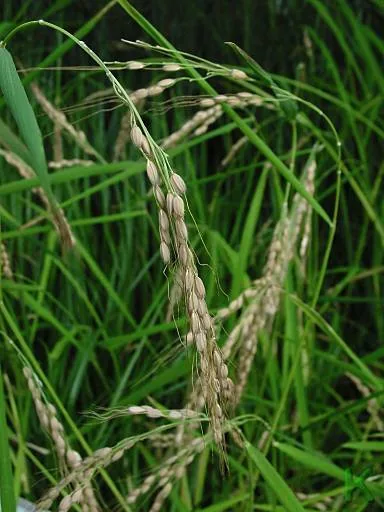
Harvest when 80–90% of the grains are golden yellow; cut, thresh and dry
What the sources say (2)
Harvest: When 80-90% of the grains have turned golden yellow
Harvesting rice involves timing the harvest when about 80-90% of the grains have turned golden yellow, indicating full maturity.
— Rice | Diseases and Pests, Description, Uses, Propagation [2] How to harvest: Harvest when about 80-90% of the grains have turned golden yellow, indicating full maturity; cut manually with sickles or with combine harvesters, then thresh and dry.
Harvesting rice involves timing the harvest when about 80-90% of the grains have turned golden yellow, indicating full maturity.
— Rice | Diseases and Pests, Description, Uses, Propagation [2] - Size
3 to 6 ft tall
What the sources say (1)
Mature height: 100-180 cm (1-1.8 m)
can reach a height of between 1 and 1.8 m
— Rice | Diseases and Pests, Description, Uses, Propagation [2] - Propagation
From seed, sown right in the field or started in a nursery bed and transplanted
What the sources say (1)
Propagation: Seed, broadcast or drilled directly in the field, or raised in nurseries and transplanted
Rice is always propagated by seed, which may be either broadcast or drilled directly in the field, or the seedlings may be grown in nurseries and transplanted.
— Rice | Diseases and Pests, Description, Uses, Propagation [2]
Overview
Rice is an annual grass grown for its grain, thriving on land that is water saturated or submerged during growth. [2] It is propagated by seed, sown directly or raised in nurseries and transplanted. [2]
This record is incomplete: the sources we read do not cover every field yet.
Not yet covered by our sources: Light, Spacing
Rice care
Measurements in square brackets are our conversion into the other unit system; the quoted text is unchanged.
How to water Rice
Watering
Keep standing water at 2-5 cm [0.8–2 in], especially in early growth
What the sources say (1)
Maintain adequate water levels, typically 2-5 cm, especially during the early stages of growth, to control weeds and support seedling establishment.Watering notes
Ensure proper drainage during the grain-filling stage to avoid waterlogging
What the sources say (1)
Ensure proper drainage during the grain-filling stage to avoid waterlogging and promote healthy grain development.How much light Rice needs
Not stated in the sources we read.
Best soil for Rice
Soil pH, minimum
5
What the sources say (1)
The optimal pH is between 5 and 7, though rice has been grown in fields with a PH between 3 and 10.Soil pH, maximum
7
What the sources say (1)
The optimal pH is between 5 and 7, though rice has been grown in fields with a PH between 3 and 10.Where to grow Rice
Not stated in the sources we read.
How to propagate Rice
Seed, broadcast or drilled directly in the field, or raised in nurseries and transplanted
What the sources say (1)
Rice is always propagated by seed, which may be either broadcast or drilled directly in the field, or the seedlings may be grown in nurseries and transplanted.How to grow Rice
The plant
Life cycle
annual (may be perennial under tropical conditions)
What the sources say (2)
All rices are customarily grown as annuals, although under tropical conditions they may be perennial, perpetuated by new tillers or even rhizomes.Rice is an annual plant, harvested after one growing seasonMature height
100-180 cm (1-1.8 m)
What the sources say (1)
can reach a height of between 1 and 1.8 mHarvest and storage
How to harvest
Harvest when about 80-90% of the grains have turned golden yellow, indicating full maturity; cut manually with sickles or with combine harvesters, then thresh and dry.
What the sources say (1)
Harvesting rice involves timing the harvest when about 80-90% of the grains have turned golden yellow, indicating full maturity.Fertilizing
When
At planting, at tillering and at panicle initiation
What each source says
transplanted paddy rice in Japan: Complete fertilizer plowed down before flooding and transplanting; a topdressing just before heading
What the sources say (2)
transplanted paddy rice in Japan: A complete fertilizer is generally plowed down prior to fl ooding and hand planting of the seedling rice plants. Another topdressing is applied just before heading to increase yields.Apply balanced fertilizers, including nitrogen, phosphorus, and potassium, at recommended stages typically at planting, tillering, and panicle initiation.Natural fertilizers
Compost; green manure (vetch) plowed down; in Asian paddies, the water fern Azolla with nitrogen-fixing blue-green algae
What the sources say (2)
A green manure (vetch) is sometimes planted and plowed down. The paddy fi elds may also be used for a winter cropcompost and sewage have been used since ancient times to fertilize paddy fi elds. Symbiotic nitrogen fi xation by blue-green algae grow-ing in association with the water fern Azolla commonly maintains fertility in Asiatic paddy fi elds.Mineral fertilizers
Balanced fertilizer with nitrogen, phosphorus and potassium; nitrogen at the recommended rate in split doses
What the sources say (2)
Apply balanced fertilizers, including nitrogen, phosphorus, and potassium, at recommended stages typically at planting, tillering, and panicle initiation.Grow resistant varieties. Treat the seeds with suitable fungicide. Apply only recommended quantity of nitrogen fertilizer in split dose.Avoid
Excess nitrogen, which raises susceptibility to blast, bacterial blight and other diseases
What the sources say (2)
If disease is not endemic to the region, blast can be controlled by planting resistant rice varieties; avoid over-fertilizing crop with nitrogen as this increases the plant's susceptibility to the diseaseBacterial blight can be effectively controlled by planting resistant rice varieties; avoid excessive nitrogen fertilization; plow stubble and straw into soil after harvestRemedies
Each remedy shows what official sources say about it; traditional remedies without an official source are marked as such. Harmful ones are listed so you know to avoid them.
Treating the plant
rice bug
neem seed kernel extract spray Not verified
Traditional remedy, not verified by an official source.
How: Spray neem seed kernel extract at 50 gram per litre of water.
rice leaf folder
bacillus thuringiensis spray Not verified
Traditional remedy, not verified by an official source.
How: Spray Bacillus thuringiensis at 4 gram per 10 litre of water.
proper spacing and controlled nitrogen Not verified
Traditional remedy, not verified by an official source.
How: Follow proper spacing to avoid shaded conditions and control the application of nitrogen.
rice water weevil
removing weeds on levees Partly works
How: Eliminate weedy vegetation on levees in spring, near the time of seeding.
Eliminating weedy vegetation on levees in spring, near the time of seeding, can reduce rice water weevil infestations in fields and subsequent larvae.
— ipm.ucanr.edu [4] What the evidence says Eliminating weedy vegetation on levees in spring, near the time of seeding, can reduce rice water weevil infestations in fields and subsequent larvae.
— ipm.ucanr.edu [4] winter flooding Partly works
How: Flood the field in winter, to improve straw decomposition and provide waterfowl habitat.
Winter flooding of the field, to improve straw decomposition and provide waterfowl habitat, can help with weevil control and reduce numbers by about 50%.
— ipm.ucanr.edu [4] What the evidence says Winter flooding of the field, to improve straw decomposition and provide waterfowl habitat, can help with weevil control and reduce numbers by about 50%.
— ipm.ucanr.edu [4]
Calendar
November-January
What each source says
South-east Asia: November-January
What the sources say (2)
South-east Asia: are transplanted by hand into fl ooded paddies, usually between November and January in South-east Asiaare transplanted by hand into fl ooded paddies, usually between November and January in South-east AsiaWhen 80-90% of the grains have turned golden yellow
What the sources say (1)
Harvesting rice involves timing the harvest when about 80-90% of the grains have turned golden yellow, indicating full maturity.Months as given by the sources, which are mostly from the United States (northern hemisphere). In the southern hemisphere they shift by about six months.
Edibility
Reported by the source, quoted verbatim. Do not eat a plant on the basis of this page alone: identification mistakes can be dangerous.
Rice is a vital staple food for over half of the world's population
[2]
Similar plants
- Abyssinian banana Ensete ventricosum
- Agretti Soda inermis
- Aji Capsicum chinense
- Alexanders Smyrnium olusatrum
- Allium senescens Allium senescens
- Allium triquetrum Allium triquetrum
- Alpine dock Rumex alpinus
- Alpine mountain-sorrel Oxyria digyna
Sources
Every value above is quoted from these documents. Links lead to the original publisher.
- Tropical Horticulture © 2002 Jules Janick, Purdue University · hort.purdue.edu, consulted
- Rice | Diseases and Pests, Description, Uses, Propagation · plantvillage.psu.edu, consulted
- FESTIVAL CEREALIA XI EDIZIONE 2021 · unora.unior.it, consulted
- ipm.ucanr.edu · ipm.ucanr.edu
Written by Emilio Marruso · last checked