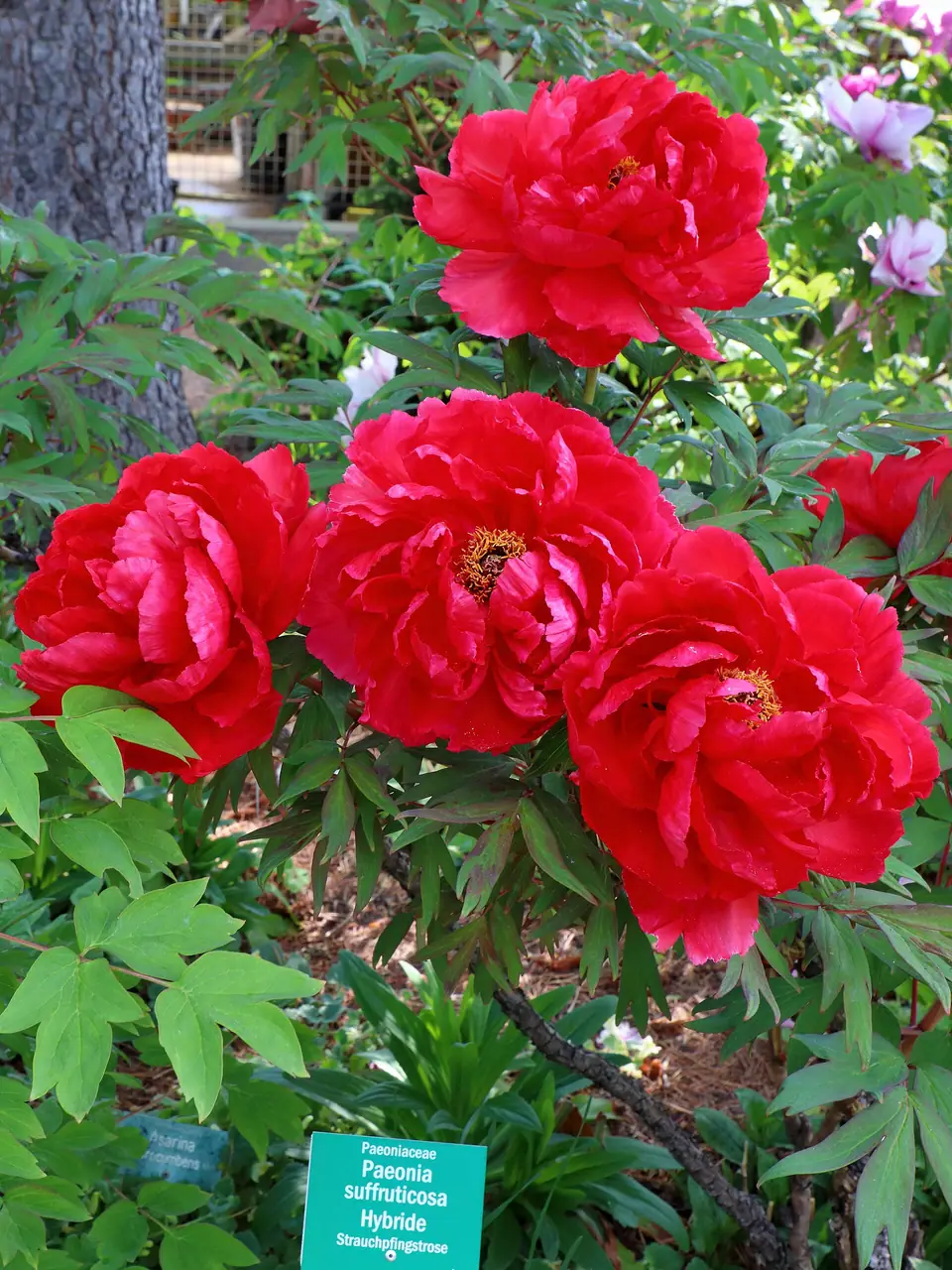

Cómo cultivar y cuidar Mudanpi
Paeonia suffruticosa
Escrito por Emilio Marruso · última revisión
De un vistazo
La peonía arbórea es una planta perenne que vive feliz a pleno sol o en semisombra, y pide muy poco. Plántala en otoño, dale un riego profundo una vez por semana cuando suban las temperaturas y aléjala de los suelos encharcados. No te pases con el abono: si abonas de más, tendrás hojas en lugar de flores. Además, casi nunca tiene plagas.
- Sol
Pleno sol o semisombra
Qué dicen las fuentes (3)
Luz: Pleno sol a semisombra
Best Light Conditions : Full sun through to partial shade.
— Paeonia suffruticosa | Tree Peony Growing Guide [4] It is best to plant in a spot with morning sun followed by afternoon shade.
— How to grow a tree peony: a flowering shrub pollinators love | Homes and Gardens [5] They prefer a sunny location, so plant your tree peony where it will receive dappled sunshine all day, or 5 hours of direct sunlight a day.
— Do tree peonies need special care when grown outdoors in the Northeast? - NYBG Mertz Library Reference [2] - Riego
Riega a fondo una vez por semana cuando haga calor; evita zonas encharcadas y con aspersores
Qué dicen las fuentes (4)
Riego: Riega profundamente durante la temporada de crecimiento, empapando el suelo aproximadamente una vez por semana cuando suben las temperaturas; no es particularmente tolerante a la sequía
Water your tree peony deeply during the growing season, soaking the soil once a week when the temperatures rise.
— How to grow a tree peony: a flowering shrub pollinators love | Homes and Gardens [5] They are not particularly drought tolerant (especially when young), so provide extra water during extended dry spells.
— Paeonia suffruticosa | Tree Peony Growing Guide [4] Notas sobre el riego: Riega las raíces regularmente después de plantar para ayudar a que la planta se asiente; evita las zonas con encharcamiento, incluidas las áreas regadas por aspersores automáticos
Water the roots regularly to help the plant settle in.
— Paeonia suffruticosa | Tree Peony Growing Guide [4] They do not do well in the shade or in areas that become waterlogged (including areas watered by automatic sprinklers).
— Do tree peonies need special care when grown outdoors in the Northeast? - NYBG Mertz Library Reference [2] - Frío
Aguanta inviernos de hasta −34,4 °C (−30 °F)
Muy rústica · USDA 4 · RHS H7 · Z4
Qué dicen las fuentes (2)
Rusticidad, zona más fría: 4 [mínima invernal de −34,4 a −28,9 °C (de −30 a −20 °F)]
Tree peonies ( Paeonia suffruticosa ) are quite hardy plants (Zones 4-8) that are easy to grow.
— Do tree peonies need special care when grown outdoors in the Northeast? - NYBG Mertz Library Reference [2] growing well in US hardiness zone 4 to US hardiness zone 8 .
— How to grow a tree peony: a flowering shrub pollinators love | Homes and Gardens [5] - Suelo
Suelo con pH no superior a 7,0
Qué dicen las fuentes (1)
pH del suelo, máximo: 7.0
Tree peonies do not tolerate acid soils (below 6.0); ideal soil pH is between 6.5 and 7.0.
— Do tree peonies need special care when grown outdoors in the Northeast? - NYBG Mertz Library Reference [2] - Distancia
0,9–1,2 m entre plantas
Qué dicen las fuentes (1)
Distancia de plantación: 91.4-121.9 cm (3-4 pies)
Remember that tree peonies grow larger than herbaceous peonies, so space the plants 3-4 feet apart.
— Do tree peonies need special care when grown outdoors in the Northeast? - NYBG Mertz Library Reference [2] - Plantación
Planta en otoño o, como tarde, a principios de primavera
Qué dicen las fuentes (1)
Plantación: Otoño; se puede comenzar hasta el inicio de la primavera
To grow a tree peony, it is best to plant in the autumn. They can be started through to the beginning of spring.
— Paeonia suffruticosa | Tree Peony Growing Guide [4] - Abonado
Abona poco a finales de verano, lejos de la base; si abonas de más, da hojas en lugar de flores
Qué dicen las fuentes (8)
Cuándo: Finales del verano
Paeonia en general: If you decide to fertilize, do so after they are done blooming and use a balanced fertilizer or one with a higher phosphorous content (middle number).
— [7] Paeonia en general: Mix soil from the holes with superphosphate fertilizer and organic matter, add some of the mixture to each hole and water to settle the soil.
— [8] Spread it over the area where the roots grow, 6 to 18" from the crown, and thoroughly scratch it into the soil. Apply fertilizer in the late summer, preferably a slow release type.
— [9] Evitar: Exceso de fertilizante, que produce follaje en lugar de flores; fertilizante en contacto con las coronas
Paeonia en general: Over-fertilizing can also reduce the bloom of your peonies. Too much nitrogen fertilizer will cause the plants to produce a lot of foliage and a reduced number of blooms.
— [7] Over fertilized peonies will produce foliage instead of flowers, so fertilize with discretion.
— [9] Keep all fertilizer away from the crowns of the plants.
— [9] Signos de exceso: Follaje en lugar de flores
Paeonia en general: Over-fertilizing can also reduce the bloom of your peonies. Too much nitrogen fertilizer will cause the plants to produce a lot of foliage and a reduced number of blooms.
— [7] Over fertilized peonies will produce foliage instead of flowers, so fertilize with discretion.
— [9] - Plagas
Casi sin plagas, pero vigila el chancro, el tizón de la hoja, la marchitez del tallo y la cochinilla
Qué dicen las fuentes (1)
Enfermedades: cancro, tizón foliar, marchitez del tallo
Canker, leaf blight and stem wilt occasionally afflict the plant.
— Suffruticosa Hybrids - Paeonia – Woody Types | North Carolina Extension Gardener Plant Toolbox [3] - Multiplicación
Normalmente por injerto sobre raíz de peonía; también por acodo o por división en invierno
Qué dicen las fuentes (3)
Propagación: Injerto sobre raíces de peonía herbácea (método habitual); semilla; acodo; división de plantas con raíces propias en invierno
The usual commercial method of propagating the moutan varieties is by grafting on the roots of an herbaceous paeony.
— Bean's Trees and Shrubs [6] Propagating can also be performed through layering, but will take a good three years before roots develop.
— Paeonia suffruticosa | Tree Peony Growing Guide [4] A plant that is on its own roots, and has formed a stool, can be propagated by division during the winter
— Bean's Trees and Shrubs [6] - Siembra
Siembra las semillas a principios de otoño
Qué dicen las fuentes (1)
Siembra: Inicio de otoño
Sow split seeds at the start of autumn, in compost, at a depth of about 1 inch (2.5 cm).
— Paeonia suffruticosa | Tree Peony Growing Guide [4]
Resumen
La peonía arbórea (Paeonia suffruticosa) es un arbusto leñoso y caducifolio originario de China que crece a pleno sol o semisombra en suelo bien drenado. [4] Se propaga principalmente por injerto sobre raíces de peonías herbáceas y puede tardar años en florecer desde la semilla. [6][4]
Citado en inglés, como en la fuente.
Cuidados
Riego
Riego
Riega profundamente durante la temporada de crecimiento, empapando el suelo aproximadamente una vez por semana cuando suben las temperaturas; no es particularmente tolerante a la sequía
Qué dicen las fuentes (2)
Water your tree peony deeply during the growing season, soaking the soil once a week when the temperatures rise.They are not particularly drought tolerant (especially when young), so provide extra water during extended dry spells.Notas sobre el riego
Riega las raíces regularmente después de plantar para ayudar a que la planta se asiente; evita las zonas con encharcamiento, incluidas las áreas regadas por aspersores automáticos
Qué dicen las fuentes (2)
Water the roots regularly to help the plant settle in.They do not do well in the shade or in areas that become waterlogged (including areas watered by automatic sprinklers).Luz
Pleno sol a semisombra
Qué dicen las fuentes (3)
Best Light Conditions : Full sun through to partial shade.It is best to plant in a spot with morning sun followed by afternoon shade.They prefer a sunny location, so plant your tree peony where it will receive dappled sunshine all day, or 5 hours of direct sunlight a day.Clima y frío
Rusticidad, zona más fría
4 [mínima invernal de −34,4 a −28,9 °C (de −30 a −20 °F)]
Qué dicen las fuentes (2)
Tree peonies ( Paeonia suffruticosa ) are quite hardy plants (Zones 4-8) that are easy to grow.growing well in US hardiness zone 4 to US hardiness zone 8 .Rusticidad, zona más cálida
Las fuentes no coinciden:
Growing Zone (USA / UK Hardiness) : USDA Zones 4 to 8/9; Europe and UK H5
[4]
Qué dicen las fuentes (2)
Tree peonies ( Paeonia suffruticosa ) are quite hardy plants (Zones 4-8) that are easy to grow.growing well in US hardiness zone 4 to US hardiness zone 8 .Suelo
7.0
Qué dicen las fuentes (1)
Tree peonies do not tolerate acid soils (below 6.0); ideal soil pH is between 6.5 and 7.0.Dónde cultivarla
91.4-121.9 cm (3-4 pies)
Qué dicen las fuentes (1)
Remember that tree peonies grow larger than herbaceous peonies, so space the plants 3-4 feet apart.Propagación
Injerto sobre raíces de peonía herbácea (método habitual); semilla; acodo; división de plantas con raíces propias en invierno
Qué dicen las fuentes (3)
The usual commercial method of propagating the moutan varieties is by grafting on the roots of an herbaceous paeony.Propagating can also be performed through layering, but will take a good three years before roots develop.A plant that is on its own roots, and has formed a stool, can be propagated by division during the winterCultivo
La planta
Ciclo de vida
perenne
Qué dicen las fuentes (1)
Woody peonies are erect and coarsely branched, deciduous, perennial shrubs that grow up to 6.5 feet tall.Familia
Paeoniaceae
Qué dicen las fuentes (1)
They are in the peony family (Paeoniaceae).Plagas y enfermedades
Enfermedades
cancro, tizón foliar, marchitez del tallo
Qué dicen las fuentes (1)
Canker, leaf blight and stem wilt occasionally afflict the plant.Abonado
Cuándo
Finales del verano
Lo que dice cada fuente
Paeonia en general: Después de la floración
Paeonia en general: Al plantar, mezclado con la tierra del hoyo de plantación
Qué dicen las fuentes (3)
Paeonia en general: If you decide to fertilize, do so after they are done blooming and use a balanced fertilizer or one with a higher phosphorous content (middle number).Paeonia en general: Mix soil from the holes with superphosphate fertilizer and organic matter, add some of the mixture to each hole and water to settle the soil.Spread it over the area where the roots grow, 6 to 18" from the crown, and thoroughly scratch it into the soil. Apply fertilizer in the late summer, preferably a slow release type.Frecuencia
No se necesita fertilizante adicional durante 3 a 4 años cuando se planta en tierra franca enriquecida y fértil; después, según el tipo de suelo y el estado de nutrientes
Lo que dice cada fuente
Paeonia en general: Como máximo cada pocos años para plantas establecidas que crecen bien
Qué dicen las fuentes (3)
Paeonia en general: Established plants with good growth only need to be fertilized every few years, if at all.If the peony was planted in properly enriched, fertile loam to start with, the plant should not need additional fertilizer for 3 to 4 years.The type of soil and current nutrient status of the soil will determine the need for additional fertilizer.Abonos naturales
Las fuentes dan valores distintos según la región, la zona o las condiciones de cultivo.
Lo que dice cada fuente
Paeonia en general: Harina de huesos al plantar, 454 g por cada 35,2 L [9,3 gal] de tierra devuelta al hoyo
Paeonia en general: Moho de hoja, compost o estiércol compostado como enmiendas del suelo
Paeonia en general: Compost o estiércol bien descompuesto trabajado profundamente en el suelo antes de plantar
Qué dicen las fuentes (3)
Paeonia en general: to which bonemeal or superphosphate (0- 20-0) has been thoroughly mixed. Bonemeal may be added at a rate of one pound (1-1/2 cups) to each bushel of soil replaced in the hole.Paeonia en general: Leafmold, compost or composted manure may be added as soil amendments.Paeonia en general: Peonies will be in place for many years, so work the soil deep (18 to 24 inches) and incorporate organic matter, such as compost, well rotted manure or peat moss.Abonos minerales
Fertilizante de liberación lenta, extendido sobre la zona de raíces a 15.2 a 45.7 cm [6–18 in] de la corona y rastrillado en el suelo
Lo que dice cada fuente
Paeonia en general: Superfosfato al plantar, 227 g por cada 35,2 L [9,3 gal] de tierra en los 30,5 cm [12 in] inferiores del hoyo
Paeonia en general: Fertilizante equilibrado o uno con mayor contenido de fósforo, después de la floración
Qué dicen las fuentes (3)
Paeonia en general: Superphosphate should be added at a rate of one-half pound (1/2 cup) per bushel of soil replaced in the bottom 12" of the hole, to prevent burning the roots.Paeonia en general: If you decide to fertilize, do so after they are done blooming and use a balanced fertilizer or one with a higher phosphorous content (middle number).Spread it over the area where the roots grow, 6 to 18" from the crown, and thoroughly scratch it into the soil. Apply fertilizer in the late summer, preferably a slow release type.Evitar
Exceso de fertilizante, que produce follaje en lugar de flores; fertilizante en contacto con las coronas
Lo que dice cada fuente
Paeonia en general: Exceso de fertilizante y demasiado nitrógeno, que reducen la floración
Qué dicen las fuentes (3)
Paeonia en general: Over-fertilizing can also reduce the bloom of your peonies. Too much nitrogen fertilizer will cause the plants to produce a lot of foliage and a reduced number of blooms.Over fertilized peonies will produce foliage instead of flowers, so fertilize with discretion.Keep all fertilizer away from the crowns of the plants.Signos de exceso
Follaje en lugar de flores
Lo que dice cada fuente
Paeonia en general: Mucho follaje y menos flores
Qué dicen las fuentes (2)
Paeonia en general: Over-fertilizing can also reduce the bloom of your peonies. Too much nitrogen fertilizer will cause the plants to produce a lot of foliage and a reduced number of blooms.Over fertilized peonies will produce foliage instead of flowers, so fertilize with discretion.Problemas
Tizón foliar, cancro y cochinilla
Síntoma: Susceptible a tizón foliar, cancro y cochinilla; generalmente libre de plagas.
Qué dicen las fuentes (1)
Generally, pest free. Attracts butterflies to the garden. Fairly tolerant to attacks from rabbits and deer. Susceptible to leaf blight, canker, and scale.
— Paeonia suffruticosa | Tree Peony Growing Guide [4]
Remedios
Las fuentes consultadas no dan remedios para esta planta.
Calendario
Siembra
Inicio de otoño
Qué dicen las fuentes (1)
Sow split seeds at the start of autumn, in compost, at a depth of about 1 inch (2.5 cm).Plantación
Otoño; se puede comenzar hasta el inicio de la primavera
Qué dicen las fuentes (1)
To grow a tree peony, it is best to plant in the autumn. They can be started through to the beginning of spring.Poda
Las fuentes dan valores distintos según la región, la zona o las condiciones de cultivo.
Lo que dice cada fuente
Según Homes and Gardens: Verano, después de que las flores se marchiten
Según Gardener's HQ (shaping): Inicio de otoño
Según Gardener's HQ (spent wood): Finales del invierno
Qué dicen las fuentes (3)
Según Homes and Gardens: The best time to do this is in the summer after blooms fade but before the buds for next years begin to develop.Según Gardener's HQ (shaping): Shape, and encourage the development of lower branches by pruning at the start of autumn.Según Gardener's HQ (spent wood): Tree peonies can be pruned in late winter to remove spent material.Meses tal como los dan las fuentes, en su mayoría de Estados Unidos (hemisferio norte). En el hemisferio sur se desplazan unos seis meses.
Valores orientativos
Valores de una fuente secundaria, no comprobados palabra por palabra como el resto de esta página. Úselos como punto de partida.
- Altura adulta
- 91.4-152.4 cm (3-5 pies)Valor orientativo, adáptalo a tu clima · Fuente secundaria
- Horas de sol
- 4-6 horasValor orientativo, adáptalo a tu clima · Fuente secundaria
- Suelo
- Rico en humus, Bien drenadoValor orientativo, adáptalo a tu clima · Fuente secundaria
- Nivel de cuidado
- AltaValor orientativo, adáptalo a tu clima · Fuente secundaria
- Crecimiento
- ModeradoValor orientativo, adáptalo a tu clima · Fuente secundaria
- Plagas
- Tizón, quemazón de agujas, podredumbre de la corona, virus, marchitez, resistente a plagas, resistente a ciervos, resistente a conejosValor orientativo, adáptalo a tu clima · Fuente secundaria
Plantas similares
- Common peony Paeonia officinalis
- Paeonia tenuifolia Paeonia tenuifolia
- Paeonia obovata Paeonia japonica
- Paeonia mascula Paeonia mascula
- Abeto de Vancuver Abies grandis
- Abraham Trachystemon orientalis
- Bananero de Etiopía Ensete ventricosum
- Acacia longifolia Acacia longifolia
Fuentes
Cada valor anterior se cita de estos documentos. Los enlaces llevan al editor original.
- Paeonia × suffruticosa - Trees and Shrubs Online · treesandshrubsonline.org, consultado
- Do tree peonies need special care when grown outdoors in the Northeast? - NYBG Mertz Library Reference · libanswers.nybg.org, consultado
- Suffruticosa Hybrids - Paeonia – Woody Types | North Carolina Extension Gardener Plant Toolbox · plants.ces.ncsu.edu, consultado
- Paeonia suffruticosa | Tree Peony Growing Guide · gardenershq.com, consultado
- How to grow a tree peony: a flowering shrub pollinators love | Homes and Gardens · homesandgardens.com, consultado
- Bean's Trees and Shrubs · beanstreesandshrubs.org, consultado
- extension.illinois.edu · extension.illinois.edu
- lancaster.unl.edu · lancaster.unl.edu
- s3.amazonaws.com · s3.amazonaws.com
Escrito por Emilio Marruso · última revisión