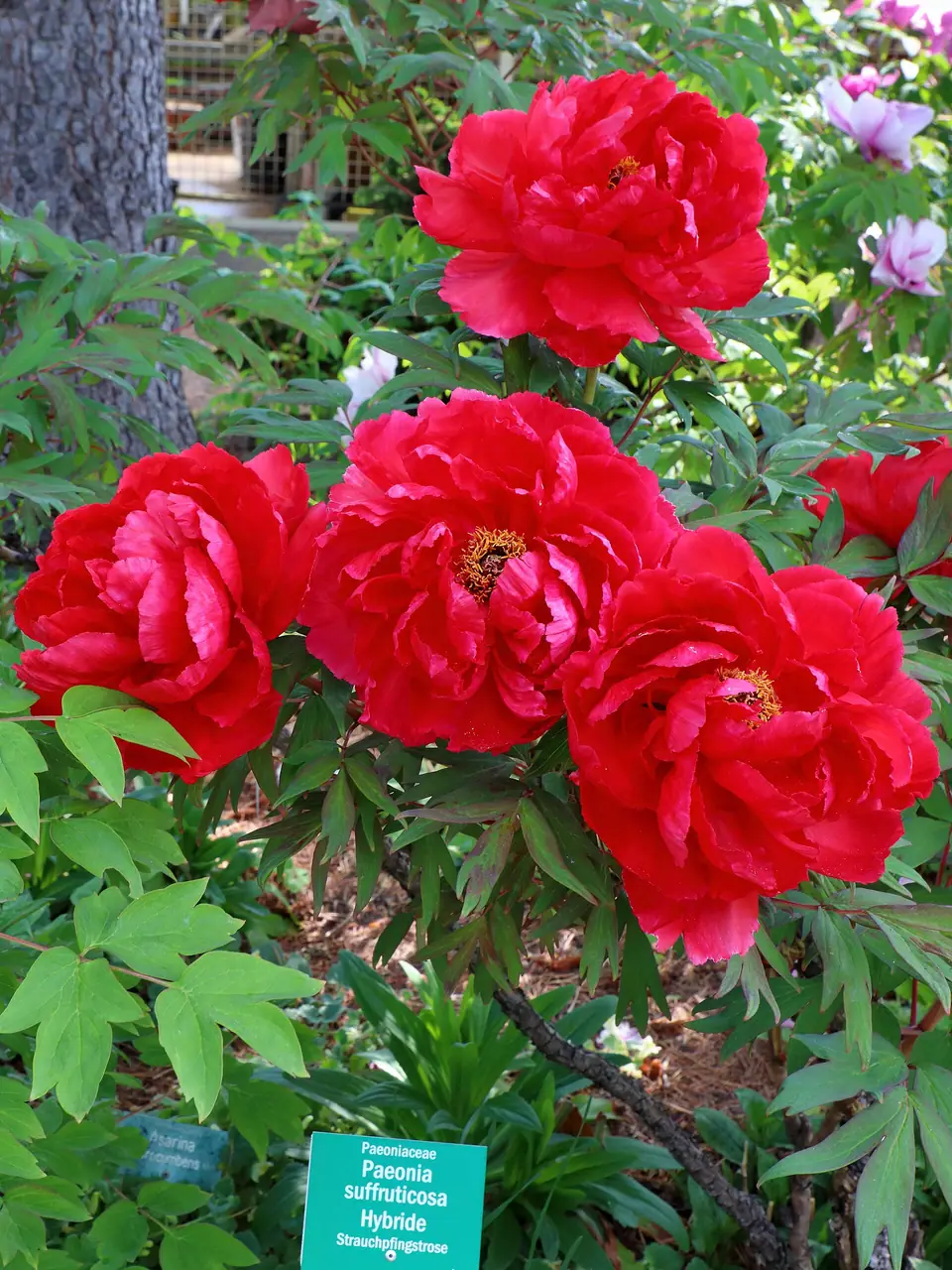

How to Grow and Care for Moutan peony
Paeonia suffruticosa
Written by Emilio Marruso · last checked
At a glance
The tree peony is a perennial that's happy in full sun or partial shade, and it asks for very little. Plant it in autumn, give it a deep soak once a week as the weather warms, and keep it away from soggy spots. Go easy on fertilizer, since too much gives you leaves instead of flowers. It's generally pest free.
- Sun
Full sun to partial shade
What the sources say (3)
Light: Full sun to partial shade
Best Light Conditions : Full sun through to partial shade.
— Paeonia suffruticosa | Tree Peony Growing Guide [4] It is best to plant in a spot with morning sun followed by afternoon shade.
— How to grow a tree peony: a flowering shrub pollinators love | Homes and Gardens [5] They prefer a sunny location, so plant your tree peony where it will receive dappled sunshine all day, or 5 hours of direct sunlight a day.
— Do tree peonies need special care when grown outdoors in the Northeast? - NYBG Mertz Library Reference [2] - Water
Soak deeply once a week when it warms up; avoid soggy spots and sprinkler areas
What the sources say (4)
Watering: Water deeply during the growing season, soaking the soil about once a week when temperatures rise; not particularly drought tolerant
Water your tree peony deeply during the growing season, soaking the soil once a week when the temperatures rise.
— How to grow a tree peony: a flowering shrub pollinators love | Homes and Gardens [5] They are not particularly drought tolerant (especially when young), so provide extra water during extended dry spells.
— Paeonia suffruticosa | Tree Peony Growing Guide [4] Watering notes: Water the roots regularly after planting to help the plant settle in; avoid waterlogged areas, including areas watered by automatic sprinklers
Water the roots regularly to help the plant settle in.
— Paeonia suffruticosa | Tree Peony Growing Guide [4] They do not do well in the shade or in areas that become waterlogged (including areas watered by automatic sprinklers).
— Do tree peonies need special care when grown outdoors in the Northeast? - NYBG Mertz Library Reference [2] - Cold
Survives winters down to −30 °F (−34.4 °C)
Very hardy · USDA 4 · RHS H7 · Z4
What the sources say (2)
Hardiness, coldest zone: 4 [winter low −34.4 to −28.9 °C (−30 to −20 °F)]
Tree peonies ( Paeonia suffruticosa ) are quite hardy plants (Zones 4-8) that are easy to grow.
— Do tree peonies need special care when grown outdoors in the Northeast? - NYBG Mertz Library Reference [2] growing well in US hardiness zone 4 to US hardiness zone 8 .
— How to grow a tree peony: a flowering shrub pollinators love | Homes and Gardens [5] - Soil
Soil pH no higher than 7.0
What the sources say (1)
Soil pH, maximum: 7.0
Tree peonies do not tolerate acid soils (below 6.0); ideal soil pH is between 6.5 and 7.0.
— Do tree peonies need special care when grown outdoors in the Northeast? - NYBG Mertz Library Reference [2] - Spacing
3–4 ft between plants
What the sources say (1)
Spacing: 91.4-121.9 cm (3-4 ft)
Remember that tree peonies grow larger than herbaceous peonies, so space the plants 3-4 feet apart.
— Do tree peonies need special care when grown outdoors in the Northeast? - NYBG Mertz Library Reference [2] - Planting
Plant in autumn, or up to the start of spring
What the sources say (1)
Planting: Autumn; can be started through to the beginning of spring
To grow a tree peony, it is best to plant in the autumn. They can be started through to the beginning of spring.
— Paeonia suffruticosa | Tree Peony Growing Guide [4] - Feeding
Feed lightly in late summer, away from the crown; too much gives leaves instead of flowers
What the sources say (8)
When: Late summer
Paeonia in general: If you decide to fertilize, do so after they are done blooming and use a balanced fertilizer or one with a higher phosphorous content (middle number).
— [7] Paeonia in general: Mix soil from the holes with superphosphate fertilizer and organic matter, add some of the mixture to each hole and water to settle the soil.
— [8] Spread it over the area where the roots grow, 6 to 18" from the crown, and thoroughly scratch it into the soil. Apply fertilizer in the late summer, preferably a slow release type.
— [9] Avoid: Over-fertilizing, which gives foliage instead of flowers; fertilizer in contact with the crowns
Paeonia in general: Over-fertilizing can also reduce the bloom of your peonies. Too much nitrogen fertilizer will cause the plants to produce a lot of foliage and a reduced number of blooms.
— [7] Over fertilized peonies will produce foliage instead of flowers, so fertilize with discretion.
— [9] Keep all fertilizer away from the crowns of the plants.
— [9] Signs of excess: Foliage instead of flowers
Paeonia in general: Over-fertilizing can also reduce the bloom of your peonies. Too much nitrogen fertilizer will cause the plants to produce a lot of foliage and a reduced number of blooms.
— [7] Over fertilized peonies will produce foliage instead of flowers, so fertilize with discretion.
— [9] - Pests
Mostly pest free, but watch for canker, leaf blight, stem wilt and scale
What the sources say (1)
Diseases: canker, leaf blight, stem wilt
Canker, leaf blight and stem wilt occasionally afflict the plant.
— Suffruticosa Hybrids - Paeonia – Woody Types | North Carolina Extension Gardener Plant Toolbox [3] - Propagation
Usually grafted onto peony roots; also by layering or by dividing in winter
What the sources say (3)
Propagation: Grafting onto roots of herbaceous peony (usual method); seed; layering; division of own-rooted plants in winter
The usual commercial method of propagating the moutan varieties is by grafting on the roots of an herbaceous paeony.
— Bean's Trees and Shrubs [6] Propagating can also be performed through layering, but will take a good three years before roots develop.
— Paeonia suffruticosa | Tree Peony Growing Guide [4] A plant that is on its own roots, and has formed a stool, can be propagated by division during the winter
— Bean's Trees and Shrubs [6] - Sowing
Sow seeds at the start of autumn
What the sources say (1)
Sowing: Start of autumn
Sow split seeds at the start of autumn, in compost, at a depth of about 1 inch (2.5 cm).
— Paeonia suffruticosa | Tree Peony Growing Guide [4]
Overview
Tree peony (Paeonia suffruticosa) is a woody, deciduous shrub native to China that grows in full sun to partial shade in well-drained soil. [4] It is propagated mainly by grafting onto the roots of herbaceous peonies and can take years to bloom from seed. [6][4]
Moutan peony care
How to water Moutan peony
Watering
Water deeply during the growing season, soaking the soil about once a week when temperatures rise; not particularly drought tolerant
What the sources say (2)
Water your tree peony deeply during the growing season, soaking the soil once a week when the temperatures rise.They are not particularly drought tolerant (especially when young), so provide extra water during extended dry spells.Watering notes
Water the roots regularly after planting to help the plant settle in; avoid waterlogged areas, including areas watered by automatic sprinklers
What the sources say (2)
Water the roots regularly to help the plant settle in.They do not do well in the shade or in areas that become waterlogged (including areas watered by automatic sprinklers).How much light Moutan peony needs
Full sun to partial shade
What the sources say (3)
Best Light Conditions : Full sun through to partial shade.It is best to plant in a spot with morning sun followed by afternoon shade.They prefer a sunny location, so plant your tree peony where it will receive dappled sunshine all day, or 5 hours of direct sunlight a day.How much cold Moutan peony can take
Hardiness, coldest zone
4 [winter low −34.4 to −28.9 °C (−30 to −20 °F)]
What the sources say (2)
Tree peonies ( Paeonia suffruticosa ) are quite hardy plants (Zones 4-8) that are easy to grow.growing well in US hardiness zone 4 to US hardiness zone 8 .Hardiness, warmest zone
The sources disagree:
Growing Zone (USA / UK Hardiness) : USDA Zones 4 to 8/9; Europe and UK H5
[4]
What the sources say (2)
Tree peonies ( Paeonia suffruticosa ) are quite hardy plants (Zones 4-8) that are easy to grow.growing well in US hardiness zone 4 to US hardiness zone 8 .Best soil for Moutan peony
7.0
What the sources say (1)
Tree peonies do not tolerate acid soils (below 6.0); ideal soil pH is between 6.5 and 7.0.Where to grow Moutan peony
91.4-121.9 cm (3-4 ft)
What the sources say (1)
Remember that tree peonies grow larger than herbaceous peonies, so space the plants 3-4 feet apart.How to propagate Moutan peony
Grafting onto roots of herbaceous peony (usual method); seed; layering; division of own-rooted plants in winter
What the sources say (3)
The usual commercial method of propagating the moutan varieties is by grafting on the roots of an herbaceous paeony.Propagating can also be performed through layering, but will take a good three years before roots develop.A plant that is on its own roots, and has formed a stool, can be propagated by division during the winterHow to grow Moutan peony
The plant
Life cycle
perennial
What the sources say (1)
Woody peonies are erect and coarsely branched, deciduous, perennial shrubs that grow up to 6.5 feet tall.Family
Paeoniaceae
What the sources say (1)
They are in the peony family (Paeoniaceae).Pests and diseases
Diseases
canker, leaf blight, stem wilt
What the sources say (1)
Canker, leaf blight and stem wilt occasionally afflict the plant.Fertilizing
When
Late summer
What each source says
Paeonia in general: After flowering
Paeonia in general: At planting, mixed into the soil of the planting hole
What the sources say (3)
Paeonia in general: If you decide to fertilize, do so after they are done blooming and use a balanced fertilizer or one with a higher phosphorous content (middle number).Paeonia in general: Mix soil from the holes with superphosphate fertilizer and organic matter, add some of the mixture to each hole and water to settle the soil.Spread it over the area where the roots grow, 6 to 18" from the crown, and thoroughly scratch it into the soil. Apply fertilizer in the late summer, preferably a slow release type.How often
No additional fertilizer for 3 to 4 years when planted in enriched, fertile loam; afterwards as soil type and nutrient status require
What each source says
Paeonia in general: Every few years at most for established plants growing well
What the sources say (3)
Paeonia in general: Established plants with good growth only need to be fertilized every few years, if at all.If the peony was planted in properly enriched, fertile loam to start with, the plant should not need additional fertilizer for 3 to 4 years.The type of soil and current nutrient status of the soil will determine the need for additional fertilizer.Natural fertilizers
The sources give different values depending on region, zone or growing conditions.
What each source says
Paeonia in general: Bone meal at planting, 454 g per 35.2 L [9.3 gal] of soil returned to the hole
Paeonia in general: Leaf mould, compost or composted manure as soil amendments
Paeonia in general: Compost or well-rotted manure worked deeply into the soil before planting
What the sources say (3)
Paeonia in general: to which bonemeal or superphosphate (0- 20-0) has been thoroughly mixed. Bonemeal may be added at a rate of one pound (1-1/2 cups) to each bushel of soil replaced in the hole.Paeonia in general: Leafmold, compost or composted manure may be added as soil amendments.Paeonia in general: Peonies will be in place for many years, so work the soil deep (18 to 24 inches) and incorporate organic matter, such as compost, well rotted manure or peat moss.Mineral fertilizers
Slow-release fertilizer, spread over the root area 15.2 to 45.7 cm [6–18 in] from the crown and scratched into the soil
What each source says
Paeonia in general: Superphosphate at planting, 227 g per 35.2 L [9.3 gal] of soil in the bottom 30.5 cm [12 in] of the hole
Paeonia in general: Balanced fertilizer or one with a higher phosphorus content, after flowering
What the sources say (3)
Paeonia in general: Superphosphate should be added at a rate of one-half pound (1/2 cup) per bushel of soil replaced in the bottom 12" of the hole, to prevent burning the roots.Paeonia in general: If you decide to fertilize, do so after they are done blooming and use a balanced fertilizer or one with a higher phosphorous content (middle number).Spread it over the area where the roots grow, 6 to 18" from the crown, and thoroughly scratch it into the soil. Apply fertilizer in the late summer, preferably a slow release type.Avoid
Over-fertilizing, which gives foliage instead of flowers; fertilizer in contact with the crowns
What each source says
Paeonia in general: Over-fertilizing and too much nitrogen, which reduce flowering
What the sources say (3)
Paeonia in general: Over-fertilizing can also reduce the bloom of your peonies. Too much nitrogen fertilizer will cause the plants to produce a lot of foliage and a reduced number of blooms.Over fertilized peonies will produce foliage instead of flowers, so fertilize with discretion.Keep all fertilizer away from the crowns of the plants.Signs of excess
Foliage instead of flowers
What each source says
Paeonia in general: Lots of foliage and fewer blooms
What the sources say (2)
Paeonia in general: Over-fertilizing can also reduce the bloom of your peonies. Too much nitrogen fertilizer will cause the plants to produce a lot of foliage and a reduced number of blooms.Over fertilized peonies will produce foliage instead of flowers, so fertilize with discretion.Moutan peony pests and problems
Leaf blight, canker and scale
Symptom: Susceptible to leaf blight, canker and scale; generally pest free.
What the sources say (1)
Generally, pest free. Attracts butterflies to the garden. Fairly tolerant to attacks from rabbits and deer. Susceptible to leaf blight, canker, and scale.
— Paeonia suffruticosa | Tree Peony Growing Guide [4]
Remedies
The sources we checked give no remedies for this plant.
Calendar
Sowing
Start of autumn
What the sources say (1)
Sow split seeds at the start of autumn, in compost, at a depth of about 1 inch (2.5 cm).Planting
Autumn; can be started through to the beginning of spring
What the sources say (1)
To grow a tree peony, it is best to plant in the autumn. They can be started through to the beginning of spring.Pruning
The sources give different values depending on region, zone or growing conditions.
What each source says
According to Homes and Gardens: Summer, after blooms fade
According to Gardener's HQ (shaping): Start of autumn
According to Gardener's HQ (spent wood): Late winter
What the sources say (3)
According to Homes and Gardens: The best time to do this is in the summer after blooms fade but before the buds for next years begin to develop.According to Gardener's HQ (shaping): Shape, and encourage the development of lower branches by pruning at the start of autumn.According to Gardener's HQ (spent wood): Tree peonies can be pruned in late winter to remove spent material.Months as given by the sources, which are mostly from the United States (northern hemisphere). In the southern hemisphere they shift by about six months.
Indicative values
Values from a secondary source, not checked word for word like the rest of this page. Use them as a starting point.
- Mature height
- 91.4-152.4 cm (3-5 ft)Indicative value, adapt it to your climate · Secondary source
- Hours of sun
- 4-6 hoursIndicative value, adapt it to your climate · Secondary source
- Soil
- Humus rich, Well-drainedIndicative value, adapt it to your climate · Secondary source
- Care level
- HighIndicative value, adapt it to your climate · Secondary source
- Growth rate
- ModerateIndicative value, adapt it to your climate · Secondary source
- Pests
- Blight, needle cast, Crown rot, Virus, Wilt, Pest resistant, Deer resistant, Rabbit resistantIndicative value, adapt it to your climate · Secondary source
Similar plants
- Common peony Paeonia officinalis
- Paeonia tenuifolia Paeonia tenuifolia
- Paeonia obovata Paeonia japonica
- Paeonia mascula Paeonia mascula
- Abies grandis Abies grandis
- Abraham Trachystemon orientalis
- Abyssinian banana Ensete ventricosum
- Acacia longifolia Acacia longifolia
Sources
Every value above is quoted from these documents. Links lead to the original publisher.
- Paeonia × suffruticosa - Trees and Shrubs Online · treesandshrubsonline.org, consulted
- Do tree peonies need special care when grown outdoors in the Northeast? - NYBG Mertz Library Reference · libanswers.nybg.org, consulted
- Suffruticosa Hybrids - Paeonia – Woody Types | North Carolina Extension Gardener Plant Toolbox · plants.ces.ncsu.edu, consulted
- Paeonia suffruticosa | Tree Peony Growing Guide · gardenershq.com, consulted
- How to grow a tree peony: a flowering shrub pollinators love | Homes and Gardens · homesandgardens.com, consulted
- Bean's Trees and Shrubs · beanstreesandshrubs.org, consulted
- extension.illinois.edu · extension.illinois.edu
- lancaster.unl.edu · lancaster.unl.edu
- s3.amazonaws.com · s3.amazonaws.com
Written by Emilio Marruso · last checked